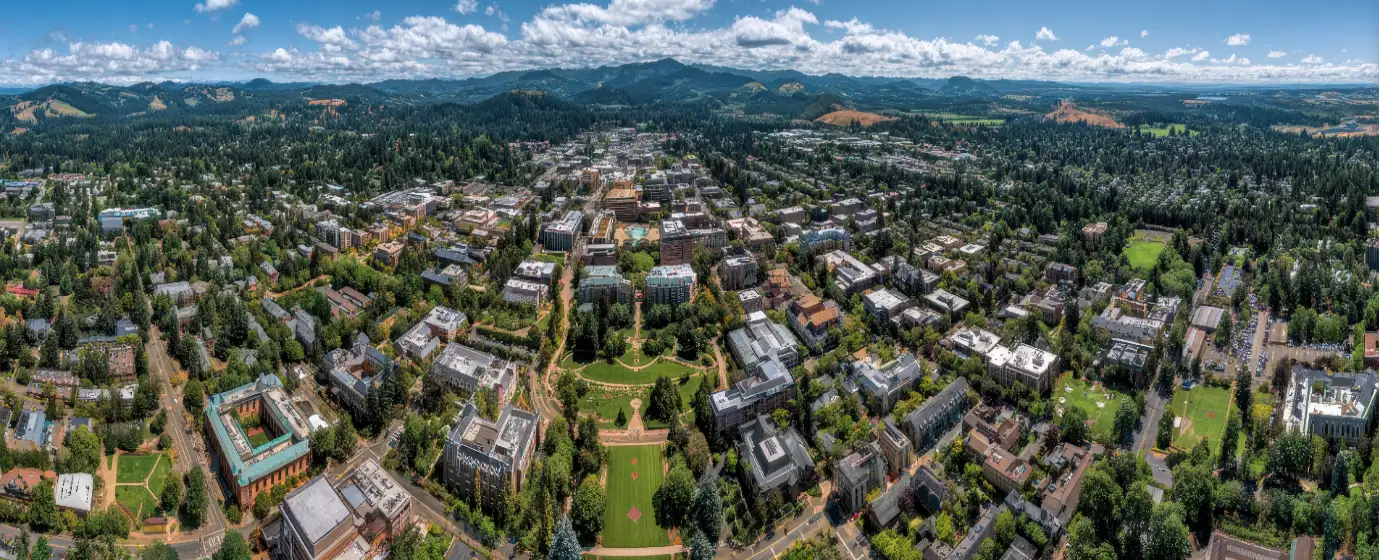
Willamette Valley · Oregon
Retiring in Corvallis: Is It the Right Fit for Your Next Chapter? (2026)
Corvallis earns serious consideration from retirees — but it's not the right fit for everyone, and the people who move here without understanding its particular character sometimes find themselves surprised. This is a mid-sized university town, not a retirement-focused community. Oregon State University's 30,000+ students set the cultural and demographic tone, the median age hovers around 28, and the social infrastructure tilts toward academic and outdoor pursuits rather than golf courses and snowbird amenities. For retirees who want exactly that kind of intellectual stimulation and access to real nature, Corvallis delivers at a level that's hard to find elsewhere in the Willamette Valley.
The practical bones are strong. Good Samaritan Regional Medical Center sits just off the freeway in North Corvallis, operating as one of only five Level II trauma centers in Oregon. The Willamette Valley climate is mild enough that year-round outdoor activity is realistic. And while the median home price has climbed to approximately $568,000 — placing Corvallis above most of its neighboring cities — the property tax rate of roughly 1.01% keeps carrying costs reasonable once you're in.
This guide covers the retirement tax picture for Oregon, the healthcare infrastructure you'll actually rely on, senior living options across the spectrum from independent to memory care, and an honest assessment of what daily life looks like when you're not commuting to OSU every morning. If you're weighing Corvallis against Albany, Philomath, or even the coast, there's a comparison table for that too.

Oregon has one of the more retiree-friendly income tax structures in the West — with one important caveat. The state has no sales tax, which benefits retirees living on fixed incomes and making regular purchases. Social Security income is fully exempt from Oregon state income tax, which matters considerably for retirees who rely on it as a primary income stream.
| Income Type | Oregon Tax Treatment |
|---|---|
| Social Security Benefits | Fully exempt from state income tax |
| Public Pension (Oregon PERS) | Partially exempt depending on contribution year |
| Federal Government Pension | Partially exempt (up to $6,250 single / $12,500 married) |
| Military Retirement Pay | Exempt up to $6,250 per person |
| IRA / 401(k) Withdrawals | Taxed as ordinary income (state rate 8–9.9%) |
| Private Pension Income | Taxed as ordinary income |
| Investment / Capital Gains | Taxed as ordinary income (no preferential rate) |
| Property Tax (state rate) | Approximately 1.01% assessed value |
| Sales Tax | None |
| Estate / Inheritance Tax | Oregon estate tax on estates over $1 million |
Oregon's income tax rates run among the higher end nationally — the 8% bracket kicks in at relatively modest income levels, and the top rate of 9.9% applies above $125,000 for single filers. For retirees drawing primarily from IRAs or 401(k)s, that's a real consideration. What softens the blow is Oregon's Senior Property Tax Deferral Program, which allows qualifying homeowners 62 and older to defer property taxes until the home is sold — essentially a state-backed loan against your equity, accruing at a low interest rate. For retirees on fixed incomes who own a home outright or nearly so, this program can eliminate a recurring cash flow burden entirely.
Washington state, by comparison, has no income tax at all — making it attractive on paper for retirement income. But Washington does tax capital gains above $262,000 and has a higher cost of entry for housing in most desirable areas near healthcare. The practical reality for most Corvallis retirees is that Oregon's tax structure is manageable, especially when Social Security is exempt and property tax deferral is available. The retirees who feel it most are those drawing significant IRA income or investment returns — for them, tax planning with an Oregon-based CPA is worth doing before the move, not after.
Good Samaritan Regional Medical Center, located at 3600 NW Samaritan Drive in North Corvallis, is the healthcare anchor for the entire mid-Willamette Valley. As one of only five Level II trauma centers in Oregon, it handles serious emergencies that smaller regional hospitals cannot, including major trauma, comprehensive cardiac care, and neurosurgery. The 84-acre campus has operated in its current location since 1975 and runs active residency training programs across more than a dozen specialties — dermatology, family medicine, internal medicine, cardiology, orthopedic surgery, and psychiatry among them.
For cardiac health specifically, Good Samaritan carries meaningful credentialing. The hospital received the American Heart Association's Stroke Gold Plus Quality Achievement and Target: Stroke Honor Roll Elite Award in both 2023 and 2024 — a distinction that matters for retirees managing hypertension, atrial fibrillation, or stroke risk. The campus includes a heliport for critical transfers, and a partnership with Western University of Health Sciences' College of Osteopathic Medicine keeps clinical staff current in a way that isolated community hospitals often aren't.
The hospital's parent network, Samaritan Health Services, is in the process of affiliating with MultiCare Health System out of Tacoma — a transition expected to finalize in mid-2026. For patients, nothing changes immediately: same clinicians, same facilities, same insurance relationships. What MultiCare has committed to is a decade-long capital investment to expand Good Samaritan's inpatient capacity and grow specialist availability. For retirees making a 10- to 20-year bet on local healthcare, that trajectory matters.
The honest limitation: for highly complex cases — rare cancers, advanced cardiac interventions, organ transplant — the referral destination is Oregon Health & Science University (OHSU) in Portland, about 90 minutes north. That's not unusual for a city this size. Most retirees in Corvallis will spend their healthcare lives entirely within Good Samaritan's network. But if you're managing a complex chronic condition that requires frequent specialist visits in Portland, that 90-minute drive is part of the life calculus here.
Veterans in Corvallis have a dedicated resource in the Benton County Veterans Service Office at 777 NW 9th Street. For end-of-life care, the Samaritan Evergreen Hospice House in Albany — about 10 miles east — operates as one of only three hospice houses in Oregon and has served the region for nearly three decades.
Corvallis supports more senior housing depth than its size might suggest — roughly 22 to 23 assisted living, independent living, and continuing care communities operate in and immediately around the city. The options below reflect what's currently available across the care spectrum.
| Community | Type | General Location | Est. Monthly Cost |
|---|---|---|---|
| Corvallis Caring Place | Assisted Living (Nonprofit) | Northwest Corvallis | $3,500–$5,500 |
| Timberhill Place | Assisted / Independent Living | Timberhill neighborhood | $3,200–$5,000 |
| Stoneybrook Lodge | Independent Living | Southwest Corvallis | $2,800–$4,200 |
| Stoneybrook Assisted Living | Assisted Living | Southwest Corvallis | $3,800–$5,800 |
| Prestige Senior Living West Hills | Assisted Living | West Corvallis | $4,000–$6,000 |
| Regency Park Place | Assisted Living | Central Corvallis | $3,500–$5,200 |
Corvallis Caring Place at 750 NW 23rd Street stands out as a nonprofit option with 42 apartments and a genuine month-to-month structure — no long-term lease commitments, which matters when health trajectories are uncertain. It's been operating for more than 24 years and includes three daily meals, weekly housekeeping, and 24/7 care assistance in a facility that doesn't feel institutional.
Stoneybrook's two-tier structure — Stoneybrook Lodge for independent living with 115 apartments, and Stoneybrook Assisted Living for those needing more hands-on support — makes it a natural landing spot for couples at different points on the care spectrum. The ability to stay within the same community as needs change is something retirees consistently cite as a priority, and Stoneybrook handles that transition within a single campus.
The gap in Corvallis's senior living inventory is dedicated memory care. Options are more limited than in larger metro areas, and families dealing with mid-to-late-stage dementia may find themselves looking toward Albany or the Portland suburbs for appropriate placement. If memory care is a near-term possibility for a spouse or partner, that's worth researching before committing to Corvallis as your permanent base.

Looking to buy in Corvallis? Estimate your payment.
Enter your numbers to see an estimated monthly mortgage payment.
Estimate only. Excludes HOA fees and mortgage insurance.
The honest answer on walkability: Downtown Corvallis is genuinely walkable by Oregon small-city standards, but it is not a city where you can go car-free without real planning. The historic commercial core along 2nd and 3rd streets offers coffee shops, restaurants, the public library, and the Corvallis-Benton County Public Library within easy walking distance if you live in the right neighborhoods. College Hill and Downtown proper give you the most on-foot access; West Hills and Timberhill require a car for most errands.
Corvallis Area Transit (CAT) runs fixed routes connecting major districts, but service frequency is modest — this is not a transit system designed for daily independence. Ride-share services are available but coverage thins outside peak hours. Retirees who remain comfortable driving will find the city easy to navigate; those planning ahead for reduced driving should seriously consider proximity to Downtown when choosing a neighborhood.
The cultural calendar punches above Corvallis's weight class, largely because of OSU. DaVinci Days, the annual arts and technology festival, draws thousands each July. The Corvallis Fall Festival has been a fixture along the riverfront for decades. OSU's Linus Pauling Science Center hosts free public lectures and exhibits, and the university's music and theater programs run performances throughout the academic year. The Corvallis Public Market on Saturdays brings local farms, artisans, and food vendors to the riverfront from spring through fall — retirees who came for the nature end up treating it as a weekly social ritual.
Outdoor access is woven into daily life in a way that takes newcomers time to fully appreciate. Avery Park's rose gardens and natural areas are a five-minute drive from most of the city. Bald Hill Natural Area and Chip Ross Natural Area offer legitimate hiking on trails that can be either a mellow 45-minute walk or a strenuous climb depending on how far you go. The Willamette River Trail gives walkers and cyclists a multi-mile paved route with mountain views on clear days. For retirees whose sense of daily quality depends on access to real nature without driving 45 minutes to find it, Corvallis delivers consistently.
What surprises most retirees after six months here is how much they engage with the university community. Free and low-cost lectures, films, athletic events, and exhibits cycle through campus weekly. It's not unusual for a retired engineer or teacher to end up auditing an OSU course, volunteering with the master gardener program, or simply becoming a regular at the Valley Library. The university doesn't feel like a separate institution once you're living here — it's woven into the town's rhythm.
The grocery situation is solid in most parts of the city. Fred Meyer on Circle Boulevard handles the bulk of Corvallis's grocery traffic, and Market of Choice on NW Kings Boulevard serves the Northwest neighborhoods well. Natural Grocers and the Corvallis Community Co-op round out the organic and specialty options. The gap is in South Corvallis and the fringes of West Hills, where a car trip for a full grocery run is unavoidable.
| City | Median Home Price | Hospital Access | Walkability | Senior Living Depth | Overall Fit |
|---|---|---|---|---|---|
| Corvallis, OR | $568,000 | Level II Trauma (on-site) | Moderate | Strong (22+ communities) | Excellent for active, educated retirees |
| Albany, OR | ~$385,000 | Community hospital (10 mi from Corvallis) | Low-Moderate | Moderate | Good budget alternative |
| Philomath, OR | ~$380,000 | Relies on Corvallis (5 mi) | Low | Limited | Best for rural-lifestyle buyers |
| Salem, OR | ~$420,000 | Salem Health (Level II) | Moderate | Very strong | Better for city-amenity seekers |
| Newport, OR | ~$450,000 | Samaritan Pacific Communities (small) | Moderate | Moderate | Coast lifestyle; limited medical depth |
| Eugene, OR | ~$465,000 | PeaceHealth (Level II) | Good | Very strong | Larger-city alternative to Corvallis |
Eugene represents a genuine alternative for retirees who want more urban density — larger concert venues, a more developed restaurant scene, PeaceHealth's Level II hospital, and a deeper senior living market. The commute to the coast is similar, and the university (University of Oregon) provides the same kind of cultural energy. Corvallis tends to win for retirees who prefer a slightly smaller scale and the specific research-university character that OSU brings.

Local Expert Takeaway: Corvallis consistently attracts retirees who were professionals — academics, engineers, healthcare workers, teachers — and want their retirement to feel intellectually alive, not just comfortable. The retirees who thrive here tend to be active, curious, and fine with a car-dependent lifestyle outside the core neighborhoods. If single-floor living and proximity to Good Samaritan are your priorities, Northwest Corvallis and Timberhill are where to focus first. If price point matters more than neighborhood prestige, South Corvallis in the $490,000–$520,000 range gives you access to Avery Park and the river trail at a meaningful discount. The one buyer profile that tends to struggle here: retirees who want a tight-knit senior-centric social scene — Corvallis is a university town first, and building a social life takes more initiative than it would in a purpose-built retirement community.
Is Corvallis a good place to retire?
For the right retiree, yes — Corvallis offers an unusually strong combination of healthcare access, outdoor recreation, and intellectual culture for a city of 61,000. The best fit tends to be active, educated retirees who value proximity to a research university and real hiking over retirement-village amenities. The city's relatively modest senior population means the social scene requires some initiative to build, but the raw ingredients — lectures, markets, river trails, arts festivals — are consistently there.
What healthcare is available for retirees in Corvallis?
Good Samaritan Regional Medical Center is the city's primary hospital, operating as a Level II trauma center with comprehensive specialties including cardiovascular surgery, oncology, neurosurgery, and orthopedic surgery. It runs active residency programs across more than a dozen fields, keeping its clinical staff current. For cases requiring tertiary care or transplant services, OHSU in Portland is the referral destination — about 90 minutes north.
How does Corvallis compare to Eugene for retirement?
Both cities offer a research university, a Level II trauma center, and an active outdoor culture. Eugene is larger, with a more developed restaurant and entertainment scene and deeper senior living inventory. Corvallis tends to be slightly pricier on the housing side at the median but offers a smaller-scale, quieter feel that many retirees prefer after decades in denser metro areas. The decision often comes down to scale preference more than any single practical factor.
Explore the full Corvallis series: The Ultimate Corvallis Relocation Guide · Is Corvallis Safe? · Cost of Living in Corvallis · Best Neighborhoods in Corvallis · Corvallis Schools & Family Life · Corvallis Youth Sports · Corvallis Parks & Recreation · Retiring in Corvallis · 1031 Tax-Deferred Exchange in Corvallis · Corvallis First-Time Homebuyers Guide · · Moving to Corvallis from California
Tell us what you need help with and we'll connect you with local resources.

About the Author
Todd Davidson is the founder of Living in Oregon and Living in Washington, where he publishes in-depth city guides, neighborhood resources, and local market insights covering more than 180 communities across the Pacific Northwest. While his background is in home financing and real estate, he created these digital platforms to help families research and compare regions before making a move.