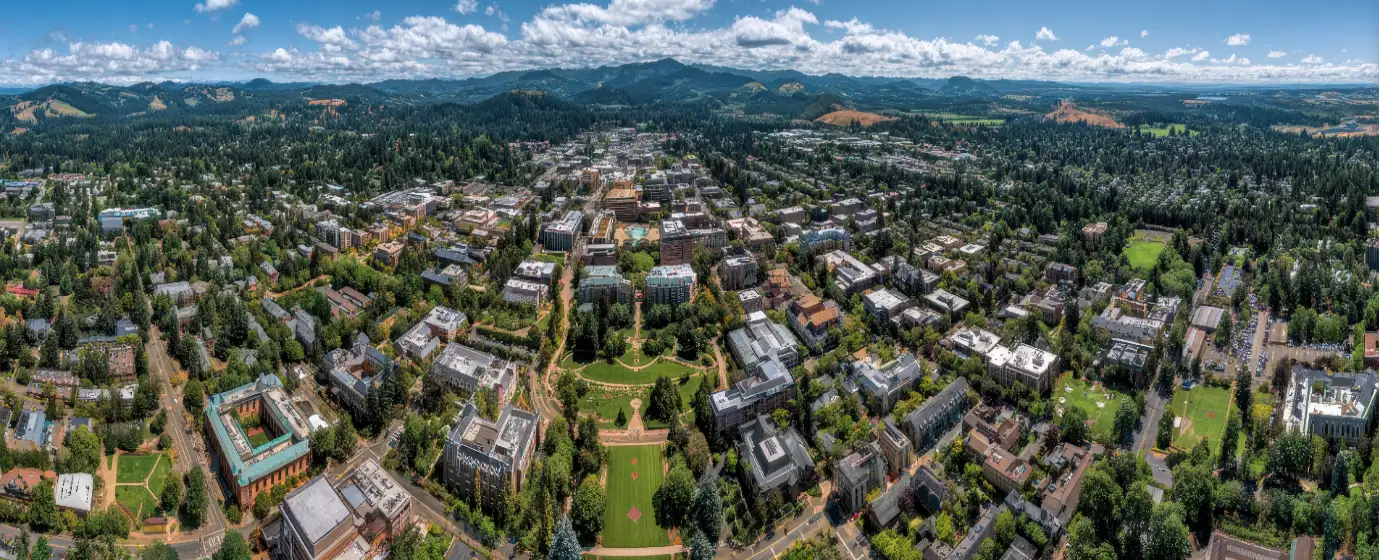
Willamette Valley · Oregon
Moving to Corvallis from California: The Honest Comparison (2026)
The Bay Area software engineer who finally went remote didn't just want lower housing costs — she wanted a yard her kids could use, a commute that didn't exist, and mornings that didn't begin with freeway noise. The San Diego family who moved to Corvallis last year stopped dreading the summer electric bill within one month. The Sacramento buyer who sold a two-bedroom townhome and purchased a four-bedroom house with a full acre outside the city still can't quite believe the math worked. California-to-Oregon migration isn't one story — it's a dozen versions of the same realization: the numbers stopped making sense, and somewhere north of the state line, they started again.
Corvallis is not the obvious Oregon destination. Portland gets the press. Bend gets the outdoor lifestyle crowd. But buyers who do their homework keep landing on Corvallis — a university city of 61,000 anchored by Oregon State University, sitting at the southern end of the Willamette Valley with a housing market still priced around $547,000 median, employers that include a major research hospital and multiple tech-adjacent companies, and a walkable downtown that punches above its size. For California buyers, particularly those leaving the I-680 corridor or the Inland Empire, the numbers make an immediate argument.
The honest version of that argument, though, requires more than a price comparison. This guide covers what California equity buys in Corvallis across different origin markets, what the Oregon tax picture actually looks like (including the part that surprises most transplants), how the weather compares by California city, and the four mistakes California buyers make most often after arriving. Use the comparison tool in Section 6 to model your specific California city against Corvallis with current data.

| Corvallis, Oregon | Bay Area | Southern CA | Sacramento Metro | Central Valley | |
|---|---|---|---|---|---|
| Median Home Price (approx. 2026) | $547,000 | $1,400,000–$1,800,000+ | $750,000–$1,100,000 | $490,000–$600,000 | $340,000–$450,000 |
| Property Tax Rate (effective) | ~1.01% | ~1.1–1.2% | ~1.1–1.25% | ~1.0–1.15% | ~1.0–1.1% |
| State Income Tax (top bracket) | 9.9% | 13.3% | 13.3% | 13.3% | 13.3% |
| State Sales Tax | 0% | 7.25–10.75% | 7.25–10.50% | 7.25–8.75% | 7.25–8.75% |
| Avg Utilities (monthly est.) | ~$105–$130 | ~$180–$230 | ~$170–$220 | ~$160–$210 | ~$155–$200 |
| Avg 1BR Rent | ~$1,200–$1,400 | ~$2,800–$3,600 | ~$2,200–$2,900 | ~$1,500–$1,900 | ~$1,100–$1,500 |
A buyer leaving Walnut Creek with $1.5 million in home equity can purchase a well-appointed property in Corvallis outright and invest the remainder — eliminating a mortgage entirely while landing in a city with strong schools, a research university, and a healthcare infrastructure that most mid-sized Oregon cities can't match. Even the Sacramento buyer, whose equity gap is smaller, is looking at a meaningful step up in property: more square footage, a larger lot, and property taxes capped in their appreciation by Oregon's Measure 50 protections.
The sales tax picture deserves its own sentence. California's base rate of 7.25% climbs to 10.75% in parts of Los Angeles and the Bay Area. Oregon levies none. A household spending $60,000 annually on taxable goods and services is effectively saving $4,350 to $6,450 per year just by crossing the state line — a figure that compounds quietly but significantly over a decade of ownership.
Oregon does not have a sales tax — but it does have a state income tax, and California transplants who arrive expecting a tax-free environment tend to find that assumption corrected quickly. Oregon's income tax structure is graduated, topping out at 9.9% on income above $125,000 for individuals. That's meaningfully lower than California's 13.3% top bracket, but it's not zero, and high earners need to model the comparison honestly before assuming Oregon is dramatically cheaper from an income tax perspective.
| Tax Item | California | Oregon | Net Impact for Transplants |
|---|---|---|---|
| State Income Tax (top bracket) | 13.3% | 9.9% | Oregon saves 3.4 points at top bracket |
| State Sales Tax | 7.25–10.75% | 0% | Major annual savings on household spending |
| Property Tax Rate (effective) | ~1.1–1.25% | ~1.01% (Benton Co.) | Modest savings; similar structures |
| Assessed Value Cap | Prop 13 (2% annual) | Measure 50 (3% annual) | Both protect long-term owners |
| Capital Gains Tax | Up to 13.3% (state) | Up to 9.9% (state) | Oregon lower, but not zero |
| Senior Property Tax Deferral | Limited programs | Yes, for 62+ homeowners | Significant for retirees |
A California resident earning $150,000 annually pays roughly $15,900 in state income tax at California's effective rates. In Oregon, that same income generates approximately $11,800–$12,500 in state income tax, depending on deductions — a savings of $3,400 to $4,100 per year. Pair that with eliminating sales tax on household spending, and the combined annual tax relief for a middle-to-upper-income transplant often lands in the $6,000–$9,000 range, not counting the mortgage reduction.
Measure 50 deserves specific mention for buyers planning to stay long-term. Oregon caps annual increases in assessed value at 3% per year after purchase — meaning your property tax base grows predictably, not with the market. A buyer who purchases at $547,000 today and holds the property for fifteen years won't face a tax bill recalculated against a potential $900,000 future market value. That long-term protection is structurally similar to California's Proposition 13 and is one of the less-publicized financial advantages of Oregon homeownership.
A buyer leaving Palo Alto, Menlo Park, or the Oakland hills with $1.4 million in equity can purchase the best properties Corvallis offers outright — and still have $700,000 to $900,000 remaining. The West Hills and Northwest Corvallis neighborhoods offer custom-built homes on wooded lots, some exceeding 4,000 square feet, with prices ranging from $750,000 into the low $1.5 millions for true luxury inventory. A verified listing on NW Crescent Valley Drive ran approximately $4.4 million — the absolute top of the Corvallis market — which gives a sense of the ceiling. Most Bay Area buyers won't need to touch that tier to live extremely well.
The more practical scenario: a buyer from Walnut Creek or San Jose selling a $1.6 million home with $1.2 million in equity buys a four-bedroom, three-bathroom house in Northwest Corvallis for $680,000, pays cash, and invests the $520,000 remainder. Their effective monthly housing cost drops to property taxes — roughly $460 per month at Corvallis's 1.01% rate on a $547,000 assessment. This is not a theoretical scenario. It's a transaction pattern that Corvallis has seen repeatedly over the past three years.
A buyer leaving Irvine, Pasadena, or Carlsbad with $900,000 in equity is entering the top tier of the Corvallis market with meaningful flexibility. They can purchase a well-appointed home in the $600,000–$800,000 range — think newer construction in Timberhill or the Grand Oaks area — and carry a modest mortgage or pay cash depending on total equity. The Timberhill neighborhood on the city's northwest edge offers planned community amenities, newer builds, and easy access to hiking at Bald Hill Natural Area, all at prices that would represent a fraction of comparable Southern California inventory.
Southern California buyers moving from the $1 million+ markets of the South Bay or coastal Orange County will find the dollar-per-square-foot comparison almost disorienting. Corvallis's median sold price per square foot runs approximately $330 — against figures two to three times higher in coastal SoCal. The buyer leaving Torrance or Burbank with $800,000 in equity isn't just buying more home. They're buying into a city with a fraction of the traffic, a stronger public school district, and a downtown that's walkable without the density pressures.
This buyer is working with a closer relative advantage, but the move still makes financial sense — particularly on taxes and long-term cost stability. A buyer from Roseville or Elk Grove with $500,000 in equity is likely purchasing in Corvallis's $500,000–$600,000 range, carrying a modest mortgage and arriving in a city with no sales tax and lower income tax rates than what they're leaving. South Corvallis, where the median sold price runs approximately $500,000, offers this buyer a solid entry point with faster market velocity — 31 average days on market versus 68 in Northwest Corvallis.
The Sacramento buyer who compares property tax bills will find only marginal savings at first — but Measure 50's 3% annual assessment cap begins to compound meaningfully after five years of ownership. The buyer who plans to hold ten-plus years is building real long-term cost protection into their purchase from day one.
This is the most modest relative advantage, and honest guidance matters here. A buyer leaving Fresno or Bakersfield with $380,000 in equity is looking at a Corvallis purchase that likely requires a meaningful mortgage to reach the $547,000 median. The financial calculus shifts from "eliminate the mortgage" to "buy more stability and infrastructure." Corvallis at $547,000 buys a substantially different city than what most Central Valley markets offer at comparable prices — OSU-anchored employment, a nationally recognized school district, and the Pacific Northwest lifestyle.
Entry-level Corvallis inventory — typically older construction south of campus or in neighborhoods adjacent to downtown — can start in the mid-to-upper $300,000s, which makes Central Valley equity competitive for buyers willing to start there and build equity. The no-sales-tax reality is also more impactful for buyers at this income level, where household spending makes up a larger share of income.
Looking to buy in Corvallis? Estimate your payment.
Enter your numbers to see an estimated monthly mortgage payment.
Estimate only. Excludes HOA fees and mortgage insurance.
Here is what a good friend who moved from San Diego to Corvallis three years ago would actually tell you: the summers are extraordinary, and the winters will test you until they don't. Corvallis logs roughly 157 sunny days per year — about 48 fewer than Los Angeles and 112 fewer than Sacramento. The annual rainfall sits around 46 inches, spread across roughly 128 rainy days, with the wettest months clustering from November through February. December gets approximately 2.5 hours of sunlight per day on average. If you've spent your life in Southern California's 284-annual-sunshine-day climate, that number is not metaphorical — it's a different kind of living.
The other side of that equation is worth equal emphasis. Corvallis's June through September is legitimately spectacular — warm, dry, with an average of nearly 12 hours of daily sunshine in July, trails immediately accessible from most neighborhoods, and outdoor culture that rivals what Northern California offers in the same season. Summers on the Willamette River, hiking at Bald Hill Natural Area or Chip Ross, and the farmers market energy at the Corvallis downtown market satisfy the outdoor instinct that most California transplants arrive carrying. What shifts is the expectation that this lifestyle runs year-round — Oregon's winters require a deliberate adjustment to indoor pursuits, running in the rain, or accepting that your hiking weekends drop significantly from November through March.
What California transplants consistently report loving after a year: the absence of traffic anxiety, the ability to walk to a real downtown, the community scale where you run into neighbors at the Co-op, and the summers — specifically Corvallis summers, which feel like a secret the rest of the country doesn't know about. What they genuinely miss: year-round beach access, the specific food energy of LA or the Bay Area's restaurant culture, and the sheer volume of sunshine that California delivers without asking. The Pacific Northwest lifestyle requires buy-in, not just arrival.
If you want to see how Corvallis compares directly to the city you're leaving, use the tool below — it covers the 120 largest California cities with current housing and tax data.
Home prices: Redfin median sale data, Q1–Q2 2026. Select your city to compare.
Ready to talk through what your specific California equity could do in Corvallis? Todd can model your exact scenario in a single call.
Mistake 1: Assuming the whole city prices uniformly. Corvallis has meaningful price variation by neighborhood that California buyers often flatten into a single number. Northwest Corvallis runs a $571,000 median with a 68-day average on market — slower, more deliberate. South Corvallis runs a $500,000 median with 31-day average velocity — faster, more competitive at the entry level. A buyer who budgets for the citywide median and then falls in love with a Northwest Corvallis property often finds themselves $80,000–$150,000 short on their mental budget.
Mistake 2: Skipping radon testing. Oregon's Willamette Valley has elevated radon potential, and Corvallis homes — particularly older construction in neighborhoods near campus and downtown — are not exempt. California buyers who haven't encountered this in previous transactions sometimes waive the test or deprioritize it. A radon mitigation system costs $800–$2,500 if needed, but it's leverage during negotiation only if you test before closing.
Mistake 3: Underestimating winter driving and outdoor access shifts. Corvallis gets light snow — around 5 inches per year — but the actual winter issue is wet roads, fog on OR-99W south toward Monroe, and the psychological shift of six consecutive dark months. California buyers who planned to maintain their weekend hiking habit through January and February often find themselves unprepared. The Pacific Coast Range trails outside Philomath can be muddy or iced-over from November through March in a wet year.
Mistake 4: Miscalculating the Oregon income tax impact. A buyer relocating from California with $150,000 in remote work income assumes the tax picture dramatically improves. The sales tax savings are real and immediate. The income tax savings are real but more modest — about 3.4 percentage points at the top bracket. Buyers who mentally bank on "no state income tax" are confusing Oregon with Washington or Nevada, and the surprise on their first Oregon filing can reshape the financial logic they used to justify the move.
Bay Area sellers with large equity — typically $1 million or more — are often operating in cash or near-cash territory in Corvallis's price range. At $547,000 median, even a buyer carrying 50% of their equity in the purchase is looking at a $273,500 mortgage, which qualifies easily under conventional terms. The rate environment matters less to this buyer than timeline and terms — particularly the ability to close quickly in a competitive offer situation. For Bay Area sellers who sold an investment property rather than a primary residence, a 1031 exchange into Corvallis income-producing property is worth a direct conversation before the sale closes. See the 1031 Exchange guide for Corvallis-specific application.
Southern California sellers arriving with $700,000 to $1.1 million in equity are unlikely to need jumbo financing in most Corvallis price bands — the conforming loan limit covers the majority of transactions here. A buyer putting $400,000 down on a $680,000 Northwest Corvallis property is carrying a $280,000 conventional loan with a debt-to-income profile that most lenders will approve without issue. The more important variable for this buyer is pre-approval speed — Corvallis's competitive middle tier doesn't wait for buyers still gathering documents.
Sacramento and Inland Empire buyers entering Corvallis near the $400,000–$500,000 range — below the area's $547,000 median — are often well-positioned to buy outright, which sidesteps financing and qualification questions and preserves cash for buyers who'd rather not carry a mortgage at all.

Local Expert Takeaway: The single thing California buyers most consistently underestimate about Corvallis is how quickly the $500,000–$650,000 price band moves when inventory is tight. Buyers who budget correctly and arrive pre-approved for cash-equivalent speed — or with full cash — have a decisive advantage over buyers still waiting on their California close to fund. If you're selling in California and buying in Corvallis, structure the timeline so your Oregon pre-approval or proof of funds is in hand before your California listing goes live. Corvallis won't wait.
✅ California equity translates powerfully in Corvallis — Bay Area and Southern California sellers can often eliminate their mortgage entirely and still own a home in one of Oregon's strongest school districts and employer markets.
⚠️ Oregon has a state income tax — the top bracket is 9.9%, not zero. The overall tax picture improves meaningfully over California, but high earners should model their specific scenario rather than assume dramatic relief.
📍 The weather requires honest preparation — Corvallis averages 157 sunny days per year against Southern California's 284. The summers are genuinely exceptional; the winters require a lifestyle adjustment that California buyers should plan for, not discover in February.
Is moving from California to Corvallis worth it?
For most California buyers, yes — particularly those coming from Bay Area, Southern California, or Sacramento markets where equity has compounded well. The combination of a $547,000 median home price, no state sales tax, lower property tax rates, and a city anchored by a major university and regional healthcare system makes Corvallis one of the more financially defensible moves available to California transplants. The lifestyle adjustment is real, but buyers who go in with accurate expectations about weather and pace tend to stay and build roots.
How much cheaper is housing in Corvallis vs. California?
Against the California statewide median of approximately $782,000, Corvallis's $547,000 median represents roughly a 30% reduction. Against Bay Area medians of $1.4 million to $1.8 million, the gap is closer to 65–70%. Sacramento-area buyers see the smallest relative difference — perhaps 10–15% depending on submarket — but still benefit from Oregon's no-sales-tax structure and Measure 50's long-term assessment cap.
What do I need to know about moving from California to Oregon?
Oregon taxes income but not sales. Radon testing is worth doing on any home purchase in the Willamette Valley. The weather is genuinely different from every California metro — plan for 128 rainy days per year and a December that delivers about 2.5 hours of sunlight daily. On the positive side: summers in Corvallis are warm, dry, and accessible in a way that Bay Area microclimates rarely are, and the cost-of-living relief on housing, utilities, and daily spending typically shows up within the first year of residency.
Explore the full Corvallis series: The Ultimate Corvallis Relocation Guide · Is Corvallis Safe? · Cost of Living in Corvallis · Best Neighborhoods in Corvallis · Corvallis Schools & Family Life · Corvallis Youth Sports · Corvallis Parks & Recreation · Retiring in Corvallis · 1031 Tax-Deferred Exchange in Corvallis · Corvallis First-Time Homebuyers Guide · · Moving to Corvallis from California
Tell us what you need help with and we'll connect you with local resources.

About the Author
Todd Davidson is the founder of Living in Oregon and Living in Washington, where he publishes in-depth city guides, neighborhood resources, and local market insights covering more than 180 communities across the Pacific Northwest. While his background is in home financing and real estate, he created these digital platforms to help families research and compare regions before making a move.