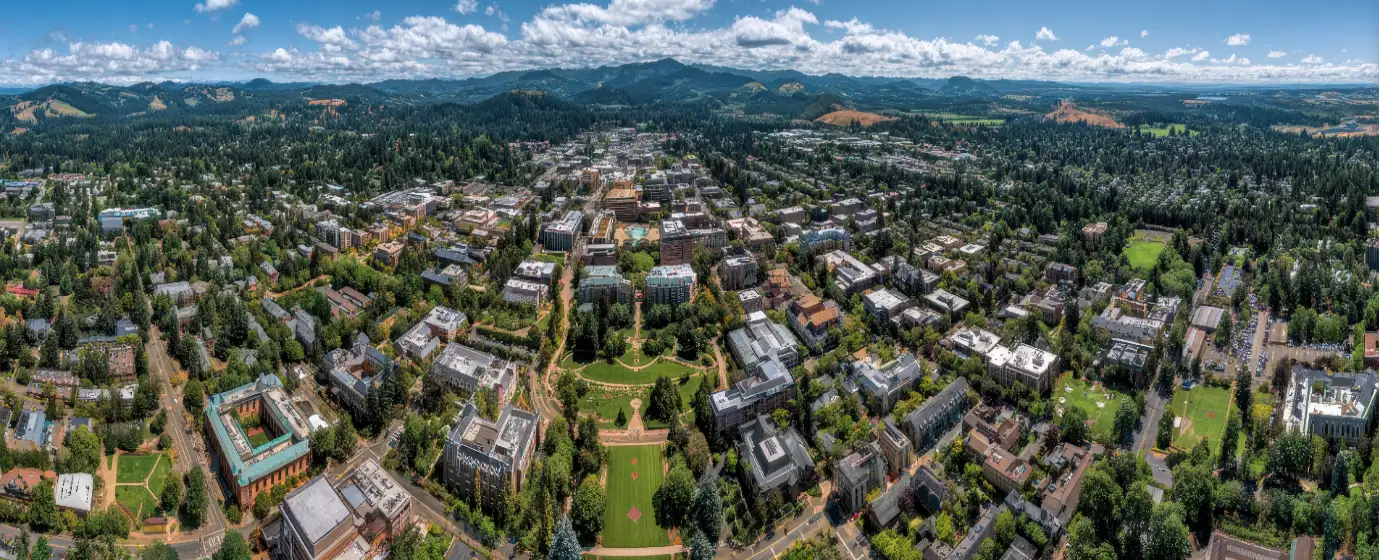
Willamette Valley · Oregon
1031 Exchange & Investment Real Estate in Corvallis (2026)
Not everyone doing a 1031 exchange is a seasoned portfolio investor. A significant share of the California capital flowing into Corvallis right now comes from homeowners — people who sold a Bay Area bungalow or a Southern California condo they'd held for twenty years, and suddenly have $600,000 to $1.4 million in equity that needs a new home within 180 days. Corvallis keeps appearing on their shortlists for a specific reason: it offers durable rental demand, a university anchor that doesn't care about economic cycles, and median home prices well below the markets these sellers are leaving.
The rental market here is shaped almost entirely by Oregon State University, which enrolls roughly 30,000 students and draws a steady stream of faculty, researchers, and healthcare professionals to the region. About 59% of Corvallis households are renter-occupied — one of the highest owner-to-renter ratios of any mid-sized Oregon city — and that figure holds year after year regardless of interest rates or employment trends. The property types that trade most often as investment vehicles are single-family rentals near campus, small multifamily buildings in South and Northwest Corvallis, and the occasional duplex within walking distance of the OSU quad. Inventory is thin and competition from other investors is real.
This guide covers the mechanics of a 1031 exchange for anyone who needs a clean refresher, the current Corvallis investment property market by property type and cap rate, why Pacific Northwest markets are attracting California capital specifically, Oregon's tax landscape for landlords, and the management realities that out-of-state owners consistently underestimate. If you're on a 45-day identification clock or approaching one, the due diligence checklist at the end is where to start.

The core mechanic is straightforward: sell a piece of investment real estate, park the proceeds with a qualified intermediary (QI) — never touch the money yourself — and reinvest into a like-kind replacement property to defer the capital gains tax. "Like-kind" is broader than most people realize. Any real property held for investment or business use qualifies as like-kind to any other real property held for investment or business use. A California single-family rental can exchange into an Oregon duplex, a small apartment building, or even a commercial property. The asset types don't need to match; the investment intent does.
The two deadlines that define every exchange are the 45-day identification window and the 180-day closing deadline. From the day escrow closes on your relinquished property, you have 45 calendar days to formally identify replacement properties in writing to your QI — no extensions, no exceptions. You can identify up to three properties regardless of value, or more properties if their combined value doesn't exceed 200% of the relinquished property's sale price. The 180-day clock to close on your replacement property runs concurrently from the same sale date, not from the identification deadline.
The boot trap catches investors who reinvest less than their full net equity. If you sold a property for $900,000 with $600,000 in net proceeds and only roll $500,000 into the replacement property, that $100,000 difference — the "boot" — becomes taxable in the year of the exchange. To fully defer, your replacement property must equal or exceed the value of the relinquished property, and you must reinvest all of the equity. Mortgage debt replacement matters too: if you had a $200,000 loan on the relinquished property, you need to take on at least $200,000 in debt on the replacement, or add cash to make up the difference.
The median sold price for Corvallis residential property currently sits at approximately $568,000, and the investment market layers onto that foundation in distinct tiers. Single-family rentals near campus trade close to that figure and generate gross rents in the $1,900–$2,400 per month range for a well-maintained three-bedroom. Small multifamily — the duplexes and fourplexes that exchange buyers prize most — list at a median of around $624,000 for available inventory, though larger commercial-grade apartment buildings push into seven figures quickly. The market is described as "somewhat competitive," with homes averaging 55 days on market, but investment-grade properties with strong rent rolls move considerably faster.
Cap rates compress closer to campus and expand as you move toward the edges of town. Apartment buildings and multifamily assets in Corvallis typically trade at cap rates around 5.7% to 6.0% based on current listings — a 24-unit complex near campus recently listed at $2.68 million with a stated cap rate just over 6%. Single-family rentals pencil closer to 4.2%–5.0% on a gross basis before expenses, which reflects both the premium pricing and the strong rent demand that sustains values. Industrial and commercial property in the broader Corvallis area trades at meaningfully higher cap rates, often in the 9% range, though that segment is much thinner in transaction volume.
| Property Type | Typical Price Range | Est. Cap Rate | Avg Days to Close |
|---|---|---|---|
| Single-Family Rental (3BR) | $480,000–$620,000 | 4.2%–5.0% (gross) | 45–60 days |
| Duplex / Small Multifamily | $580,000–$900,000 | 4.5%–6.0% | 30–50 days |
| Apartment Building (8–24 units) | $1.8M–$4.9M | 5.7%–6.5% | 45–75 days |
| Commercial / Industrial | $600,000–$3.0M | 7.0%–9.5% | 60–90 days |
Near-campus duplexes and fully leased small multifamily properties move fastest — typically under contract before the average buyer finishes their due diligence list. Larger commercial assets and properties requiring repositioning tend to sit, which can work in a 1031 buyer's favor if timing allows.

A Bay Area homeowner who sold a 1,400-square-foot house in the East Bay for $1.4 million can realistically acquire a duplex near OSU and a single-family rental in South Corvallis — debt-free — and still have equity remaining to cover closing costs and initial reserves. That's not a hypothetical; it's a straightforward arithmetic outcome of the price gap between the two markets. The cash-on-cash return on an all-cash Corvallis duplex compares favorably to a leveraged Bay Area rental at current interest rates.
Southern California sellers — particularly those exiting the San Diego or Los Angeles single-family rental market — are drawn to Corvallis's price-to-rent fundamentals relative to what they're leaving. A property that generates $2,400 per month in rent on a $600,000 purchase price looks different from a property generating $3,200 per month on a $1.3 million purchase price, even if the raw dollar income is similar. The equity deployment goes further, and the management complexity of one or two Corvallis properties typically runs well below a comparable LA rental.
Sacramento and Inland Empire investors often arrive with more modest exchange proceeds — in the $400,000–$700,000 range — and find that Corvallis offers a clean match at that price point. A well-maintained three-bedroom SFR in South Corvallis or near the Garfield Park area can be identified and closed well within the 180-day window, and the OSU tenant pool means finding a qualified renter is rarely a prolonged process. Many of these buyers are making their first out-of-state investment and value the relative simplicity of a single-family rental over the operational complexity of a multifamily building.
Looking to buy in Corvallis? Estimate your payment.
Enter your numbers to see an estimated monthly mortgage payment.
Estimate only. Excludes HOA fees and mortgage insurance.
Oregon's most immediate advantage for a landlord doing a rehab or turnover is the absence of a state sales tax. Every appliance, fixture, flooring material, and contractor supply purchased in Oregon comes in at the sticker price — no 8.5% to 10.75% layered on top of the tab. On a $40,000 unit renovation, that difference is real money.
Oregon does impose income tax on rental income at rates that climb to 9.9% at higher income levels, which matters for investors with significant earned income. The practical offset is depreciation: a residential rental property is depreciated over 27.5 years, and on a $568,000 purchase (land excluded), the annual depreciation deduction alone — roughly $17,000–$19,000 depending on land allocation — eliminates most or all of the taxable net income on a leveraged property in the early years. Investors carrying exchange properties from California also carry over their original (lower) depreciation basis; the 1031 does not step up basis, which means the deferred tax liability stays on the books, but annual depreciation resets based on the new property's allocated value.
| Tax Item | California | Oregon |
|---|---|---|
| State income tax on rental income | Up to 13.3% | Up to 9.9% |
| Property tax rate (new purchase) | ~1.1%–1.3% effective (Prop 13 reset) | ~1.01% (Benton County) |
| State sales tax | 7.25%–10.75% | None |
| Capital gains (state, real property) | Up to 13.3% (ordinary income rate) | Up to 9.9% (ordinary income rate) |
| 1031 Exchange availability | Yes | Yes — recognized under Oregon law |
For investors who want to participate in Corvallis real estate without any management responsibility, a Delaware Statutory Trust — a DST — allows 1031 proceeds to be invested into a professionally managed fractional ownership structure that qualifies as like-kind replacement property. DSTs are worth a conversation with a 1031 attorney for anyone who wants passive income without the landlord role.
Oregon has among the stronger tenant protection frameworks in the country, and Corvallis owners need to understand the landscape before acquiring. The state limits no-cause eviction notices to situations where specific statutory criteria are met, and rent increase caps apply in jurisdictions with populations over 15,000 — which means Corvallis properties are subject to Oregon's statewide rent stabilization rules. Rent increases are capped annually based on a formula tied to the Consumer Price Index, typically landing in the 5%–10% range per year depending on the index calculation for that year. Out-of-state owners who expect to reset rents aggressively between tenants may find the rules more constraining than they anticipated.
Professional property management in Corvallis typically runs 8%–10% of gross monthly rent, plus leasing fees of one-half to one full month's rent at turnover. For a property generating $2,000 per month, that's $160–$200 in monthly management fees plus occasional placement costs. The trade-off for an out-of-state owner is genuine: OSU's academic calendar creates a predictable summer turnover window, and properties that go vacant in June without local management in place can sit longer than owners expect. Having a local manager who knows the student leasing cycle is not optional for most remote owners — it's the difference between a smooth June-to-August transition and a month of lost rent.
Vacancy in Corvallis runs well below the Oregon state average during the academic year, with rates dropping to around 1%–2% at the start of fall term. Summer months see a seasonal uptick as student leases roll, which is the primary reason investors underwrite conservatively with one month of vacancy per year. The tenant pool here skews educated — roughly 42% of renters hold a bachelor's degree or higher — and the OSU connection means background and income verification is more predictable than in many comparable markets.
| Item | What to Verify | Local Resource |
|---|---|---|
| Title Search | Clear title, no undisclosed liens or easements | Benton County title companies; First American, Fidelity National |
| Sewer vs. Septic Status | City sewer connection (most of Corvallis) vs. septic system | City of Corvallis Public Works |
| Radon Testing | Oregon has elevated radon zones; test before closing | Oregon Health Authority radon map; local inspector |
| Flood Zone Status | FEMA flood zone designation; required for mortgage lenders | FEMA Flood Map Service Center; Benton County GIS |
| Rental Permit Requirements | City of Corvallis residential rental registration requirements | City of Corvallis Community Development |
| HOA Restrictions | Any rental restrictions or short-term rental prohibitions in HOA docs | Review CC&Rs and HOA meeting minutes |
| ADU Zoning Potential | Lot size and R-1/R-2 zoning for accessory dwelling unit addition | City of Corvallis Zoning & Planning |
| School District Boundary | Corvallis School District catchment affects long-term tenant pool | Corvallis School District boundary map |
| Current Lease Status | Tenant in place, lease terms, rent roll, security deposit status | Request from seller; verify with estoppel letters |
| Deferred Maintenance Inspection | Roof, HVAC, foundation, seismic — use Oregon-licensed inspector | Oregon Home Inspector list; local referrals |
| Oregon Landlord-Tenant Law Compliance | Existing lease compliance with Oregon statewide rent increase caps | Oregon Residential Landlord Tenant Act (ORS Chapter 90) |
| Property Management Referral | Local manager lined up before close, not after | Corvallis-based property management firms |
| Title Company Recommendation | Local title company familiar with 1031 coordination and QI timelines | Ask your QI for local title company referrals |
| Environmental (if commercial) | Phase I environmental for any commercial or industrial property | Licensed environmental consultants, Benton County |

Local Expert Takeaway: The single most common mistake California 1031 buyers make in Corvallis is underestimating how quickly the Oregon landlord-tenant framework constrains their post-acquisition flexibility. If you're acquiring a tenant-occupied duplex near OSU expecting to reset rents to market at lease renewal, understand that Oregon's annual rent increase cap limits how fast you can move — and no-cause eviction is restricted, so inherited tenants may stay longer than you planned. Identify properties with rents already at or near market rate, not properties you're planning to reposition. The cash flow is there; it's the repositioning timeline that trips up out-of-state buyers who run California-style underwriting assumptions on Oregon properties.
✅ Corvallis offers durable rental demand anchored by Oregon State University's 30,000-student enrollment, with vacancy rates dropping to 1%–2% during the academic year and a tenant pool that skews educated and stable.
⚠️ Oregon's landlord-tenant protections are real — rent increase caps and no-cause eviction limits apply in Corvallis. Underwrite based on current rents, not on what you hope to charge after acquisition.
📍 Near-campus small multifamily properties move fast — investment-grade duplexes and fourplexes in the OSU corridor are typically under contract within two weeks. 1031 buyers on a 45-day clock need to be underwriting before their relinquished property closes.
Does a 1031 exchange work for out-of-state property?
Yes — a 1031 exchange has no geographic restriction within the United States. A California investor selling a property in Los Angeles can exchange into an Oregon property in Corvallis with full tax deferral, provided all the standard rules apply: a qualified intermediary holds the proceeds, replacement property is identified within 45 days, and the exchange closes within 180 days of the relinquished property sale.
What is the cap rate on rental property in Corvallis?
Cap rates vary meaningfully by property type. Multifamily apartment buildings in Corvallis currently trade at cap rates in the 5.7%–6.5% range based on active listings. Single-family rentals compress closer to 4.2%–5.0% gross before expenses. Near-campus properties with strong existing rent rolls tend to price at the lower end of these ranges; properties requiring any repositioning or located farther from OSU offer more room for yield.
Do I need a local property manager for a 1031 investment in Oregon?
For out-of-state owners, local property management is functionally essential rather than optional. Oregon's landlord-tenant laws — including notice requirements, habitability standards, and lease compliance rules — carry real legal exposure for owners who manage remotely without local expertise. Beyond compliance, Corvallis's OSU academic calendar creates a predictable summer turnover window that local managers navigate routinely and remote owners often handle poorly. Budgeting 8%–10% of gross rent for professional management is the right starting assumption.
Explore the full Corvallis series: The Ultimate Corvallis Relocation Guide · Is Corvallis Safe? · Cost of Living in Corvallis · Best Neighborhoods in Corvallis · Corvallis Schools & Family Life · Corvallis Youth Sports · Corvallis Parks & Recreation · Retiring in Corvallis · 1031 Tax-Deferred Exchange in Corvallis · Corvallis First-Time Homebuyers Guide · · Moving to Corvallis from California
Tell us what you need help with and we'll connect you with local resources.

About the Author
Todd Davidson is the founder of Living in Oregon and Living in Washington, where he publishes in-depth city guides, neighborhood resources, and local market insights covering more than 180 communities across the Pacific Northwest. While his background is in home financing and real estate, he created these digital platforms to help families research and compare regions before making a move.