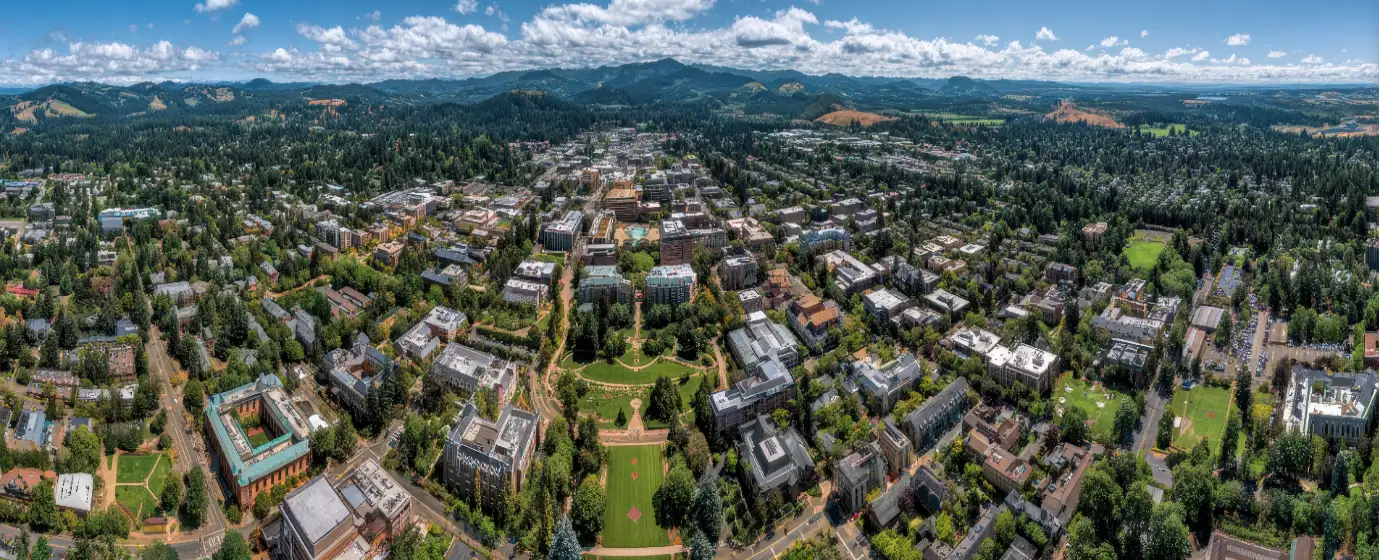
Willamette Valley · Oregon
Is Corvallis Safe? Crime Rates, Safest Neighborhoods & Local Reality (2026)
Corvallis has a reputation that doesn't quite match the headlines — and that's actually a good thing. On paper, some crime aggregators assign the city alarming grades, and those numbers can make relocating buyers do a double-take. But when you look at what's actually driving those statistics, a more nuanced picture emerges: violent crime in Corvallis runs well below both the Oregon average and the national average, and the numbers have been trending in the right direction for years. The honest story is that Corvallis is a genuinely safe place to live, with a specific and manageable property crime challenge that's highly concentrated and largely predictable.
The real driver of Corvallis's elevated crime metrics is larceny-theft, which accounts for the vast majority of all reported incidents. Oregon State University pulls tens of thousands of students, visitors, and event-goers into a relatively compact urban core — and that foot traffic, especially around commercial and campus-adjacent areas, inflates raw crime totals relative to a city of 61,000 permanent residents. Where you live in Corvallis matters enormously to your daily experience of safety. The northwest neighborhoods are consistently the safest part of the city by every major data source. East of downtown, the picture is different.
This guide breaks down what the 2024 FBI data actually says, explains why the numbers vary so wildly depending on where you look, and maps out which neighborhoods offer the quietest, most secure daily life. If you're weighing a move to Corvallis and want to understand safety without the spin in either direction, you're in the right place.

The 2024 FBI data — the most current full-year data available — reported 113 violent crimes and 1,544 property crimes in Corvallis, for a combined total of 1,657 incidents. Total crime fell roughly 8% year over year, continuing a long-term downward trajectory that local police data suggests has been underway for nearly two decades. That trajectory matters: Corvallis isn't a city getting worse, it's a city that has been improving steadily, with 2024 marking one of the lower-incident years in recent history.
Where Corvallis looks different from many comparable Oregon cities is in the violent-versus-property split. The violent crime rate of approximately 1.8 per 1,000 residents runs nearly 49% below the national rate and well below Oregon's own average — a state that has struggled with elevated violent crime in many metro areas. On violent crime alone, Corvallis holds up favorably against cities of similar size across the Pacific Northwest. Property crime is the genuine area of concern, running roughly 25 per 1,000 residents, with larceny-theft composing nearly 79% of all reported incidents. That's meaningfully above the national property crime benchmark, though it tracks closely with what most Oregon college towns report.
Structurally, what drives these numbers is fairly transparent. OSU's campus draws thousands of people daily into a concentrated footprint, and the commercial corridor along 9th Street, Monroe Avenue, and the downtown core sees high foot traffic from students, visitors, and university event crowds. Crimes of opportunity — unlocked bikes, unattended bags, vehicles left with valuables visible — account for a disproportionate share of Corvallis's larceny numbers. In residential neighborhoods away from that corridor, the picture changes substantially. The west side of the city reports approximately 170 total crimes annually compared to roughly 670 in the central core. That's not a rounding difference — it's a fundamentally different daily reality.
Corvallis logged a violent crime rate of approximately 183.8 per 100,000 residents in 2024 — local police data suggests this puts the city nearly 49% below the national rate and roughly 44% below Oregon's statewide average. In practical terms, this means the kind of random violent encounter that defines fear in urban safety conversations is genuinely rare in Corvallis. The city of 61,000 recorded 113 violent incidents across the full year — a number that covers everything from aggravated assault to robbery. For the vast majority of residents, especially those living west of campus, violent crime registers as a background statistic rather than a daily concern.
Larceny-theft is the defining crime story in Corvallis, making up roughly 78% of all reported incidents. Bike theft is the category locals talk about most, particularly around OSU's campus and the downtown corridor — and residents consistently note that an unlocked bike near campus has a short life expectancy. Vehicle break-ins cluster near parking structures and trailheads rather than in residential driveways. Burglary rates vary dramatically by geography: centrally located neighborhoods see roughly 59 burglaries annually, while west-side neighborhoods see closer to 20. The takeaway isn't that property crime is unavoidable — it's that most of it follows predictable patterns, and most of it can be mitigated with basic precautions.
Corvallis's safety landscape is genuinely geographic — where you buy determines your experience far more than city-wide averages suggest. These six neighborhoods represent the range of safety profiles you'll encounter when shopping here.
Every major crime data source ranks the northwest as the safest zone in Corvallis, and the underlying numbers back that up. The chance of being a crime victim in northwest neighborhoods sits around 1 in 31, compared to 1 in 9 in the easternmost parts of the city. This is where you find the Timberhill area's larger lots, wooded streets, and a homeowner-heavy demographic that keeps both crime rates low and neighborhood cohesion high. Families with school-age children consistently gravitate here precisely because the combination of safety, school proximity, and green space access is hard to match anywhere else in the city.
Best for: Buyers prioritizing consistent, data-backed safety across all crime categories.
Timberhill sits within the northwest zone and earns its own mention because it represents the pinnacle of residential safety in Corvallis. Quiet cul-de-sacs, modern homes, and immediate access to the Timberhill Natural Area trail network create an environment where residents rarely think about crime at all. The neighborhood's relative distance from the university corridor insulates it from the larceny-theft patterns that inflate citywide numbers, and the higher homeownership rates here correlate directly with lower incident counts. It's the neighborhood local agents most often mention when families with children ask where to feel truly settled.
Best for: Families who want distance from campus activity without sacrificing access to trails and parks.
College Hill has a reputation as one of Corvallis's most community-oriented neighborhoods, and that reputation has a safety dimension to it. Neighbors here tend to know each other, which creates the kind of informal street-level awareness that formal crime statistics don't capture. The proximity to OSU means some of the same foot traffic dynamics that affect downtown bleed into the edges of the neighborhood — residents lock their bikes and cars consistently, and that habit makes a real difference. Overall, College Hill trends calmer than its campus-adjacent location might suggest, largely because the residential core maintains strong owner-occupant rates that contribute to neighborhood stability.
Best for: Buyers who want walkable access to OSU and downtown with a more settled residential feel than you'd get right on Monroe Avenue.
Downtown Corvallis is where the city's crime numbers concentrate most visibly, and buyers considering lofts or condos here should go in with clear expectations. The central core accounts for the highest incident volume in the city — roughly 670 crimes annually — driven almost entirely by larceny-theft in high-traffic commercial areas rather than violent incidents targeting residents. The evening economy around 2nd Street and the farmers market corridor brings crowds and occasional property crime, but serious violent incidents are rare. Living downtown means parking your car in a structure and locking everything every time — it's not a burden, but it is a different relationship with daily precaution than you'd have in Timberhill.
Best for: Buyers comfortable with urban-style vigilance who want walkable access to restaurants, the riverfront, and OSU events.
West Hills occupies the elevated terrain west of the main residential grid and benefits from both its geography and its demographics. Lower-density development, long-established homeowners, and limited through-traffic combine to keep incident rates well below the citywide average. The neighborhood doesn't make many crime data headlines precisely because there's little to report — it's the kind of place where a porch package sits undisturbed for three days. Access to Bald Hill Natural Area from this part of the city is a genuine quality-of-life asset, and the trail network brings regular foot traffic without the commercial-density crime patterns that affect downtown.
Best for: Buyers willing to drive for errands in exchange for quiet streets and one of the best trailhead locations in Corvallis.
South Corvallis covers a broad swath of the city and its safety profile is correspondingly mixed. The neighborhoods closer to Harrison Boulevard and the south end of the OSU campus pick up some of the same activity patterns as the core. Further south, particularly in the areas near Avery Park and along the Willamette River, things quiet down noticeably. Buyers shopping South Corvallis should distinguish carefully between blocks — a few streets of difference can mean meaningfully different incident rates. Property crime, particularly vehicle-related theft, is the main concern in the more transited sections; residents further from the commercial spine rarely encounter anything beyond a neighbor's Ring camera catching a porch solicitor.
Best for: Value-focused buyers who want Corvallis quality at slightly lower price points, with the understanding that street selection matters more here than in the northwest.
| City | Violent Crime/1K | Property Crime/1K | Overall Safety Profile |
|---|---|---|---|
| Corvallis | ~1.8 | ~25 | Low violent crime; property crime above national avg |
| Albany | ~4.2 | ~38 | Higher across both categories; larger commercial base |
| Philomath | ~1.1 | ~12 | Small-town rates; limited commercial activity |
| Lebanon | ~5.8 | ~44 | Among the higher rates in the region |
| Adair Village | ~0.4 | ~6 | Very low; small population, minimal commercial density |
| Monroe | ~0.6 | ~9 | Rural rates; minimal foot traffic |
Corvallis compares favorably on violent crime against most of its neighbors, with only Philomath, Adair Village, and Monroe — all substantially smaller communities — posting lower rates across the board. Albany, the most direct regional comparison for buyers who are weighing cost versus safety, runs notably higher on both violent and property crime. Lebanon posts some of the highest rates in the immediate region. For buyers choosing between Corvallis and Albany specifically, the safety data consistently favors Corvallis, though the price difference in the housing market reflects that gap.
Looking to buy in Corvallis? Estimate your payment.
Enter your numbers to see an estimated monthly mortgage payment.
Estimate only. Excludes HOA fees and mortgage insurance.
The apps and aggregators often miss what Corvallis residents understand through lived experience: the crime map is really a campus-proximity map. The further your address is from the OSU campus footprint and the downtown commercial corridor — roughly bounded by Circle Boulevard to the north, 9th Street to the east, and Harrison Boulevard to the south — the more your daily safety experience diverges from the citywide statistics. Locals who've lived here for years rarely think about personal safety in a meaningful way. What they do think about is bike locks and not leaving anything visible in a parked car, particularly anywhere near campus or the riverfront parking areas on evenings when OSU events are running.
The Nextdoor chatter in Corvallis skews toward package theft and occasional catalytic converter issues rather than anything more serious. The 2nd Street and Monroe Avenue corridor after midnight on football weekends is where you encounter the highest concentration of incident potential — not because it's dangerous, but because it's crowded and alcohol-involved. Families with children living west of 9th Street in the Timberhill or Northwest Circle Boulevard areas routinely describe their neighborhoods as among the safest places they've ever lived. That contrast — between what the aggregate numbers suggest and what northwest-side residents actually experience — is the central truth of safety in Corvallis.
One practical note: OSU's campus effectively functions as a city within a city, with its own police force handling incidents on university property. Campus-reported crimes feed into the Corvallis totals in some data sources and not others, which helps explain some of the variance between aggregators. Buyers who plan to live in established residential neighborhoods — as opposed to renting near Greek Row — are shopping a genuinely different safety environment than the headline numbers imply.

Local Expert Takeaway: If safety is your primary concern, focus your search north of Arnold Way and west of 9th Street — the data consistently supports these corridors as the lowest-incident residential zones in the city. Buyers who stretch into the Timberhill area or northwest Circle Boulevard neighborhoods typically find that Corvallis's reputation for safety matches their daily reality almost immediately after moving in. Don't let the aggregate scores from sites that compare Corvallis to rural hamlets steer you away from what is, in the residential west side, a genuinely calm and well-watched community.
✅ Violent crime in Corvallis runs well below both the Oregon and national averages — the city logged just 113 violent incidents in 2024 across a population of over 61,000, making it one of the safer mid-sized cities in the Pacific Northwest on that measure.
⚠️ Property crime, particularly larceny-theft, is the real story — and it clusters heavily around the OSU campus corridor and downtown commercial zone. Residents in northwest and west-side neighborhoods experience this at a fraction of the citywide rate.
📍 Neighborhood selection matters more in Corvallis than the headline numbers suggest — the gap between the central core and Timberhill or Northwest Circle Boulevard isn't a small difference in feel, it's a statistically significant difference in your actual odds of a property crime incident.
Is Corvallis a safe place to live?
For the vast majority of residents — particularly those in the northwest and west-side neighborhoods — Corvallis is a safe, low-stress place to live. Violent crime runs nearly 49% below the national average, and the city's total crime count fell again in 2024. The elevated property crime numbers are real but highly geographic, concentrated in areas with high foot traffic near campus and downtown. Residential neighborhoods away from that corridor routinely report rates that would be unremarkable in any small Oregon town.
What is the most common crime in Corvallis?
Larceny-theft, by a significant margin. It accounts for roughly 79% of all reported incidents and includes everything from bike theft near campus to vehicle break-ins at trailhead parking areas. It's the crime most directly tied to the university's presence and the foot traffic patterns of a college town — and it's also the category most effectively mitigated by basic habit changes like locking bikes with quality U-locks and keeping vehicles visibly empty.
How does Corvallis compare to Albany for safety?
Corvallis is meaningfully safer than Albany on both violent and property crime metrics. Albany runs substantially higher across both categories, which is one reason the two cities — just 10 miles apart on US-20 — attract somewhat different buyer profiles. Buyers who prioritize safety in the Willamette Valley mid-region and are choosing between the two cities will find the data consistently favors Corvallis, with the tradeoff being that Albany offers lower home prices relative to that safety gap.
Explore the full Corvallis series: The Ultimate Corvallis Relocation Guide · Is Corvallis Safe? · Cost of Living in Corvallis · Best Neighborhoods in Corvallis · Corvallis Schools & Family Life · Corvallis Youth Sports · Corvallis Parks & Recreation · Retiring in Corvallis · 1031 Tax-Deferred Exchange in Corvallis · Corvallis First-Time Homebuyers Guide · · Moving to Corvallis from California
Tell us what you need help with and we'll connect you with local resources.

About the Author
Todd Davidson is the founder of Living in Oregon and Living in Washington, where he publishes in-depth city guides, neighborhood resources, and local market insights covering more than 180 communities across the Pacific Northwest. While his background is in home financing and real estate, he created these digital platforms to help families research and compare regions before making a move.