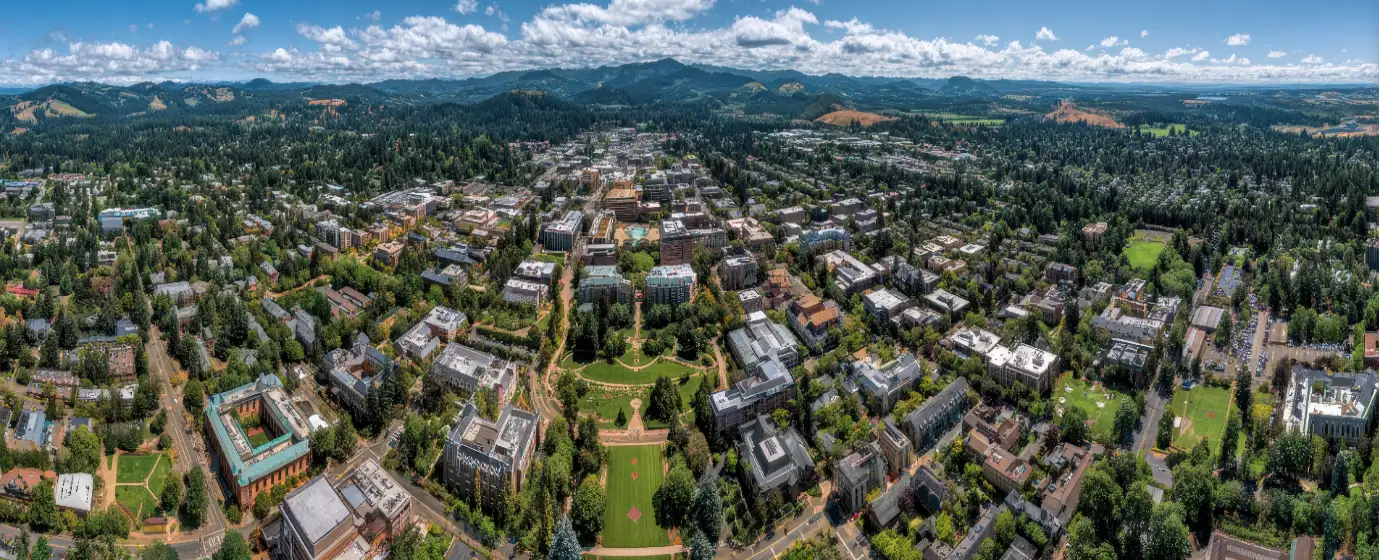
Willamette Valley · Oregon
Cost of Living in Corvallis: Housing, Taxes, Utilities & Lifestyle (2026)
Here's the financial reality most people miss before moving to Corvallis: this is not an affordable college town. The presence of Oregon State University doesn't suppress housing costs the way you might expect — it inflates them. With roughly 25,000 students competing for off-campus housing alongside a workforce that includes high-earning engineers, healthcare professionals, and university faculty, Corvallis has earned the uncomfortable distinction of being one of the most rent-burdened communities in Oregon.
What shapes the cost picture here is a combination of constrained supply, persistent demand, and Oregon's broader tax structure. Benton County ranks near the bottom of all Oregon counties for housing affordability — 35th out of 36 — and the local rental market reflects a renter-majority city where 59% of households rent rather than own. No sales tax softens the blow somewhat, but Oregon's income tax is among the steepest in the country, and housing costs have diverged sharply from income growth since roughly 2017.
This guide will walk you through what it actually costs to buy, rent, and live in Corvallis in 2026 — including property taxes, utilities, grocery and transportation costs, and how the numbers compare to neighboring cities. Whether you're relocating for OSU, Samaritan Health, or Hewlett-Packard, the goal is to give you a budget you can actually stand behind.

The median home price in Corvallis sits at approximately $547,000, though recent sold data from mid-2026 puts the three-month median closer to $565,000–$568,000 — a gap driven by a market that has absorbed consistent demand pressure from OSU-related employment and limited new construction. At $330 per square foot on average, you're not getting Portland square footage bargains here. That figure buys you roughly 1,600 square feet on a typical lot in an established neighborhood, or a well-located townhome a mile or two from campus.
The market is currently balanced, with homes averaging around 55 days on the market and selling at approximately 99% of asking price. That's a meaningful shift from the frenzied seller's market of a few years ago, and it gives buyers more room to negotiate than they've had since 2020. Single-family homes average closer to $640,000, while condos average around $428,000 — and the spread between those two categories represents a genuine decision point for buyers who want to stay under $500,000.
Entry-level inventory — homes priced below $400,000 — exists primarily in South Corvallis and includes older construction or smaller condos. If your budget is closer to the $500,000–$600,000 range, you'll find the widest selection of move-in-ready single-family homes in Northwest Corvallis and the Timberhill corridor. Above $700,000, the market shifts toward larger homes in West Hills and Grand Oaks, where lot sizes increase and neighborhood finishes improve noticeably.
| Budget Range | What You Can Expect |
|---|---|
| Under $400,000 | Condos, older single-family homes in South Corvallis, smaller lots |
| $400,000–$550,000 | 2–3 bed single-family, established neighborhoods, some deferred maintenance |
| $550,000–$700,000 | Updated 3–4 bed homes, Northwest Corvallis, Timberhill, newer construction |
| $700,000+ | West Hills, Grand Oaks, larger lots, modern finishes, views in some cases |
Benton County's effective property tax rate runs approximately 1.01%, which on the median home price of $547,000 translates to roughly $5,525 per year — or just under $460 per month when folded into a mortgage payment. Oregon's Measure 50, passed in 1997, limits annual assessed value growth to 3% regardless of market appreciation, which means longtime owners frequently pay taxes on assessed values well below actual market value. New buyers, however, are assessed at purchase price, so that Measure 50 cushion doesn't apply to you until you've owned for several years.
Corvallis is a renter's city by the numbers — 59% of households rent — but that doesn't make it an easy renter's market. OSU's enrollment of roughly 25,000 on the Corvallis campus means a substantial portion of the rental market turns over every August, and competition for well-located two-bedroom apartments near campus can be intense in late spring. The city has been consistently flagged as one of Oregon's most rent-burdened communities, meaning a disproportionate share of renter income goes toward housing costs.
| Unit Type | Average Monthly Rent |
|---|---|
| Studio / 1-BR near campus | $1,100–$1,450 |
| 1-BR apartment (citywide) | $1,350–$1,650 |
| 2-BR apartment | $1,600–$2,000 |
| 2-BR house | $1,800–$2,400 |
| 3-BR house | $2,200–$2,900 |
| 4-BR near OSU (student-oriented) | $2,800–$3,600 |
Rental inventory outside the immediate OSU corridor is more stable and occasionally more affordable. South Corvallis tends to have lower rents than the College Hill or Northwest Corvallis areas, though it trades walkability to campus for access to Highway 20 and easier commutes toward Albany. Families looking for a rental house with a yard will find more options in the North Corvallis and Walnut Park areas, though $2,200 per month for a three-bedroom is a realistic floor in most neighborhoods.
Corvallis utility costs run slightly below the national average — the cost-of-living utility index comes in at 97, meaning residents pay fractionally less on power and water than the average American city. Pacific Power and Pacific Corp serve most of the city for electricity. The wet Willamette Valley winters mean heating costs are real, though the region's mild summers eliminate air conditioning costs for most households. A typical household in Corvallis can expect to spend $120–$160 per month on electricity and gas combined, depending on home size and efficiency.
Car dependency is a genuine cost factor here. Corvallis has a respectable transit system by small-city standards — Corvallis Transit System (CTS) routes cover most of the city and connect to the OSU campus — but the reality for most working residents is that you'll need a vehicle. The commute to Portland runs roughly 90 minutes under normal conditions on Highway 99W or I-5 via Albany, making this a viable relocation for remote workers but a significant daily commitment for anyone working in the metro. Gas prices track with Oregon statewide averages, typically running $0.20–$0.30 per gallon above the national average due to Oregon's fuel standards.
Groceries in Corvallis run modestly above the national average — a cost index of 108. The city has a Fred Meyer, a Winco, a Natural Grocers, and a Trader Joe's, which gives residents a reasonable range of price points. The downtown farmers market, running Saturdays in Central Park from spring through fall, is a genuine local institution rather than a novelty, and many residents fold it into their weekly food budget. Dining out in Corvallis skews toward casual and mid-range — the presence of a large student population keeps a lot of restaurants in the $12–$18 entree range, with fewer of the $40-per-plate options you'd find in Portland's close-in neighborhoods.
Healthcare costs index at roughly 99 — essentially at the national average — which is partly a function of Corvallis being home to Good Samaritan Regional Medical Center and the broader Samaritan Health Services network. Access to specialty care is solid for a city of this size, and the presence of OSU's College of Public Health and Human Sciences adds research-adjacent medical infrastructure that most similarly sized cities don't have.

Looking to buy in Corvallis? Estimate your payment.
Enter your numbers to see an estimated monthly mortgage payment.
Estimate only. Excludes HOA fees and mortgage insurance.
| City | Median Home Price | Property Tax Rate | Commute to Corvallis | Key Trade-Off |
|---|---|---|---|---|
| Corvallis | $547,000 | 1.01% | — | OSU demand, limited inventory |
| Albany | ~$380,000 | ~1.05% | 15–20 min | Lower prices, less walkability |
| Philomath | ~$430,000 | ~1.01% | 10 min | Quieter, smaller services |
| Adair Village | ~$370,000 | ~1.01% | 15 min | Rural feel, very limited services |
| Monroe | ~$320,000 | ~1.00% | 25 min | Rural, very limited amenities |
| Lebanon | ~$340,000 | ~1.05% | 35 min | Lower cost, longer commute |
| Jefferson | ~$310,000 | ~1.00% | 30 min | Rural bedroom community |
The Albany comparison deserves a closer look. At roughly $380,000 median, Albany buyers get significantly more square footage and often newer construction — but they trade away Corvallis's walkable downtown, the proximity to OSU events and facilities, and what locals describe as a noticeably different street-level culture. Many Samaritan Health and HP employees who can't stretch to Corvallis prices land in Albany and commute the 15–20 minutes on Highway 20. It works, but it's a different daily life.
The table below reflects a household purchasing at the $547,000 median with 10% down ($54,700), at a mid-2026 fixed rate of approximately 6.75%, with typical Corvallis living costs.
| Cost Category | Monthly Estimate |
|---|---|
| Mortgage (principal + interest) | $3,185 |
| Property taxes (1.01% / 12) | $460 |
| Homeowner's insurance | $120 |
| HOA (if applicable — most single-family homes: $0) | $0–$150 |
| Utilities (electric, gas, water/sewer) | $200–$260 |
| Internet | $65–$90 |
| Groceries (2-person household) | $550–$700 |
| Transportation (1 vehicle, gas + maintenance) | $350–$450 |
| Dining out & entertainment | $300–$500 |
| Healthcare (premiums + out-of-pocket) | $300–$500 |
| Total Estimated Monthly Expenses | $5,530–$6,415 |
At the median household income of $65,012 — roughly $5,418 per month before taxes — this budget math is tight. Oregon's income tax (more on that below) means take-home pay on a $65,000 salary lands closer to $4,400–$4,600 per month after state and federal withholding. That gap between take-home and housing cost is exactly what drives Corvallis's rent-burden ranking. Households buying here typically need two incomes, an income meaningfully above the city median, or significant equity from a prior home sale.
Oregon's income tax structure is one of the steepest in the country, with marginal rates reaching up to 9.9% for higher earners. Most middle-income households in Corvallis fall into the 8.75% bracket after standard deductions. For a household earning $65,000, that translates to an effective state income tax burden in the range of 6–7% — meaningful, but partially offset by Oregon's complete absence of a state sales tax.
No sales tax is a genuine advantage for Corvallis residents who make large purchases — appliances, electronics, vehicles, building materials. Washington residents who cross the Columbia to shop in Portland are chasing the same benefit, and Oregonians take it for granted in a way that newcomers from California or Texas find surprisingly pleasant. On a $600,000 home purchase, you're not paying sales tax, which in a state like Washington would add $6,000–$12,000 to transaction costs depending on the county.
Oregon also offers a property tax deferral program for seniors and disabled homeowners who meet income thresholds, allowing eligible owners to defer property taxes until the property is sold or transferred. For retirees on fixed incomes who bought into Corvallis before the price run-up, Measure 50's assessed value cap combined with deferral eligibility can make staying in a paid-off home remarkably cost-effective. For new buyers at current prices, neither of those cushions applies immediately — the tax math is straightforward, and the 1.01% rate is what you'll pay from day one.
One notable local wrinkle: Corvallis operates a city living wage ordinance, currently set at $16.70 per hour as of July 2025, adjusted annually to the prior year's CPI. This doesn't affect property buyers directly, but it does reflect the city's general stance on wage floors and has downstream effects on local service costs.

Local Expert Takeaway: The financial mistake I see most often among Corvallis buyers is treating the $547,000 median as a starting point rather than a midpoint. Entry-level single-family homes in move-in condition are running $580,000–$640,000 in most desirable neighborhoods, and buyers who've budgeted to the median often find themselves compromising on condition or location. If your household income is below $110,000, run your numbers with Albany as a serious alternative — the 15-minute commute on Highway 20 is genuinely manageable, and the $150,000–$160,000 price difference can mean the difference between financial comfort and monthly strain.
Is Corvallis an affordable place to live?
Relative to national averages, Corvallis is moderately above average in overall cost of living — roughly 8–10% higher — but housing is the significant outlier, running 74% above the national average by some measures. Utilities and healthcare are close to national norms, which softens the overall picture, but buyers and renters should plan for housing costs that are meaningfully higher than most cities of similar size.
How much do I need to earn to buy a home in Corvallis?
At the current median price with a 10% down payment, most financial guidelines point to a household income in the range of $110,000–$125,000 to keep housing costs below 35% of gross income. Two-income households where both partners work in Corvallis — particularly at OSU, Samaritan, or HP — are the most common buyer profile in the $550,000–$650,000 range.
How does Corvallis compare to Albany for cost of living?
Albany's median home price runs approximately $160,000–$170,000 below Corvallis's, with comparable property tax rates and similar utility costs. The main cost trade-offs are the additional 15–20 minutes of daily commute time and somewhat fewer walkable amenities. For households that need more purchasing power and can tolerate the additional commute, Albany is a legitimate and commonly chosen alternative.
Explore the full Corvallis series: The Ultimate Corvallis Relocation Guide · Is Corvallis Safe? · Cost of Living in Corvallis · Best Neighborhoods in Corvallis · Corvallis Schools & Family Life · Corvallis Youth Sports · Corvallis Parks & Recreation · Retiring in Corvallis · 1031 Tax-Deferred Exchange in Corvallis · Corvallis First-Time Homebuyers Guide · · Moving to Corvallis from California
Tell us what you need help with and we'll connect you with local resources.

About the Author
Todd Davidson is the founder of Living in Oregon and Living in Washington, where he publishes in-depth city guides, neighborhood resources, and local market insights covering more than 180 communities across the Pacific Northwest. While his background is in home financing and real estate, he created these digital platforms to help families research and compare regions before making a move.