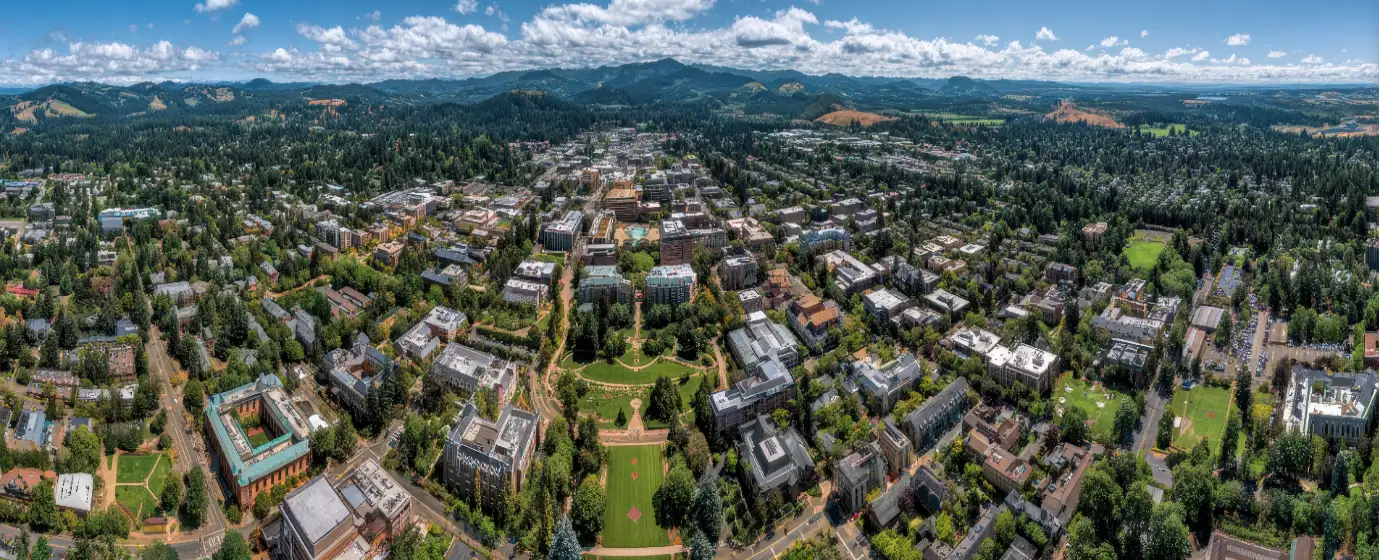
Willamette Valley · Oregon
Corvallis Schools & Family Life: Top Districts, Academics & Community (2026)
If you're relocating to Corvallis with kids in tow, the school question usually comes up before the house question. The Corvallis School District 509J ranks among Oregon's top ten districts — 9th out of 140 statewide by SchoolDigger's most recent ratings — and that standing is one of the primary reasons families choose this city over nearby Albany or Philomath. But a district-level ranking is a starting point, not a verdict. The gap between the district's top-performing elementary schools and its lower-performing ones is real, and knowing which side of that gap your address falls on matters a great deal.
What shapes school quality here is impossible to understand without acknowledging Oregon State University. OSU doesn't just bring research jobs to Corvallis — it brings a highly educated, academically engaged parent population that shows up at school board meetings, volunteers in classrooms, and pushes for strong academics. That culture filters all the way down to the elementary level. It also means this district punches above its weight in STEM programming, AP participation, and extracurricular depth relative to its size. The flip side is a chronic absenteeism rate that runs around 34%, a number that tells you something complicated about the socioeconomic range within a city that looks uniformly well-resourced from the outside.
This guide is designed for families who need to make a real decision — often from a thousand miles away — about where to buy or rent based in part on where their kids will spend their weekdays. You'll find honest assessments of every school level, the programs that genuinely stand out, the gaps the district hasn't fully closed, and the community life that makes Corvallis more than just a good school assignment.

| Metric | Detail |
|---|---|
| District Name | Corvallis School District 509J |
| Total Students | ~6,000 |
| Number of Schools | 13 (9 elementary, 2 middle, 2 high schools) |
| Student-to-Teacher Ratio | 20:1 |
| Licensed Teacher Rate | 100% |
| District Niche / SchoolDigger Rating | 9th in Oregon / 5-star district |
| Math Proficiency (district avg.) | ~39% (Oregon avg. ~31%) |
| Reading Proficiency (district avg.) | ~52% (Oregon avg. ~44%) |
| Free & Reduced Lunch Eligible | ~30% of students |
| Chronic Absenteeism Rate | ~34.3% |
| Open Enrollment / School Choice | Yes — ~30% attend non-boundary schools |
| District Office | 1555 SW 35th St, Corvallis |
The numbers in that table tell two different stories at once. The proficiency rates and statewide ranking tell you this is a genuinely strong district — outpacing Oregon averages in both math and reading, with all schools earning five-star district-level ratings from SchoolDigger. The absenteeism number tells you something else: roughly one in three students misses enough school to qualify as chronically absent, a figure that reflects both the challenges facing economically disadvantaged families and the broader post-pandemic attendance patterns that Oregon schools are still working through. For a family moving here from a high-performing district in California or the Pacific Northwest, the headline ranking will feel reassuring. The day-to-day reality is strong but uneven, and that unevenness is worth understanding before you close on a house.
The nine elementary schools within the Corvallis School District span a meaningful range of performance, resources, and community character — and where you land on that range is largely a function of which neighborhood you buy in.
Bessie Coleman Elementary (3838 NW Walnut Blvd) sits at the top of that range. Roughly 70% of third graders here test proficient in ELA, and the math figure runs even higher — around 77%. It consistently ranks in the top 10% of Oregon elementary schools, and families in the northwest neighborhoods actively factor it into their home search. The honest limitation is that its strength attracts significant demand, which means class sizes can run toward the upper end of the district norm.
Kathryn Jones Harrison Elementary (1825 NW 27th Street) draws families from the established northwest neighborhoods and benefits from the same engaged, academically oriented parent community that elevates Bessie Coleman. It suits families who want a smaller-school feel without sacrificing academic programming. Like Bessie Coleman, it's in a part of the city where homes carry a modest premium tied to school access.
Franklin K-8 is the district's most unusual school — and often its most sought-after. It operates without a geographic enrollment boundary, meaning any family in 509J can apply for a transfer. Franklin consistently ranks among Oregon's best K-8 programs, with strong proficiency rates across ELA, math, and science. The limitation is practical: no guaranteed seat based on your address, and popular grades can fill quickly in the spring transfer window.
Letitia Carson Elementary (2701 NW Satinwood Drive) is newer to the district's lineup and serves the growing northwest corridor near Timberhill. It suits families in the newer subdivisions west of Highway 99W who want a neighborhood school with a still-forming identity. As a newer building, it doesn't yet carry the deep community tradition of some older schools — but that also means it's less competitive for open enrollment transfers.
Adams Elementary, Lincoln Elementary, and Mountain View Elementary round out the district's offerings, all within city limits. Mountain View and Garfield Elementary are typically cited as the lower-performing schools in the district — not failing, but operating with higher proportions of economically disadvantaged students and lower proficiency averages than their northwest counterparts. Garfield Elementary serves a more economically diverse student body near the southern neighborhoods, and families who prioritize diversity alongside academics may find its community character appealing for reasons the proficiency numbers don't fully capture.
College Hill (510 NW 31st St) operates as an alternative K-8 program within the district. It draws families who want a different pedagogical approach — more project-based, less traditional — and functions almost like a district-within-a-district. It suits families who feel the standard curriculum doesn't fit their kid's learning style. The limitation is that its alternative structure means it isn't the right fit for every student, and social dynamics can be different from a conventional neighborhood school.
The transition to middle school in Corvallis means landing in one of two buildings: Linus Pauling Middle School (1111 NW Cleveland Avenue) or Cheldelin Middle School in northwest Corvallis. Your feeder path generally depends on your elementary school, with Cheldelin serving the northwest neighborhoods that eventually send students to Crescent Valley High School, and Linus Pauling feeding into Corvallis High School. Both middle schools offer core instruction alongside electives including art, band, and orchestra — and the band programs, in particular, have a strong enough reputation that parents with musically inclined kids specifically mention it as a reason to appreciate the district. School hours run 9:15 to 3:40 Monday through Thursday, with early release Fridays at 2:40 PM.
At the high school level, the district's two schools share a conference but have distinct personalities worth understanding before you assume they're interchangeable.
Corvallis High School (the Spartans, OSAA 5A) has been serving the city since 1910, and the current building — which opened in 2005 facing Buchanan Street — sits between downtown and Oregon State University. It enrolls about 1,255 students, with an AP participation rate of roughly 55%. That figure is one of the strongest in the 5A classification and reflects the district's academic ambitions. The Concert Choir has won state championships, Team 997 Spartan Robotics competes in FIRST Robotics nationally, and the school newspaper The High-O-Scope has been running since 1920. What the numbers can't tell you is that CHS rewards self-motivated students who take initiative on AP coursework, extracurriculars, and dual enrollment at OSU. Students who need more structure or smaller settings sometimes find the 1,200-student environment harder to navigate. Standardized test proficiency at the 11th grade level runs around 52% in ELA, 22% in math, and 30% in science — solid for the state, but not the numbers families moving from highly resourced districts in California or Washington should assume as a given.
Crescent Valley High School (the Raiders, OSAA 5A-3 Mid-Willamette Conference) opened in 1971 at 4444 NW Highland Drive and has historically been considered the slightly more suburban, community-oriented counterpart to CHS. Both compete in the same Mid-Willamette Conference, both are 5A classification schools, and both carry comparable graduation rates — typically reported in the low-to-mid 90% range for recent cohorts, with the district consistently outpacing Oregon's statewide average. Crescent Valley suits students who want strong academics with a somewhat tighter-knit campus culture. The athletic facilities and competitive programs at both high schools reflect the per-student spending of approximately $21,700, which is well above what most Oregon districts operate with.

Looking to buy in Corvallis? Estimate your payment.
Enter your numbers to see an estimated monthly mortgage payment.
Estimate only. Excludes HOA fees and mortgage insurance.
The most common thing parents say after their first year in Corvallis schools is that the quality depends more on which school you're in than what the district average suggests. Families who land at Bessie Coleman or Franklin tend to feel they made a great choice; families who expected every school to reflect the top-line ranking sometimes experience a more complicated reality. The open enrollment system exists precisely because the district acknowledges this variation — and using it strategically is something savvy Corvallis parents do routinely.
The OSU effect is real and tangible in the classroom. Volunteer rates are high, parent-teacher organizations are well-funded, and the academic culture in the stronger schools reflects a community where higher education is the default expectation rather than the exception. For families moving from high-performing districts in California or the Bay Area, the transition often feels seamless at the elementary level — and occasionally more adjustment is needed at the high school level, where test proficiency in math lags behind what those families were used to seeing.
What surprises most families after six months is the Friday early-release schedule, which runs across every grade level. Primary students get out at 1:30 PM on Fridays; middle schoolers at 2:40 PM. It's a district-wide professional development structure, but it creates a recurring childcare puzzle that families don't fully appreciate until it's a standing weekly logistics problem.
Corvallis School District is genuinely strong — but it has real gaps, and families with specific needs should understand them before assuming the district ranking answers their question.
Gifted and highly capable learners will find limited formal programming. There is no district-wide gifted and talented program with pull-out instruction or accelerated cohorts. Access to advanced coursework is largely self-directed, occurring through AP classes at the high school level and individual teacher differentiation at the elementary level. Families coming from districts with dedicated G/T programs may find this the most significant adjustment.
International Baccalaureate is not offered in the district. Families seeking a full IB diploma program will need to look at Salem or Eugene, where some high schools carry the designation.
Students who need intensive special education support will find the district offers services under federal IDEA requirements, but the depth of specialized programming varies. Families with children requiring specific therapeutic approaches or highly specialized learning environments may find the resources stretched relative to larger urban districts.
Competitive athletics at the 5A level means the talent pool is solid but not the deepest in the state. Families relocating with student-athletes hoping to play in front of college scouts should understand that 5A is a competitive but not top-tier classification in Oregon. The 6A schools in the Portland metro and Eugene area consistently produce more division-one signees.
Arts-focused students will find music programming strong — particularly band and choir — but the visual arts and theater programs are more modest compared to larger suburban districts. Families whose kids are serious about visual arts or dance at a pre-professional level may find Eugene's South Eugene High School or schools in the Portland area offer more resources.
| School | Type | Grades | Notes |
|---|---|---|---|
| Cascade Christian School | Private Christian | K–12 | Faith-based curriculum, smaller enrollment |
| Trinity Lutheran School | Private Lutheran | PreK–8 | Strong community values emphasis |
| Muddy Creek Charter School | Public Charter | K–8 | Place-based, agricultural learning; rural location (Bellfountain Rd) |
| Corvallis Montessori School | Private Montessori | PreK–6 | Authentic AMI-aligned program |
For preschool and childcare, Corvallis is reasonably well-served compared to its size, largely because OSU's presence drives demand for quality early childhood options and attracts educators with advanced degrees in child development. The OSU Child Development Lab operates a campus preschool that occasionally has openings for non-OSU-affiliated families, though priority placement goes to university community members. Corvallis Community Playschool is a cooperative preschool model that's been operating in the city for decades and suits families who want to be actively involved in their child's early learning environment. Infant and toddler care is tighter — the city has a waitlist culture for the most reputable centers, and families relocating should begin the childcare search the moment their move date is confirmed, not after closing.
The school day is only part of what shapes a child's experience growing up in Corvallis. The Corvallis-Benton County Public Library system offers strong youth programming, including summer reading challenges, STEM workshops, and story times that have genuine community followings. The main library on NW Monroe Avenue is a place families actually use, not just visit once.
Osborn Aquatic Center is a community institution. Swim lessons book out within hours of opening each session, and the facility hosts competitive youth swim programs alongside casual open swim. It's one of those places that shows up in almost every conversation with parents about where kids spend time outside school.
The Corvallis Farmers Market runs downtown on Saturdays from April through November and Wednesday afternoons through the summer — it's a genuine family gathering point, not just a grocery alternative. The Corvallis Fall Festival in Central Park has been a community staple for decades, drawing families for arts, music, and food in a setting that feels very much like the city's version of itself.
For organized youth programming beyond school sports, the Corvallis Parks and Recreation Department runs seasonal leagues and classes out of multiple facilities, and Bald Hill Natural Area and Chip Ross Park give families with active kids real trail systems — not just groomed paths — within city limits. OSU's Peavy Arboretum north of campus is a surprisingly underused gem for families who want nature education without driving far.

Local Expert Takeaway: If you're buying with school access as a primary driver, focus your home search on the northwest quadrant — specifically properties in the Bessie Coleman or Kathryn Jones Harrison boundary zones that also feed into Cheldelin Middle School and Crescent Valley High. That corridor has shown the most consistent price stability among school-driven buyers over the past two years. If Franklin K-8 is your target, don't limit your search geographically — the open enrollment structure means your address is secondary to your ability to submit a transfer request early in the spring window. Regardless of where you buy, call the district at (541) 757-5811 before removing contingencies to verify current enrollment capacity at your preferred school.
Are Corvallis schools good for families moving from out of state?
Yes, with some calibration. The district ranks among the top ten in Oregon, outpaces state averages in both reading and math, and benefits from a deeply engaged academic community shaped by Oregon State University. Families moving from the Pacific Northwest or California's top-performing districts will find the academics strong at the elementary level, particularly in the northwest neighborhoods.
What is the graduation rate at Corvallis high schools?
Both Corvallis High School and Crescent Valley High School typically report graduation rates in the low-to-mid 90% range, comfortably above Oregon's statewide average. Both compete in the OSAA 5A Mid-Willamette Conference, and the district's per-student spending — among the higher figures in Oregon at roughly $21,700 — supports a range of AP, arts, and STEM programming that most 5A schools don't match.
How does Corvallis compare to Albany schools for families choosing between the two cities?
Corvallis School District consistently outperforms Greater Albany Public Schools on statewide rankings, proficiency rates, and per-student spending. Families who prioritize academic programming, AP access, and a college-preparatory culture will generally find Corvallis the stronger choice — which is also reflected in the home prices, with the Corvallis median sitting at $547,000 compared to Albany's notably lower entry point. The trade-off is straightforward: Albany offers more affordable housing, and Corvallis offers a measurably stronger school district.
Explore the full Corvallis series: The Ultimate Corvallis Relocation Guide · Is Corvallis Safe? · Cost of Living in Corvallis · Best Neighborhoods in Corvallis · Corvallis Schools & Family Life · Corvallis Youth Sports · Corvallis Parks & Recreation · Retiring in Corvallis · 1031 Tax-Deferred Exchange in Corvallis · Corvallis First-Time Homebuyers Guide · · Moving to Corvallis from California
Tell us what you need help with and we'll connect you with local resources.

About the Author
Todd Davidson is the founder of Living in Oregon and Living in Washington, where he publishes in-depth city guides, neighborhood resources, and local market insights covering more than 180 communities across the Pacific Northwest. While his background is in home financing and real estate, he created these digital platforms to help families research and compare regions before making a move.