Oregon Coast · Oregon
Cost of Living in Florence: Housing, Taxes, Utilities & Lifestyle (2026)
Florence catches people off guard. Most coastal Oregon towns either price out serious buyers with resort-market premiums or feel economically hollowed out. Florence sits in a surprising middle ground — a working small city with a median sold price around $460,000, meaningful employer diversity anchored by PeaceHealth Peace Harbor Medical Center and Three Rivers Casino Resort, and a cost structure that actually works on a $53,000 household income if you approach it strategically.
What shapes the cost picture here is geography as much as economics. Florence is a 60-minute drive from Eugene across a winding mountain pass, which means the city doesn't function as a bedroom community the way coastal towns closer to Portland do. Prices aren't inflated by tech-worker commuter demand. Instead, they're shaped by retirees buying their forever home, second-home buyers from the Willamette Valley, and a local workforce that earns modestly and spends locally.
This guide breaks down exactly what it costs to live in Florence in 2026 — what the median price actually buys you, how taxes and utilities compare to neighboring coastal cities, what renters pay, and what a realistic monthly budget looks like across different income levels. If you're deciding whether Florence fits your financial picture, this is the number-by-number answer.
The median sold price in Florence sits at approximately $460,000, with the most current 90-day sold data for ZIP 97439 running closer to $488,000 as of spring 2026. That gap matters: full-year 2025 RMLS data across 386 transactions landed at $425,000, which reflects the softer end of the market, while recent sales are trending modestly higher. Buyers should budget toward the $460,000–$488,000 range and understand that the market has slowed — homes are spending a median of roughly 83 days listed before going under contract, which gives you more negotiating room than buyers had in 2022 or 2023.
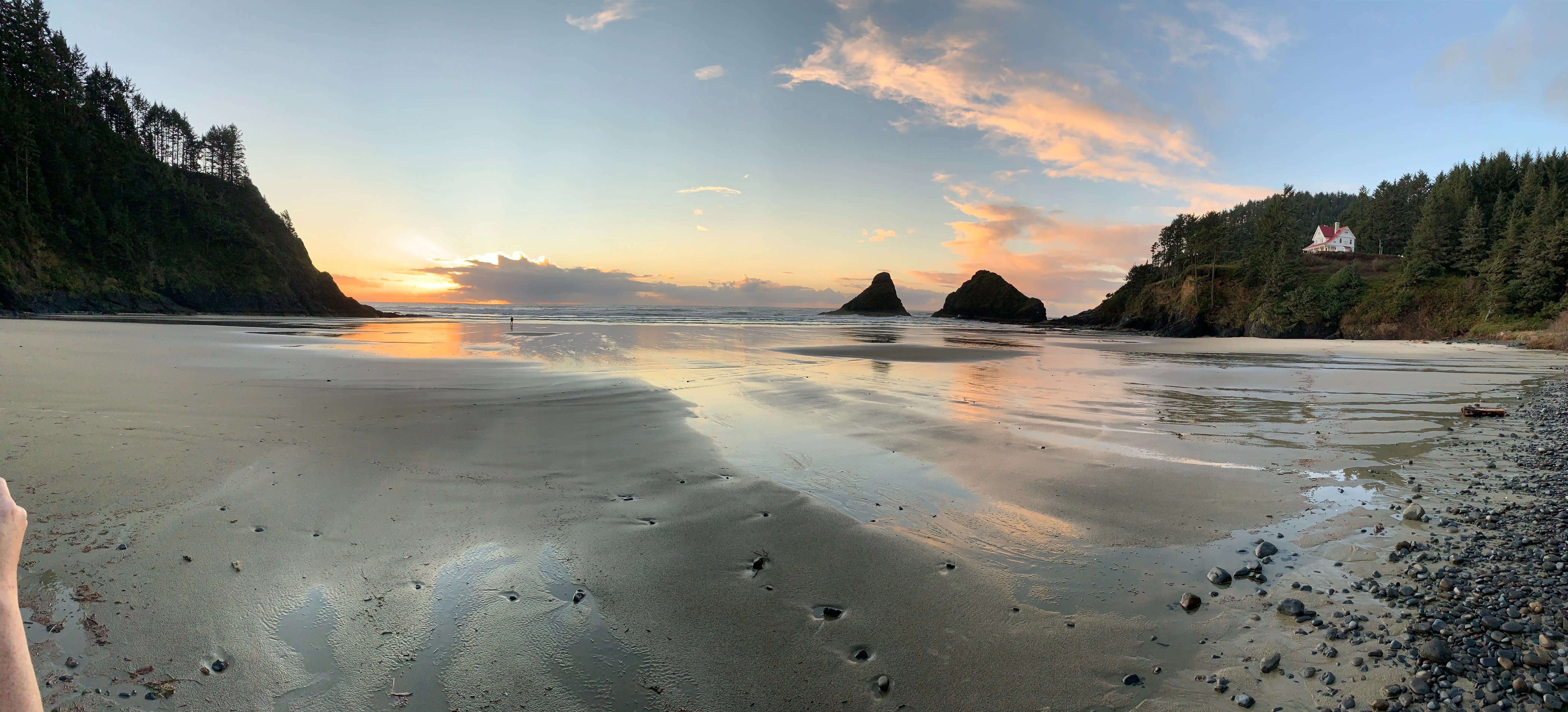
At $460,000, you're typically looking at a 3-bedroom, 2-bath home in the range of 1,400–1,700 square feet — likely built in the 1990s or early 2000s, on a standard residential lot, with a single-car garage and no ocean views. The city's median price per square foot runs around $300. Entry-level buyers can find manufactured homes in communities like Greentrees Village starting around $271,000, while the upper end of the market stretches to custom oceanfront builds on Heceta Beach where the median sits at $625,000 and average sale prices have recently reached $651,000.
The Florence housing market does not have the sharp luxury-vs-starter divide you see in premium Oregon coastal towns. The range from Greentrees Village to Heceta Beach represents the full spectrum, and most of the action clusters in the $375,000–$540,000 corridor. New construction is limited but present, primarily in communities like The Reserve at Heceta Lake, where lots and custom builds are pushing $550,000 to $750,000-plus.
| Budget | What You Get |
|---|---|
| Under $300,000 | Manufactured home in Greentrees Village or Glenada; older mobile on leased land in some cases |
| $350,000–$450,000 | Older SFR in Florence West, Three Mile Prairie, or South Florence; solid condition but likely dated finishes |
| $450,000–$600,000 | Updated 3BR/2BA SFR citywide; entry into Heceta South or Bayshore; select condos at Driftwood Shores and Heceta Beach |
| $600,000+ | Oceanfront or lakefront custom builds; Heceta Beach ramblers and A-frames; premium properties at Woahink Lake |
Lane County levies an effective property tax rate of approximately 0.67% on assessed value — one of the lowest rates among Oregon's larger counties, and a figure that shapes the monthly math significantly for Florence buyers. On a $460,000 purchase, that works out to roughly $3,082 annually, or about $257 per month. Oregon's Measure 50, passed in 1997, caps annual assessed value increases at 3% regardless of what the market does, which means long-term owners often pay taxes on assessed values well below actual market value. Buyers purchasing at today's prices reset at current market assessed value, so the full $257 monthly figure is the realistic starting point for budget planning.

The $460,000 to $488,000 range you're seeing here matches what I'm quoting buyers right now, and the property tax math is worth sitting with — at roughly 0.67%, Lane County's rate is genuinely one of the lower ones on this coast, which changes the monthly payment conversation more than people expect. I've had clients budget for Heceta Beach oceanfront in the $625,000-plus range and others land comfortably in Greentrees Village starting around $271,000, and both are legitimate paths into this market.
Thirty-plus years of renovating and developing property here means I've got a good feel for where the real costs hide beyond the sale price — older homes with deferred maintenance, lots that need site work, that kind of thing. If you're weighing whether Florence's cost of living actually pencils out for your situation, I'd welcome the opportunity to run the real numbers with you, not just the median.
Florence has limited rental inventory for a city of its size, and that scarcity tends to keep rents higher than the local income picture might suggest they'd be. The city's median household income of $53,333 means many residents are rent-burdened at market-rate units. Turnover is slow — retirees and long-term residents don't move often — so finding a quality rental often requires patience and local networking as much as a Zillow search.
| Unit Type | Estimated Monthly Rent Range |
|---|---|
| Studio / 1BR apartment | $900 – $1,200 |
| 2BR apartment | $1,200 – $1,600 |
| 2BR/2BA condo (Driftwood Shores/Heceta Beach) | $1,400 – $1,800 |
| 3BR SFR (standard residential) | $1,600 – $2,100 |
| 3BR SFR (oceanfront or river view) | $2,200 – $3,200+ |
Short-term vacation rental activity absorbs a meaningful share of Florence's housing stock, particularly in Old Town-adjacent properties and Heceta Beach. This compresses the long-term rental supply even further. Prospective renters will find the best conventional inventory in Florence West and South Florence neighborhoods, where standard residential streets haven't been converted to Airbnb operations at the same rate as more scenic corridors.
Florence residents are served by Pacific Power for electricity, which sources a significant portion of its supply from renewable generation across the Pacific Northwest grid. Monthly utility bills for a standard 3-bedroom home typically run $150–$220 for electricity depending on season, with coast temperatures moderating the extremes — summers rarely demand heavy air conditioning, and winters are mild enough that heating loads stay manageable. The city has no natural gas distribution in most residential areas, making electric heat the default for most homes. Water and sewer through the City of Florence adds roughly $80–$120 monthly for a typical single-family household.
Car dependency is the defining daily expense reality in Florence. There is no meaningful transit infrastructure, and while Old Town is walkable within its immediate footprint, virtually every other errand requires a vehicle. Grocery options center on Fred Meyer on Highway 101, which handles most staple shopping, along with Grocery Outlet for budget buyers. Specialty groceries, Costco, and the broader retail network of Eugene require that 60-minute drive over the Coast Range on Highway 126 — a road that demands respect in winter conditions.
Gas prices on the coast typically run $0.20–$0.35 per gallon above inland Oregon averages, a pattern that holds at Florence's stations year-round. Budget an extra $40–$60 per month if you commute frequently to Eugene or make regular Costco runs. Dining out in Florence is genuinely affordable by Oregon coast standards — waterfront meals at Old Town restaurants run $18–$28 per entree, and the casual taco stands and local diners near Highway 101 keep lunch under $15 most days. Healthcare costs carry an asterisk: PeaceHealth Peace Harbor is the only hospital within a practical distance, and for specialists or complex procedures, the 60-minute drive to Eugene's medical corridor is the reality.
💰 Oregon Coast Cost of Living Rankings
Wondering how Florence stacks up against other Oregon Coast cities on cost? Our complete rankings guide covers every coast city — home prices, monthly costs, rent, and overall affordability side by side.
See the Full Oregon Coast Cost of Living Rankings →Looking to buy in Florence? Estimate your payment.
Enter your numbers to see an estimated monthly mortgage payment.
Estimate only. Excludes HOA fees and mortgage insurance.
| City | Median Home Price | Effective Property Tax Rate | State Income Tax | Sales Tax | Ocean/Water Access |
|---|---|---|---|---|---|
| Florence, OR | ~$460,000 | 0.67% | Yes (up to 9.9%) | None | Direct |
| Yachats, OR | ~$550,000–$620,000 | ~0.75% | Yes | None | Direct |
| Reedsport, OR | ~$280,000–$320,000 | ~0.72% | Yes | None | Umpqua River/Coast |
| Newport, OR | ~$420,000–$470,000 | ~0.80% | Yes | None | Direct |
| Coos Bay, OR | ~$260,000–$310,000 | ~0.75% | Yes | None | Bay access |
| Eugene, OR | ~$430,000–$460,000 | ~1.10% | Yes | None | None (inland) |
| Mapleton, OR | ~$200,000–$300,000 | ~0.65% | Yes | None | Siuslaw River |
Florence's property tax rate is the sharpest competitive advantage in this comparison. Newport and Eugene both carry higher effective rates, and while Coos Bay and Reedsport are cheaper to buy into, they offer less employer diversity and infrastructure. Yachats is more expensive with a smaller town footprint and fewer services. For buyers weighing coastal access against total housing cost, Florence sits in a position that Reedsport and Coos Bay can't match on amenities, and that Newport and Yachats can't match on price.
The table below models a household purchasing at the $460,000 median with 10% down ($46,000), financing $414,000 at a 30-year fixed rate.
| Expense Category | Estimated Monthly Cost |
|---|---|
| Mortgage (principal + interest, ~7.0%) | $2,755 |
| Property taxes (0.67% annual rate) | $257 |
| Homeowner's insurance | $120 |
| Electricity (Pacific Power) | $175 |
| Water / sewer (City of Florence) | $100 |
| Internet (Charter/Spectrum or Starlink) | $70 |
| Groceries (1-2 person household) | $450 |
| Transportation / gas (2 vehicles) | $380 |
| Dining & entertainment | $350 |
| Healthcare (estimate, out of pocket) | $300 |
| Miscellaneous / home maintenance | $250 |
| Total Estimated Monthly | ~$5,207 |
A household at Florence's $53,333 median income brings home roughly $3,600–$3,900 monthly after federal and Oregon state income taxes — which means the median-income buyer carrying a median-priced mortgage is stretched. This is why Florence skews so heavily toward retirees and equity buyers rather than first-time buyers financing from scratch. The math works significantly better for households earning $75,000-plus, or for buyers bringing substantial equity from a prior home sale.
Oregon's income tax structure is the most significant factor in Florence's cost equation that doesn't show up in a mortgage calculator. The state levies income tax on a graduated scale reaching 9.9% on income over $125,000 for joint filers, with a middle bracket of 8.75% covering most working households. There is no sales tax in Oregon — none at the register, none on vehicles, none on groceries — which meaningfully reduces the daily cost of living compared to Washington State or California. For a household spending $3,000 per month on taxable goods and services, the sales-tax-free environment is worth roughly $250–$270 monthly compared to an 8.5–9% sales tax state.
Florence's retiree population benefits from several Oregon-specific provisions worth understanding. Social Security income is fully exempt from Oregon state income tax for most recipients, which is a meaningful advantage relative to states that partially or fully tax Social Security benefits. Oregon also offers a property tax deferral program for qualifying seniors and disabled homeowners — the state essentially defers property tax payments as a lien against the home, allowing qualifying residents to eliminate the monthly tax obligation during retirement years. The Lane County Assessor's office administers this program locally, and it's an underused financial tool for income-constrained retirees in Florence.

Local Expert Takeaway: The Florence buyer who gets the math to work is usually one of three people: a retiree with equity from a Willamette Valley or California home, a remote worker earning $75,000-plus who's eliminating a high-rent metro lease, or a local dual-income household in healthcare or hospitality. If you're coming in with 20% down and no prior equity to leverage, the monthly budget is genuinely tight at the median price — and the honest play is targeting the $375,000–$425,000 range in Florence West or Three Mile Prairie before going after the river-view and dunes-adjacent listings that push toward $500,000.
💰 Oregon Coast Cost of Living Rankings
Wondering how Florence stacks up against other Oregon Coast cities on cost? Our complete rankings guide covers every coast city — home prices, monthly costs, rent, and overall affordability side by side.
See the Full Oregon Coast Cost of Living Rankings →Is Florence, Oregon an affordable place to live?
Florence is affordable by Oregon coast standards, but it requires a realistic income or equity picture to make the math work. The $460,000 median home price combined with a $53,333 median household income creates a stretch for buyers financing from scratch — the monthly payment exceeds what most local wages comfortably support. Retirees with home equity, remote workers, and dual-income households earning above $75,000 typically find Florence genuinely livable within their budgets.
What are property taxes like in Florence?
Florence sits in Lane County with an effective property tax rate of approximately 0.67% — among the lower rates on the Oregon coast. On a $460,000 purchase, that translates to roughly $3,082 annually. Oregon's Measure 50 limits annual assessed value growth to 3%, which benefits long-term owners significantly over time.
How does Florence compare to Eugene for cost of living?
Eugene and Florence carry similar median home prices — Eugene's median has been running in the $430,000–$460,000 range — but Eugene's effective property tax rate runs closer to 1.1%, meaningfully higher than Florence's 0.67%. The major difference is income opportunity: Eugene's university, medical, and tech-adjacent employer base supports higher household incomes. Florence residents often drive to Eugene for specialty healthcare, Costco, and services not available locally, adding transportation costs that Eugene residents don't face.
Explore the full Florence series: The Ultimate Florence Relocation Guide · Is Florence Safe? · Cost of Living in Florence · Best Neighborhoods in Florence · Florence Schools & Family Life · Florence Youth Sports · Florence Parks & Recreation · Retiring in Florence · 1031 Tax-Deferred Exchange in Florence · Florence First-Time Homebuyers Guide · · Moving to Florence from California · Florence Realtor's Perspective · Top 10 Questions a Realtor Gets About Florence
Tell us what you need help with and we'll connect you with local resources.

About the Author
Todd Davidson is the founder of Living in Oregon and Living in Washington, where he publishes in-depth city guides, neighborhood resources, and local market insights covering more than 180 communities across the Pacific Northwest. While his background is in home financing and real estate, he created these digital platforms to help families research and compare regions before making a move.