Oregon Coast · Oregon
Moving to Florence from California: The Honest Comparison (2026)
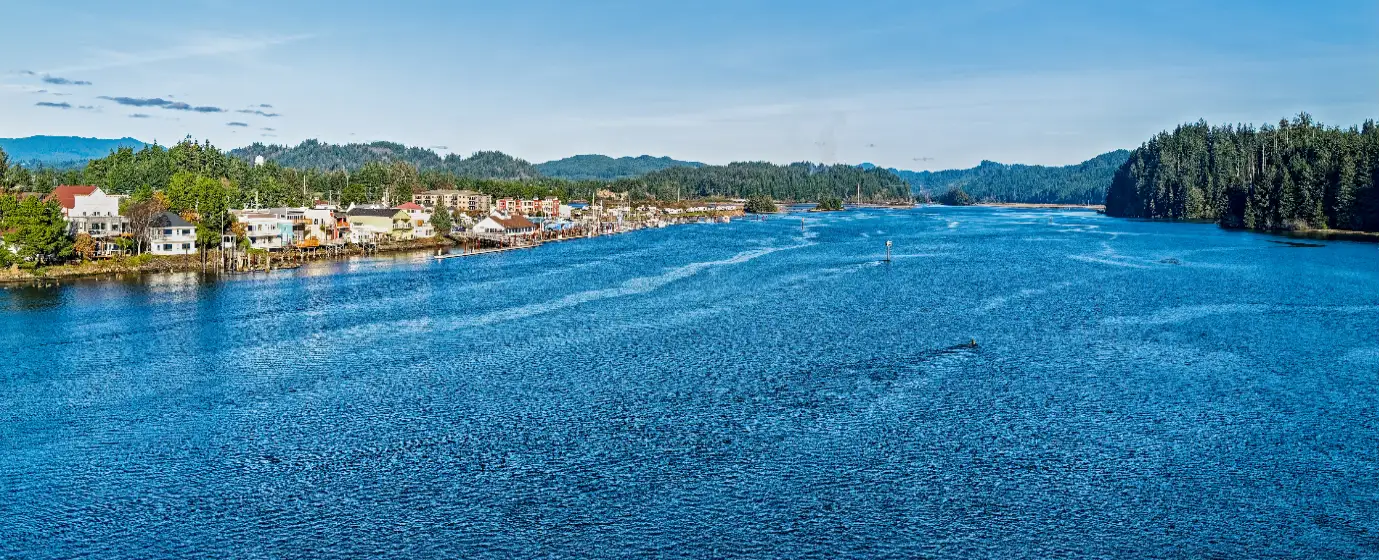
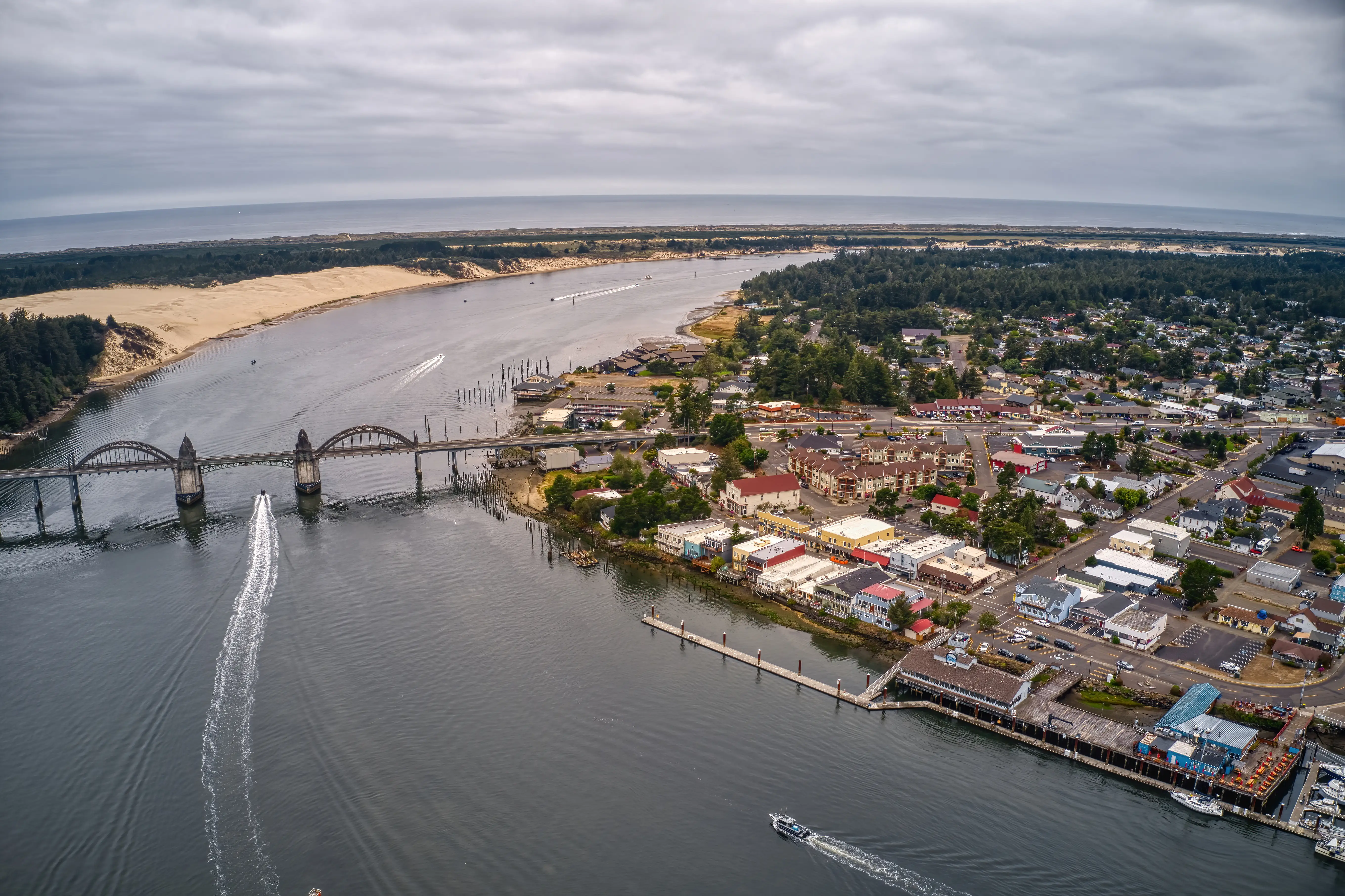
The remote work revolution handed a lot of California households an unexpected gift: the ability to choose where they live based on what they actually want instead of where the office is. For a certain subset of that group — the Bay Area software engineer tired of a 900-square-foot condo, the San Diego couple watching their summer utility bills climb toward $400, the Sacramento family whose townhome has appreciated enough to buy something genuinely different — Florence, Oregon has quietly become one of the most compelling targets in the Pacific Northwest. It offers something rare on the Oregon Coast: a real town with a real downtown, a functioning medical center, a working harbor, and one of the most dramatic natural backdrops on the continent, all for a median sold price that Bay Area buyers sometimes mistake for a typo.
The hard part is that Florence is genuinely not California. The winters here are not wet in the way Oregonians who grew up inland describe wet — they are coastal-wet, meaning December brings roughly 14 inches of rain over 23 rainy days, with skies that stay gray for stretches that can last weeks. Florence logs roughly 157 sunny days per year compared to 284 in Los Angeles and 266 in San Diego. The town's pace is unhurried in a way that some transplants love immediately and others find quietly disorienting. The restaurant scene is limited. The nearest urban center with full urban amenities is Eugene, 60 minutes east through the Coast Range. None of this is disqualifying — but discovering it six months after moving is very different from understanding it before you make an offer.
This guide walks through the full picture: how Florence's costs stack up against your specific California region, what your home equity actually buys here, the true tax comparison between Oregon and California, the lifestyle realities that travel guides skip, and an interactive tool to compare your exact California city to Florence side by side.
| Florence, Oregon | Bay Area | Southern CA | Sacramento Metro | Central Valley | |
|---|---|---|---|---|---|
| Median Home Price (approx. 2026) | $460,000 | $1.3M–$1.8M+ | $750K–$1.1M | $520K–$620K | $350K–$450K |
| Property Tax Rate (effective) | ~0.67% | ~1.1–1.2% | ~1.1–1.25% | ~1.1–1.2% | ~1.0–1.15% |
| State Income Tax (top bracket) | 9.9% | 13.3% | 13.3% | 13.3% | 13.3% |
| State Sales Tax | 0% | 8.625–10.75% | 7.25–10.5% | 8.75–9.0% | 7.25–8.75% |
| Avg Utilities (monthly est.) | ~$95–$110 | ~$200–$280 | ~$180–$250 | ~$160–$220 | ~$150–$200 |
| Avg 1BR Rent | ~$1,200–$1,500 | ~$2,800–$4,200 | ~$2,100–$3,200 | ~$1,600–$2,100 | ~$1,100–$1,500 |
A Bay Area buyer selling a $1.4 million home and purchasing in Florence at $460,000 is not just reducing their mortgage — in many scenarios, they are eliminating it entirely and pocketing the difference. The property tax comparison alone is significant: on a $460,000 Florence home at 0.67%, the annual bill runs approximately $3,082. That same $460,000 assessed value in San Jose or Fremont would carry a tax bill closer to $5,000–$5,500 annually under California's effective rates, and Bay Area buyers typically aren't buying at $460,000 — they're buying at multiples of that.
The zero sales tax reality compounds over time in ways that don't make headlines but show up consistently in household budgets. A family spending $60,000 annually on taxable goods and services in a California county with a 9.5% combined rate is paying roughly $5,700 per year in sales tax that simply disappears in Oregon. Over a decade, that's meaningful money — and it's recurring, unlike a one-time equity gain.

The property tax comparison in the table above understates it if anything — a Bay Area buyer moving equity from a $1.3 million-plus home into Florence's $460,000 median isn't just cutting their mortgage, in a lot of cases they're eliminating it and banking the difference. I work with California buyers on this exact math regularly, and the zero sales tax and lower effective property tax rate compound in ways that don't show up until you've lived here a year or two.
I lived on Molokai, Hawaii before settling on the Oregon Coast, so I understand what it's like to leave a place you know for somewhere entirely different, financially and otherwise. If you're weighing a move from California to Florence, I'd welcome the opportunity to share what that kind of transition actually feels like once the moving trucks are gone, not just the tax savings on paper.
One of the most common misconceptions California transplants carry north is that moving to Oregon means escaping state income tax. It does not. Oregon has a graduated income tax that tops out at 9.9% on income over $125,000 for individuals — structurally similar to California's, though the top bracket in California reaches 13.3%, which applies to income over $1 million. For most working-age transplants, the income tax difference between the two states is meaningful but not dramatic. Where the math shifts significantly is for retirees on fixed incomes and for households whose primary wealth is in home equity rather than earned income.
| Tax Item | California | Oregon | Net Impact |
|---|---|---|---|
| Top State Income Tax Rate | 13.3% | 9.9% | Oregon saves ~3.4 pts at top bracket |
| State Sales Tax | 7.25–10.75% | 0% | Oregon saves $3,000–$6,000+/yr for avg. household |
| Effective Property Tax Rate | ~1.1–1.25% | ~0.67% | Oregon significantly lower |
| Assessed Value Cap | Prop. 13 (2% cap) | Measure 50 (3% cap) | Similar long-term protection |
| Senior Property Tax Deferral | Yes (65+, income limits) | Yes (62+, income limits) | Both states offer relief |
| Capital Gains Tax | Up to 13.3% (state) | Up to 9.9% (state) | Oregon slightly lower |
For a household earning $150,000 in Oregon, the state income tax bill runs approximately $10,500–$11,500 depending on deductions and filing status. That same income in California generates a state tax bill closer to $13,500–$14,500. The net annual savings is real — roughly $2,000–$3,000 per year for a typical earner at that income level — but it's the combination of income tax savings, zero sales tax, and dramatically lower property taxes that makes the Oregon move compelling, not any single line item.
Measure 50, Oregon's property tax limitation, deserves specific attention for long-term planning. Once you purchase a home, the assessed value used for tax purposes can increase no more than 3% per year regardless of market appreciation. A Florence buyer who purchases at $460,000 today and watches their home appreciate to $700,000 over a decade still pays taxes on an assessed value that grows at 3% annually — a meaningful hedge against rising property values that works similarly to California's Proposition 13 structure.
A buyer leaving a San Francisco condo or a Walnut Creek single-family home with $1.4 million in equity arrives in Florence with the ability to purchase outright — cash, no mortgage, no rate conversation — and still have money left over. The top tier of Florence's market sits in the $600,000–$850,000 range, represented by properties on Woahink Lake, larger lots near Heceta South, or beachfront-adjacent homes at Driftwood Shores. Buying at that level with Bay Area equity means a paid-off home plus a substantial reserve that many buyers deploy into a rental property, home improvements, or retirement savings.
The practical implication is that Bay Area buyers are often the most competitive offers in Florence — not because they're overbidding, but because cash offers in a market where most local buyers are financing shift the dynamic entirely. Sellers move faster, contingencies drop, and closing timelines compress. If you're arriving from Palo Alto, Marin, or the East Bay with a recent sale in escrow, you are entering Florence as one of the strongest buyer profiles in the market, full stop.
A buyer selling a Thousand Oaks or Carlsbad home with $900,000 in equity can purchase at Florence's median with a substantial down payment — likely 50–80% — and carry a mortgage payment that bears no resemblance to what they left behind. At $460,000 with $350,000 down, the monthly principal and interest on a 30-year conventional loan runs well under $1,500 at most rate scenarios — a figure that Southern California buyers find almost disorienting.
At this equity level, buyers frequently explore the Reserve at Heceta Lake or properties along Bayshore with water views, where the market sits in the $500,000–$700,000 range. The combination of reduced housing cost and eliminated California sales tax creates a monthly budget that many SoCal transplants describe, after a year in Florence, as feeling "loose" in a way their California life never did — even when they were earning more.
Sacramento buyers don't arrive with Bay Area surpluses, but the move still makes structural sense. A Roseville or Elk Grove family with $500,000 in equity from a home that's appreciated steadily over the past decade can reach Florence's median price range comfortably, often purchasing in South Florence or Florence West where the market delivers more square footage and lot size per dollar than anywhere on the California coast.
What makes this buyer profile particularly interesting is the ongoing tax relief. Sacramento County's effective property tax rate runs approximately 1.1–1.2%, meaning a $460,000 Sacramento purchase would carry a tax bill roughly $2,000 per year higher than the same purchase in Florence. Add the sales tax elimination and a modest income tax reduction, and the Inland Empire or Sacramento buyer who breaks even on equity often gains meaningfully on annual cash flow — which is the point of the move for many households with school-age children or one spouse transitioning out of the workforce.
This is the tightest scenario — buyers leaving Fresno, Bakersfield, or Stockton with modest equity gains. The relative advantage is real but requires more precision. A buyer with $350,000 in equity arriving in Florence at the $460,000 median puts approximately 75% down, which drops monthly carrying costs dramatically even without eliminating the mortgage. The more compelling case at this equity level is often the property type: that same budget in Fresno buys a modest suburban home; in Florence, it can reach neighborhoods like Rhodo View Dunes or Glenada where the setting — coastal access, mature trees, proximity to the Oregon Dunes — would be impossible to replicate at any price in the Central Valley.
Looking to buy in Florence? Estimate your payment.
Enter your numbers to see an estimated monthly mortgage payment.
Estimate only. Excludes HOA fees and mortgage insurance.
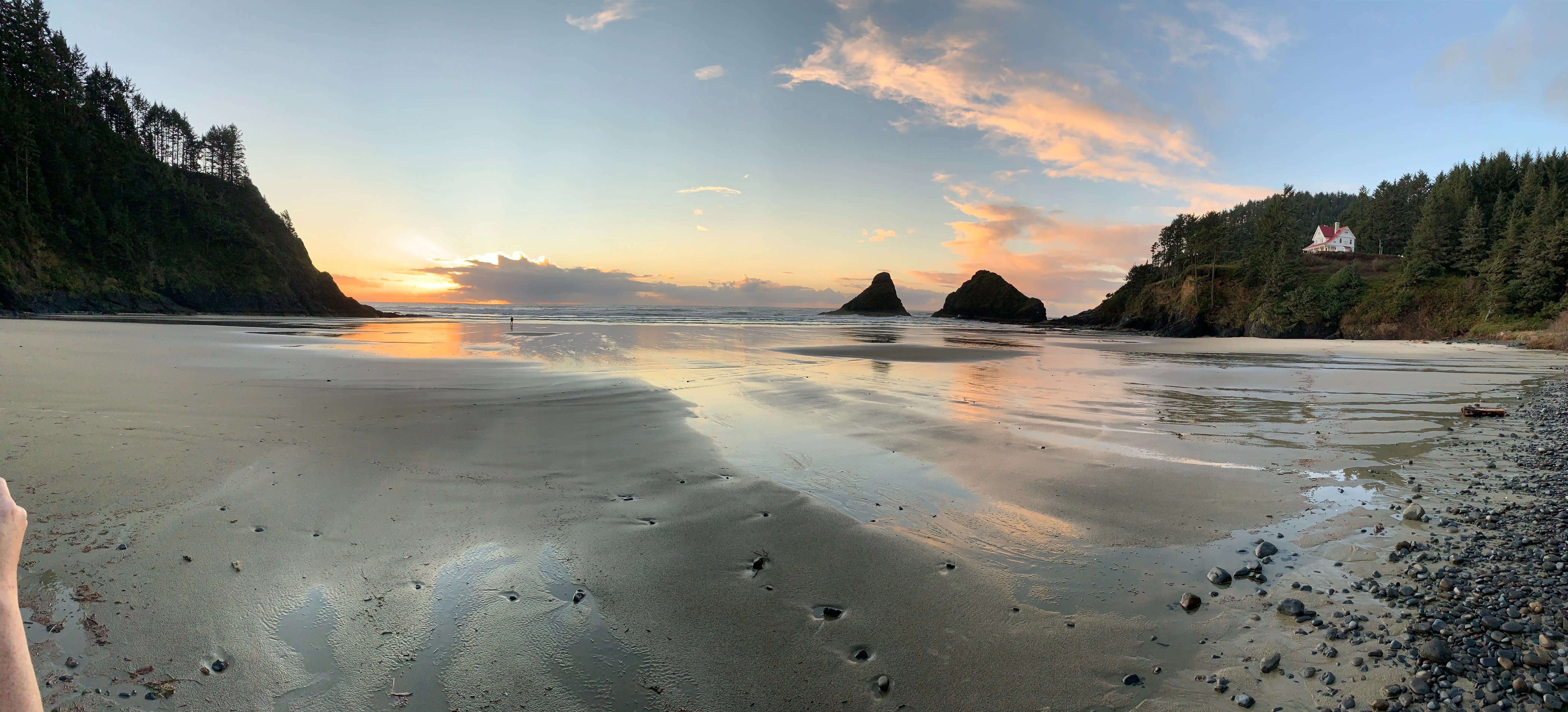
Here is what a friend who moved from San Jose to Florence three years ago would actually tell you: the summers are genuinely magical and unlike anything on the California coast. July and August in Florence mean highs in the upper 60s, virtually no rain, no heat waves, no wildfire smoke rolling in from inland fires, and a kind of light that photographers drive from Portland to capture. The beaches are uncrowded. The pace drops to something that feels pre-pandemic in a way that isn't nostalgic — it's just real. If you moved to Florence for the summers, you would not regret it.
The winters are a different conversation. Florence receives roughly 128 rainy days annually and logs only about 157 sunny days per year — compared to 284 in Los Angeles and 266 in San Diego. December averages around 14 inches of rain over 23 wet days, and gray stretches of two or three weeks are common from November through March. This is not the romantic drizzle of a Pacific Northwest tourism brochure. It is persistent, flat, dark sky punctuated by spectacular storms and occasional breaks. Californians who love dramatic weather — the kind of person who actually goes to the beach in January to watch 20-foot swells hit the headlands at Heceta Head — adjust well and sometimes fall deeply in love with Oregon winters. Californians who tolerate rain but assumed it wouldn't be that different from San Francisco's 71 rainy days per year often find the first winter genuinely hard.
What transplants consistently report loving after a full year in Florence: the traffic relief is immediate and total. The commute within town takes minutes. The absence of the social performance that defines certain California cities — the restaurant-as-status game, the constant upward comparison — disappears. The food scene in Old Town has improved meaningfully over the past few years, though it is not Portland, not San Francisco, and not trying to be. Outdoor culture here is genuine and accessible rather than aspirational. Sea Lion Caves, the Oregon Dunes, Heceta Head Lighthouse, and Jessie M. Honeyman Memorial State Park are not things residents drive to on weekends occasionally — they are the texture of daily life. What most transplants miss: year-round outdoor dining, consistent sunshine for backyard entertaining, the density of restaurant options they previously took for granted, and proximity to major airports.
If you want to see how Florence compares directly to the city you're leaving, use the tool below — it covers the 120 largest California cities with current housing and tax data.
Home prices: Redfin median sale data, Q1–Q2 2026. Select your city to compare.
Ready to talk through what your specific California equity could do in Florence? Todd can model your exact scenario in a single call.
Assuming Florence functions like a scaled-down California coastal town. Carmel, Santa Cruz, and Laguna Beach are tourist-destination coastal cities with dense commercial infrastructure, year-round culinary scenes, and easy freeway access to major metros. Florence is a working-class coastal town with genuine character that happens to have some exceptional restaurants and a well-loved historic downtown — but the infrastructure comparison doesn't hold. Buyers who arrive expecting California coastal density in a smaller package tend to find the limited retail and restaurant options frustrating in the first year. Buyers who arrive expecting something genuinely different and more rural tend to find it exactly that.
Underestimating the Eugene relationship. Florence is 60 minutes from Eugene through the Coast Range on Highway 126, and that route is beautiful in summer and fully manageable in winter — but it is not a commute anyone does casually twice a day. Californians who relocate to Florence while maintaining any kind of regular in-person obligation in Eugene or beyond need to treat that drive as a real logistical factor, not a scenic backdrop. Highway 126 is a two-lane mountain highway. It has weather. It has logging trucks. Buyers who underestimate this frequently find themselves making choices in year two about whether to stay coastal or move closer to Eugene.
Skipping radon testing. Oregon has elevated radon zones, and Lane County — which includes Florence — sees enough positive radon tests that skipping this inspection is a meaningful oversight. California buyers aren't trained to think about radon because California's geology and ventilation patterns result in lower prevalence. In Florence, where homes are often built on soils that can concentrate radon, the test is inexpensive and the mitigation, where needed, is straightforward. Do not skip it.
Misreading the market as uniformly slow. Florence's overall days-on-market average of around 82 days creates a false sense that buyers have time to deliberate. The specific homes that California buyers want — turnkey, well-located, with views or water proximity — often move in 30–45 days, sometimes faster if they're priced correctly. Remote buyers who take a few weeks to schedule a visit after a listing goes live frequently arrive to find the property under contract. The practical solution is pre-approval before you start browsing, and a local agent who can do a video walkthrough on short notice.
Bay Area sellers arriving with large equity positions frequently have the option to purchase all-cash or at very low loan-to-value ratios — and in Florence's price range, that's a powerful position. All-cash offers in a market where most competing buyers are financing at 80–90% LTV can compress timelines and eliminate appraisal risk. If the California property being sold was held as an investment or rental, a 1031 exchange into a Florence property can preserve capital gains tax deferral — see the Florence 1031 Exchange guide for mechanics and timeline rules.
Southern California sellers typically enter Florence with enough equity for a substantial conventional down payment — often 40–60% — which keeps them well below any jumbo threshold at Florence's median price point. Standard conventional financing at this LTV means favorable pricing and straightforward underwriting for W-2 income earners. The main consideration is timing: bridge financing or a sale-contingent offer may be necessary if the California property hasn't closed before a Florence offer is made, which adds complexity that a local lender experienced with California transplants can help navigate cleanly.
Sacramento and Inland Empire buyers whose equity positions land in the $300,000–$400,000 range can still purchase comfortably at Florence's median, though they may want to explore if purchasing below $400,000 — certain DPA structures and rate-advantage programs are available for qualifying buyers at that price point. The equity gain from a Sacramento sale is real but tighter, which makes getting pre-approved with multiple lender scenarios before listing the California home a useful exercise rather than an optional one.

Local Expert Takeaway: The single thing most California buyers underestimate about Florence is the weather gap — not in a vague "it rains more" sense, but in the specific reality of 128 rainy days against a California baseline of 34 to 71. Buyers who visit in July or August and fall in love with Florence are making a decision based on the city's best possible version of itself. Before you commit, spend a long weekend in January or February and walk Old Town, drive Highway 126, and sit with what the light actually looks like in winter. The buyers who do that and still want to move are the ones who stay.
✅ Florence's median sold price of $460,000 represents a transformative equity conversion for most California buyers — Bay Area sellers can purchase outright in cash while SoCal and Sacramento sellers arrive with down payments that eliminate the mortgage stress they've been carrying for years.
⚠️ Oregon has a state income tax — the break from California's 13.3% top rate is real but not total. The bigger savings come from zero sales tax, significantly lower property taxes at the same purchase price, and Measure 50's 3%-per-year cap on assessed value growth.
📍 Florence's winters require honest assessment before you move. With roughly 128 rainy days and only 157 sunny days per year, the coastal climate is dramatically different from every major California metro — and buyers who underestimate this are the ones who reconsider the move after their first winter.
Is moving from California to Florence worth it?
For buyers with meaningful California equity — particularly from the Bay Area or Southern California — the financial case is strong and often immediate. A paid-off or nearly paid-off home, no state sales tax, lower property taxes, and a dramatically reduced cost of housing frees up cash that California living had been absorbing for years. The lifestyle shift is equally real: Florence is quieter, slower, and more dependent on nature for its entertainment value. Buyers who want that specific trade tend to love it. Buyers who want urban density at a lower price point generally find a better fit in Eugene or the Portland metro.
How much cheaper is housing in Florence vs. California?
Florence's median sold price sits at approximately $460,000, which represents roughly a 65–75% discount from Bay Area medians, a 40–50% discount from most Southern California coastal markets, and a 10–25% discount from the Sacramento metro depending on the specific submarket. The raw price difference is significant, but the more important number for most buyers is what their California equity covers after the sale — which frequently eliminates the mortgage entirely.
What do I need to know about moving from California to Oregon?
Three things matter most that California-specific experience won't prepare you for: Oregon's income tax is real and graduated up to 9.9% — budget for it. Oregon's coastal climate is genuinely wetter and grayer than any major California metro, particularly November through March. And Oregon's property tax system, governed by Measure 50, caps assessed value increases at 3% annually — which is a meaningful long-term financial advantage that compounds over years of ownership and protects buyers from tax bills that race ahead of their income growth.
Explore the full Florence series: The Ultimate Florence Relocation Guide · Is Florence Safe? · Cost of Living in Florence · Best Neighborhoods in Florence · Florence Schools & Family Life · Florence Youth Sports · Florence Parks & Recreation · Retiring in Florence · 1031 Tax-Deferred Exchange in Florence · Florence First-Time Homebuyers Guide · · Moving to Florence from California · Florence Realtor's Perspective · Top 10 Questions a Realtor Gets About Florence
Tell us what you need help with and we'll connect you with local resources.

About the Author
Todd Davidson is the founder of Living in Oregon and Living in Washington, where he publishes in-depth city guides, neighborhood resources, and local market insights covering more than 180 communities across the Pacific Northwest. While his background is in home financing and real estate, he created these digital platforms to help families research and compare regions before making a move.
Check Out the Oregon Coast Rankings: Oregon Coast Cost of Living — All 16 Cities Ranked · Best Places to Retire on the Oregon Coast · Best Oregon Coast Cities for Families · Best Oregon Coast Cities for Remote Workers · Oregon Coast Real Estate Market Report 2026 · Oregon Coast vs. Washington Coast