
Oregon Coast · Oregon
Cost of Living in Brookings: Housing, Taxes, Utilities & Lifestyle (2026)
The price tag on a Brookings home will surprise you — but probably not the way you expect. This isn't a cheap coastal town. The median sold price runs around $525,000 to $550,000, which places it squarely in Pacific Northwest coastal territory and well above what many inland Oregon cities charge for similar square footage. The misconception most relocating buyers carry into their search is that a town of 6,500 people on a remote stretch of Southern Oregon coast should be affordable. It's not, and understanding why changes how you approach the market.
What shapes the cost picture here is isolation as much as scenery. Brookings sits 84 miles south of Gold Beach and 27 miles north of Crescent City, California — the nearest city with a commercial airport. That distance means every commodity, every contractor, and every grocery delivery costs more to get here. The local economy runs on government jobs, healthcare, lumber, and tourism, and the housing stock reflects decades of modest construction interrupted by a wave of retirees who arrived from California with equity checks and bid up the coastal view properties. The result is a market where the entry point is surprisingly high and the upper end reaches well into the $700,000s for premium ocean-view parcels.
This guide will walk you through exactly what you're spending — on housing, property taxes, utilities, groceries, and daily life — so you can make a realistic budget before you fall in love with a harbor-view cottage on the Chetco River.
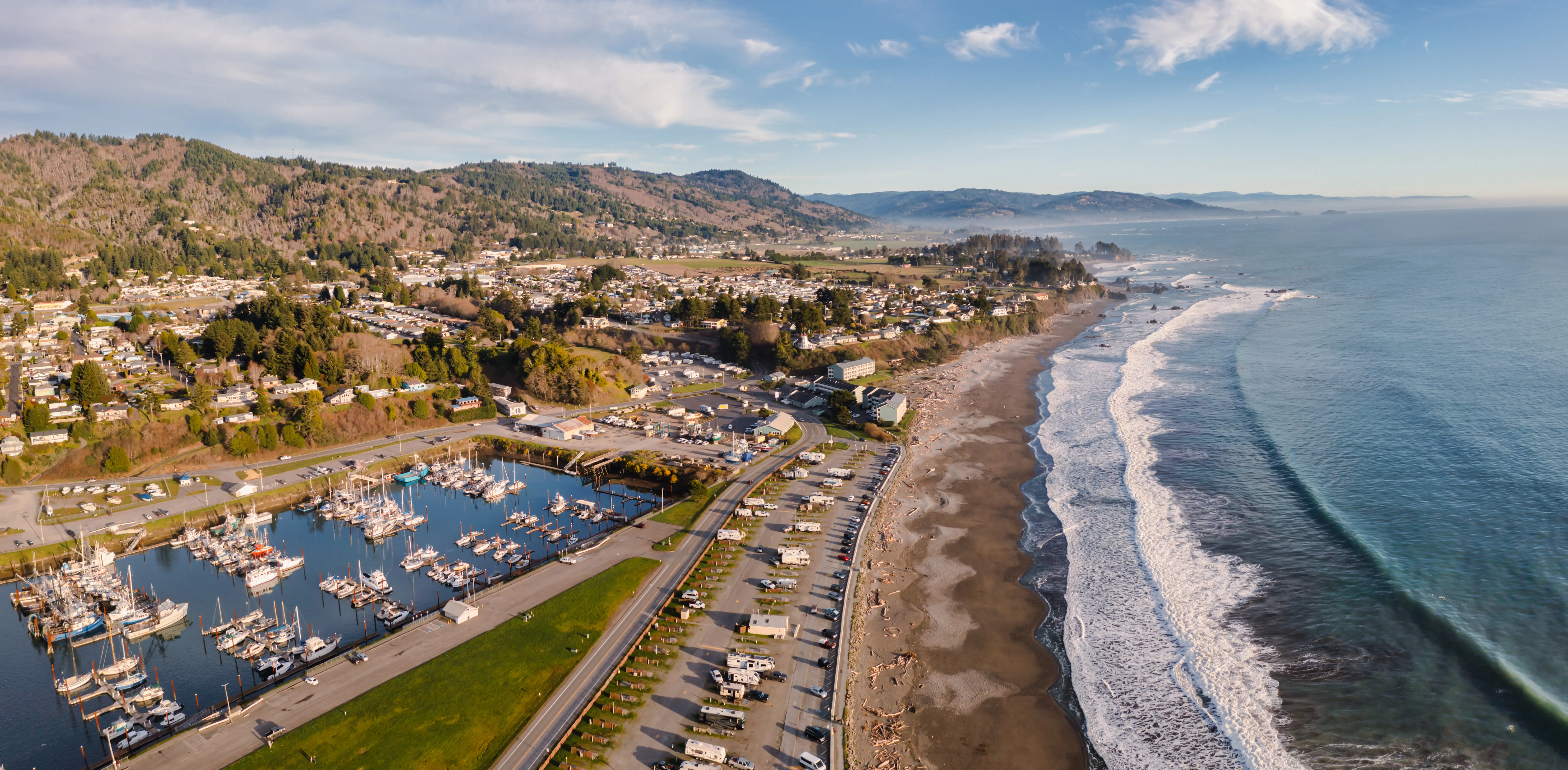
The current median sold price in Brookings lands in the $525,000 to $550,000 range based on closed transactions through early 2026. That figure buys a 3-bedroom, 2-bath home with roughly 1,400 to 1,800 square feet — likely built between the 1970s and 1990s, with updated kitchens in the better-priced examples. Homes are spending around 110 to 114 days on market, and most close about 3 to 4 percent below list price, which means patient buyers with solid financing have real negotiating room here.
The entry point into the Brookings market begins around $325,000 to $375,000 for older fixer-uppers in established neighborhoods or manufactured homes on owned land. At the other end, oceanfront and sea-cliff properties in Pacific Heights and along the Harbor Bench command $700,000 and above, with a handful of luxury listings in the mid-$500,000s that surprise buyers who expected ocean views to be priced higher. New construction in Seacrest Estates — Brookings' most active subdivision — is running $500,000 to $650,000+ for single-level modern homes with engineered hardwood, quartz countertops, and vaulted great rooms averaging around 1,600 square feet.
The market isn't moving fast. Days on market stretching past 100 days signals a buyer-friendly environment in terms of negotiating leverage, but it also signals thin inventory and limited demand — meaning resale when you eventually leave may require patience. This is not a hot flip market. It's a community where people buy to stay, and the numbers reflect that reality.
| Budget Range | What It Buys |
|---|---|
| Under $350,000 | Manufactured homes on owned land, fixer-uppers inland, older single-wides in established parks |
| $350,000–$499,000 | Entry-level 2–3BR homes in Brookings East or Central, some Harbor cottages |
| $500,000–$650,000 | Solid 3BR+ homes in Seacrest Estates, Brookings North, Azalea Park area; new construction |
| $650,000+ | Ocean-view parcels, Pacific Heights hillside homes, Harbor Bench, premium coastal lots |
Curry County's effective property tax rate sits at approximately 0.42%, which is among the lower rates in Oregon. On a home at the $525,000 median sold price, that translates to roughly $2,205 annually — or about $184 per month added to your housing cost. Oregon's Measure 50, passed in 1997, caps annual property tax growth at 3% on assessed value, which means long-time homeowners often pay taxes based on an assessed value well below current market price. New buyers get reassessed at purchase price, so don't assume the prior owner's tax bill is what you'll pay — expect the first year's bill to reflect the full 0.42% on your purchase price.

The numbers in the section above track with what I see on a weekly basis — median sold prices in the $525,000 to $550,000 range, homes sitting 110-plus days on market, and real negotiating room for patient buyers. I've spent over thirty years working renovation and investment property on this stretch of coast, and the entry-level fixer-uppers around $325,000 to $375,000 mentioned above are exactly the kind of properties I've built a career around bringing back to life.
New construction in Seacrest Estates has been one of the more interesting shifts in this market — modern single-level homes at a price point that's still accessible compared to what buyers are used to paying elsewhere on the Oregon Coast. If you're weighing whether the entry-level end or the new-construction end of this market fits your budget better, I'd welcome the opportunity to walk the numbers with you and point you toward the properties that match what you're actually trying to accomplish.
The rental market in Brookings is thin. Vacancy rates run low, turnover is slow, and the inventory that exists skews toward older single-family homes and a handful of apartment complexes near the center of town. Brookings is primarily an owner-occupant community — roughly 60% of households own their homes — which means renters are competing for a small slice of the available stock.
| Unit Type | Estimated Monthly Rent Range |
|---|---|
| Studio / 1BR apartment | $900–$1,200 |
| 2BR apartment | $1,200–$1,600 |
| 2BR house | $1,400–$1,900 |
| 3BR house | $1,700–$2,400 |
| Manufactured home rental | $700–$1,100 (lot rent + home) |
Utilities in Brookings run moderately, with the primary electrical provider being Coos-Curry Electric Cooperative — a member-owned rural co-op rather than a large investor-owned utility. Monthly electrical bills for a typical 3-bedroom home average in the range of $100 to $160 depending on season and heating setup. The mild coastal climate — Brookings famously records some of the warmest winter temperatures on the Oregon Coast — keeps heating costs lower than you'd expect for a Pacific Northwest location. Many locals joke that the "Banana Belt" nickname is half marketing and half meteorological reality, and on that front, they're not wrong.
Internet service options are more limited than urban buyers are used to. Charter Spectrum provides cable-based broadband in most of the city proper, with speeds adequate for remote work but without the fiber-optic reliability some households require. Homes in more rural areas east of town and up the Chetco River corridor may find their options reduced to fixed wireless or satellite. If remote work is part of your calculus, verify service availability at the specific address before signing.
Car ownership is not optional in Brookings. The city has no meaningful public transit, and the distances between daily errands — the Fred Meyer near the north end of town handles most grocery needs for the central city, with a Safeway serving Harbor residents — mean that a household without two reliable vehicles is genuinely inconvenienced. Gas prices on the Southern Oregon Coast typically run $0.20 to $0.40 above the state average, reflecting the transportation cost of delivery to a remote coastal region. Residents driving to Grants Pass for medical specialists, COSTCO runs, or big-box retail are looking at roughly a 90-minute drive each way through winding mountain roads — a routine Brookings residents accept as part of coastal life but one that catches newcomers off guard.
Dining out in Brookings skews casual and seafood-heavy near the harbor, with prices that land slightly below Portland levels but above what you'd find in comparable inland small towns. Fresh Dungeness crab, albacore tuna, and rockfish from the commercial docks available seasonally through local markets and the harbor fish houses make the grocery budget for seafood-loving households genuinely competitive. Where costs climb is in anything requiring specialty imports — organic produce, specialty ingredients, electronics, and furniture — because the nearest substantial shopping corridor is in Crescent City to the south or Medford to the northeast.
💰 Oregon Coast Cost of Living Rankings
Wondering how Brookings stacks up against other Oregon Coast cities on cost? Our complete rankings guide covers every coast city — home prices, monthly costs, rent, and overall affordability side by side.
See the Full Oregon Coast Cost of Living Rankings →Looking to buy in Brookings? Estimate your payment.
Enter your numbers to see an estimated monthly mortgage payment.
Estimate only. Excludes HOA fees and mortgage insurance.
| City | Median Home Price (Est.) | Property Tax Rate | Nearest Airport | Commute Feel | Key Trade-off |
|---|---|---|---|---|---|
| Brookings, OR | ~$525,000–$550,000 | 0.42% | Crescent City, CA (27 mi) | Island isolation | Ocean access, mild climate |
| Gold Beach, OR | ~$400,000–$450,000 | ~0.45% | North Bend, OR (70+ mi) | More isolated | Lower prices, fewer services |
| Crescent City, CA | ~$340,000–$380,000 | ~1.1% | On-site (Del Norte Co.) | Similar isolation | Much higher property taxes; CA income tax |
| Cave Junction, OR | ~$275,000–$325,000 | ~0.65% | Medford, OR (50 mi) | Inland rural | Affordable but no ocean access |
| Grants Pass, OR | ~$385,000–$420,000 | ~0.65% | Medford, OR (30 mi) | Mid-valley suburban | Services, employers, warmer summers |
| Medford, OR | ~$395,000–$430,000 | ~0.68% | Jackson Co. Airport (on-site) | Urban services | Full amenities, no coast |
| Harbor, OR | ~$350,000–$500,000 | ~0.42% | Crescent City, CA (27 mi) | Shares Brookings market | Technically adjacent; marina/port access |
This table reflects a household purchasing at $525,000 with 10% down ($52,500), financing $472,500 at a 30-year fixed rate of approximately 6.75%.
| Expense Category | Estimated Monthly Cost |
|---|---|
| Mortgage principal & interest | ~$3,065 |
| Property taxes (0.42% on $525K) | ~$184 |
| Homeowner's insurance | ~$120–$160 |
| Electricity (Coos-Curry Electric) | ~$110–$150 |
| Water/sewer/garbage | ~$80–$110 |
| Internet (Charter Spectrum) | ~$60–$90 |
| Groceries (household of 2–3) | ~$600–$850 |
| Gasoline (2 vehicles, local + regional) | ~$250–$350 |
| Dining out / entertainment | ~$300–$500 |
| Healthcare (out-of-pocket/copays) | ~$150–$300 |
| Estimated Monthly Total | ~$4,920–$5,710 |
Oregon charges no sales tax, which has a real daily-life impact that California transplants and Washington state movers notice immediately. That $550 piece of furniture, that $1,200 appliance purchase — there's no state sales tax added at checkout. On a household spending $30,000 annually on taxable goods, the absence of sales tax represents meaningful savings compared to California (7.25%+ base) or Washington (6.5% base plus local additions).
Oregon does levy a state income tax, with rates ranging from 4.75% to 9.9% depending on income bracket. For a household at the $74,933 median income, the effective Oregon income tax rate typically lands in the 7% to 8% range after deductions. That's worth factoring if you're comparing Brookings to Nevada or Washington state retirement destinations — but within Oregon, it's a fixed cost all residents share.
Oregon's senior property tax deferral program is worth specific mention for retirement-age buyers. Homeowners 62 and older who meet income and equity requirements can defer property taxes entirely until the property sells — with the state essentially providing a low-interest loan against future equity. For a fixed-income retiree in a $525,000 Brookings home, that program can free up roughly $2,200 per year in cash flow. Given that nearly 30% of Brookings residents are 65 or older, this program is not a footnote — it's a financial planning tool a meaningful portion of the local homeowning population has accessed or is eligible for.
Oregon also has no inheritance tax at the state level for most estates, and the state does not tax Social Security income, which matters considerably in a community where retirement income makes up a large share of household revenue. The overall tax picture for retirees choosing between Oregon and California is almost uniformly favorable to Oregon, and Brookings specifically benefits from a property tax rate that sits at the lower end of the Oregon range.
Local Expert Takeaway: The number buyers in Brookings most commonly miscalculate is the true carrying cost of coastal isolation. The mortgage payment is only part of the story — factor in bi-monthly Grants Pass supply runs at $60 to $80 in gas per trip, higher grocery prices on specialty items, and the real cost of tradespeople who charge travel premiums to service remote coastal locations. Buyers who budget $400 to $500 per month beyond their mortgage for the "coastal tax" on goods and services are consistently better prepared than those who discover it after closing.
💰 Oregon Coast Cost of Living Rankings
Wondering how Brookings stacks up against other Oregon Coast cities on cost? Our complete rankings guide covers every coast city — home prices, monthly costs, rent, and overall affordability side by side.
See the Full Oregon Coast Cost of Living Rankings →Is Brookings, Oregon an affordable place to live?
Brookings offers lower property taxes and no sales tax, which help, but the median sold price of $525,000 to $550,000 and the practical costs of coastal isolation mean it is not a cheap destination. It tends to be most affordable for households arriving with California equity, dual incomes, or retirement savings, rather than first-time buyers stretching on a single local income.
How much do property taxes cost in Brookings?
Curry County's effective rate of approximately 0.42% is one of the lower rates in Oregon. On a home purchased at the median sold price, annual taxes run roughly $2,200 — well below the national median tax bill. Oregon's Measure 50 limits annual growth to 3%, so taxes stay predictable after purchase.
How does Brookings compare to Crescent City, California for cost of living?
Crescent City offers lower home prices in the $340,000 to $380,000 range, but California's property tax rates run more than double Oregon's, and the state income tax adds a significant ongoing burden. For most working or retired households, the total annual tax savings of living in Brookings versus Crescent City more than offset the higher home purchase price over a 5- to 10-year ownership horizon.
Explore the full Brookings series: The Ultimate Brookings Relocation Guide · Is Brookings Safe? · Cost of Living in Brookings · Best Neighborhoods in Brookings · Brookings Schools & Family Life · Brookings Youth Sports · Brookings Parks & Recreation · Retiring in Brookings · 1031 Tax-Deferred Exchange in Brookings · Brookings First-Time Homebuyers Guide · · Moving to Brookings from California · Brookings Realtor's Perspective · Top 10 Questions a Realtor Gets About Brookings
Tell us what you need help with and we'll connect you with local resources.

About the Author
Todd Davidson is the founder of Living in Oregon and Living in Washington, where he publishes in-depth city guides, neighborhood resources, and local market insights covering more than 180 communities across the Pacific Northwest. While his background is in home financing and real estate, he created these digital platforms to help families research and compare regions before making a move.
Check Out the Oregon Coast Rankings: Oregon Coast Cost of Living — All 16 Cities Ranked · Best Places to Retire on the Oregon Coast · Best Oregon Coast Cities for Families · Best Oregon Coast Cities for Remote Workers · Oregon Coast Real Estate Market Report 2026 · Oregon Coast vs. Washington Coast