Oregon Coast vs. Washington Coast · 2026 Comparison
Oregon Coast vs.
Washington Coast (2026)
Taxes, home prices, climate, healthcare, schools, beaches, and lifestyle — a head-to-head comparison from a loan officer licensed in both states who has worked with buyers on both coasts.
By Todd Davidson, Relocation Specialist, Updated June 2026
Head-to-Head: The Full Scorecard
| Category |
🌲 Oregon Coast |
🏔 Washington Coast |
| State Income Tax | WA WINS: No state income tax — Oregon taxes income including Social Security above thresholds | No state income tax — significant advantage for higher earners and retirees with pension/investment income |
| State Sales Tax | OR WINS: No sales tax — every purchase, every day | Washington sales tax: 8.5–10.6% depending on county — meaningful cost on large purchases and everyday spending |
| Property Taxes | 0.42%–0.89% effective rate by county. Curry County (OR) is among the Pacific Northwest's lowest | COMPARABLE: Washington coast counties run 0.75%–1.01%. Generally slightly higher than Oregon coast equivalents |
| Home Prices | $320K (Reedsport) to $950K (Cannon Beach). Strong mid-range $440–$490K for quality coastal cities | Long Beach/Ocean Shores: $250–$380K. Olympic Peninsula: $433–$600K. More affordable entry points but less infrastructure |
| Climate (Sunshine) | OR WINS: Brookings "banana belt" (+70 sunny days vs. north coast). Oregon coast range is significantly wider — you can choose your climate | Olympic Peninsula is the wettest area in the continental U.S. (Hoh Rainforest: 12–14ft/yr). WA coast is uniformly wetter with less variation |
| Rainfall | Wide range: Brookings (~65"/yr) to Astoria (~65"/yr with more grey days). Most coast cities: 50–70" annually | Aberdeen/Hoquiam: ~80–100"/yr (some of the highest in continental U.S.). Olympic Peninsula coast: 70–140" depending on location |
| Healthcare | OR WINS: Two full acute care hospitals on-coast (Newport, Coos Bay). Portland OHSU accessible from north coast cities | Olympic Peninsula has Olympic Medical Center (Port Angeles). Long Beach Peninsula has very limited local healthcare — travel to Portland or Olympia required |
| Beach Access | OR WINS: Oregon Beach Bill (1967) guarantees all 363 miles of coast are public. No private beach ownership. Incredible variety of beach types | Washington has fewer total miles of ocean-facing public beach. Olympic coast wilderness is spectacular but less accessible. No equivalent to Oregon Beach Bill |
| Schools | Small districts throughout. Newport, Astoria, Florence perform best. All small compared to metro standards | COMPARABLE: Olympic Peninsula school districts (Port Angeles, Sequim) similar size and quality to Oregon coast equivalents |
| City Infrastructure | OR WINS: More city options with complete infrastructure — Coos Bay/North Bend, Newport, Lincoln City all offer hospital + full retail + services | Port Angeles has the most complete infrastructure on the WA coast. Long Beach Peninsula cities are very small with limited services |
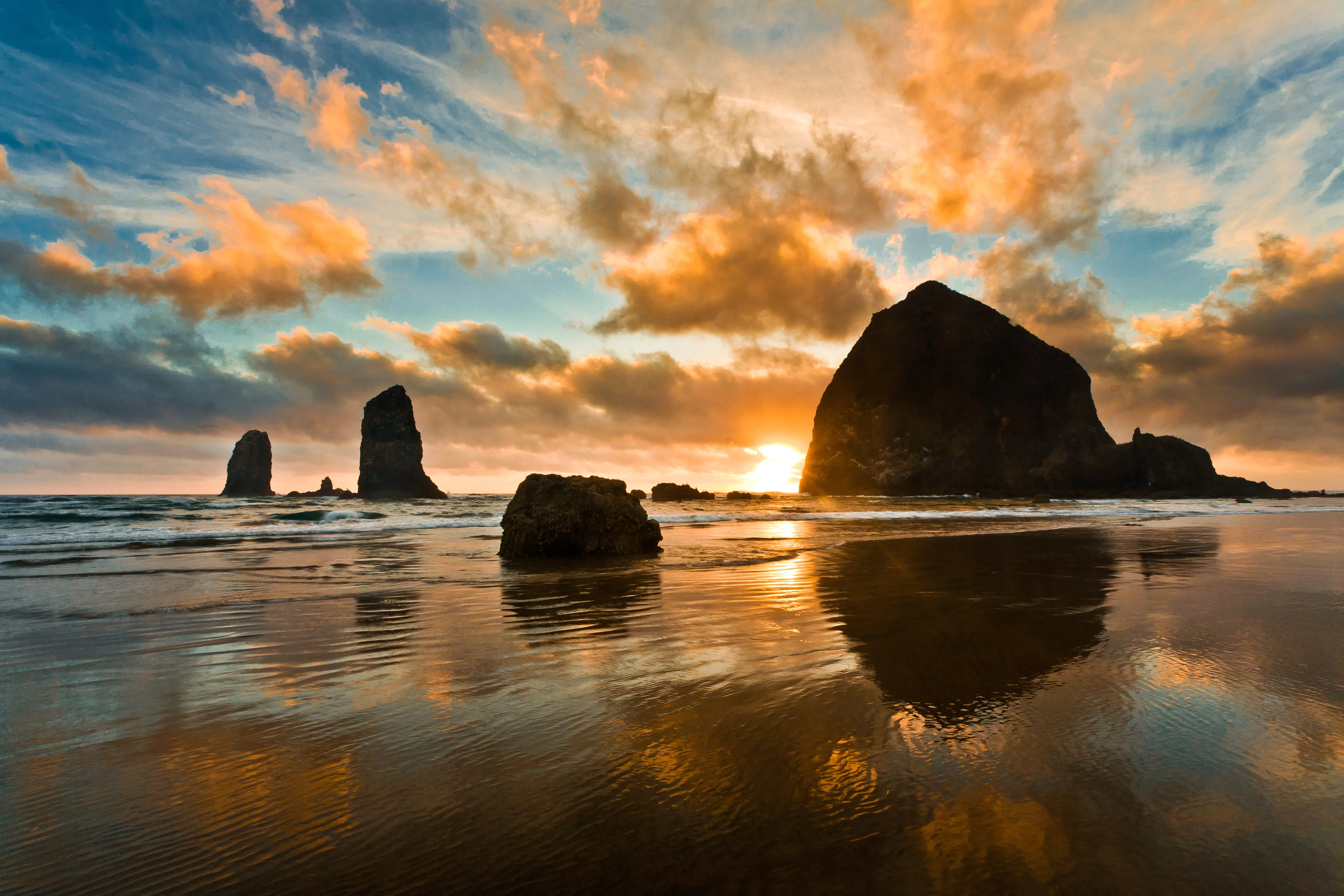
| Natural Beauty | TIE: Haystack Rock, sea stacks, Oregon Dunes, Cape Perpetua — world-class | Olympic National Park, rainforest, Hurricane Ridge — genuinely world-class in different ways. Different type of spectacular |
| Remote Work | Better overall infrastructure and internet in more cities. Newport and Astoria have fiber. More third-place options coast-wide | Port Townsend and Port Angeles have improving connectivity. Long Beach Peninsula and rural WA coast have significant connectivity challenges |
Taxes: The Biggest Financial Difference
The tax comparison between Oregon and Washington is the most significant financial factor for many buyers — and it cuts both ways, making neither state universally better.
📊
Washington wins on income tax, Oregon wins on sales tax. For retirees with significant pension or investment income, Washington's no-income-tax advantage can be worth thousands per year. For everyday buyers, Oregon's no-sales-tax advantage is felt on every purchase. The crossover point depends on your income composition and spending patterns.
Oregon income tax: Oregon taxes most income including wages, Social Security (above certain thresholds), pensions, and IRA withdrawals as regular income at rates up to 9.9%. A retiree with $80,000 in annual income could pay $6,000–$7,000+ in Oregon state income tax annually.
Washington no income tax: Washington has no state income tax — that same $80,000 retiree pays zero Washington state income tax. This is Washington's single most significant financial advantage and is particularly impactful for higher earners and retirees with pension income.
Oregon no sales tax: Oregon has no sales tax at all — on groceries, vehicles, furniture, appliances, clothing, or anything else. A Washington coast resident buying a $40,000 vehicle pays $3,400–$4,200 in sales tax. A new Oregon coast resident pays nothing. On everyday spending of $2,500/month, Washington's ~9% sales tax adds roughly $225/month — $2,700/year — in additional costs.
Property taxes: Both states have property taxes that vary by county. Oregon's Curry County (Gold Beach, Brookings) at 0.42% is the Pacific Northwest's most tax-friendly coastal area. Washington's coastal counties run 0.75%–1.01% — somewhat higher, which partially offsets the income tax advantage.
Which Tax Structure Benefits You More?
Oregon Wins For:Retirees on fixed Social Security income below the OR threshold. Everyday buyers with moderate income. Anyone making large purchases frequently (vehicles, appliances, home goods). Families spending heavily on retail. People prioritizing predictability over optimization.
Washington Wins For:High-income remote workers earning $150K+. Retirees with substantial pension, 401K, or investment income. Business owners with pass-through income. Anyone where the income tax savings clearly exceed the sales tax costs. Worth calculating your specific scenario — it's not universal.
Home Prices and Affordability
🏡
Washington coast is cheaper in raw price — Oregon coast offers more for the money. You can buy in Ocean Shores or the Long Beach Peninsula for $250,000–$350,000. But you're getting very limited infrastructure. On the Oregon Coast, $350,000–$460,000 buys you Coos Bay or Florence — cities with hospitals, full retail, and active communities.
Most affordable cityReedsport — $320K
Best value + servicesCoos Bay — $360K
Best value + lifestyleFlorence — $460K
Mid-coast benchmarkNewport — $500K
Most expensiveCannon Beach — $950K
Avg YoY appreciation+5.8% coast-wide
Strongest appreciationBrookings +9.4%
Most affordable cityAberdeen — $229K
Long Beach Peninsula$280K–$380K
Ocean Shores$290K–$370K
Port Angeles$433K
Sequim$550K
Port Townsend$600K
Avg YoY appreciation+4.2% Olympic Peninsula
Climate: Oregon Wins on Variety
☀️
Oregon Coast wins on climate — especially if you choose carefully. The Oregon Coast's biggest climate advantage over Washington is variety: you can choose from Astoria (lush and grey, classic PNW) to Brookings ("banana belt," genuinely sunny and warm). Washington's coast is more uniformly wet, with less range between its sunniest and rainiest areas.
The Oregon Coast runs from Astoria in the north (similar rainfall to the Washington coast) to Brookings in the south — which averages roughly 70 more sunny days per year than Astoria and temperatures 5–10°F warmer year-round. The Klamath Mountains create a protective microclimate that simply has no Washington equivalent. The mid-coast cities (Florence, Newport) fall between these extremes — mild, moderate rainfall, more sun than the north coast without Brookings-level warmth.
Washington's Pacific-facing coast (Long Beach Peninsula, Ocean Shores, Westport) is characterized by strong ocean exposure — dramatic but often windy, stormy, and foggy. The Olympic Peninsula is the wettest area in the continental United States, with the Hoh Rainforest receiving up to 14 feet of annual rainfall. This is spectacular if you love lush rainforest and don't mind grey winters; it's challenging if you need sunshine for mental wellbeing. Sequim, WA is the notable exception — a "rain shadow" microclimate that receives far less precipitation than surrounding Olympic Peninsula areas.
Sunniest cityBrookings (~165 sunny days/yr)
Rainiest cityAstoria (~65" annual rainfall)
Summer highs (typical)60–68°F coast-wide
Winter lows (typical)38–45°F coast-wide
Snow frequencyRare — most coast cities see snow every few years
Climate varietyHigh — you can choose your microclimate
Sunniest areaSequim "rain shadow" (~160 sunny days/yr)
Rainiest areaHoh Rainforest (~140" annual rainfall)
Summer highs (typical)60–72°F (Olympic Peninsula slightly warmer)
Winter lows (typical)36–42°F coast-wide
Snow frequencyRare at sea level; Olympic Peninsula higher elevations get significant snow
Climate varietyLimited — mostly wet with Sequim as exception
Healthcare: Oregon Has More On-Coast Options
🏥
Oregon Coast wins on healthcare infrastructure. The Oregon Coast has two full acute care hospitals directly on the coast (Newport and Coos Bay), plus critical access hospitals in Tillamook, Lincoln City, and Seaside. Portland's world-class medical centers (OHSU, Providence, Legacy) are accessible from north coast cities in under 2 hours. Washington's Pacific-facing coast and Long Beach Peninsula have very limited local healthcare.
Oregon's mid and south coast has the best coastal healthcare infrastructure in the Pacific Northwest. Samaritan Pacific Communities Hospital in Newport and Bay Area Hospital in Coos Bay are full acute care facilities that handle cardiology, oncology, orthopedics, and complex procedures. For north coast Oregon residents, Columbia Memorial Hospital in Astoria and Portland's OHSU (under 2 hours) provide complete specialist access.
Washington's Olympic Peninsula has Olympic Medical Center in Port Angeles — a solid regional hospital serving the peninsula. Sequim and Port Townsend rely on this facility or travel to Seattle (60–90 minutes from Port Townsend via ferry). The Long Beach Peninsula, Ocean Shores, and Westport have very limited local healthcare — residents travel to Olympia, Centralia, or Vancouver for anything beyond basic care. For retirees or families with health concerns, this is a significant factor in comparing the coasts.
Beaches: Oregon's Public Access Is Unmatched
🏖
Oregon Coast wins on beach access — it's not close. The Oregon Beach Bill (1967) guarantees that all 363 miles of Oregon's Pacific coastline are permanently public — no private beach ownership. Washington has no equivalent law. Oregon's beaches are also extraordinarily varied: sea stacks (Cannon Beach), sand dunes (Florence/Reedsport), tidal pools (Newport, Yachats), and wide sandy stretches (Seaside, Lincoln City, Brookings).
Oregon's Beach Bill is one of the most significant public land access laws in American history. Every foot of Oregon ocean beach from the Pacific Ocean to the vegetation line is permanently public property — you can walk from Astoria to Brookings on public beach without ever crossing private land. No other Pacific Coast state has this protection. Washington's ocean beaches on the Pacific coast are largely public, but the legal framework is different and beach access varies more by location.
Washington's Olympic Peninsula ocean coast is spectacular — some of the most dramatic wilderness coastline in North America — but it's genuinely remote and not accessible for daily recreation from most residential areas. The Long Beach Peninsula has accessible beaches, but the variety and scale of the Oregon Coast's public beaches is unmatched.
Schools: Comparable — Small Everywhere
Both the Oregon Coast and Washington Coast are served by small rural school districts. The comparison is genuinely similar: graduating classes of 30–150 students, limited AP course offerings, and tight-knit community schools where teachers know every student's name. Neither coast offers suburban school infrastructure — families prioritizing large, competitive academic programs will find both coasts limiting.
Strongest districtsNewport SD, Astoria SD, Siuslaw (Florence)
School rating rangeC to B+ (GreatSchools)
Typical class size15–22 students
AP availabilityLimited — larger districts have some AP
Proximity to universityFlorence: 60mi to U of O / Lane CC. Astoria: OSU extension programs
Strongest districtsPort Angeles SD, Sequim SD, Port Townsend SD
School rating rangeC+ to B+ (GreatSchools)
Typical class size16–24 students
AP availabilityLimited — Port Angeles has more options
Proximity to universityOlympic Peninsula: 60–90min to WSU/UW via ferry or drive
Lifestyle and Community Infrastructure
🏘
Oregon Coast wins on lifestyle infrastructure — more cities with complete services, better healthcare, more dining and arts options, and greater variety in community character across 16 distinct cities. Washington's Olympic Peninsula has its own strong lifestyle, particularly for outdoor recreation enthusiasts, but fewer complete communities with full amenities.
The Oregon Coast has an unusual density of distinct, livable communities — 16 cities across 363 miles, each with its own character. You can choose between Astoria's Victorian arts culture, Newport's mid-coast completeness, Florence's quiet charm, and Brookings' sunny retirement appeal. That variety doesn't exist on the Washington coast, where most communities are smaller and less comprehensively developed.
Washington's Olympic Peninsula offers world-class outdoor recreation — Olympic National Park, Hurricane Ridge, the Hoh Rainforest — that is genuinely unmatched for a specific type of outdoor enthusiast. For hikers, kayakers, and backcountry explorers, the Olympic Peninsula offers experiences the Oregon Coast can't replicate. For people who want beach lifestyle, walkable communities, and urban amenities in a coastal setting, Oregon is the stronger choice.
City-by-City Comparisons
If you're considering a specific Washington city against an Oregon alternative, here are the most common comparisons my clients make:
Home price$490,000
Property tax0.69% (Clatsop)
Income taxOregon state tax applies
Sales taxNone
HospitalColumbia Memorial on-site
Portland access95 miles / ~2 hours
CharacterVictorian, arts, breweries, walkable
Home price$600,000
Property tax~0.90% (Jefferson County)
Income taxNone
Sales tax~8.9%
HospitalJefferson Healthcare on-site
Seattle access60 miles / ferry + drive ~2 hours
CharacterVictorian, arts, ferries, walkable
Home price$500,000
Property tax0.89% (Lincoln)
Income taxOregon state tax applies
Sales taxNone
HospitalSamaritan Pacific (full acute)
Portland access113 miles / ~2 hours
CharacterActive coastal city, aquarium, bayfront
Home price$433,000
Property tax~0.90% (Clallam)
Income taxNone
Sales tax~8.9%
HospitalOlympic Medical Center (full acute)
Seattle access75 miles / ferry + drive ~2.5 hours
CharacterOlympic Peninsula gateway, outdoor focus
Home price$490,000
Property tax0.42% (Curry) — Pacific NW lowest
Income taxOregon state tax applies
Sales taxNone
HospitalUrgent care; Medford 85mi
ClimateSunniest on Oregon Coast — 165 sunny days
CharacterRetirement-focused, harbor, sunshine
Home price$550,000
Property tax~0.75% (Clallam) — WA coast low
Income taxNone
Sales tax~8.9%
HospitalOlympic Medical Center 16mi (Port Angeles)
ClimateRain shadow — ~160 sunny days, relatively dry
CharacterRetirement-focused, lavender farms, Dungeness
The Verdict: Who Should Choose Which Coast?
Choose the Oregon Coast if:
You need healthcare accessTwo full acute care hospitals on the Oregon Coast vs. limited options on most of the Washington coast. Families with health concerns or retirees planning for their later years will find Oregon dramatically better-served.
You want variety in your coastal city16 distinct cities with different characters, climates, and price points. You can optimize for sunshine (Brookings), culture (Astoria), schools (Newport), or value (Coos Bay) all within Oregon.
You make major purchases frequentlyNo Oregon sales tax saves $3,000–$5,000 on a vehicle purchase alone. If you're buying furniture, appliances, or a boat, Oregon's tax structure wins immediately.
You want guaranteed beach accessOregon's Beach Bill is unique in the nation. All 363 miles of coast are permanently public. No private beaches, ever.
You're on a moderate incomeOregon's income tax at moderate income levels (under $60K) is less burdensome than Washington's sales tax on everyday spending. The crossover point is approximately $80K–$100K in annual income.
You want the sunniest coastal climateBrookings, Oregon's "banana belt" has no Washington equivalent. If sunshine is your priority and you want coastal living, Oregon wins.
Choose the Washington Coast if:
You're a high-income earner or retiree with significant investment incomeNo Washington state income tax saves $6,000–$15,000/year for higher earners. For retirees with substantial pension or IRA income, Washington's tax structure is clearly superior.
You want Olympic National Park accessThe Olympic Peninsula is one of the most extraordinary landscapes in the country — rainforest, glacier, and Pacific wilderness within an hour's drive. For serious hikers and backcountry enthusiasts, it's unmatched.
You want ferry culture and Puget Sound accessThe Olympic Peninsula's access to ferry routes, islands, and the broader Puget Sound ecosystem is unique. The San Juan Islands, Whidbey Island, and Seattle are part of daily life in a way that has no Oregon equivalent.
You want the most affordable entry point possibleAberdeen ($229K), Ocean Shores ($290K–$370K), and Long Beach Peninsula cities offer the Pacific Northwest's lowest coastal home prices. The trade-off is infrastructure — but for buyers on very tight budgets, Washington opens doors Oregon can't.
You love the rainforest aestheticThe Olympic Peninsula's moss-covered, ancient rainforest is one of the most distinctive environments in North America. If that aesthetic resonates with you, no part of the Oregon Coast replicates it.
You're planning to drive to Seattle for city accessThe Olympic Peninsula is Seattle's backyard in a way the Oregon Coast isn't Portland's. Ferry + drive access to Seattle's world-class medical, cultural, and economic ecosystem is a genuine quality-of-life advantage for the right buyer.
Frequently Asked Questions
Is Oregon or Washington better to live on the coast?+
For most buyers prioritizing beach lifestyle, community infrastructure, healthcare access, and variety of city options, the Oregon Coast offers more. Washington's Olympic Peninsula is better for buyers prioritizing no income tax, Olympic National Park access, and ferry connectivity to Seattle. The right answer depends on your income level, healthcare needs, and lifestyle priorities.
Is it cheaper to live on the Oregon Coast or Washington Coast?+
Washington coast home prices are generally lower (Long Beach Peninsula, Ocean Shores: $250K–$380K), and Washington's no-income-tax policy benefits high earners significantly. However, Washington's sales tax (8.5–10.6%) adds real daily cost. Oregon's no-sales-tax policy benefits moderate-income buyers and families. The crossover point where Washington's tax structure becomes more favorable is approximately $80K–$100K in annual income.
Does Oregon Coast or Washington Coast get more rain?+
The Washington coast and Olympic Peninsula are significantly wetter. The Hoh Rainforest receives 12–14 feet of annual rainfall — among the highest in the continental U.S. Aberdeen and Hoquiam are among the rainiest cities in the country. The Oregon Coast is wet but generally less extreme, and offers the "banana belt" at Brookings with dramatically more sunshine and lower rainfall than anywhere on the Washington coast.
Are Oregon beaches better than Washington beaches?+
Oregon has a significant advantage in accessible beach variety and guaranteed public access. The 1967 Oregon Beach Bill ensures all 363 miles of coast are permanently public — no private beaches anywhere. Oregon's beaches range from broad sandy stretches (Seaside, Lincoln City) to sea stacks (Cannon Beach) to sand dunes (Florence) to tidal pools (Newport, Yachats). Washington's Olympic coast is spectacular wilderness but less accessible for daily recreation.
More Oregon Coast Guides
📊 Cost of Living
All 16 Cities Ranked 2026
Read →
🏖 Retirement
Best Places to Retire 2026
Read →
👨👩👧 Families
Best Places for Families 2026
Read →
💻 Remote Work
Best for Remote Workers 2026
Read →
🏠 Market Data
Real Estate Market Report 2026
Read →
🌲 Washington
Living in Washington — City Guides
Browse →
Moving to the Oregon Coast?
Tell us what you need help with and we'll connect you with local resources.

Todd Davidson
About the Author
Todd Davidson is the founder of Living in Oregon and Living in Washington, where he publishes in-depth city guides, neighborhood resources, and local market insights covering more than 180 communities across the Pacific Northwest. While his background is in home financing and real estate, he created these digital platforms to help families research and compare regions before making a move.