
Oregon Coast · Oregon
Moving to Brookings from California: The Honest Comparison (2026)
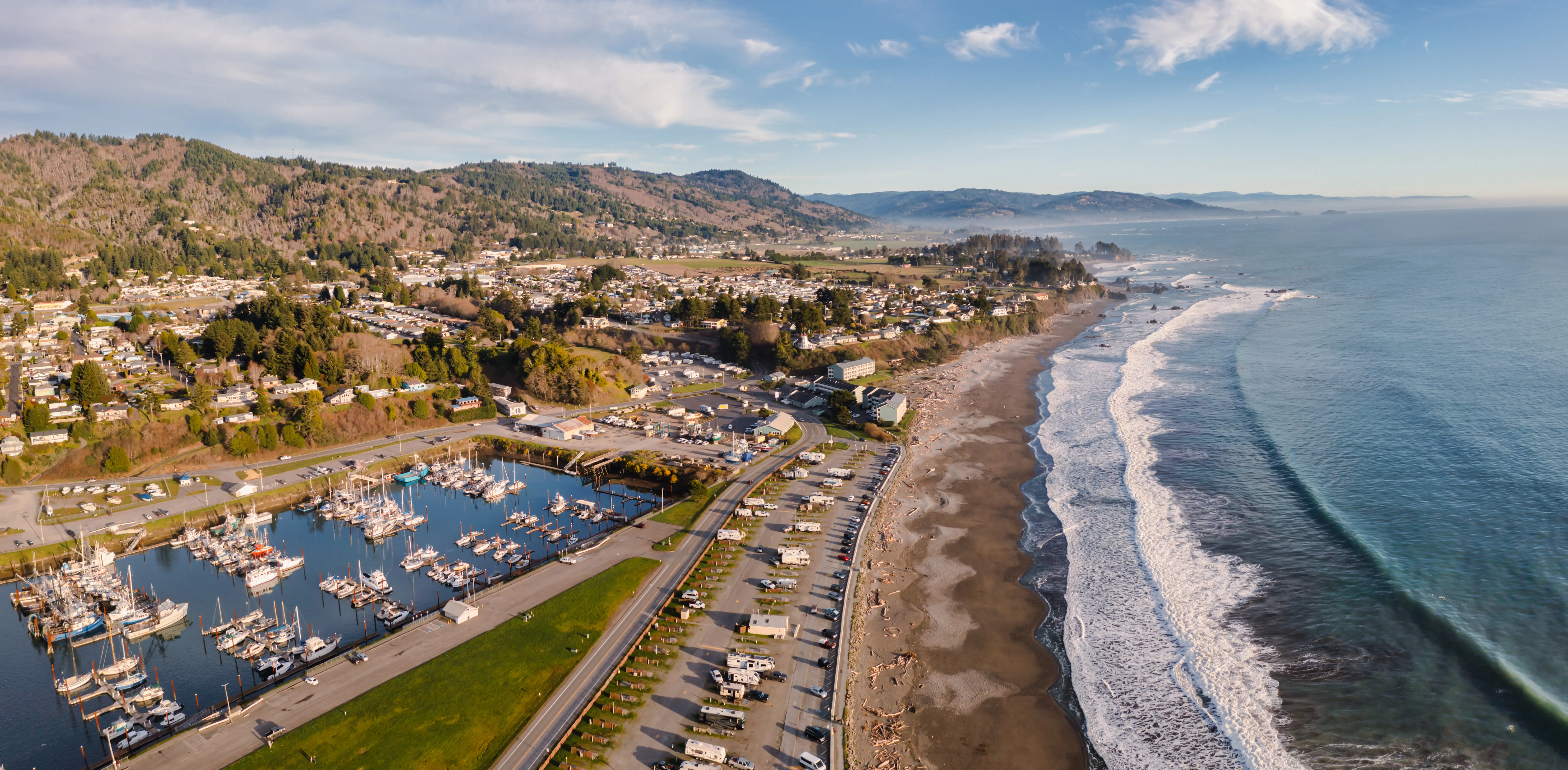
The Bay Area software engineer who finally went remote didn't move to Brookings because of a spreadsheet. She moved because she sold a 1,100-square-foot condo in Walnut Creek for $1.1 million and bought a 2,400-square-foot house with a yard, a view of the Chetco River corridor, and no mortgage. The San Diego family stopped dreading their summer utility bill — not because Oregon is cheap, but because 68°F summers don't require air conditioning. The Sacramento buyer who'd been watching his neighborhood go from affordable to merely less expensive than San Francisco finally had enough. Brookings, a coastal town of roughly 6,700 at the southern tip of the Oregon coast, keeps appearing in these stories because it offers something rare: ocean access, genuine quiet, and a median sold price that California equity can actually handle.
The honest version of this story includes the part that doesn't appear in the relocation headlines. Brookings is not California. The winters are darker and wetter than anything most California cities prepare you for. The restaurant scene is thin. The cultural energy of even a mid-sized California city — the farmers markets, the weekend options, the spontaneous energy of a place with critical mass — doesn't exist here in the same form. California transplants who didn't research this part tend to discover it around February of their first year.
This guide is built for the California buyer who has done the math but wants the full picture. We'll cover the cost comparison by California region, what your home equity actually buys at Brookings's current price points, the tax reality (Oregon is not a no-income-tax state), the weather trade you're making, and a comparison tool to look up your specific California city directly.
| Brookings, Oregon | Bay Area | Southern CA | Sacramento Metro | Central Valley | |
|---|---|---|---|---|---|
| Median Home Price (approx. 2026) | $550,000 | $1.3M–$1.8M | $750K–$1.1M | $520K–$650K | $360K–$480K |
| Property Tax Rate (effective) | 0.42% | 1.1%–1.3% | 1.1%–1.25% | 1.0%–1.2% | 1.0%–1.15% |
| State Income Tax (top bracket) | 9.9% | 13.3% | 13.3% | 13.3% | 13.3% |
| State Sales Tax | 0% | 8.25%–10.75% | 7.75%–10.25% | 7.25%–8.75% | 7.25%–8.75% |
| Avg Utilities (monthly est.) | $150–$200 | $250–$350 | $220–$320 | $200–$280 | $180–$260 |
| Avg 1BR Rent | $1,200–$1,600 | $2,800–$3,800 | $2,200–$3,100 | $1,500–$2,000 | $1,100–$1,600 |
The sales tax elimination is less dramatic but genuinely adds up. A California household spending $60,000 per year on taxable goods at an average 8.5% sales tax rate is paying roughly $5,100 annually in sales tax. Oregon's rate is zero. Combined with the property tax savings, a former Bay Area homeowner moving to Brookings can reasonably expect to bank $18,000–$22,000 per year in reduced housing-related and consumption taxes — before touching the equity they freed up on the home sale.

The tax comparison above is one I walk buyers through constantly, since a huge share of my clients over the years have come from California looking for exactly this kind of relief — a $550,000 median sold price and a 0.42% effective property tax rate against what they're used to paying in the Bay Area or Southern California. I've been doing renovation and investment work on the Oregon Coast since 1994, and the California-to-Oregon move is one of the most common stories I hear at the closing table.
What surprises most transplants isn't just the tax savings, it's how far that freed-up equity goes once they're here — whether that means paying cash, funding a renovation, or picking up a second property as an investment. If you're weighing a move from California to Brookings, I'd welcome the opportunity to share what nearly three decades of helping California buyers make this exact transition has taught me about doing it well.
Oregon has a state income tax, graduated from 4.75% to 9.9% at the top bracket. California transplants who've heard "Oregon has no sales tax" sometimes extrapolate further than they should — no income tax is Nevada, not Oregon. What Oregon does offer is a meaningfully different overall tax structure that tends to favor homeowners, retirees, and buyers with significant equity.
| Tax Item | California | Oregon | Net Impact |
|---|---|---|---|
| State Income Tax (top bracket) | 13.3% | 9.9% | Oregon saves ~3.4 pts |
| State Sales Tax | 7.25%–10.75% | 0% | Major Oregon advantage |
| Property Tax (effective rate) | 1.1%–1.3% | 0.42% | Substantial Oregon savings |
| Capital Gains Tax (state) | Up to 13.3% | Up to 9.9% | Oregon lower |
| Senior Property Tax Deferral | Limited | Age 62+ eligible | Oregon advantage for retirees |
| Property Tax Growth Cap | Prop 13 (2% cap) | Measure 50 (3% cap) | Similar long-term protection |
Oregon's Measure 50 mirrors California's Prop 13 in one key way: assessed value growth is capped at 3% per year after purchase. For long-term owners, this prevents the tax bill from escalating with the market. Buyers who purchase in Brookings now and hold for fifteen years will likely pay taxes based on a figure well below market value — a significant benefit in a coastal market that has historically appreciated during the right cycles. Residents 62 and older may also qualify for Oregon's senior property tax deferral program, which defers payments until the property is sold or transferred.
A buyer leaving San Jose, Fremont, or Marin County with $1.4 million in equity is staring at one of the cleanest transactions in residential real estate: buying Brookings's entire market at the median sold price of $550,000 in cash, with $850,000 left over. At the upper end of the Brookings market — think custom builds on Spyglass Ridge with panoramic ocean views, or larger homes on the Chetco River corridor with private acreage — prices range from $700,000 to $950,000. A Bay Area seller with $1.5 million in equity can purchase the top tier of this market all-cash and retain a seven-figure cash position.
The neighborhoods that represent the best strategic value at this equity level are Spyglass and Seacrest Estates for views and privacy, and the Chetco River corridor for buyers who want acreage and river access over ocean proximity. Bay Area buyers often discover that Brookings's luxury tier — the homes they'd consider "entry-level" in Palo Alto — offers something California long stopped providing: genuine space, natural setting, and low carrying costs. Property taxes on a $850,000 Brookings home run approximately $3,570 per year.
A buyer selling in Irvine, Pasadena, or coastal San Diego and walking away with $900,000 in equity lands in Brookings's top quartile with cash to spare. The current median sold price sits at $550,000, which means a SoCal buyer with this equity level can purchase well above median — into Pacific Heights, Marina Heights, or ocean-view properties in Rainbow Rock — and retain $300,000–$400,000 in liquid reserves. That's a genuinely different financial position than what most Southern California buyers have experienced since 2015.
What tends to resonate most for SoCal transplants is the climate proximity — Brookings summers track surprisingly close to San Diego coastal conditions, with lows rarely dropping below 50°F even in January. The lifestyle gap is real in winter, but the summer trade is more favorable than most people anticipate before arriving.
These buyers have a narrower relative advantage on paper, but the financial logic still holds. A Sacramento buyer selling a home in Elk Grove or Roseville for $580,000 and clearing $500,000 after costs can purchase in Brookings near or above median with minimal or no mortgage — or put 40–50% down and carry a payment dramatically lower than anything comparable in the Sacramento metro. The no-sales-tax benefit is immediately tangible, and property taxes drop from roughly 1.1% in Sacramento County to Brookings's 0.42%.
For buyers at the lower end of this equity range, Brookings North and Harbor offer well-maintained single-family homes in the $380,000–$490,000 range where Sacramento equity goes the furthest. Buyers who need to stretch their remaining cash can also explore the Winchuck Estates area, where larger lots are available below the citywide median.
The relative advantage is most modest here, but it's still real. A buyer selling a Fresno or Stockton home and clearing $380,000 can likely purchase a Brookings property in the $400,000–$480,000 range with a manageable mortgage — and do so in a coastal community where the same dollar in their origin city buys a landlocked suburban lot. Harbor and Brookings North are the most accessible entry points, with smaller single-family homes and some fixer inventory in the $340,000–$440,000 range.
Central Valley buyers may also qualify for Oregon Housing and Community Services (OHCS) down payment assistance programs if their purchase price falls within program limits — worth confirming with a mortgage professional before assuming they're out of range.
Looking to buy in Brookings? Estimate your payment.
Enter your numbers to see an estimated monthly mortgage payment.
Estimate only. Excludes HOA fees and mortgage insurance.
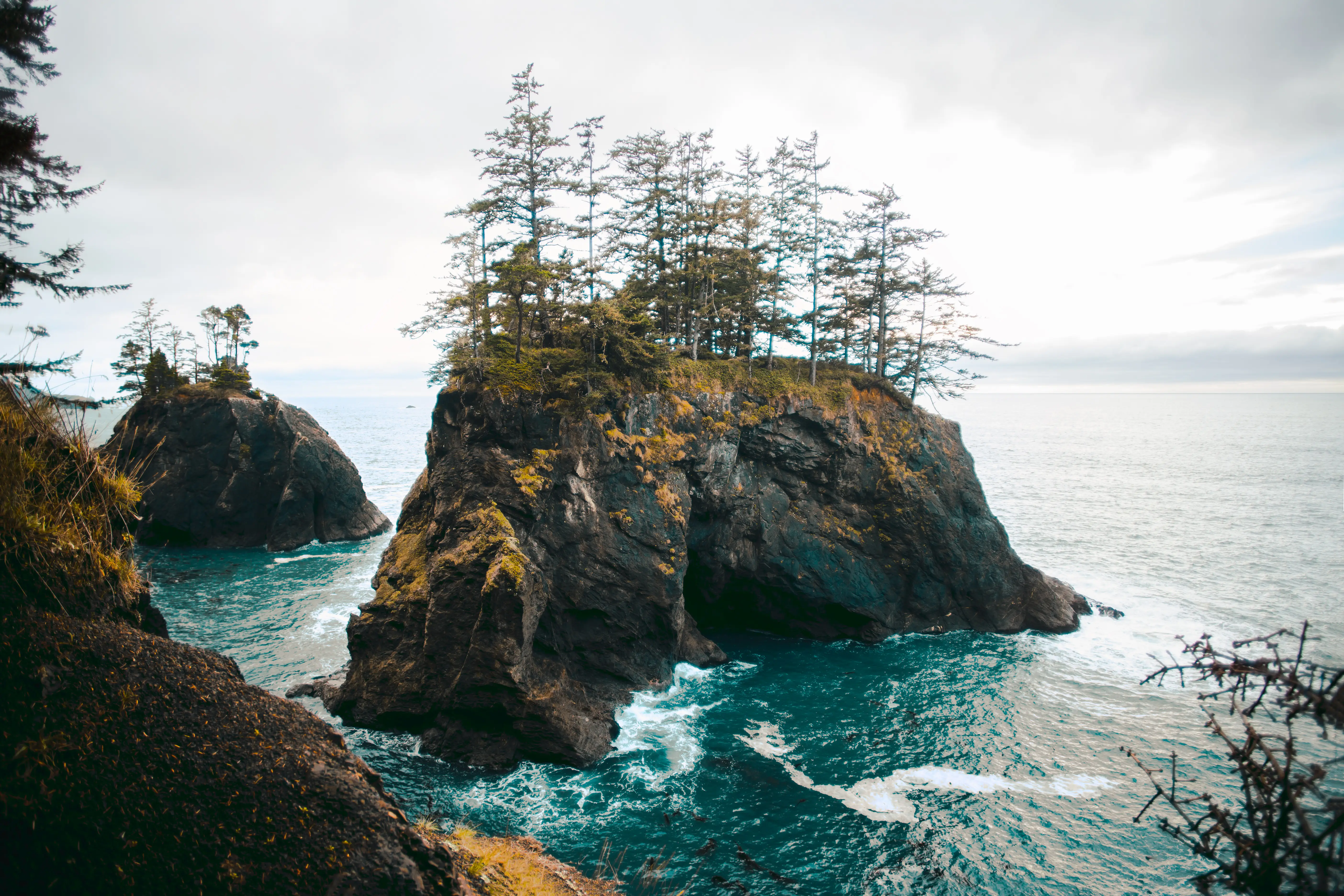
Here is what a good friend who moved from San Diego three years ago would actually tell you: the summers exceeded expectations. June through September in Brookings is genuinely beautiful — dry, mild, rarely above 72°F, with offshore fog burning off by 10am most days and the Chetco River corridor lit gold in the afternoons. Harris Beach State Park and the tide pools at Lone Ranch Beach have the kind of uncrowded coastal access that San Diego stopped offering somewhere around 2005. If the only months that existed were May through October, this would be one of the most obvious relocation decisions on the West Coast.
November through March is the honest part. Brookings receives roughly 65 inches of rain per year, concentrated heavily in the winter months — December alone averages 15 inches across 20 rainy days. Annual sunshine hours run around 2,568, compared to Los Angeles's 3,257 and Sacramento's 3,608. That gap is real. Los Angeles gets roughly 284 sunny days per year; Brookings gets around 191. The "Banana Belt" reputation is earned by Oregon coastal standards — Brookings is genuinely milder and sunnier than Coos Bay or Astoria — but it is not a California climate in any winter month.
What California transplants consistently report loving after their first full year: the absence of traffic, the lack of crime anxiety, the ability to access the beach on a Tuesday in August without competing for parking, and the community scale that makes neighbors feel like neighbors. What they miss most honestly: year-round beach culture, the food scene they took for granted (Brookings has limited restaurant variety), the spontaneous social energy of living near a million people, and Sacramento or Bay Area sunshine in January. The buyers who thrive here are the ones who came for the summers and built routines around the winters — hiking the Samuel H. Boardman corridor on clear December days, finding the local rhythm of a small coastal town rather than waiting for California to reappear.
If you want to see how Brookings compares directly to the city you're leaving, use the tool below — it covers the 120 largest California cities with current housing and tax data.
Home prices: Redfin median sale data, Q1–Q2 2026. Select your city to compare.
Ready to talk through what your specific California equity could do in Brookings? Todd can model your exact scenario in a single call.
Mistake 1: Assuming slow days-on-market means the market is soft everywhere. The aggregate days-on-market figure for Brookings hovers around 114 days, which leads California buyers to assume they have unlimited time to deliberate. That average masks the real split: overpriced or condition-challenged properties sit for months, while cleanly priced, well-maintained homes in Pacific Heights, Spyglass, and Harbor sometimes go pending in under three weeks. California buyers who approach every listing with Sacramento-style due diligence timelines — multiple walk-throughs, extended inspection periods, leisurely offer windows — frequently lose the listings that were actually worth having.
Mistake 2: Not testing for radon. Oregon has elevated radon zones, and Curry County properties — particularly those with basements or crawl spaces — are not exempt. California buyers almost universally skip this because radon testing is uncommon in the California coastal markets most of them are coming from. Oregon's geology is different, and the remediation cost when radon is found is manageable ($800–$2,500 for a mitigation system), but only if you test before closing. Make it a non-negotiable line item in every inspection.
Mistake 3: Confusing Harbor and Brookings as the same place. Harbor sits just south of Brookings proper, across the Chetco River, and the two communities have meaningfully different characters. Harbor is generally more affordable, less developed commercially, and further from Brookings's downtown core and services. Buyers who purchase in Harbor assuming they're getting the full Brookings experience — walkable to local shops, close to Harris Beach, convenient to the harbor district — sometimes discover the practical distance is greater than the map suggests. Know which side of the river you're choosing.
Mistake 4: Underestimating the pace and services gap in winter. California buyers from San Diego, the Bay Area, or Sacramento are accustomed to a density of services — urgent care clinics, grocery options, specialty retail — that requires critical mass to sustain. Brookings operates on a small-town service model that works smoothly in summer and requires more planning in winter. Medical specialty care typically means a drive to Medford (roughly 2 hours via US-101 and US-199). The nearest Costco is in Medford. Buyers who build their lifestyle around convenience services available within 15 minutes will need to recalibrate — not because Brookings is failing, but because it is genuinely a small coastal town of 6,700 people, not a suburb.
Bay Area sellers with substantial equity are often in position to purchase all-cash or at very low loan-to-value ratios — sometimes 20% LTV or less on a Brookings purchase. At that equity level, the rate environment matters less than transaction speed and terms. Sellers in this position should confirm their cash position before traveling to Brookings to tour properties; a written proof-of-funds letter from a financial institution dramatically strengthens offer position in a low-inventory coastal market. If the California property being sold was an investment property, a 1031 exchange deserves serious evaluation — purchasing a Brookings rental or vacation property with deferred capital gains can meaningfully change the post-tax outcome. The Brookings 1031 Exchange guide covers this in detail.
Southern California sellers with $700,000–$1.2 million in equity are typically looking at conventional purchase scenarios — strong down payments, low LTV, and no need for jumbo financing at Brookings price points. The Brookings market sits comfortably within conforming loan limits at the median sold price of $550,000, which means rate and term options are broad. These buyers often benefit from moving quickly through pre-approval before their California home closes, so they can make clean offers without a financing contingency where possible.
Sacramento and Inland Empire buyers with $400,000–$650,000 in equity occupy a range where purchase price and down payment determine whether OHCS programs apply. Buyers targeting properties below program purchase price limits should explore Oregon Housing and Community Services down payment assistance options; the covers current program eligibility and limits. Even buyers who don't need DPA should run the numbers — some OHCS programs offer below-market rates that outperform conventional financing even when a buyer has substantial equity available.

Local Expert Takeaway: The single thing most California buyers underestimate about Brookings is the tax efficiency of holding the property long-term. At 0.42% effective property tax with assessed value growth capped at 3% annually under Measure 50, a buyer who purchases today and holds for fifteen years will be paying taxes on an assessed value roughly half of what the home will likely be worth on the open market. Combined with Oregon's zero sales tax, buyers who plan to stay — not flip — gain compounding annual advantages that don't show up in any first-year cost comparison. If you're buying Brookings as a permanent relocation rather than a short-term hedge, the financial case gets stronger every year you stay.
✅ California equity goes further here than almost anywhere on the West Coast. A buyer selling at Bay Area or SoCal prices and purchasing at Brookings's $550,000 median sold price is looking at a dramatically restructured financial life — lower or eliminated mortgage, property taxes under $2,500/year, and no state sales tax on daily spending.
⚠️ Oregon has a state income tax. The 9.9% top bracket is lower than California's 13.3%, but buyers who assume they're escaping income tax entirely will be surprised. The net tax picture is still favorable for most California transplants — just not as simple as the "no sales tax" headline suggests.
📍 The Brookings market is thin and moves unevenly. With 35 homes sold per month, the listings worth buying and the listings sitting at $700K overpriced are sometimes hard to distinguish on paper. Local guidance on current neighborhood values matters more here than in a deep MLS market.
Is moving from California to Brookings worth it?
For buyers with California equity who want coastal Oregon access, a dramatically lower cost of carrying a home, and a quieter pace, Brookings consistently delivers on its financial promise. The lifestyle adjustment — smaller services footprint, darker winters, limited restaurant and cultural scene — is real, and buyers who research it honestly before moving tend to thrive. Buyers who arrive expecting a California coastal town with Oregon prices tend to struggle by February.
How much cheaper is housing in Brookings vs California?
The median sold price in Brookings sits at approximately $550,000 as of early 2026, compared to $1.3M–$1.8M in the Bay Area and $750,000–$1.1M across much of Southern California. Sacramento Metro buyers face a smaller gap — roughly $520,000–$650,000 median in many Sacramento submarkets — but still benefit from Brookings's dramatically lower property tax rate of 0.42% versus approximately 1.1% in most California counties.
What do I need to know about moving from California to Oregon?
Oregon does not have a sales tax, which saves a typical household several thousand dollars per year. Oregon does have a state income tax graduated up to 9.9% — plan accordingly. Property taxes are low and growth-capped under Measure 50. Oregon drivers must obtain an Oregon license and register vehicles within 30 days of establishing residency. Radon testing is strongly recommended on any Oregon home purchase. And if you're moving from a major California metro, give yourself an honest assessment of how you'll spend February through March — the winters are real, the summers are worth it.
Explore the full Brookings series: The Ultimate Brookings Relocation Guide · Is Brookings Safe? · Cost of Living in Brookings · Best Neighborhoods in Brookings · Brookings Schools & Family Life · Brookings Youth Sports · Brookings Parks & Recreation · Retiring in Brookings · 1031 Tax-Deferred Exchange in Brookings · Brookings First-Time Homebuyers Guide · · Moving to Brookings from California · Brookings Realtor's Perspective · Top 10 Questions a Realtor Gets About Brookings
Tell us what you need help with and we'll connect you with local resources.

About the Author
Todd Davidson is the founder of Living in Oregon and Living in Washington, where he publishes in-depth city guides, neighborhood resources, and local market insights covering more than 180 communities across the Pacific Northwest. While his background is in home financing and real estate, he created these digital platforms to help families research and compare regions before making a move.
Check Out the Oregon Coast Rankings: Oregon Coast Cost of Living — All 16 Cities Ranked · Best Places to Retire on the Oregon Coast · Best Oregon Coast Cities for Families · Best Oregon Coast Cities for Remote Workers · Oregon Coast Real Estate Market Report 2026 · Oregon Coast vs. Washington Coast