

I'm Elizabeth Davidson, a Real Estate Broker with Cascade Hasson Sotheby's International Realty, consistently ranked in the top 2% of REALTORS® in the Portland Metro by volume sold. I've spent years working the West Linn market specifically — not as a satellite territory, but as one of my primary focuses — and the nuance I've built neighborhood by neighborhood, street by street, is what I bring to every buyer conversation.
West Linn is a market that rewards patience and punishes assumptions. I've watched buyers come in thinking it's interchangeable with Lake Oswego, or that the citywide median tells them what they'll actually compete for. It doesn't. The spread between a Bolton bungalow and a Pete's Mountain estate is enormous, and understanding that spread is the difference between finding your home and spinning your wheels.
My job is to give you the honest picture — which neighborhoods fit your budget, which ones fit your life, and where the market is actually moving right now. I don't work for the city's chamber of commerce, and I'm not here to sell you on West Linn as a concept.
In this guide, I'll walk you through the neighborhoods worth knowing, what your budget realistically buys, where buyers consistently go wrong, and who West Linn genuinely makes sense for — and who should probably look somewhere else.
Willamette is the entry point into West Linn for buyers who want character and walkability without committing to the upper tiers. The historic district along the riverfront runs about 12 blocks of registered buildings from the late 1800s and early 1900s — Queen Anne Victorians, Craftsman bungalows, the kind of streetscape that doesn't get built anymore. On a Wednesday evening in summer, the farmers market is running on Main Street and the Garages food cart pod is full — this is the most neighborhood-as-a-place part of West Linn. Most of what sells here falls into the entry tier, under $650K, though larger historic homes and new construction can push higher.
Bolton sits east of downtown along the west bank of the Willamette River, rolling hills and river frontage with a genuinely historic feel. It's quieter than Willamette proper and one of the more affordable pockets in the city — typically in the entry tier as well. Buyers who want established trees, proximity to the water, and a less trafficked stretch of West Linn tend to find this neighborhood undervalued relative to what it offers.
Robinwood is where I send buyers who want suburban convenience without feeling like they're in a subdivision that could be anywhere. It's a mid-tier neighborhood — generally $650K to $800K — with good access to Robinwood Park and reasonable commute lines north. The housing stock is mostly well-kept ranches and split-levels from the 1970s and 1980s; not flashy, but solid and livable, and the lots tend to be generous.
Barrington Heights is a top-tier neighborhood in the classic sense — planned, polished, and priced accordingly. Streets like Barrington Drive sit up in the hills with views that photograph well and hold value. On a clear morning you can see Mount Hood from the upper streets. Homes here run $800K and above as of mid-2026, and buyers are typically families making a deliberate choice to prioritize the school district and the long-term resale floor that comes with a well-maintained hilltop address.
Parker Crest is one of the neighborhoods I highlight most often for buyers moving up from Portland who aren't sure what West Linn's upper-middle tier actually looks like. It's a top-tier neighborhood — homes typically start at $800K — with newer construction, clean lines, and the kind of quiet that means your kids can ride bikes without you watching every second. The Tualatin River National Wildlife Refuge is a short drive, and the neighborhood has a settled, permanent feel that newer developments often take years to develop.
Pete's Mountain is the outlier in West Linn's lineup — a rural-ish ridge community with acreage lots, long Willamette Valley views, and homes that regularly cross $1M. If you're comparing this to anything in the city proper, you're comparing apples to timber. Buyers who land here usually knew they wanted this kind of space before they started looking; it's not a compromise option, it's a deliberate lifestyle choice.
The single biggest mistake I see is treating West Linn as one market. The citywide median — currently in the $775K–$800K range — blends a Bolton bungalow at $580K with a Pete's Mountain estate at $1.4M, and the number you get from that math tells you almost nothing useful about either one.
Buyers also underestimate how much the terrain drives price. West Linn is genuinely hilly, and the difference between a flat-lot ranch in Robinwood and a ridgeline home in Barrington Heights isn't just aesthetic — it's a completely different product, a different commute pattern, and a different daily experience. I've seen buyers fall in love with a view property and not fully reckon with what it means to drive that hill in January ice.
The third misconception: buyers coming from Lake Oswego sometimes assume West Linn is the more affordable version of the same thing. There's overlap, but the two cities have distinct characters. Lake Oswego's walkable core around the lake is a different product entirely from anything West Linn offers. West Linn's strength is schools, green space, and a slower pace — not a lakefront lifestyle. If you want that specific thing, West Linn won't scratch that itch, and I'll tell you so upfront.
| Budget | What You'll Typically Find | Where to Look |
|---|---|---|
| Under $650K | Condos, townhomes, smaller single-family homes; some historic bungalows with character | Willamette, Bolton |
| $650K–$800K | Established single-family homes, good lots, well-regarded neighborhoods with strong school access | Robinwood, Sunset, Tanner Basin |
| $800K+ | Newer construction, hillside views, larger lots, luxury finishes; some acreage | Barrington Heights, Parker Crest, Pete's Mountain |
The honest reality is that West Linn's market is weighted toward the middle and upper tiers. Buyers with budgets under $650K have real options, but the selection is genuinely narrower, and competition for well-priced entry-tier homes can be sharp even in a market that's otherwise giving buyers more breathing room.
West Linn is a buyer-friendlier market in mid-2026 than it was two or three years ago — inventory has risen meaningfully, and homes are taking longer to move, with the current median around 36–51 days on market depending on the segment. The sold price range across reliable sources runs $750K–$800K, and the days of every home fielding multiple offers above asking are largely behind us, though well-priced homes in top-tier neighborhoods still move.
West Linn makes the most sense for households that are anchoring to the school district — West Linn-Wilsonville is consistently one of the top-rated districts in Oregon, and that's not incidental, it's a primary reason families pay this premium. If you're commuting to Portland, the roughly 24-minute drive is manageable by metro standards, and buyers who work in Tualatin or Wilsonville have an even easier case.
It's a weaker fit if you're prioritizing walkability in the urban sense — coffee shop downstairs, no car needed on a Saturday — or if your budget is firmly under $600K and you need a detached single-family home with a yard. Oregon City offers genuine historic character at a meaningfully lower price point, and Milwaukie gives you better Portland access without the premium.

Buyers coming from California — particularly the Bay Area and Southern California — consistently underestimate how much house $800K buys here relative to what they're used to. The lot sizes, the tree cover, the general quietness of a neighborhood like Parker Crest or Barrington Heights at that price point land differently when you're used to paying $1.2M for a smaller house on a flat lot in a suburb of San Jose. That recalibration usually happens fast, and it tends to make West Linn feel like a strong value even at prices that look premium from a national perspective.
What catches buyers from Seattle off guard more often is the terrain. The Pacific Northwest topography they know tends to be flatter in the suburban corridors they're comparing to. West Linn's hills are genuine — beautiful, but consequential for daily life. The drives are winding, some streets don't have sidewalks, and the distance between two homes that look close on a map can feel much longer when you're actually navigating it. Buyers who preview the city on a clear day in July and don't revisit in November sometimes discover that the commute and the neighborhood feel shift more than they expected.
| City | Schools | Commute to Portland | How It Compares |
|---|---|---|---|
| West Linn | A — West Linn-Wilsonville SD | ~24 min | Premium schools, hillside setting, higher price floor |
| Lake Oswego | A — Lake Oswego SD | ~20 min | Similar price range, walkable lake core, different lifestyle feel |
| Oregon City | B+ — Oregon City SD | ~28 min | Lower price point, historic character, improving but uneven |
| Tualatin | B+ — Tigard-Tualatin SD | ~25 min | More suburban, lower prices, better access to Washington County jobs |
| Wilsonville | A- — West Linn-Wilsonville SD | ~30 min | Shares the school district, newer construction, quieter feel |
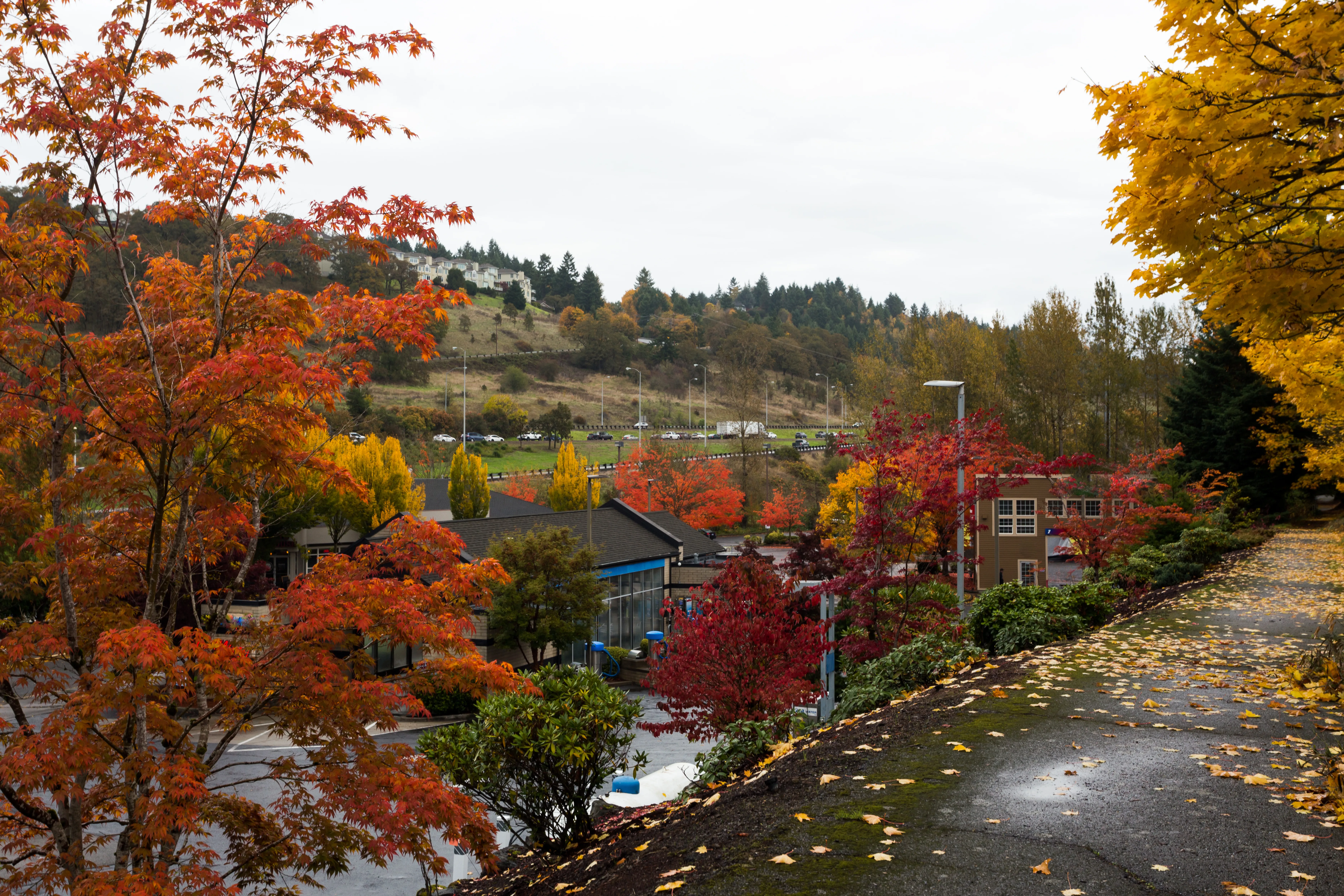
What's everyday life in West Linn actually like? It earns its nickname — "City of Hills, Trees and Flowers" isn't just branding. The city sits between the Willamette and Tualatin rivers with terrain that climbs steeply from the riverbanks, so historic Willamette down by the water feels like a different place entirely from the newer hilltop neighborhoods like Parker Crest. With about 27,000–31,000 residents, it consistently ranks among the best places to live in Oregon on independent livability scoring, and the reasons show up the moment you drive through it — parks, trails, and river access woven into nearly every neighborhood.
How's the actual commute to Portland from West Linn? About 24 minutes via I-205 under normal conditions. Willamette and Bolton, both in the entry tier, sit closest to the on-ramp and shave a few minutes off the drive. The hillside neighborhoods — Barrington Heights, Parker Crest — add a bit of local navigation before you reach the freeway, which matters more on the way home in traffic than the raw mileage suggests.
Which West Linn neighborhood actually fits different buyers? Willamette and Bolton are the entry point — historic charm, walkable pockets, the lowest price floor in the city. Parker Crest and Barrington Heights are where buyers go for newer construction and hillside views, at a real premium. Robinwood and Hidden Springs are the quieter, more purely residential family neighborhoods in between.
How strong is the West Linn-Wilsonville district really? It carries an A rating and is consistently named among Oregon's top public school districts. It's one of the few things in this market that reliably supports long-term resale value — buyers I work with who later sell almost always point to the school district as a top reason their home held its value.
How does West Linn compare to Lake Oswego, Oregon City, and Tualatin? Lake Oswego is the peer in price but not character — it has a true walkable downtown and the lake itself, which West Linn simply doesn't replicate. Oregon City and Tualatin are the practical alternatives when budget drives the decision — both give up some school ranking but return real value in price per square foot.
Is West Linn really one of the safest cities in Oregon? Yes, and the data backs it up — West Linn consistently ranks among the very lowest cities in the state for both violent and property crime, with odds of violent crime victimization running below 1 in 1,600. It's not a marketing line; independent crime analysis puts it at or near the top of statewide safety rankings year after year.
Is West Linn walkable anywhere? Citywide, it's car-dependent — Walk Scores in the low 30s across most neighborhoods. The genuine exception is Historic Willamette, where you can walk a 3-mile loop past more than 70 architecturally distinct homes, hit the seasonal farmers market, and grab coffee without getting in the car. It's a real, if small, walkable pocket — not the rest of the city.
What's the long-term appreciation case for West Linn? West Linn grades highly on independent housing scoring for both appreciation rates and home value stability. The school district reputation has historically supported stronger resale value here than in neighboring Oregon City, and the newer-construction hillside neighborhoods — Parker Crest and Barrington Heights in particular — have shown the strongest recent price growth as buyers prioritize move-in-ready product over the older historic stock near the river.
If you're serious about buying in West Linn in 2026, the window of relative buyer leverage is real — more inventory, homes taking longer to sell, and sellers more willing to negotiate than they were two years ago. That doesn't mean you should wait indefinitely or assume prices will fall sharply; it means you have more room to be deliberate, to make offers with reasonable inspection terms, and to walk away from something overpriced without losing your chance at the market.
What I've seen over years of working this specific city is that the buyers who end up happiest here chose West Linn for the right reasons — the schools, the parks, the manageable commute, and a neighborhood pace that gives their family room to actually breathe. Those things don't show up in listing photos. They show up six months after you move in, when your kids know their neighbors and you're walking Mary S. Young on a Sunday morning and wondering why you deliberated so long.
If you're thinking about making a move to West Linn, I'd genuinely love to talk through what the right fit looks like for your family — reach out and let's start there.
Browse current listings updated daily — filtered for West Linn buyers by Elizabeth Davidson, your local expert.
Powered by Elizabeth Davidson · Cascade Hasson Sotheby's International Realty · 503-939-2035
Explore the full West Linn series: The Ultimate West Linn Relocation Guide · Is West Linn Safe? · Cost of Living in West Linn · Best Neighborhoods in West Linn · West Linn Schools & Family Life · West Linn Youth Sports · West Linn Parks & Recreation · Retiring in West Linn · 1031 Tax-Deferred Exchange in West Linn · West Linn First-Time Homebuyers Guide · · Moving to West Linn from California · The West Linn Realtor's Perspective · Top 10 Questions a Realtor Gets About West Linn