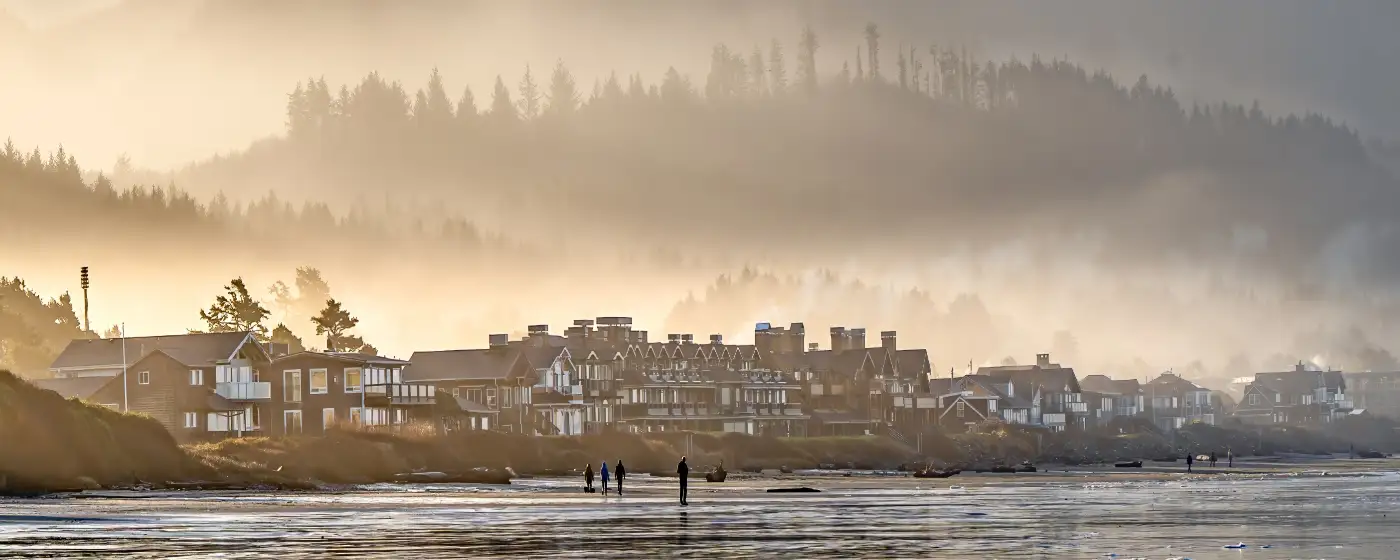
Oregon Coast · Oregon
There's a specific moment most first-time buyers in Seaside describe — usually somewhere between the pre-approval call and the first offer — where the abstraction of "buying a home" becomes something real and slightly terrifying. You've been watching Zillow for months, you've done the back-of-the-napkin math, and you've convinced yourself you understand the market. Then you see what $440,000 actually buys on a Tuesday afternoon in a coastal town with 20 active listings, and the whole picture sharpens. Seaside is genuinely worth that moment of recalibration. It's one of the few places on the Oregon Coast where a first-time buyer can still find a path to ownership without needing a co-signer who owns a tech company.
The median sold price in Seaside sits at $440,000 — confirmed through early 2026 sales data. At that price, you're typically looking at a 2-to-3 bedroom home in the range of 1,000 to 1,400 square feet, often on a modest lot, possibly with some deferred maintenance on a home built in the 1970s or 80s. You are not getting ocean views at that number. What you are getting is a real home in a real coastal community, with a mortgage payment that — depending on your down payment — could run $200 to $400 less per month than renting a comparable place in Seaside's increasingly competitive rental market.
This guide covers the entire first-time buyer process as it actually unfolds in Seaside specifically — not the generic Oregon version you've already read. That includes the qualifying income and credit realities, what each price tier realistically gets you, the five mistakes that cost Seaside buyers time and money, and two assistance programs that can meaningfully change the math on cash to close.

Seaside has some genuine advantages for first-time buyers that don't get enough attention. Compared to Cannon Beach — just 10 miles south — where entry-level homes routinely start above $700,000, Seaside's $440,000 median makes ownership a conversation worth having. The town is small enough that you'll never feel like you're in the wrong neighborhood, and the inventory, while thin, has been loosening: homes are averaging around 86 days on market in early 2026, compared to 63 days a year prior. That extra time gives buyers the breathing room to be deliberate rather than desperate.
The honest challenges are worth naming. Seaside's school district carries a C+ rating, which matters for buyers thinking about long-term resale value to families with school-age children. The commute to Portland — 91 minutes on a clear day via U.S. 26 — makes this a difficult choice for anyone with a daily office requirement downtown. And the property crime rate of 50.5 per 1,000 residents is notably high for a town this size, concentrated largely around the tourist corridor on Broadway. For buyers who've been reading about the "Oregon Coast lifestyle," the reality of a small working-class beach town with a significant seasonal economy can take some adjustment.
The neighborhoods that represent the most realistic entry points for first-time buyers are Seaside East, South Seaside, and pockets of North Seaside away from the promenade. These areas offer the kinds of older single-family homes — often 3-bedroom ranches on standard lots — where the $380,000 to $460,000 price range actually shows up in closed sales, not just in listing aspirations.
| Price Range | What You Typically Find | Neighborhood Examples | Competition Level |
|---|---|---|---|
| Under $350K | Condos, fixer-uppers, mobile/manufactured, or lots | Seaside East edges, some North Seaside parcels | Low to moderate |
| $350K–$450K | 2–3 bed older single-family, ranch-style, modest lots | South Seaside, Seaside East, North Seaside | Moderate |
| $450K–$550K | Updated 3-bed homes, some newer construction, more finishes | Seaside West, Seaside Heights, Blue Heron Pointe | Moderate to competitive |
| $550K–$650K | Larger homes, better condition, proximity to amenities or views | The Cove area, South Promenade edges, Thomson Falls Estates | Competitive |
| $650K+ | Ocean proximity, promenade access, vacation rental potential | Downtown Promenade, Sunset Hills, oceanfront streets | Highly competitive, often cash |
The sweet spot for most first-time buyers in Seaside is the $380,000 to $470,000 range, where you'll find 2-to-3 bedroom homes with enough bones to live in comfortably while building equity. South Seaside and Seaside East consistently produce closed sales in this range, and the neighborhoods are established enough to have predictable resale comps — something that matters when you go to sell or refinance in five years.
One thing worth understanding: the $353 per square foot median value in Seaside (mid-2026) means a 1,200 square foot home is worth roughly $424,000 by that metric. If you're seeing something listed at $389,000 with more than 1,200 square feet, that's a number worth paying attention to. There are still pockets where older homes haven't fully repriced to reflect the broader market, and those gaps represent real opportunity for buyers who know the comps.
| Step | What Happens | Typical Timeline | What First-Timers Get Wrong |
|---|---|---|---|
| Get finances in order | Pull credit, reduce debt, document income sources | 1–3 months before buying | Applying for new credit or changing jobs right before |
| Pre-approval | Lender reviews full file, issues pre-approval letter | 1–5 business days | Confusing pre-qualification (soft pull) with pre-approval (full underwrite) |
| Find an agent | Interview 1–2 agents with coastal/Clatsop County experience | Before active search | Using an agent unfamiliar with vacation market dynamics |
| Active search | Tour homes, attend open houses, track market | 2–8 weeks typically | Waiting for "the right one" while the market shifts |
| Making offers | Submit purchase agreement with earnest money | 1–3 offers before success | Offering list price assuming that's fair value — verify with comps |
| Under contract | Negotiation, addenda, timelines set | Days 1–5 post-acceptance | Not reading every contingency deadline carefully |
| Inspection | Licensed inspector examines property | Scheduled within 10 days typically | Skipping inspection to be competitive on older coastal homes |
| Appraisal | Lender orders; confirms value supports loan | 1–2 weeks | Panic if value comes in low — there are options |
| Final walkthrough | Confirm property condition before closing | 24–48 hours pre-close | Skipping it; verify agreed repairs were completed |
| Closing | Sign documents, fund loan, receive keys | 30–45 days from accepted offer | Not having closing funds wired 24 hours early |
In Seaside specifically, the earnest money norm in Clatsop County typically runs 1% to 2% of the purchase price — on a $440,000 home, expect to bring $4,400 to $8,800 in earnest money, which is held in escrow and applied to your closing costs. Clatsop County closings typically run 30 to 45 days, though USDA loans — which are relevant here given Seaside's rural eligibility — can run closer to 45 to 50 days due to the additional federal processing layer.
Inspection waivers are particularly risky in Seaside. A significant portion of the housing stock was built in the 1960s through 1980s, when coastal construction standards were different, moisture management was less sophisticated, and deferred maintenance on older plumbing and roofing is common. A $500 inspection can uncover $15,000 in problems. In a market where homes are averaging 86 days on market, you rarely need to waive a contingency to win — and the ones where you do should give you pause about what the seller knows.

Looking to buy in Seaside? Estimate your payment.
Enter your numbers to see an estimated monthly mortgage payment.
Estimate only. Excludes HOA fees and mortgage insurance.
For a conventional loan, the minimum credit score is 620, but the rate you get at 620 is meaningfully different from what you get at 740. On a $420,000 loan, the difference between a 6.8% rate at 650 credit and a 6.3% rate at 740 credit works out to roughly $140 per month — that's $1,680 per year, and $50,000 over the life of the loan. If your score is between 620 and 680, it's worth asking your lender whether 60 to 90 days of credit improvement would change your rate tier before you lock.
FHA loans allow a 580 minimum credit score with 3.5% down, and technically allow 500–579 with 10% down (though very few lenders will originate that). FHA requires mortgage insurance for the life of the loan unless you refinance out of it, which adds $150 to $200 per month on a $440,000 purchase. That cost is real, but for buyers with limited down payment savings, FHA is often the right first step. Qualifying income is the other piece most buyers underestimate: at a 28% front-end debt-to-income ratio, you need roughly $5,700 per month (about $68,400 annually) to comfortably qualify for a $400,000 mortgage, $6,400 per month for $450,000, and $7,100 per month for $500,000 — those figures assume no other debt eating into your DTI. The DTI ratio is the number lenders use to make sure your housing payment doesn't crowd out the rest of your financial life; most conventional loans cap total DTI at 43–45%, meaning all your debts combined (car, student loans, credit cards, housing) can't exceed that share of your gross income.
USDA loans are available in Seaside — the entire city is USDA-eligible — and they carry no down payment requirement. The income ceiling for a household of up to four people is $90,300; for five to eight people, it's $119,200. For buyers who meet those income limits and have decent credit, USDA is one of the most underused tools in a coastal Oregon buyer's toolkit.
Mistake 1: Treating the list price as the market price. Seaside homes are currently closing about 4% below list price on average, meaning a home listed at $460,000 is likely to close around $441,000. Buyers who offer full list price on a home that's been sitting for 70 days are overpaying — not bidding competitively. Pull the closed comps for the specific neighborhood before every offer.
Mistake 2: Skipping inspection on older ranch-style homes in South Seaside and Seaside East. These neighborhoods are full of homes built between 1960 and 1985, and coastal conditions are hard on structures. Moisture intrusion, aging electrical panels, and original single-pane windows are common findings. The inspection cost is $450 to $550; the repairs it might uncover can run into five figures. In a market where you have time to negotiate, this is not the place to save $500.
Mistake 3: Not accounting for the school district boundary in your resale math. Seaside School District 10's C+ rating affects how certain buyers — particularly those moving from suburbs with stronger school systems — evaluate the purchase. If resale is part of your 5 to 7-year plan, homes in neighborhoods with easy access to recreational amenities (the Necanicum River trail system, Sunset Empire Park, The Cove) tend to carry more durable value than school proximity in this market.
Mistake 4: Shopping at the top of what you qualify for, not what you can actually sustain. Seaside's economy is seasonally driven, and many local employers — tourism, hospitality, parks and rec — don't offer the income stability of a Portland-metro employer. If your income has any variability, qualifying for the maximum loan your lender will approve is a risk that compounds quickly when a slow season hits.
Mistake 5: Waiting for prices to drop back to 2019 levels. Home values in Seaside are up roughly 1.6% year-over-year even after a slight cooling in late 2025. The buyers who have been "waiting for the market to correct" for two years have watched their future down payment savings earn 4–5% in a high-yield account while home prices have continued to inch upward. If you can qualify today with a payment you can sustain, the math almost never favors waiting in a market with this little inventory.
South Seaside is the neighborhood that shows up most consistently in first-time buyer closed sales between $380,000 and $460,000. It's residential in character, away from the tourist traffic on Broadway and the Promenade, and the housing stock is predominantly single-family — the kind of neighborhood where you can own a 3-bedroom home on a real lot without paying the ocean-view premium. The trade-off is distance from the beach, but that's a 10-minute walk at most.
Seaside East, on the inland side of Highway 101, offers some of Seaside's most attainable entry-level pricing. The neighborhood has older homes, a more utilitarian character, and less competition from vacation buyers who prefer the western side of town. For buyers whose priority is monthly payment sustainability over address prestige, Seaside East delivers. Expect to find 2-to-3 bedroom homes in the $340,000 to $430,000 range with patience.
Blue Heron Pointe and Thomson Falls Estates represent a step up — homes here tend to be newer, better maintained, and priced in the $450,000 to $550,000 range. For first-time buyers who have stronger down payments or dual incomes, these neighborhoods offer better condition, more predictable maintenance costs, and stronger long-term comps than the older stock in South Seaside or Seaside East.
North Seaside is worth considering for buyers who want walkability to the Promenade and Broadway Street amenities without paying the premium of the downtown core. Pricing varies widely here depending on how close to the ocean you get, but inland pockets of North Seaside can produce deals in the $410,000 to $480,000 range — particularly on homes that need cosmetic updating rather than structural work.
✅ Seaside's $440,000 median sold price is among the most accessible entry points on the Oregon Coast — and with homes averaging 86 days on market, first-time buyers have more negotiating room than they've had in years.
⚠️ The property crime rate (50.5 per 1,000) and school district rating (C+) are real factors to weigh — especially for buyers thinking about 5-to-7-year resale potential to family buyers.
📍 South Seaside, Seaside East, and inland North Seaside are the three neighborhoods most consistently producing closed sales in the first-time buyer price range of $380,000–$460,000.
Is FHA financing a good option for first-time buyers in Seaside?
FHA financing is a strong option for many first-time buyers in Seaside, since it allows a lower down payment and more flexible credit requirements than most conventional loans. USDA financing may also be worth checking if your property and income are eligible, since it can eliminate the down payment entirely. A local lender can walk you through your specific numbers based on today's rates.
Should I get pre-approved before looking at homes in Seaside?
Yes — and not just pre-qualified. A full pre-approval means a lender has verified your income, assets, and credit, and issued a letter that sellers and agents take seriously. In a market with only 20–25 active listings at any given time, showing up to make an offer without a pre-approval letter isn't a negotiating position; it's a disqualifier. Same-day pre-approval is available through this office with a direct call to Todd.
What does a home inspection cost in Oregon and is it worth it?
A licensed home inspection in the Seaside area typically runs $450 to $550 for a standard single-family home. Given the age of much of Seaside's housing stock — a large share built in the 1960s through 1980s in coastal conditions that accelerate wear — the answer to "is it worth it" is nearly always yes. An inspection gives you negotiating leverage, a repair credit, or the information to walk away. In a market where you are rarely in a bidding war that requires waiving contingencies, there is almost no scenario where skipping the inspection is the right call.
Explore the full Seaside series: The Ultimate Seaside Relocation Guide · Is Seaside Safe? · Cost of Living in Seaside · Best Neighborhoods in Seaside · Seaside Schools & Family Life · Seaside Youth Sports · Seaside Parks & Recreation · Retiring in Seaside · 1031 Tax-Deferred Exchange in Seaside · Seaside First-Time Homebuyers Guide · · Moving to Seaside from California
Tell us what you need help with and we'll connect you with local resources.

About the Author
Todd Davidson is the founder of Living in Oregon and Living in Washington, where he publishes in-depth city guides, neighborhood resources, and local market insights covering more than 180 communities across the Pacific Northwest. While his background is in home financing and real estate, he created these digital platforms to help families research and compare regions before making a move.
Check Out the Oregon Coast Rankings: Oregon Coast Cost of Living — All 16 Cities Ranked · Best Places to Retire on the Oregon Coast · Best Oregon Coast Cities for Families · Best Oregon Coast Cities for Remote Workers · Oregon Coast Real Estate Market Report 2026 · Oregon Coast vs. Washington Coast