
Oregon Coast · Oregon
Moving to Seaside from California: The Honest Comparison (2026)
The Bay Area software engineer who finally went full remote. The San Diego couple who opened their utility bill one August and started Zillow-searching Oregon out of spite. The Sacramento family that sold a 1,400-square-foot townhome and bought a four-bedroom house with a yard and ocean views for less money. California-to-Oregon migration is real, it's accelerating, and Seaside keeps showing up on the shortlist — not because it's a compromise destination, but because it delivers something specific: a small oceanfront city with genuine character, a walkable historic core, and home prices that make California sellers feel like they've discovered a cheat code.
The honest part comes next. Seaside is not a California city with Oregon license plates. The weather is not a minor inconvenience — it's a fundamental lifestyle shift. The food scene, the nightlife, the cultural density that California residents absorb without noticing — those things don't transfer. Seaside has a population of around 7,110 people, and that number is the entire city, not a single neighborhood. The pace is slower by design, the gray season is longer than most people expect, and the cultural calendar is built around tides, surf, and the Turnaround — not Michelin stars and rooftop bars.
This guide runs the actual numbers by California origin market — Bay Area, Southern California, Sacramento, and Central Valley — and shows what your specific equity does in Seaside. It covers the tax picture honestly (yes, Oregon has income tax), the weather reality month by month, and the specific mistakes California buyers make when they arrive. There's also an interactive comparison tool where you can look up your exact city.

| Seaside, Oregon | Bay Area | Southern California | Sacramento Metro | Central Valley | |
|---|---|---|---|---|---|
| Median Home Price (approx. 2026) | $440,000 | $1.3M–$1.8M | $750K–$1.1M | $530K–$620K | $340K–$420K |
| Property Tax Rate (effective) | ~0.63% | ~1.1–1.2% | ~1.1–1.25% | ~1.1–1.2% | ~1.0–1.15% |
| State Income Tax (top bracket) | 9.9% | 13.3% | 13.3% | 13.3% | 13.3% |
| State Sales Tax | 0% | 7.25–10.75% | 7.25–10.75% | 7.25–8.75% | 7.25–8.75% |
| Avg Utilities (monthly est.) | $175–$220 | $150–$200 | $130–$185 | $160–$210 | $155–$215 |
| Avg 1BR Rent | $1,200–$1,600 | $2,900–$3,800 | $2,200–$3,000 | $1,500–$1,900 | $1,000–$1,400 |
A buyer leaving Walnut Creek with $1.5 million in home equity who purchases in Seaside at the $440,000 median is likely eliminating their mortgage entirely and banking over a million dollars in remaining equity. That's not a modest upgrade — it's a fundamental restructuring of monthly cash flow. Even at the higher end of Seaside's active market, around $525,000–$540,000 for a well-maintained home with ocean views, a Bay Area seller walks in with cash to spare.
The sales tax elimination alone is meaningful on a day-to-day basis. A California household spending $60,000 annually on taxable goods and services at a blended 8.5% rate is paying roughly $5,100 per year in sales tax. In Oregon, that line item goes to zero on day one of residency. Property taxes on a $440,000 Seaside purchase run approximately $2,772 per year at the 0.63% effective rate — compared to roughly $5,720 on a comparable assessed value in California at 1.3%. Even accounting for Oregon's income tax, the combined tax picture often favors the Oregon side of the ledger for buyers who own rather than rent.
Oregon does have a state income tax — graduated up to 9.9% at the top bracket — and California transplants who assumed the Pacific Northwest means no income tax need to recalibrate quickly. Oregon is not Washington. The trade-off is real but nuanced: you're giving up a 13.3% top California rate and landing at 9.9%, which on a $150,000 income represents a meaningful reduction in state income tax liability. A rough calculation: California's rate on $150K runs approximately $13,000–$14,000 in state income tax at the upper brackets; Oregon's equivalent is closer to $10,000–$11,000 for the same income. That's a $3,000 annual difference that compounds over time.
Oregon's Measure 50 protects long-term owners in a way California's Prop 13 parallel often gets misunderstood. Once you purchase in Seaside, your assessed value can only increase by a maximum of 3% per year for property tax purposes — regardless of what the market does. If Seaside homes appreciate 15% over the next five years, your tax bill grows at a capped 3% annually. For retirees and remote workers planning to stay long-term, this creates meaningful fiscal predictability that California's system, despite its own protections, often fails to deliver for new buyers entering at today's prices.
| Tax Item | California | Oregon | Net Impact |
|---|---|---|---|
| State Income Tax (top bracket) | 13.3% | 9.9% | Oregon saves ~$3K–$5K/year at $150K income |
| State Sales Tax | 7.25–10.75% | 0% | Oregon saves ~$3,500–$5,500/year on typical spending |
| Property Tax (on $440K home) | ~$5,700/year | ~$2,772/year | Oregon saves ~$2,900/year |
| Capital Gains (state) | Up to 13.3% | Up to 9.9% | Oregon saves significantly on large CA equity gains |
| Senior Property Tax Deferral | Limited | Available at 62+ | Oregon advantage for retirees |
| Assessed Value Growth Cap | Prop 13 (limited to purchase) | Measure 50 (3%/year cap) | Similar protection, Oregon applies at purchase |
For homeowners over 62, Oregon offers a property tax deferral program that allows qualified residents to defer property tax payments until the home is sold or transferred. For California retirees with fixed incomes considering a coastal retirement, this option can be material.
The honest full picture: if you earn under $125,000 in Oregon, the income tax difference from California is modest and often offset entirely by eliminating sales tax and lowering property taxes. At higher incomes, Oregon still comes out ahead of California's 13.3% top rate, though the margin narrows. What you're trading is the illusion of California as a lower-tax state — a perception that hasn't been accurate for most buyers for well over a decade.
A buyer leaving San Jose, Fremont, or the East Bay Tri-Valley with $1.4 million in equity arrives in Seaside as a cash buyer in virtually every price tier the city offers. The top of Seaside's market — oceanfront homes along the Promenade corridor, renovated craftsmen near Broadway, and newer construction in South Seaside — tops out in the $800,000 to $950,000 range for exceptional properties. A Bay Area seller at this equity level buys what they want, pays cash, and retains $500,000 or more in liquid assets or investment capital. For buyers considering a second home or investment property in addition to a primary residence, that remaining equity makes dual-property ownership genuinely feasible in a way it would never be in California.
The neighborhoods that represent the strongest value at this equity level are the Promenade-adjacent streets in North Seaside and the quieter blocks south of Broadway toward South Seaside. Oceanfront inventory in Seaside does move, and cash buyers from California can move faster than financed buyers — which in a coastal market with limited ocean-facing supply matters more than list price negotiation.
A buyer leaving Irvine, Pasadena, or the South Bay with $900,000 in equity lands in the top tier of Seaside's market with cash to spare and no mortgage. At $700,000 in equity, they're looking at a full-price purchase at the median with $260,000 remaining — enough for a significant renovation, a cash reserve, or a down payment on a small investment property. Southern California buyers in this equity range consistently find themselves overpowered relative to the local Seaside market, which still sees plenty of financed transactions from Pacific Northwest buyers working with conventional loans.
The areas that tend to attract SoCal buyers who want their dollar to stretch visibly are The Cove neighborhood near the surf break, and Seaside Heights for elevated views. Both offer a distinct character that California buyers with outdoor-recreation backgrounds tend to respond to immediately.
Sacramento buyers selling in Elk Grove, Rocklin, or Roseville in the $550,000–$700,000 range are making a move that looks smaller on paper but is still financially compelling. A $500,000 equity position from Sacramento buys a clean three-bedroom home in Seaside outright, or converts to a very strong down payment on a higher-end property. The elimination of California's 7.25–8.75% sales tax on everyday purchases is something Sacramento buyers feel immediately and concretely — that city's residents have been paying those rates on everything from furniture to car purchases their entire lives.
Buyers from the Sacramento metro entering at the $400,000–$500,000 price point in Seaside land in a realistic range of inventory. Seaside East and Wahanna offer more land and space at this price level, with conventional financing accessible at Seaside's median without entering jumbo territory.
Central Valley buyers — Fresno, Stockton, Modesto, Bakersfield — arrive with the most modest relative advantage, but "modest" here is contextual. A $350,000 equity position from a Central Valley sale still represents a meaningful down payment in a market where the median sold price sits at $440,000. Buyers at this equity level may be entering with a small mortgage rather than going all-cash, but the monthly payment on a $90,000 balance is a number that would be unrecognizable to them as a California homeowner.
Stanley Acres, Wahanna, and the eastern parts of Seaside offer the most inventory in the $350,000–$465,000 range. These are solid starter neighborhoods for buyers transitioning from the Central Valley who want to build equity in a coastal market without stretching their finances.

Looking to buy in Seaside? Estimate your payment.
Enter your numbers to see an estimated monthly mortgage payment.
Estimate only. Excludes HOA fees and mortgage insurance.
Here is what a good friend who moved from San Diego to Seaside three years ago would actually tell you: the summers are extraordinary and the winters are long, gray, and genuinely challenging if you need sunlight to function emotionally. Seaside averages around 128 sunny days per year — Los Angeles gets roughly 284. Seaside sees precipitation on approximately 185 days annually; San Diego averages around 40 rainy days. That is not a rounding difference — that is a fundamentally different relationship with the sky. Buyers who come from Sacramento or the Central Valley, where summer heat is oppressive, often adapt more naturally because they've already built an indoor-season mentality around summer rather than winter.
What California transplants genuinely love after a year in Seaside: the summers. July temperatures average a high of 67°F with 8–11 hours of daily sunshine, no wildfire smoke most years, zero air conditioning required, and the Promenade and beach fully accessible on foot from most of the city. After years of retreating indoors in August, California buyers often describe Seaside's summer as the version of coastal living they always imagined they had in California. The commute relief is the second thing people name — not having to sit on the 405 or Highway 50 rearranges your psychology faster than any metric predicts. And Seaside's pace — a city where Broadway Street is walkable for dinner, where neighbors actually know each other, and where the Turnaround is a genuine community gathering spot — delivers a quality of daily life that is difficult to quantify but immediately felt.
What they miss: year-round outdoor beach culture. Dining at California's depth and diversity. The social energy of a larger city — the sense that something is always happening somewhere nearby. Seaside's restaurant scene is good for its size, but it is not San Francisco's Mission District or LA's Koreatown. Buyers from culturally dense California cities should plan for Portland day trips as part of their social architecture, particularly in winter. The 91-minute drive north on US-101 to US-26 is not something most people find oppressive for an occasional city day — but it does require intentionality that California city life never demanded.
If you want to see how Seaside compares directly to the city you're leaving, use the tool below — it covers the 120 largest California cities with current housing and tax data.
Home prices: Redfin median sale data, Q1–Q2 2026. Select your city to compare.
Ready to talk through what your specific California equity could do in Seaside? Todd can model your exact scenario in a single call.
Assuming the whole city feels uniform. Seaside has real internal variation that California buyers often miss during a two-day scouting trip. The Promenade corridor and Broadway commercial district have an entirely different character from Seaside East and the areas near US-101. Buying near the highway without understanding the coastal-versus-inland divide within a seven-square-mile city is one of the most common sources of post-move disappointment. Spend time in each area, ideally on a weekday in November, before committing.
Skipping radon testing. Oregon has elevated radon zones, and Clatsop County falls within areas where soil radon levels can be meaningful. California buyers arriving from coastal Southern California — where radon is rarely a transactional concern — often skip this test entirely. It is a standard and inexpensive part of the Oregon home inspection process and should not be waived regardless of the home's age or condition.
Expecting California-style year-round outdoor lifestyle to transfer directly. California transplants who built their identity around year-round cycling, hiking, and beach access tend to arrive in September, fall in love with Seaside's October, then get ambushed by January. Tillamook Head is stunning in winter — it is also 40 degrees and sideways-raining on many January days. Seaside's outdoor culture operates year-round, but it operates differently in winter. Locals wear waterproof shells, not hoodies. Building a winter social and fitness routine before the gray season arrives — rather than reacting to it — is the practical adjustment that separates happy transplants from people listing their house in March.
Underestimating how a small-town market actually works. Bay Area buyers accustomed to algorithmic Zillow offers and 72-hour bidding wars sometimes apply California market assumptions to Seaside. This market is smaller, more relationship-driven, and less predictable in timing. The right property in The Cove or on the Promenade may sit for 90 days, or it may be gone in a week. Having a pre-approval or proof-of-funds ready before you find the right house — not after — matters here in ways the California market has conditioned buyers to underestimate.
Bay Area sellers with large equity are often best served by entering Seaside's market as cash buyers or at extremely low loan-to-value ratios. At the median price of $440,000, a Bay Area seller with $1.2 million in equity needs no mortgage at all — which shifts the conversation from rate negotiation to transaction speed, terms, and seller confidence. For buyers who sold a California investment property rather than a primary residence, a 1031 tax-deferred exchange can shelter significant capital gains and redirect that equity into a qualifying Seaside investment property. The timeline and identification requirements for a 1031 exchange are strict, so that conversation needs to happen before the California close, not after.
Southern California sellers entering Seaside with a $700,000–$900,000 equity position are in conventional financing territory even if they choose not to go all-cash. Seaside's median price sits well below the conforming loan limit, which means most financed transactions here avoid jumbo pricing entirely. A SoCal seller putting 40–50% down is looking at a loan amount in the $200,000–$260,000 range — straightforward conventional underwriting with a payment structure that feels dramatically different from California norms.
Sacramento and Inland Empire buyers transitioning with $400,000–$550,000 in equity may find that some entry-level Seaside properties — particularly in Wahanna or Stanley Acres in the $350,000–$420,000 range — are within reach as an outright cash purchase, which preserves liquidity better than deploying a smaller amount into financing costs and closing fees. Buyers at the lower end of this equity range should still get pre-qualified in case they'd rather finance a portion and keep more cash on hand.
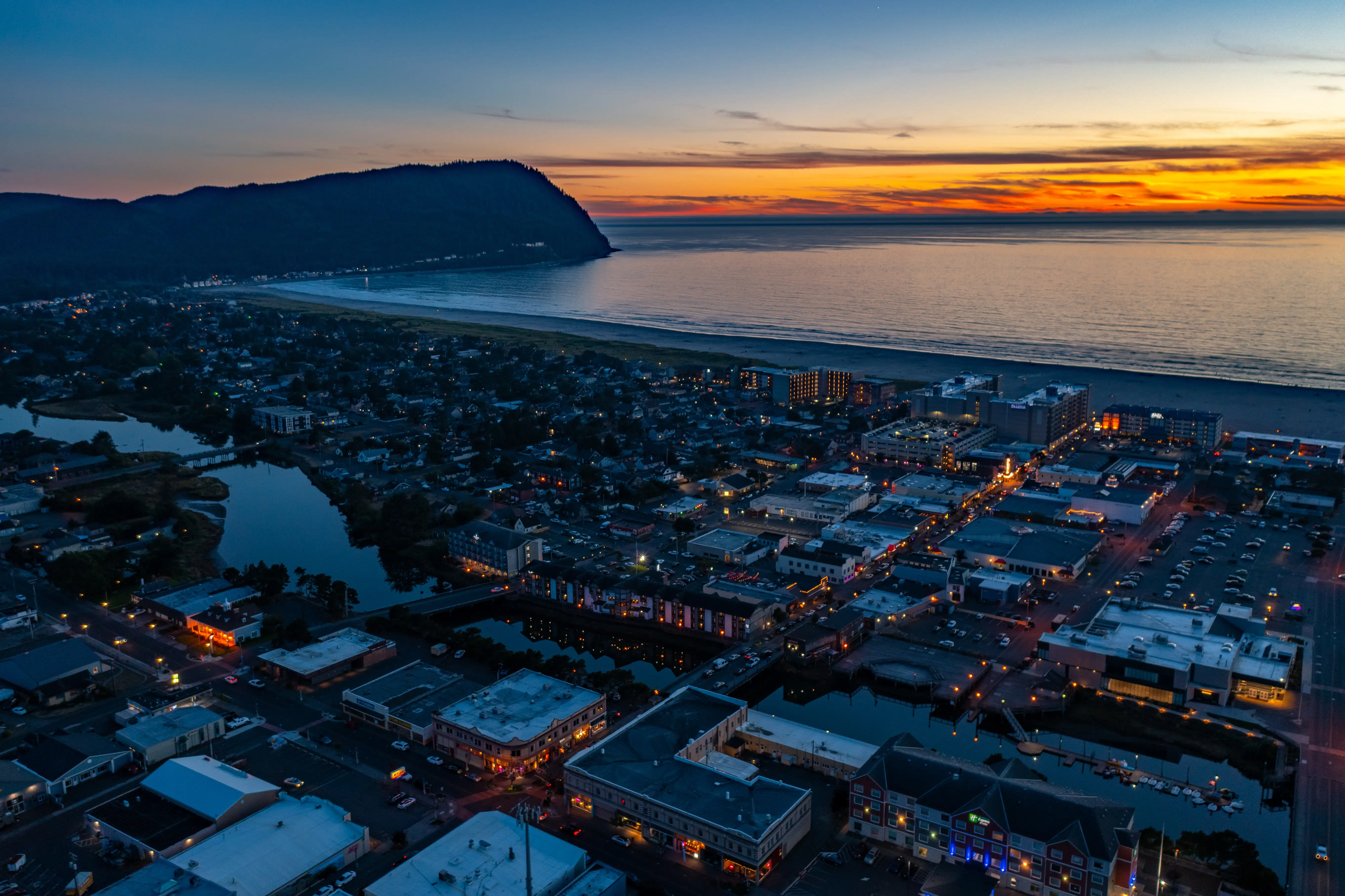
Local Expert Takeaway: California buyers consistently underestimate how much Seaside's coastal microclimate differs not just from California but from Portland — the city they often use as their Oregon weather reference point. Seaside's 91-inch annual rainfall and 185 rain days are a specific, coastal reality. Buyers who tour in July or August and buy based on that experience are making a decision on the city's best four months. Before closing, ask your agent to show you the same property in November conditions — walk the neighborhood on a gray Tuesday, not a sunny Saturday — and make sure your lifestyle plan includes the winter version of Seaside, not just the summer one.
✅ A Bay Area or Southern California seller buying at Seaside's $440,000 median typically eliminates their mortgage entirely and retains significant equity — reshaping monthly cash flow more dramatically than almost any other West Coast relocation move.
⚠️ Oregon has a state income tax up to 9.9% — California transplants who assume the Pacific Northwest means no income tax need to recalibrate before closing. The combined tax picture still favors Oregon for most buyers, but the income tax line isn't zero.
📍 Seaside's weather is genuinely different from every California metro origin market — roughly half the annual sunshine hours of Los Angeles and four to five times as many rain days as San Diego. The summers are exceptional; the winters require a lifestyle adjustment that most people underestimate until they've lived through one.
Is moving from California to Seaside worth it?
For equity-rich California sellers, the financial case is straightforward: a median Seaside home at $440,000 costs roughly one-third of a Bay Area median and less than half of most Southern California medians. The elimination of state sales tax, lower property taxes, and a reduced Oregon income tax rate create a compounding annual savings that typically exceeds $8,000–$12,000 per year for a household moving from a major California metro. The lifestyle adjustment is real — smaller city, more rain, less cultural density — but buyers who arrive knowing that reality tend to thrive. Those who arrive expecting a California-equivalent lifestyle with better housing prices are often disappointed within a year.
What does California home equity buy in Seaside?
Bay Area sellers with $1.2 million or more in equity can purchase any home in Seaside with cash and retain meaningful reserves. Southern California sellers with $700,000–$900,000 in equity enter the top tier of Seaside's market debt-free. Sacramento and Inland Empire buyers with $400,000–$550,000 can purchase at or above the median with a very small remaining loan — or go all-cash at the entry level. Even Central Valley buyers with $300,000–$400,000 in equity arrive in Seaside with enough for a strong down payment on a three-bedroom home, at a price point that requires no jumbo financing.
How does Oregon property tax compare to California?
On a $440,000 home in Seaside, annual property taxes run approximately $2,772 at the 0.63% effective rate. A comparable assessed value in California at a 1.2% effective rate would generate roughly $5,280 per year. The difference is immediate, and it grows over time because Oregon's Measure 50 caps assessed value increases at 3% per year — so a long-term Seaside owner pays significantly less in property taxes over a decade than a California owner whose assessed value tracks a rising market without similar protection.
Explore the full Seaside series: The Ultimate Seaside Relocation Guide · Is Seaside Safe? · Cost of Living in Seaside · Best Neighborhoods in Seaside · Seaside Schools & Family Life · Seaside Youth Sports · Seaside Parks & Recreation · Retiring in Seaside · 1031 Tax-Deferred Exchange in Seaside · Seaside First-Time Homebuyers Guide · · Moving to Seaside from California
Tell us what you need help with and we'll connect you with local resources.

About the Author
Todd Davidson is the founder of Living in Oregon and Living in Washington, where he publishes in-depth city guides, neighborhood resources, and local market insights covering more than 180 communities across the Pacific Northwest. While his background is in home financing and real estate, he created these digital platforms to help families research and compare regions before making a move.
Check Out the Oregon Coast Rankings: Oregon Coast Cost of Living — All 16 Cities Ranked · Best Places to Retire on the Oregon Coast · Best Oregon Coast Cities for Families · Best Oregon Coast Cities for Remote Workers · Oregon Coast Real Estate Market Report 2026 · Oregon Coast vs. Washington Coast