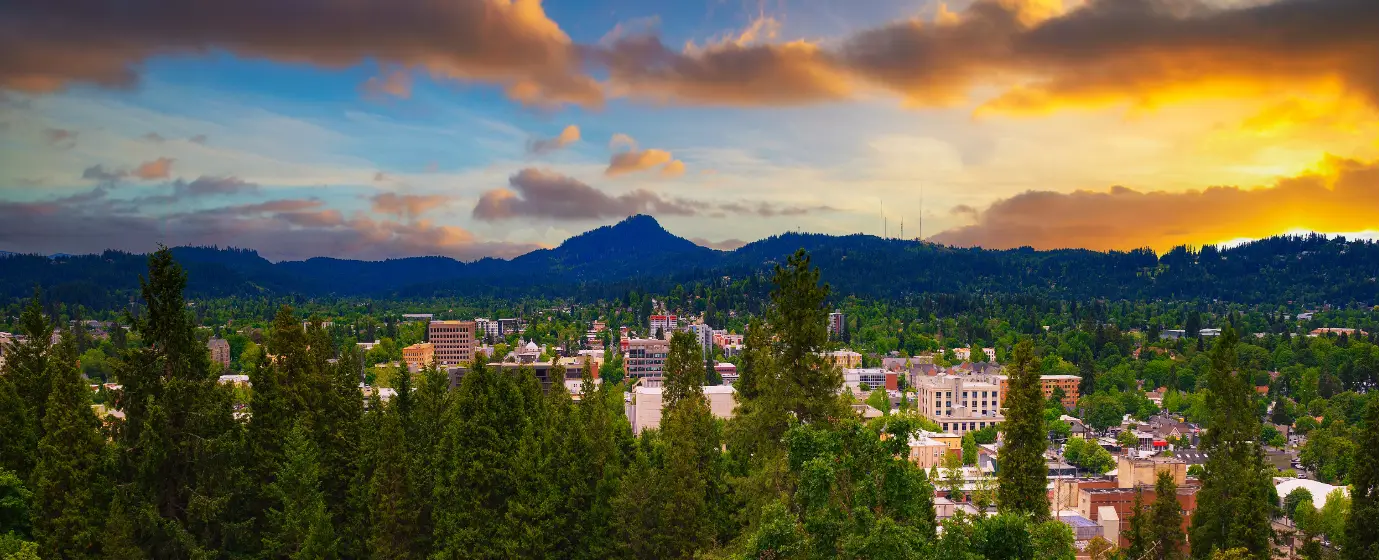
Willamette Valley · Oregon
Living in Eugene: The Ultimate Relocation Guide (2026)
Maybe you've been watching Oregon real estate for a year, triangulating between Portland's price tags and the smaller towns that actually fit your budget. Maybe someone in your field mentioned Eugene — the University of Oregon, PeaceHealth, the running culture — and you started looking at Zillow listings at 11pm and couldn't stop. Or maybe you drove through on I-5, caught a glimpse of the Willamette River and the hills rising green behind the city, and thought: that looks like a place I could actually live.
What nobody tells you before the move is that Eugene holds two cities inside one. There's the college town — young, idealistic, politically charged, with a food cart outside every brewery and a fixie bike locked to every signpost — and there's the mid-size Oregon city underneath it, with real neighborhoods, real employers, real schools, and a housing market that has quietly appreciated through every economic cycle for three decades. The tension between those two versions of Eugene is something every relocating buyer eventually has to make peace with.
This guide is built for the buyer who wants the honest version. You'll find the real neighborhood breakdown, what the commute actually looks like, why people stay for decades, and why some people leave after three years. By the end, you'll know whether Eugene belongs on your short list — or whether one of the surrounding communities is a better fit.
Before diving into geography and price points, it helps to match your situation to what Eugene actually delivers well. The city overperforms for some buyer profiles and genuinely disappoints others.
| Best For | Why |
|---|---|
| Remote workers | $475,000 median home price, strong fiber internet options, and a walkable urban core make it one of Oregon's most livable remote-work cities |
| University-adjacent professionals | UO faculty, researchers, and healthcare workers at PeaceHealth can live close to work without the long Portland commute |
| Outdoor-first households | Spencer Butte, the Ridgeline Trail, and the Willamette River are within reach of nearly every neighborhood |
| First-time buyers priced out of Portland | Eugene runs roughly 22% cheaper than Portland on housing — and there's no sales tax in Oregon |
| Retirees seeking a college-town energy | World-class events at Hayward Field, the Jordan Schnitzer Museum of Art, and a walkable downtown with healthcare anchored by PeaceHealth |
| Families with school-age children | Eugene School District 4J offers strong programming, and the city's parks system is genuinely extensive |
Eugene sits at approximately 426 feet of elevation in the southern Willamette Valley, roughly 110 miles south of Portland. The city is physically defined by two things: the Willamette River along its northern edge and the Coast Range foothills rising on its western and southern sides. Spencer Butte — visible from much of the city — functions as an informal compass point. When locals say something is "toward the butte," you're heading south.
Daily life in Eugene moves at a pace that takes some adjustment if you're arriving from a larger metro. The city covers just under 44 square miles, which means most errands don't require a freeway. Alton Baker Park, stretching along the Willamette just east of downtown, is where you'll find the city on weekday evenings — runners on the Pre's Trail, cyclists looping toward the Autzen footbridge, dogs in the off-leash area. It's genuinely the city's living room, and it fills up regardless of season.
The traffic reality is manageable but has its chokepoints. The stretch of West 11th Avenue from Highway 99 toward Beltline Road is the corridor most transplants learn to dread — heavy commercial traffic, lots of turning movements, and slowdowns between 4:30 and 6:00 PM that can stretch a two-mile errand into 20 minutes. The interchange between I-105 and I-5 near the Valley River area backs up predictably during the same window. Learn those two spots and you'll route around most of what Eugene's traffic actually is.
Commuting to Portland is a genuine conversation every relocating professional needs to have with themselves. At 109 minutes each way, it's not a daily commute — it's a once-or-twice-a-week trip at best. Most Eugene residents who have Portland obligations drive early, avoid the Woodburn-to-Salem corridor between 7 and 9 AM, and treat it as a day trip. The Amtrak Cascades line runs between Eugene and Portland with reasonable frequency, which works for occasional office days but not for daily commuters.
The outdoor access is not exaggerated. Eugene residents who arrived planning to stay three years frequently find themselves still here at fifteen, and outdoor access is almost always part of the explanation. The Ridgeline Trail system connects Hendricks Park to Spencer Butte Park through miles of forested single-track within city limits. Pre's Trail in Alton Baker Park gives runners a flat 3.2-mile loop along the river. The McKenzie River — one of the most celebrated fly-fishing rivers in the American West — is 45 minutes east. The Oregon Coast is about 65 miles west on Highway 126. Most Pacific Northwest cities promise this kind of access; Eugene actually delivers it within reach of ordinary weeknight schedules.
The cultural programming punches well above a city of 178,000. Hayward Field — completely rebuilt and reopened in 2020 — regularly hosts USATF national championships and international track meets that draw world-class athletes to a facility that seats roughly 12,500. The Jordan Schnitzer Museum of Art on the UO campus offers rotating exhibitions that would feel at home in a city three times Eugene's size. The Hult Center for the Performing Arts brings touring productions and a resident symphony. Eugene has earned the nickname "TrackTown USA" honestly, and the energy around major meets in late spring is something transplants almost universally cite as a genuine civic highlight.
The housing math relative to Portland is a meaningful lifestyle advantage. At a median sold price of $475,000 — and with Oregon's 0% sales tax — buyers arriving from Portland, the Bay Area, or Seattle often find that their dollar goes meaningfully further. A family that would be stretching into a small house in Portland can buy a well-maintained mid-century home with a real yard in South Eugene or a newer construction home in Harlow for a similar number. The monthly savings compound into life flexibility.
Eugene's food and coffee culture is real and locally sourced in ways that feel organic rather than curated. Market of Choice — a Eugene-born upscale grocery with its corporate headquarters still in the city — anchors the quality end of the grocery landscape. The Saturday Market in downtown runs April through November and has operated continuously since 1970, making it one of the longest-running outdoor arts and crafts markets in the United States. The weekly ritual of hitting the Saturday Market for breakfast and browsing is something that becomes hardwired into Eugene life faster than most transplants expect.
Looking to buy in Eugene? Estimate your payment.
Enter your numbers to see an estimated monthly mortgage payment.
Estimate only. Excludes HOA fees and mortgage insurance.
Eugene's poverty rate — running at approximately 18–19% — is higher than the national average and higher than most Oregon suburbs. This isn't an abstraction; it shows up in visible street-level homelessness, particularly in the downtown core and along the riverfront near Alton Baker Park. The city has made significant policy investments in addressing this, and the conversation is active and ongoing. Buyers who have lived only in affluent suburbs should go into Eugene with clear eyes about what the city's social fabric actually looks like at ground level, because it is part of what Eugene is.
The weather in the Willamette Valley is a lifestyle choice, not a minor footnote. Eugene receives roughly 47 inches of rain annually and sees around 143 sunny days per year — well below the national average. From mid-October through late April, the city operates under a near-constant low gray ceiling. Seasonal affective disorder is a real and commonly discussed topic in Eugene's healthcare community. Buyers arriving from California, the Southwest, or the Midwest should spend a January week in the city before committing — the summer months are genuinely beautiful, but the winter-to-summer ratio is what determines whether Eugene fits your psychology.
The income ceiling is real. With a median household income of approximately $66,562, Eugene skews lower than comparable Oregon cities, partly because of the student population pulling down averages and partly because the economy is anchored by sectors — education, healthcare, public service — that offer stability more than wealth. Remote workers and professionals earning outside the local wage scale find Eugene a genuine bargain. Buyers whose income is tied to local employment should run their numbers carefully.
Why some people leave: The most common departure story involves career progression. Eugene's economy is anchored in education, healthcare, and public sector work. Private sector professional opportunities — particularly in finance, tech, and corporate management — are significantly more limited than in Portland or Seattle. Workers who arrive for a UO position or PeaceHealth role and then outgrow the local job market frequently find themselves making a Portland or Seattle decision five to seven years in. If you're mid-career and expect to change industries or significantly advance, factor that constraint into your planning.
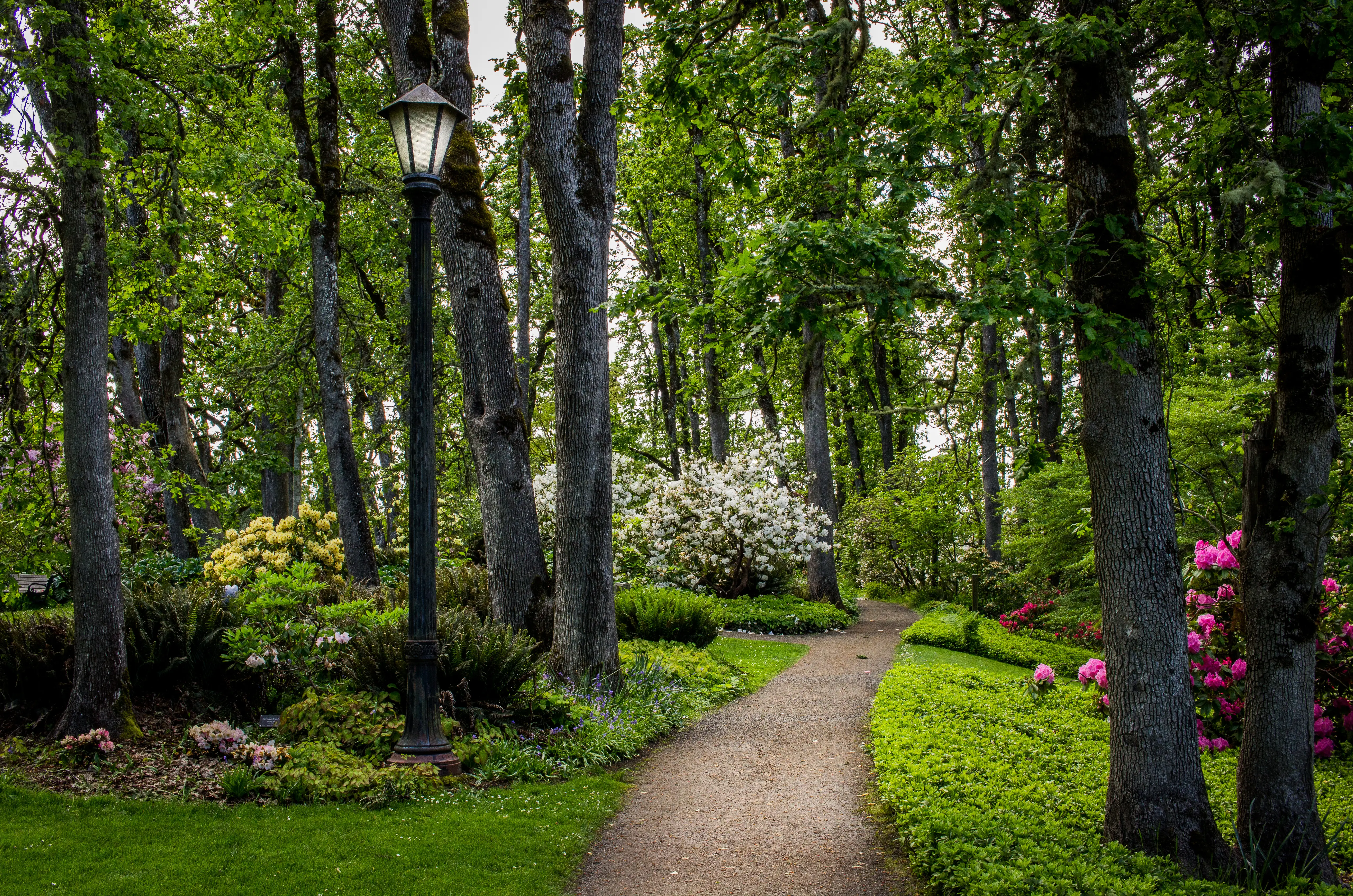
Fairmount is the neighborhood that South Eugene buyers find first and return to after looking everywhere else. It runs along the eastern edge of the University of Oregon, with Hendricks Park — the oldest park in the city, featuring a rhododendron garden and miles of forest trails — as its northern anchor. Homes here lean toward early-20th-century bungalows and craftsman revivals on larger-than-average lots, many with thoughtful updates that preserve the architectural character. The median sold price in the broader South Eugene corridor runs into the mid-$500,000s and climbs well above $700,000 for the larger park-adjacent properties. Fairmount draws UO faculty, PeaceHealth physicians, and buyers who have decided that walkability to campus and trees overhead are non-negotiable.
Best for: Professionals and families who want South Eugene character, walking access to Hendricks Park, and a long-term owner-occupied community feel.
Amazon takes its name from Amazon Creek, not the company, and the neighborhood centers around Amazon Park — 40 acres with a pool, tennis courts, and open fields in the heart of South Eugene. This is one of the more family-oriented pockets of the south side, with a mix of mid-century ranches and updated two-stories that attract households seeking good schools and park access without the full Fairmount premium. The median home value in the Amazon neighborhood runs approximately $369,000, making it one of the more accessible entry points in South Eugene. The honest tradeoff is density: lots are smaller than Fairmount and the housing stock is less architecturally distinctive.
Best for: Families who want South Eugene schools and park access at a more accessible price point than Fairmount.
South University occupies the blocks immediately south and west of the UO campus, which makes its character inseparable from the university's rhythms. Rental density is high, parking is contested during the academic year, and the neighborhood's small commercial strips — particularly along Kincaid Street — cater to a student-first customer base. Buyers who purchase here are typically investors or young professionals who want to live walking distance from campus, the Erb Memorial Union, and the Jordan Schnitzer Museum of Art. Owner-occupants exist and find the area genuinely lively, but the neighborhood trades quiet for energy in a way that makes it a poor match for households seeking a settled residential feel.
Best for: Investors, graduate students, and buyers who want walkable proximity to UO and don't mind the energy that comes with it.
Whiteaker — almost universally called "the Whit" by locals — is Eugene's most distinctly independent neighborhood, sitting just west of downtown between the railroad tracks and the Willamette. It has the density of Portland's inner eastside neighborhoods but with Eugene prices and Eugene politics. The area hosts a strong concentration of craft breweries, studios, community gardens, and the annual WOW Hall events. Home values have climbed as the neighborhood has gentrified from its earlier industrial character, and buyers who purchased here five years ago have seen meaningful appreciation. The friction is real: street noise, older housing stock with deferred maintenance, and the visible social service concentration along the neighborhood's commercial corridors.
Best for: Buyers who want the Pacific Northwest creative-neighborhood experience at a price point that inner Portland can no longer deliver.
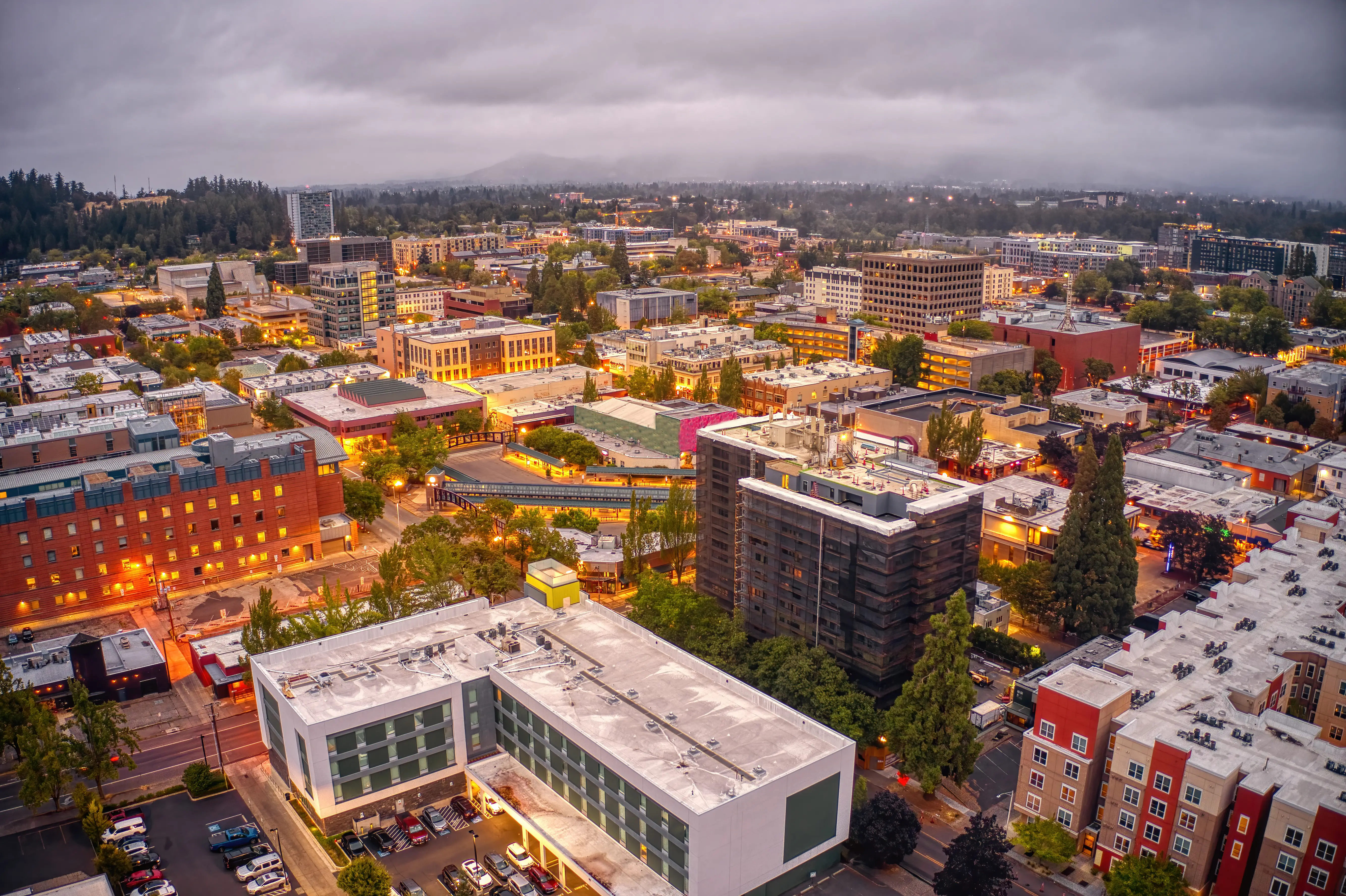
Downtown Eugene has been in a slow state of reinvention for most of the past decade. The 5th Street Public Market anchors the northeast corner of downtown with local restaurants and boutique retail. The Hult Center sits one block off the Park Blocks, and the Saturday Market fills that public space from spring through fall. Median sold prices in the downtown segment run significantly lower — closer to the mid-$300,000s — largely because the housing stock skews toward condos and smaller units rather than single-family homes. Foot traffic has improved since the opening of the Canopy by Hilton and other hospitality investments, but the blocks between the market district and the riverfront remain uneven.
Best for: Urban-lifestyle buyers who want walkable amenities, lower entry price, and proximity to the Willamette without a suburban footprint.
Cal Young sits in northeast Eugene, roughly bounded by Coburg Road to the west and the Amazon Trail to the south, and it is the neighborhood that surprises buyers who haven't looked at it carefully. The housing stock is primarily 1960s–1980s ranch-style and split-levels on generous lots, and the neighborhood has a calm, owner-occupied character that reads more like a Pacific Northwest suburb than an urban district. The median home value in Cal Young runs approximately $387,000 with a median household income significantly above the city average at nearly $70,000. For buyers who want South Eugene-style stability without South Eugene prices, Cal Young is among the more consistent recommendations from local agents.
Best for: Families and established professionals who want Northeast Eugene's quieter pace, larger lots, and below-South-Eugene pricing.
The Friendly Area Neighborhood — named for the South Willamette corridor that anchors its commercial heart — is one of Eugene's most walkable residential districts outside of the University zone. South Willamette Street from 24th to 29th Avenue offers independent restaurants, a co-op grocery, coffee shops, and a hardware store that locals cycle to on weekend mornings. Housing is a mix of 1930s–1950s bungalows and cottages on narrow lots, generally in the mid-$400,000s to low $500,000s. The neighborhood's central tension is that its walkability is its appeal and its price driver simultaneously — buyers pay for the street life, and the lot sizes reflect it.
Best for: Buyers who want genuine neighborhood walkability, South Eugene character, and a block-level community that organizes, shows up, and knows its neighbors.
Harlow occupies a large swath of northeast Eugene east of the Delta Highway corridor, and it is where much of Eugene's newer residential construction has landed over the past 15 years. Subdivisions are well-maintained, lots are larger, and the neighborhood has direct access to the Harlow Road commercial corridor and the Costco/Target retail zone near Beltline Road. This is the Eugene neighborhood that most closely resembles a conventional Pacific Northwest suburb, which is either a point in its favor or against it depending entirely on your priorities. Prices run below the South Eugene median, making Harlow one of the more accessible options for buyers with children who want newer construction and easy freeway access.
Best for: Families arriving from suburban markets who want newer construction, proximity to big-box retail, and Northeast Eugene schools without South Eugene pricing.
| City | Best For | Median Home Price | Commute to Portland | Vibe |
|---|---|---|---|---|
| Eugene | University lifestyle, outdoor access, full city amenities | $475,000 | 109 min | College town meets mid-size Oregon city |
| Springfield | First-time buyers, lower price point, quick Eugene access | ~$350,000 | 115 min | Working-class suburb, improving incrementally |
| Coburg | Small-town quiet, rural feel, Lane County taxes | ~$420,000 | 125 min | Tight-knit rural community, very limited services |
| Junction City | Agricultural character, space, affordability | ~$370,000 | 120 min | Semi-rural, quiet, limited walkability |
| Creswell | Commuters who want acreage near I-5 | ~$385,000 | 130 min | Bedroom community, limited local employment |
| Veneta | Rural lifestyle west of Eugene, larger lots | ~$380,000 | 120 min | Agricultural community, limited services |
| Metric | Data |
|---|---|
| Population | 178,961 (2026 estimate) |
| Median Home Price | $475,000 (mid-2026) |
| Median Household Income | $66,562 |
| Property Tax Rate | Approximately 0.95% |
| Commute to Portland | ~109 minutes |
| Violent Crime per 1,000 | 3.2 |
| Property Crime per 1,000 | 33 |
| School District Rating | B (Eugene School District 4J) |
| Sales Tax | 0% (Oregon statewide) |
| Median Rent | Approximately $1,800/month |
| Unemployment Rate | ~3.9% (Eugene-Springfield MSA, 2025) |
Eugene has earned some of its reputation fair and square, and a few of the local traditions are genuinely worth knowing before you arrive.
Hayward Field in late June is something else entirely. When USATF national championships come to Eugene — as they do most summers — the city transforms in a way that surprises even longtime residents. The track and field community takes over downtown hotels, the Saturday Market draws enormous crowds, and the stands at Hayward fill with people who actually know the technical difference between a steeple and a 3K. Eugene has a higher density of competitive runners per capita than almost any American city, and that culture is visible on Pre's Trail every morning of the year, not just during championship season.
The Eugene Saturday Market is a 50-year institution. Running every Saturday from April through mid-November, and adding a Sunday market through December, the Saturday Market on the Park Blocks is among the longest-running outdoor markets in the United States. It is specifically an artisan market — crafts and original artwork alongside food — not a farmers market, though produce vendors are present. For new residents, it functions as an orientation to the city's social fabric. You'll run into neighbors, find the coffee roaster you'll use for the next decade, and understand something true about how Eugene sees itself.
Track and run culture is woven into the infrastructure. Nike was co-founded in Eugene, and the city's relationship with track goes back to Bill Bowerman and Steve Prefontaine in ways that have genuinely shaped the built environment. Pre's Trail was named in Prefontaine's honor in the 1970s, and the 3.2-mile Alton Baker loop is one of the most well-maintained running surfaces in Oregon. New residents who run find themselves integrated into the local social fabric faster than almost any other activity.
What I would not do if moving here: I would not buy in the West 11th Avenue commercial corridor between Highway 99 and Beltline without spending several evenings at the property after 5 PM. This stretch — from the Chambers area east through the Costco and big-box retail zone — carries significant traffic noise, commercial density, and a character that reads very differently on a Tuesday evening than it does on a Saturday afternoon open house. Buyers attracted by lower price points in the residential streets just north and south of West 11th sometimes underestimate how much the commercial corridor shapes daily life on those blocks.
Local Expert Takeaway: If your budget is at or near the $475,000 median, focus your search in Cal Young and the northern reaches of the Friendly Area rather than defaulting to whatever comes up first in South Eugene. South Eugene's reputation is well-earned, but the premium it commands has compressed the value at the $450,000–$500,000 level — you're often buying smaller square footage than you'd get three miles north. For families who can stretch into the low $500,000s, the Amazon neighborhood gives you South Eugene schools and Amazon Park without the full Fairmount premium. And if you're arriving as a remote worker with flexibility, spend two Januaries before deciding whether the Willamette Valley's gray season is something you'll adapt to or something that will eventually send you back south.
✅ Eugene delivers genuine value at $475,000 — a median price that buys real yards, established neighborhoods, and proximity to world-class outdoor access in a city with no sales tax and a 3.9% unemployment rate.
⚠️ The weather and the poverty rate are both real. Eugene gets 47 inches of rain annually and carries a poverty rate roughly double the Oregon suburban average — both factors that shape daily life and deserve honest weight in your decision.
📍 South Eugene versus Northeast Eugene is the defining buying decision. Fairmount and the Friendly Area carry the premium. Cal Young and Harlow deliver comparable livability at meaningfully lower price points — and that spread is where most buyers' dollars are won or lost.
Is Eugene a good place to raise a family?
Eugene offers a strong combination of factors for families with children: an extensive parks system, the Eugene School District 4J with a B rating, a low-car-dependency culture, and recreational infrastructure that keeps kids active year-round. The neighborhoods of South Eugene, Cal Young, and the Friendly Area each have distinct characters that suit different household priorities — the right neighborhood fit matters as much as the city-level data.
What is the crime rate in Eugene?
Eugene's violent crime rate runs at approximately 3.2 per 1,000 residents, which is modest for a city of its size and consistent with mid-tier Oregon cities. Property crime, at approximately 33 per 1,000, is higher and worth factoring in — particularly for buyers considering downtown-adjacent or Whiteaker-adjacent properties. South Eugene and Cal Young neighborhoods run meaningfully lower on property crime than the city average.
How does Eugene compare to Portland for a relocating buyer?
Eugene runs approximately 22% cheaper on housing than Portland, carries no sales tax, and offers meaningfully shorter commute times within the city. What you give up is the depth of Portland's private sector job market and the metro's cultural breadth. For remote workers, retirees, or professionals anchored to UO or PeaceHealth, Eugene frequently wins the comparison on cost and livability. For career-focused buyers in finance, tech, or corporate roles, Portland's employment ecosystem is a difficult thing to replicate from Eugene.
Explore the full Eugene series: The Ultimate Eugene Relocation Guide · Is Eugene Safe? · Cost of Living in Eugene · Best Neighborhoods in Eugene · Eugene Schools & Family Life · Eugene Youth Sports · Eugene Parks & Recreation · Retiring in Eugene · 1031 Tax-Deferred Exchange in Eugene · Eugene First-Time Homebuyers Guide · · Moving to Eugene from California
Tell us what you need help with and we'll connect you with local resources.

About the Author
Todd Davidson is the founder of Living in Oregon and Living in Washington, where he publishes in-depth city guides, neighborhood resources, and local market insights covering more than 180 communities across the Pacific Northwest. While his background is in home financing and real estate, he created these digital platforms to help families research and compare regions before making a move.