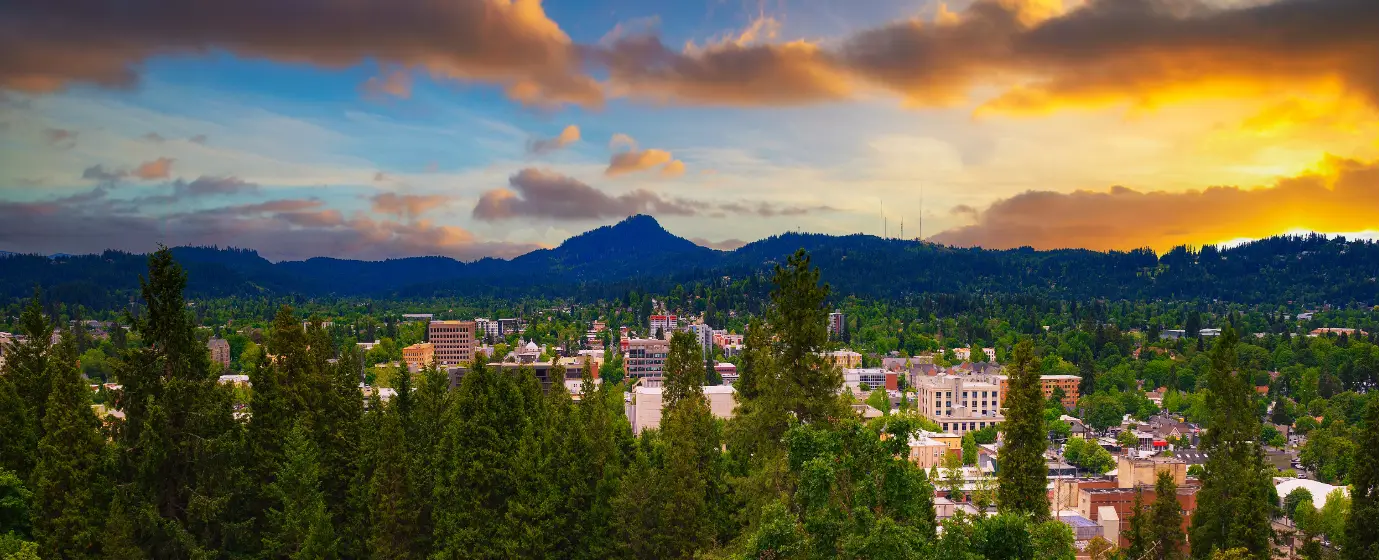
Willamette Valley · Oregon
Retiring in Eugene: Is It the Right Fit for Your Next Chapter? (2026)
Eugene surprises retirees who arrive expecting a sleepy college town and discover instead a city with genuine medical depth, a performing arts scene that rivals cities twice its size, and a housing market where $475,000 still buys a real house — not a starter condo. The honest answer to whether Eugene fits retirement is: it depends heavily on your tolerance for rain, your interest in intellectual and cultural life, and whether you need resort-style retirement infrastructure or prefer a city that integrates seniors into the broader fabric of daily life.
The retiree who thrives here is curious, active, and unbothered by the fact that Eugene doesn't center itself around retirement. University of Oregon lectures are open to the community. The Hult Center books serious national acts. Trails along the Willamette and up Spencer Butte fill with hikers in their 60s and 70s on any dry afternoon. What Eugene offers isn't a retirement destination in the Scottsdale sense — it's a livable, affordable, culturally rich city where retired life happens alongside everything else.
This guide covers the Oregon tax picture for retirees, what the healthcare infrastructure actually looks like, the range of senior living options from downtown apartments to wooded campus communities, what day-to-day life feels like without a car, and how Eugene stacks up against other Pacific Northwest retirement destinations. By the end, you'll know whether this is your city.

| Income Type | Oregon Tax Treatment |
|---|---|
| Social Security | Not taxed at state level |
| Pension (public) | Taxed as ordinary income; partial exemption available |
| Pension (private/federal) | Taxed as ordinary income |
| 401(k) / IRA distributions | Taxed as ordinary income |
| Investment income (dividends, capital gains) | Taxed as ordinary income (up to 9.9% top rate) |
| Military retirement pay | Exempt up to $6,250/year; partial thereafter |
| Oregon income tax rate (seniors) | 4.75%–9.9% graduated rate |
| Property tax rate (Lane County) | Approximately 0.95% of assessed value |
| Sales tax | None — Oregon has no state sales tax |
Oregon's tax treatment for retirees is a study in trade-offs. The absence of sales tax saves a meaningful amount on everyday purchases and major transactions like vehicles or appliances. Social Security being untaxed removes a significant burden for retirees whose income relies heavily on that benefit. Where Oregon stings is on ordinary income — pension and retirement account distributions are taxed at graduated rates that can reach 9.9%, which matters if you're drawing down a substantial IRA or receiving a full public-sector pension.
On the property tax side, Oregon offers a senior deferral program that allows homeowners aged 62 or older, with household income under $48,000 and at least 40% equity in the home, to defer property taxes as a lien against the property — effectively delaying payment until the home is sold or transferred. At Eugene's $475,000 median price, that 0.95% rate works out to roughly $4,513 annually in property taxes, so the deferral program can meaningfully improve monthly cash flow for seniors on fixed incomes. By comparison, Washington State taxes retirement income including Social Security at the federal level but has no state income tax at all — the right state depends entirely on your income mix.
Eugene's healthcare picture is stronger than its population size might suggest, partly because the city anchors a metro area that includes Springfield, and the two communities effectively share a hospital system. PeaceHealth Sacred Heart Medical Center at RiverBend, located just across the Eugene-Springfield line in Springfield, is the region's primary hospital — a 388-bed Level II Trauma Center with 24/7 emergency care, advanced cardiac and stroke services, specialized surgical care, and women's and children's health programs. For the serious cardiac event, the stroke, or the major surgery, RiverBend is where the region's highest-acuity care is concentrated.
One important correction for anyone who remembers Eugene's older medical geography: the former PeaceHealth University District campus on Hilyard Street closed its emergency department in 2023, with all services concluding by early 2024. Demolition began in spring 2026. The University District campus is gone — RiverBend in Springfield is now the primary facility for acute and emergency care.
The second hospital serving the metro, McKenzie-Willamette Medical Center at 1460 G Street in Springfield, is a 113-bed acute care facility with a Level III Trauma Center that recently completed a $115 million expansion and renovation. Named to Forbes' inaugural list of top hospitals for 2026, it holds a straight-A Hospital Safety Grade from The Leapfrog Group and is recognized for outpatient joint replacement — relevant for the hip and knee replacement surgeries that rank among the most common procedures for retirees in their 60s and 70s. For retirees who are enrolled in Trillium Community Health Plan, McKenzie-Willamette became an in-network provider in January 2026.
What Eugene can't handle locally is the rare subspecialty — complex organ transplants, certain pediatric cases, and major cancer surgeries with the highest-acuity requirements are typically referred to OHSU in Portland, about 110 miles north. For retirees managing stable chronic conditions, that limitation rarely comes up. For anyone with a complex oncology history or who anticipates needing advanced subspecialty care regularly, the distance to an academic medical center is worth factoring into the decision.
Eugene has developed a mature senior living market with options across every care level — from independent apartments in the heart of downtown to wooded campus communities on the city's western edge. The U.S. News database counts 16 independent living communities in Eugene proper, with roughly 36 assisted living communities available in the wider metro area.
| Community | Type | Location | Est. Monthly Cost |
|---|---|---|---|
| Cascade Manor | Continuing care (CCRC), non-profit | Near downtown Eugene | $4,500–$6,500 |
| Garden Way Retirement | Independent living | Near University of Oregon | $3,800–$5,200 |
| Ya-Po-Ah Terrace | Independent living (HUD-assisted) | Downtown Eugene | Income-based |
| The Springs at Greer Gardens | Independent, assisted, memory care | Eugene | $4,200–$6,800 |
| Waterford Grand | Independent, assisted, memory care | Riverfront, Eugene | $4,500–$6,500 |
| Good Samaritan Society – Eugene Village | Assisted living | 3500 Hilyard St, Eugene | $3,500–$5,000 |
| Solvang Retirement | Independent living | 1202 Jacobs Dr, Eugene | $3,200–$4,800 |
| Landsby Place | 55+ independent | West Eugene (16 forested acres) | $2,800–$4,200 |
| The Abbey (Good Samaritan) | Independent living | Downtown Eugene | $3,500–$5,000 |
| Churchill Estates | Independent, assisted, memory care | Eugene | $4,000–$6,200 |
| Holiday Sheldon Oaks | Independent living | Eugene | $2,900–$4,200 |
| Avamere Rehabilitation of Eugene | Skilled nursing / rehab | Eugene | Cost varies by care level |
| Timber Pointe Senior Living | Independent living | Near Hendricks Park | $3,500–$5,000 |
| Fox Hollow Residential Care | Assisted, independent | Wooded residential setting | $3,200–$4,800 |
| Willamette Oaks | Independent, assisted | Riverfront setting | $4,000–$5,800 |
The community that stands out for retirees who want to age in place in a single setting is Cascade Manor — Eugene's only non-profit continuing care retirement community, offering the full continuum from independent living through skilled nursing care under one roof. It's the option that allows you to enter as an independent resident and remain within the community if care needs increase, which is the primary appeal of the CCRC model.
For retirees who want to stay connected to urban life, Ya-Po-Ah Terrace offers 222 units in a downtown setting with HUD rental assistance — one of the few genuinely affordable senior options in a market where independent living costs average around $4,774 per month. The Abbey, also downtown, appeals to residents who want to walk to restaurants and the Hult Center without maintaining a car. Those who prefer the opposite — trees, quiet, and separation from the city grid — typically gravitate toward Landsby Place's 16 forested acres in West Eugene or Timber Pointe's setting near the rhododendron gardens at Hendricks Park.
Looking to buy in Eugene? Estimate your payment.
Enter your numbers to see an estimated monthly mortgage payment.
Estimate only. Excludes HOA fees and mortgage insurance.
Eugene's walkability is honest in some neighborhoods and a stretch in others. Downtown and the South University area genuinely support car-free daily life — groceries, medical appointments, coffee, and cultural events are reachable on foot or by the Lane Transit District bus network. LTD's EmX Bus Rapid Transit line runs along Franklin Boulevard and connects key parts of the city with headways short enough to be practical for daily use. Outside of those corridors, a car remains a strong asset, particularly in West Eugene, Cal Young, and the neighborhoods along River Road.
The cultural calendar offers more than most cities of Eugene's size. The Hult Center for the Performing Arts downtown books national touring acts, the Oregon Bach Festival each summer draws musicians and attendees from across the Pacific Northwest, and the Eugene Symphony Orchestra performs a full season. The Jordan Schnitzer Museum of Art on the UO campus, the Saturday Market running April through November in Park Blocks, and the University of Oregon's Osher Lifelong Learning Institute — which offers non-credit courses specifically for adults 50 and older — give retired residents consistent reasons to leave the house. Eugene's outdoor life is similarly layered: Alton Baker Park's trail system, the Ridgeline Trail network stretching through South Eugene, and Spencer Butte's summit hike are all accessible from within city limits.
What surprises most people after six months is how much the academic calendar shapes the rhythm of the city. Football Saturdays at Autzen Stadium change traffic patterns substantially. Restaurant waits during graduation weekends in June spike noticeably. Residents who lived in mid-sized cities without a major university sometimes need a few months to calibrate to the rhythms that UO creates — the energy is mostly positive, but it's real and persistent.
Why some retirees ultimately move out comes down to two things: rain and remoteness. Eugene's rainy season runs roughly October through May, and even Oregonians accustomed to it sometimes find the cumulative weight of a long wet season harder to manage in retirement, when outdoor activity is a daily priority. The other factor is distance — Portland is 110 minutes north, and the Eugene metro, while medically self-sufficient for most needs, doesn't have the subspecialty medical depth or the airport connectivity that retirees who travel frequently or who have family spread nationally sometimes require.
| City | Median Home Price | Hospital Access | Walkability | Senior Community Depth | Overall Fit |
|---|---|---|---|---|---|
| Eugene, OR | $475,000 | Level II Trauma (RiverBend) | Strong downtown/South; limited elsewhere | High — 36+ communities | ★★★★☆ |
| Salem, OR | $390,000 | Salem Health (415-bed, Level II) | Moderate | Moderate | ★★★☆☆ |
| Corvallis, OR | $485,000 | Good Sam (188-bed) | Good downtown | Growing but limited | ★★★☆☆ |
| Bend, OR | $680,000 | St. Charles (261-bed, Level II) | Limited without car | Growing rapidly | ★★★☆☆ |
| Medford, OR | $395,000 | Asante Rogue (287-bed, Level II) | Low outside downtown | Moderate | ★★★☆☆ |
| Portland Metro, OR | $545,000 | OHSU + multiple systems | High | Extensive | ★★★★☆ |
Eugene's strongest competition for budget-conscious retirees who want real urban amenities is Salem, which offers a lower entry price and its own performing arts scene but lacks the university energy and trail system that define Eugene's daily life. Bend's appeal is obvious — mountain scenery, a booming restaurant scene, and outdoor access — but the $680,000 median puts it in a different financial category, and the senior living infrastructure hasn't kept pace with the population growth. Corvallis is the comparison that comes up most often for academic-life seekers: smaller, quieter, with Oregon State anchoring a similar university-town feel and a slightly higher price point at the median. Eugene wins on senior living depth and hospital access; Corvallis wins on town-scale intimacy.

Local Expert Takeaway: The retiree who thrives in Eugene tends to be drawn to Friendly Area or Cal Young for their balance of walkability and manageable home prices — both neighborhoods have housing stock in the $420,000–$520,000 range that works well for aging in place. Buyers who want a continuing-care option without leaving the city should look at the Cascade Manor corridor near downtown before anything else. If your retirement depends on warm winters, proximity to family elsewhere in the country, or frequent subspecialty medical care, Eugene asks you to make real trade-offs — and those are worth naming honestly before you sign.
Is Eugene a good place to retire?
Eugene is a strong retirement fit for people who want an affordable Pacific Northwest city with real cultural depth, trail access, and a mature senior living market. The combination of no Oregon sales tax, Social Security exemption, and a median home price of $475,000 makes the finances work for many retirees — though income taxes on pension and IRA distributions require planning. The one honest caveat is the long rainy season, which affects active-outdoor-lifestyle retirees more than others.
What healthcare is available for retirees in Eugene?
The Eugene-Springfield metro is served by PeaceHealth Sacred Heart Medical Center at RiverBend, a 388-bed Level II Trauma Center in Springfield with advanced cardiac, stroke, and surgical services, and McKenzie-Willamette Medical Center, a 113-bed Level III facility that recently completed a $115 million expansion and earned a top-hospital designation from Forbes. For complex subspecialty care — transplants, advanced oncology — OHSU in Portland remains the regional academic medical center, about 110 miles north.
How does Eugene compare to Bend for retirement?
Eugene offers a significantly lower median home price, more developed senior living infrastructure, and better hospital depth — and trades Bend's mountain resort scenery for a university-city cultural calendar, river trails, and rain. Bend's outdoor appeal is real, but the $680,000-plus median and the relative newness of its senior care market make Eugene the stronger practical choice for retirees prioritizing affordability and healthcare access over high-desert scenery.
Explore the full Eugene series: The Ultimate Eugene Relocation Guide · Is Eugene Safe? · Cost of Living in Eugene · Best Neighborhoods in Eugene · Eugene Schools & Family Life · Eugene Youth Sports · Eugene Parks & Recreation · Retiring in Eugene · 1031 Tax-Deferred Exchange in Eugene · Eugene First-Time Homebuyers Guide · · Moving to Eugene from California
Tell us what you need help with and we'll connect you with local resources.

About the Author
Todd Davidson is the founder of Living in Oregon and Living in Washington, where he publishes in-depth city guides, neighborhood resources, and local market insights covering more than 180 communities across the Pacific Northwest. While his background is in home financing and real estate, he created these digital platforms to help families research and compare regions before making a move.