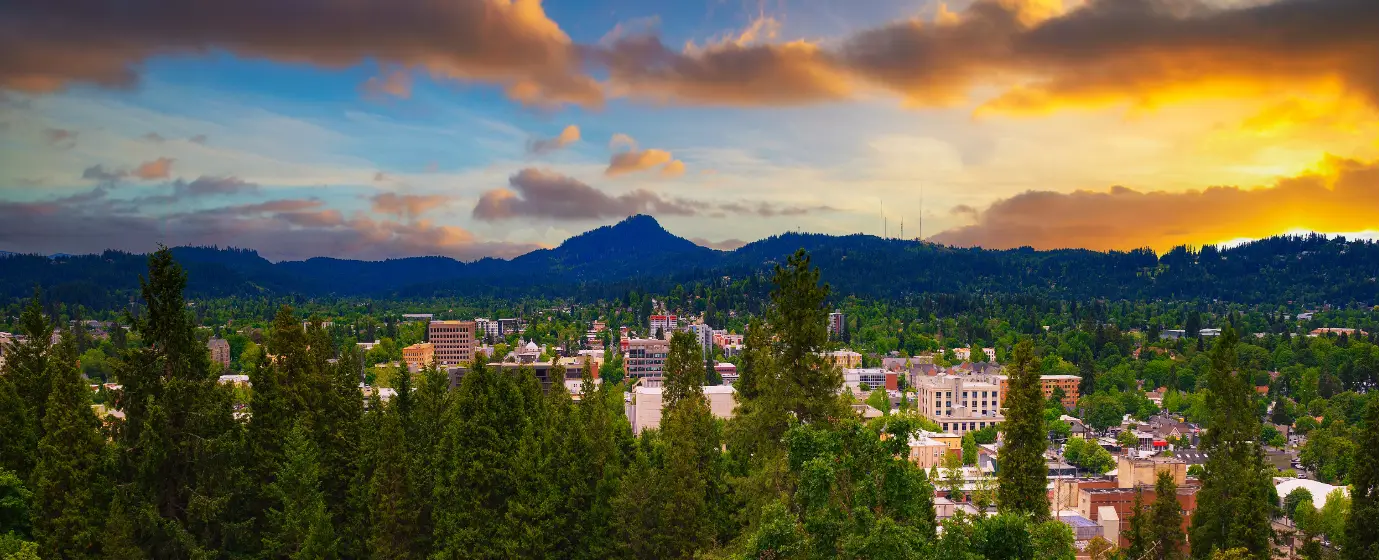
Willamette Valley · Oregon
Is Eugene Safe? Crime Rates, Safest Neighborhoods & Local Reality (2026)
Eugene's safety picture is more layered than a single statistic can capture — and the single statistic most people find first is not encouraging. The city's overall crime rate runs meaningfully above both state and national averages, and that fact is worth confronting directly rather than softening. But it's also true that Eugene is a city of genuinely distinct neighborhoods, where moving twenty blocks in the right direction can shift your personal risk profile dramatically.
The numbers that shape daily life here are primarily property crime numbers. Violent crime in Eugene actually runs slightly below the national average per 100,000 residents — a detail that gets buried when total crime rates dominate the conversation. What drives Eugene's elevated overall rate is property crime: vehicle break-ins, bike theft, shoplifting, and auto theft cluster around high-traffic corridors, the university district, and the downtown core. For residents living in the city's southeast quadrant, the foothills neighborhoods, or the Cal Young area to the north, that citywide figure feels abstract.
This guide walks through what the data actually means for someone choosing to live or buy in Eugene — which corridors carry elevated risk, which neighborhoods consistently rank among Oregon's safer communities, and what locals do to protect their property without living in a state of anxiety.

FBI data released in late 2025 covering calendar year 2024 puts Eugene's total crime rate at roughly 3,574 per 100,000 residents — approximately 69% above the national rate and 31% above the Oregon statewide figure. That context matters: Oregon itself runs above the national average, so Eugene sits elevated within an already elevated state. Local police data and independent trackers broadly agree that the city ranks in roughly the 6th percentile for safety nationally, meaning the vast majority of American cities report lower overall crime. That is a real finding and shouldn't be minimized.
What the aggregate number obscures is the improving trajectory. The 2024 total crime rate fell approximately 7% compared to 2023, continuing a five-year pattern of decline in both violent and property crime. In 2025, Eugene police reported fewer than 300 residential burglaries for the first time in at least a decade, and targeted enforcement downtown drove assaults down from 58 to 40 reports and robberies from 16 to just 5 in the first half of the year compared to the same period in 2024. The city's rollback of Measure 110 drug decriminalization in September 2024 also contributed to a sharp increase in drug enforcement activity — a factor shaping both crime patterns and the arrest statistics that feed into citywide metrics.
The structural reality driving property crime is familiar to most mid-size university cities: a large transient population, a visible homeless community concentrated around the downtown core and the Willamette River corridor, and commercial density that attracts opportunistic theft. Eugene's motor vehicle theft rate in particular sits among the higher rates in the nation for cities its size — a fact locals learn quickly when a neighbor's car disappears from a street parking spot. Understanding where those risks cluster, rather than treating the whole city as uniformly elevated, is the key to reading Eugene's safety landscape accurately.
Eugene's violent crime rate runs at roughly 318 per 100,000 residents based on the most recent FBI reporting period — a figure that sits about 11% below the national rate of 359 per 100,000 and slightly below Oregon's statewide average as well. In practical daily terms, that means the headline crime numbers most relocation websites cite for Eugene are almost entirely driven by property offenses, not personal safety risk. The city recorded just 2 homicides in 2024, down from 6 the year prior. The most common police calls categorized under disorder — disturbance of the peace, prohibited camping violations, disorderly conduct — shape the violent crime landscape more than predatory violence does, and most residents go years without any direct encounter with serious violent crime.
Property crime is where Eugene's numbers diverge most sharply from national norms, running nearly twice the national average per resident. Larceny and theft dominate, particularly bike theft and vehicle break-ins near the University of Oregon campus, Whiteaker neighborhood, and the riverfront trail corridors. Auto theft is the highest-profile concern: the odds of having a vehicle stolen in Eugene run roughly one in 310 annually — elevated enough that locals treat covered or secured parking as a genuine factor when choosing where to live. Shoplifting reached a record high in 2025 with over 1,100 incidents, concentrated along commercial corridors. The patterns are geographic and predictable, which means they are largely avoidable for residents who understand where they cluster.
Fairmount sits on the hillside above the University of Oregon campus, and that elevation creates more than a view — it separates the neighborhood from the foot-traffic patterns that drive property crime in the flatlands below. With a population under 6,000 and tree-lined streets that dead-end into Spencer Butte trailheads, the area reports significantly fewer incidents than Eugene as a whole. It ranks consistently among the city's top five safest neighborhoods across multiple tracking sources. The trade-off is terrain: navigating Fairmount in winter means icy inclines, and the winding roads make some buyers nervous about daily commute logistics.
Best for: Buyers who want proximity to the U of O and Hendricks Park without the crime exposure of the campus-adjacent flats.
Cal Young is a quiet residential district in northeast Eugene housing roughly 3,200 residents, and it carries an A+ crime grade from independent trackers — a distinction that makes it one of Eugene's clearest outliers from the citywide numbers. Crime rates in Cal Young run about 16% below Eugene's own average, and the neighborhood consistently places alongside Crest Drive and Laurel Hill Valley as among the safest places to live in the region. Larcenies make up the bulk of reported incidents, which is common across safer Eugene neighborhoods where serious crime is rare but opportunistic theft isn't zero.
Best for: Families with school-age children who want safety metrics comparable to the Willamette Valley's quietest suburbs without leaving Eugene's city limits.
The South University neighborhood sits between the U of O campus and the Friendly Area, and its safety profile reflects that position — better than the immediate campus blocks, but not as insulated as the hillside or far-northeast neighborhoods. Break-ins from vehicles and bike theft remain the most commonly reported incidents, driven largely by the density of students and the volume of foot traffic along 13th Avenue. Most residents here are long-term homeowners and established renters who have learned to treat garage parking as non-negotiable. The neighborhood's proximity to Five on Black, campus coffeeshops, and the Saturday Market corridor adds daily convenience that many buyers weigh against its slightly elevated property crime exposure.
Best for: Buyers who want a walkable, socially active neighborhood and can accept that vehicle security requires more intentionality here than in the foothills.
Whiteaker — locally shortened to "the Whit" — is Eugene's arts and counterculture district, and its safety profile reflects a neighborhood in active transition. The area around Blair Boulevard and its immediate surrounds has historically carried higher property and disorder-related incident rates than most Eugene neighborhoods, driven by proximity to social services, a transient population, and a concentration of late-night venues. At the same time, investment in the neighborhood has accelerated: breweries, galleries, and renovated craftsman homes have drawn buyers who accept the risk profile in exchange for character and price points below the city median. Whiteaker is not the neighborhood for buyers who want to avoid any contact with visible urban disorder, but it's also not the dangerous enclave the reputation sometimes suggests.
Best for: Buyers comfortable with a higher property crime baseline who prioritize neighborhood personality and affordability over statistical safety.
Downtown Eugene's safety numbers are improving measurably but remain the most elevated in the city. The targeted enforcement strategy launched by Eugene Police in 2024 produced significant results in the first half of 2025 — robberies dropped from 16 to 5, overdose calls declined by 40%, and warrant arrests more than doubled as part of a focused deterrence strategy. That progress is real. The baseline, however, is still high: foot traffic around the transit center, the blocks between Broadway and 8th Avenue, and the corridor toward the riverfront all require the kind of awareness that residents elsewhere in Eugene don't think twice about. Downtown condos and apartments attract buyers specifically for the walkability and urban energy, and many residents navigate it comfortably — but doing so without adjusting your habits would be a mistake.
Best for: Buyers who want urban Eugene on its own terms and have lived in active downtowns before.
Harlow occupies the far northeast corner of Eugene near the Delta Highway corridor, and its suburban street grid and lower density give it a safety profile that trends closer to Cal Young than to the neighborhoods nearer the core. The area is predominantly owner-occupied, and that ownership density correlates with lower property crime rates across Eugene's neighborhoods consistently. Vehicle theft remains a citywide concern, but Harlow's garages and driveways offer substantially better protection than on-street parking near downtown. It's not a neighborhood with much pedestrian energy or walkable retail, but for buyers whose primary concern is keeping their family and property safe without leaving Eugene, it delivers.
Best for: Buyers prioritizing safety and suburban quiet who work near the Delta Highway employment corridor or the northern I-5 interchanges.
| City | Violent Crime/1K | Property Crime/1K | Overall Safety Profile |
|---|---|---|---|
| Eugene | 3.2 | 33 | Elevated property crime; improving trend |
| Springfield | ~4.1 | ~38 | Higher across both categories; similar challenges |
| Coburg | <1.0 | ~6 | Very low; small town with limited comparison data |
| Junction City | ~1.8 | ~15 | Notably lower; rural-suburban character |
| Creswell | ~1.5 | ~12 | Low overall; limited services trade-off |
| Veneta | ~1.2 | ~10 | Small community; low incident volume |
Eugene and Springfield together form Lane County's urban core, and both carry elevated crime metrics relative to the smaller surrounding communities. Coburg, just a few miles north along the I-5 corridor, is functionally a small town with a fraction of the incident volume — though buyers who relocate there for safety are trading off most of what makes Eugene worth living in. Junction City and Creswell offer meaningfully lower crime profiles with real housing affordability, but the commute math into Eugene changes significantly for anyone working downtown or near the university.
Looking to buy in Eugene? Estimate your payment.
Enter your numbers to see an estimated monthly mortgage payment.
Estimate only. Excludes HOA fees and mortgage insurance.
The single most predictable rule in Eugene is that crime follows the Highway 99 corridor and the downtown transit infrastructure. The blocks around the Eugene Station bus hub on 10th Avenue, the stretch of 6th and 7th avenues heading west toward the Whiteaker, and the area surrounding the Plank Town parking structure see a disproportionate share of Eugene's disorder and property crimes. Locals who have lived here for any length of time simply don't leave valuables in cars parked in those zones overnight. It's not fear — it's habit, the same way a San Francisco resident learns which blocks to avoid leaving a laptop visible on the passenger seat.
The apps most buyers check before relocating — Niche, NeighborhoodScout, AreaVibes — present Eugene's citywide aggregate in a way that can make the entire city feel uniformly risky. The lived reality is far more differentiated. A household in Crest Drive or Laurel Hill Valley has odds of victimization comparable to much quieter Oregon cities; a household in the blocks immediately surrounding the university's west side sees incident rates closer to the city's troubling headline numbers. The gap between those two realities is sometimes as small as a mile.
What most long-term Eugene residents actually do: they garage their cars, they don't leave bikes unlocked anywhere in the city regardless of neighborhood, and they stay aware of which blocks downtown have shifted after 9 p.m. None of that is burdensome — it's the standard operating procedure of living in a mid-size university city with a visible homeless population and active nightlife. Buyers relocating from smaller Oregon communities sometimes take longer to calibrate to it; buyers moving from Portland or Seattle feel immediately at home with the level of urban awareness it requires.

Local Expert Takeaway: If safety is your primary filter, focus your search on the Fairmount, Crest Drive, Cal Young, and Laurel Hill Valley corridors — these neighborhoods consistently outperform Eugene's citywide metrics and hold their own against the broader Willamette Valley. Avoid leaving any valuables in a parked vehicle anywhere in Eugene, but especially on the blocks between the university's west edge and the Whiteaker. Downtown Eugene's trajectory is genuinely improving; buyers considering a condo near Broadway or the riverfront should tour the neighborhood at 8 p.m. on a weeknight, not just at a Saturday open house, to get a realistic read on the current street environment.
✅ Eugene's violent crime rate runs below the national average — the elevated headline numbers are overwhelmingly driven by property crime, not personal safety risk.
⚠️ Vehicle theft and bike theft are the highest-probability risks for most residents — secure parking and quality locks aren't optional here, they're standard practice.
📍 Fairmount, Cal Young, Crest Drive, and Laurel Hill Valley consistently rank among the safer neighborhoods in Oregon — the citywide average doesn't reflect life in these areas.
Is Eugene a safe place to live?
Eugene's overall crime rate is elevated compared to national averages, but the picture varies significantly by neighborhood. Residents in the city's southeast foothills, Cal Young, and Fairmount areas live in neighborhoods that rank among the safer communities in Oregon, while downtown and the immediate university district carry higher property crime exposure. Most residents navigate daily life comfortably with basic urban precautions.
What is the most common crime in Eugene?
Property crime dominates Eugene's incident reports, with larceny, vehicle break-ins, bike theft, and shoplifting accounting for the large majority of offenses. Auto theft is a specific concern — Eugene's vehicle theft rate ranks among the higher figures nationally for cities its size. Violent crime is comparatively lower, running slightly below both the national and Oregon state average per 100,000 residents.
How does Eugene compare to Springfield for safety?
Springfield's crime metrics run higher than Eugene's across both violent and property categories, based on available reporting data. Eugene's downtown improvement program has also shown measurable results in 2024 and 2025 that Springfield lacks an equivalent for. Buyers choosing between the two for safety reasons often find that specific Eugene neighborhoods like Cal Young or Harlow outperform most of Springfield on both metrics.
Explore the full Eugene series: The Ultimate Eugene Relocation Guide · Is Eugene Safe? · Cost of Living in Eugene · Best Neighborhoods in Eugene · Eugene Schools & Family Life · Eugene Youth Sports · Eugene Parks & Recreation · Retiring in Eugene · 1031 Tax-Deferred Exchange in Eugene · Eugene First-Time Homebuyers Guide · · Moving to Eugene from California
Tell us what you need help with and we'll connect you with local resources.

About the Author
Todd Davidson is the founder of Living in Oregon and Living in Washington, where he publishes in-depth city guides, neighborhood resources, and local market insights covering more than 180 communities across the Pacific Northwest. While his background is in home financing and real estate, he created these digital platforms to help families research and compare regions before making a move.