
Willamette Valley · Oregon
Moving to Eugene from California: The Honest Comparison (2026)
The Bay Area software engineer who finally went remote and bought a house with a real yard. The San Diego family who got through an entire summer without dreading the electric bill. The Sacramento couple who sold a modest two-bedroom townhome and paid cash for a four-bedroom Eugene home — with money left over. These stories are not outliers. In 2025, California accounted for 22% of all inbound moves to Oregon, and the Eugene-Springfield metro ranked as the top inbound metro in the entire country, with 85% of moves being inbound. People are not stumbling into Eugene — they are choosing it deliberately, often after years of quietly running the math.
The honest part of this guide is what comes next. Eugene is genuinely compelling for California buyers, and the numbers are real. But Eugene is not a milder version of California with cheaper housing. The winters are gray in a way that no amount of preparation fully prepares you for. The restaurant scene, the freeway infrastructure, the year-round outdoor culture — these are categorically different from what you left behind, whether you came from Walnut Creek or Woodland Hills or Elk Grove. Most California transplants who struggle here struggle because no one told them the specific things that would matter to them personally.
This guide covers the full picture: a side-by-side cost comparison by California region, what your equity realistically buys in Eugene by origin market, the tax reality that surprises most transplants, the weather data most guides bury, and a comparison tool to look up your specific California city. Read it before you make an offer.

| Eugene, Oregon | Bay Area | Southern CA | Sacramento Metro | Central Valley | |
|---|---|---|---|---|---|
| Median Home Price (approx. 2026) | $475,000 | $1.3M–$1.8M+ | $750K–$900K | $500K–$620K | $350K–$450K |
| Property Tax Rate (effective) | ~0.95% | ~1.1–1.2% | ~1.1–1.25% | ~1.1–1.2% | ~1.0–1.15% |
| State Income Tax (top bracket) | 9.9% | 13.3% | 13.3% | 13.3% | 13.3% |
| State Sales Tax | 0% | 7.25–10.75% | 7.25–10.75% | 7.25–8.75% | 7.25–8.75% |
| Avg Utilities (monthly est.) | $150–$180 | $200–$280 | $220–$310 | $175–$240 | $170–$230 |
| Avg 1BR Rent | $1,200–$1,500 | $2,800–$3,500 | $2,200–$2,800 | $1,500–$1,900 | $1,100–$1,400 |
A buyer leaving Walnut Creek or Palo Alto and selling a home at $1.4 million to buy in Eugene at $475,000 is likely eliminating their mortgage entirely or reducing it to something manageable on a single income. That delta — often $700,000 to $900,000 in equity — doesn't just change the monthly payment. It changes career decisions, retirement timelines, and how much risk the household can absorb.
Even the Sacramento comparison is meaningful. A buyer who paid $560,000 for a three-bedroom in Elk Grove and sells into today's market will arrive in Eugene with enough for a substantial down payment on a better-appointed home, a lower property tax bill in dollar terms, and zero sales tax on every purchase they make going forward. The gap between Sacramento and Eugene is narrower than the Bay Area case, but the net lifestyle gain is still significant.
Oregon does not have a state sales tax — full stop. California's baseline rate sits at 7.25%, and in cities like Los Angeles, San Francisco, and San Jose, combined local rates push that figure to 10.25% or higher. For a household spending $60,000 per year on taxable goods and services, the savings range from $4,350 to $6,150 annually simply by crossing the state line. That's not a rounding error — it's a car payment or a significant contribution to retirement every year.
What Oregon does have is a state income tax, and this is where California transplants sometimes get caught off guard. Oregon's graduated income tax tops out at 9.9%, which is lower than California's 13.3% ceiling but not insignificant. A transplant earning $150,000 in Oregon will pay roughly $11,000–$12,500 in state income tax under Oregon's bracket structure. In California, that same income would generate a state tax bill closer to $13,500–$15,000 depending on deductions. The net income tax savings are real, but they don't eliminate the tax burden — they moderate it.
Property taxes in Oregon operate under Measure 50, which caps assessed value increases at 3% per year after the year of purchase. For a long-term owner, this is a meaningful advantage — your tax bill stays predictable even as the market appreciates around you. Homeowners 62 and older also qualify for Oregon's property tax deferral program, which allows qualifying seniors to defer property tax payments until the property is sold.
| Tax Item | California | Oregon | Net Impact |
|---|---|---|---|
| State Income Tax (top bracket) | 13.3% | 9.9% | Oregon saves $3,000–$5,000/yr at $150K income |
| State Sales Tax | 7.25–10.75% | 0% | Oregon saves $4,000–$6,000/yr on typical spending |
| Property Tax Rate (effective) | ~1.1–1.25% | ~0.95% | Oregon saves $700–$1,300/yr on $475K home |
| Capital Gains Tax | Up to 13.3% (state) | Up to 9.9% (state) | Oregon lower, but federal unchanged |
| Estate/Inheritance Tax | None (CA) | None (OR) | Neutral |
| Senior Property Tax Deferral | Limited | Available at 62+ | Oregon advantage for retirees |
The combined picture is positive for most California transplants, particularly those in the middle-income range. The sales tax elimination alone frequently offsets the income tax difference for households spending above average. Where Oregon's tax structure hurts transplants is at very high income levels — tech executives, high-equity investors, and business owners in the $400,000+ income range may find Oregon's tax savings over California more modest than they expected.
A buyer selling a home in Atherton, Los Altos, or even a more modest property in Fremont or Hayward is often arriving in Eugene with enough equity to pay cash — no mortgage, no rate exposure, no monthly principal and interest. At Eugene's $475,000 median, a buyer bringing $800,000 in equity doesn't just buy outright; they potentially buy outright and have capital left to invest, renovate, or place in a rental property. Fairmount, the neighborhood tucked against the forested hills south of the University of Oregon, and South Hills represent the upper end of Eugene's market — homes here commonly list between $650,000 and $950,000, and even at that level, a Bay Area seller is often purchasing with cash and retaining significant liquidity.
For the Bay Area buyer who wants to remain invested in real estate rather than parking everything in a primary residence, Eugene's rental market — driven by the University of Oregon's enrollment — offers consistent demand. A duplex or small apartment building near campus, purchased with a portion of Bay Area equity, can generate cash flow while the remainder funds the primary home purchase. This is a strategy that simply isn't available to most buyers still living in the Bay Area on a California salary.
A buyer selling in Pasadena, Irvine, or a mid-tier neighborhood in San Diego carries enough equity to enter Eugene's market at the top of its range — or to acquire a premium property outright. South Hills, the Hendricks Park corridor, and River Road's established stretches offer homes in the $500,000 to $750,000 range that represent a genuine lifestyle step up from many Southern California neighborhoods at comparable price points. These buyers typically eliminate the jumbo loan entirely, land in a conventional mortgage with a very low LTV, and see their monthly housing costs drop by 40–60% compared to what they were carrying.
The SoCal buyer often experiences the most dramatic psychological shift: not just lower payments, but the experience of having equity in a home that actually feels permanent. In Los Angeles or San Diego, many buyers at the $900,000–$1.1 million level were still in relatively modest homes by square footage. In Eugene at the same equity level, they're in homes with room to grow, yards measured in acres rather than feet, and a property tax bill that runs a fraction of what California assessed.
This buyer's gain is more modest in dollar terms, but it's still material. A Sacramento family selling a $575,000 home and buying in Eugene at $475,000 frees up roughly $100,000 in equity while eliminating California's state income tax burden and all sales tax. The relative housing affordability isn't the headline — the cumulative tax savings over a 10-year horizon often total more than the home price differential itself.
In Eugene, this equity level puts buyers solidly in the Friendly Area, Amazon neighborhood, or Cal Young — all well-established residential areas with good school access and normal suburban infrastructure. Eugene's Cal Young neighborhood, in particular, offers single-family homes in the $450,000–$600,000 range with larger lots than anything comparable at that price in the Sacramento or Inland Empire markets. For buyers who want land per dollar, Eugene delivers consistently at this equity level.
This buyer has the narrowest relative advantage, but it's not trivial. A buyer arriving from Fresno, Stockton, or Bakersfield with $350,000 in equity is entering a Eugene market where that down payment — applied to a conventionally financed home — still gets them into a well-located neighborhood, a larger home than they're leaving, and a property tax structure that moderates long-term. North Eugene, West Eugene, and the Santa Clara corridor offer homes in the $375,000–$460,000 range where this equity provides a meaningful foundation without requiring outsized financing.
The Central Valley buyer should also factor in the lifestyle cost difference. Eugene's cost of living runs roughly 13% above the national average — but it's substantially below Los Angeles and San Francisco. Compared to the Central Valley, Eugene is not dramatically cheaper on a day-to-day basis, but the income tax comparison and sales tax elimination still create annual savings that compound meaningfully over time.
Looking to buy in Eugene? Estimate your payment.
Enter your numbers to see an estimated monthly mortgage payment.
Estimate only. Excludes HOA fees and mortgage insurance.
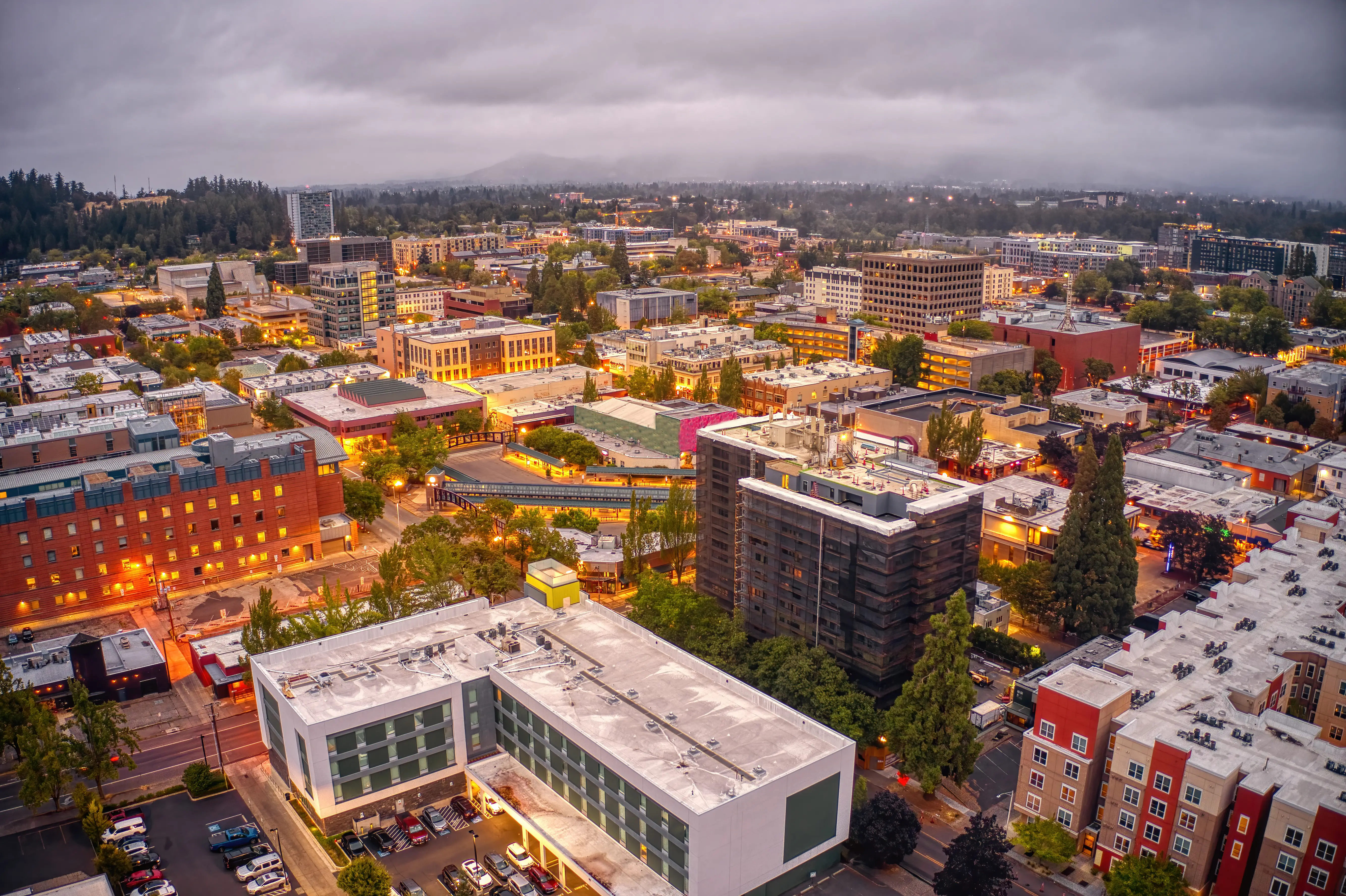
Here's the number most CA-to-OR guides avoid publishing: Eugene gets approximately 155 sunny days per year. Los Angeles gets 262. Sacramento tops 280. If you're moving from the San Fernando Valley or the Sacramento suburbs, you are giving up a meaningful portion of your annual sunshine, and no amount of framing changes that arithmetic. Eugene's gray season runs from October through April — not a few overcast weeks, but a sustained period of cloud cover, frequent rain, and temperatures that rarely feel dangerous but consistently feel damp. Homes have efficient heating systems. Oregonians own rain gear, not umbrellas. You will acclimate, but you should go in with accurate expectations.
What California transplants genuinely love after a year in Eugene — and the feedback on this is consistent — is the summer. From late June through September, Eugene shifts into a version of outdoor life that rivals anywhere on the West Coast: warm days in the 75–85°F range, almost no rain, evenings cool enough for sleep without air conditioning, and a city fully oriented around being outside. The Willamette River path system, Alton Baker Park, Spencer Butte, and the surrounding McKenzie River corridor become the backdrops for a lifestyle most California residents pay significantly more to approximate. The traffic, on a late July morning in Eugene, is not a problem.
The lifestyle shift is real beyond the weather. Eugene operates at a different pace than any California metro, and most transplants from the Bay Area or Southern California name this as both the biggest adjustment and — after six months — one of the things they most appreciate. The food scene has grown meaningfully with the university presence, but it is not Los Angeles or San Francisco, and it won't become that. The drive to the nearest international airport for a direct flight to New York is a real trip. The beach is 60 miles west through coastal mountains — beautiful, rugged, and not a casual afternoon drive the way San Diego makes it. These are real trade-offs that deserve honest weight.
If you want to see how Eugene compares directly to the city you're leaving, use the tool below — it covers the 120 largest California cities with current housing and tax data.
Home prices: Redfin median sale data, Q1–Q2 2026. Select your city to compare.
Ready to talk through what your specific California equity could do in Eugene? Todd can model your exact scenario in a single call.
Assuming all of Eugene is the same market. Buyers who search "Eugene homes for sale" and see a $475,000 median sometimes arrive expecting everything to be uniformly priced and uniformly suburban. It isn't. The Fairmount neighborhood south of the University runs $650,000–$900,000+ for move-in-ready homes. Whiteaker, the city's most eclectic and walkable neighborhood near the Willamette, trends toward smaller lots and homes in the $380,000–$480,000 range with a very different character than the Cal Young area's conventional suburban streets. West Eugene and North Eugene operate in different price tiers with different infrastructure realities. Buyers who don't understand these internal divisions sometimes fall in love with one part of the city and accidentally make an offer in a completely different neighborhood with different characteristics.
Underestimating Oregon's radon profile. Oregon has elevated radon zones, and Lane County — where Eugene sits — is included in the elevated-risk areas identified by the EPA. California buyers who have never dealt with radon testing are often surprised to learn it's a standard part of the Oregon home inspection process. Mitigation systems are common, inexpensive to install ($800–$1,500 typically), and effective — but skipping the radon test or waiving the inspection contingency as a competitive move is something many California buyers learn to regret.
Expecting year-round outdoor access like California delivers. California buyers — especially those from the Bay Area and SoCal — are accustomed to hiking in January, cycling in February, and playing outdoor sports twelve months a year. Eugene in January is a different experience. The trails exist. Some locals use them through the winter. But the culture of outdoor recreation here is genuinely seasonal in a way that catches California transplants off guard, and buyers who are buying partly to access the outdoor lifestyle should understand that from June through September, Eugene is spectacular — and from November through March, the honest answer is that you'll spend more time indoors than you did in California.
Misreading the I-5 and OR-126 commute reality. Eugene's major employment corridors run along I-5 and the Coburg Road axis north of downtown. Buyers who locate themselves in West Eugene or Santa Clara expecting a clean commute to the University or PeaceHealth's Sacred Heart campus on Hilyard Street sometimes find that the cross-town routing — particularly on I-105 or Beltline Road during morning hours — adds 20–35 minutes to a drive that looks short on paper. Eugene's traffic volume doesn't compare to Southern California, but buyers from smaller California markets sometimes make location decisions without adequately accounting for how the city's geography shapes daily travel.
Bay Area sellers with substantial equity are often best served by moving quickly — cash offers, even in Eugene's somewhat moderated market, still carry meaningful weight with sellers who want certainty. Buyers in this position who are purchasing a primary residence face no 1031 exchange complexity, but those converting investment property in California and reinvesting in Eugene should understand the 1031 timeline before closing the California sale. The Eugene 1031 Exchange Guide covers the identification and closing timeline in detail.
Southern California buyers typically arrive with enough down payment to avoid jumbo loan territory entirely in Eugene — a $475,000 purchase with 20–25% down sits well within conventional conforming limits, which simplifies the approval process. Buyers at this equity level can often qualify on a single income with a debt-to-income ratio that would have been impossible to sustain in California's market. Rate shopping matters more than it does for all-cash buyers, but the strong LTV position gives these buyers leverage in negotiating lender terms.
Sacramento and Inland Empire buyers who are stretching for a home in the $400,000–$475,000 range with a moderate down payment may find Oregon's down payment assistance programs worth exploring. OHCS and the Oregon Bond Residential Loan Program offer below-market rate options for qualifying buyers at certain income thresholds — the outlines current eligibility in detail.

Local Expert Takeaway: The single thing California buyers consistently underestimate about Eugene is the weight of the gray season on long-term satisfaction with the move. The housing math is clear, the tax picture is favorable, and the summer is genuinely excellent — but buyers who arrive expecting to replicate a California outdoor lifestyle year-round often hit a wall in January that no one warned them about. Before you close, visit Eugene in February. Walk around Whiteaker on a Thursday evening. Drive the Cal Young neighborhood when it's overcast and 47 degrees. If you can picture yourself genuinely content in that version of the city, you've found your market.
Is moving from California to Eugene worth it?
For most California buyers, the financial case is compelling and consistent — home prices roughly half the California statewide median, no state sales tax, property taxes that stay predictable under Measure 50, and a lower state income tax ceiling than California's 13.3%. The lifestyle case is real but more personal. Eugene's summers are genuinely excellent and the outdoor access is significant. The winters require honest adjustment, particularly for buyers coming from Southern California. Most transplants who struggle with the move cite the gray season, not the housing or the taxes.
How much cheaper is housing in Eugene vs. California?
Eugene's median home price sits at $475,000 — compared to California's statewide median that has pushed past $780,000 and Bay Area medians that routinely exceed $1.3 million. In dollar terms, a buyer moving from San Jose to Eugene could pay cash for a Eugene home and retain several hundred thousand dollars in equity. Even the Sacramento-to-Eugene comparison yields meaningful savings — and combined with the elimination of California's sales tax, the cumulative financial advantage over a decade is substantial.
What do I need to know about moving from California to Oregon?
Three things most California transplants wish they'd known earlier: Oregon does have a state income tax (up to 9.9%), so don't assume you're moving to a no-income-tax state. Oregon homes in Lane County should be radon-tested — it's standard practice here and not something California buyers typically expect. And Eugene's real estate market has distinct neighborhoods with meaningfully different character and price points, so doing neighborhood-level research before house hunting will save you significant time and potentially a costly mismatch.
Explore the full Eugene series: The Ultimate Eugene Relocation Guide · Is Eugene Safe? · Cost of Living in Eugene · Best Neighborhoods in Eugene · Eugene Schools & Family Life · Eugene Youth Sports · Eugene Parks & Recreation · Retiring in Eugene · 1031 Tax-Deferred Exchange in Eugene · Eugene First-Time Homebuyers Guide · · Moving to Eugene from California
Tell us what you need help with and we'll connect you with local resources.

About the Author
Todd Davidson is the founder of Living in Oregon and Living in Washington, where he publishes in-depth city guides, neighborhood resources, and local market insights covering more than 180 communities across the Pacific Northwest. While his background is in home financing and real estate, he created these digital platforms to help families research and compare regions before making a move.