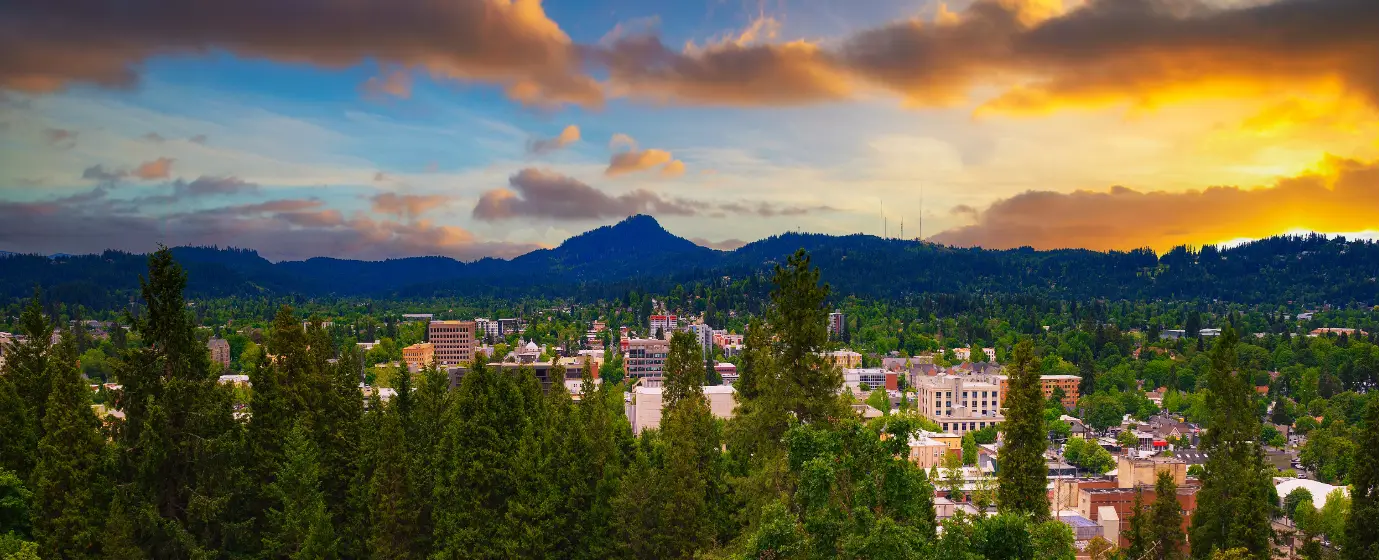
Willamette Valley · Oregon
Eugene Schools & Family Life: Top Districts, Academics & Community (2026)
You've narrowed it down to Eugene. The job transfer is real, the lease is up, and your kids start school in September. The question you keep coming back to isn't about the house — it's about whether the school district can actually deliver on what the Niche rating promises. Eugene School District 4J carries a solid above-average reputation, but the honest answer is more layered than a letter grade: this is a district where the gap between its highest-performing schools and its struggling ones is wide enough to make the neighborhood you choose feel like the most consequential decision of your move.
What shapes academic quality here isn't the district budget — 4J spends above national averages per pupil — it's the concentration of the University of Oregon's faculty, graduate students, and professional households in the southeast quadrant of the city. Schools closest to the UO campus and Fairmount Hill tend to serve more economically stable, education-focused populations, and the test scores reflect it. Meanwhile, the western portions of the city fall outside 4J entirely, served instead by Bethel School District 52, a smaller and lower-ranked district that covers neighborhoods like Bethel and parts of West Eugene. Knowing which district boundary your prospective address falls in isn't optional — it's the first thing you need to check.
This guide breaks down both districts, names the schools that consistently outperform, explains where the immersion and IB programs live, and gives you the honest picture of who this system serves well and who might need to look elsewhere. By the end, you'll know whether 4J fits your family's priorities — and what to do if it doesn't.

Eugene School District 4J serves the city of Eugene and surrounding unincorporated areas with approximately 16,500 students across more than 30 schools. It's one of the larger districts in Oregon and one of the more structurally complex — a combination of traditional neighborhood schools, language immersion magnets, charter schools, and alternative programs that gives families meaningful choice but also requires active navigation to use well.
| Metric | Eugene 4J | Oregon Average |
|---|---|---|
| Enrollment | ~16,500 | Varies by district |
| Graduation Rate | ~78% | ~80% |
| Student-Teacher Ratio | ~19:1 | ~19:1 |
| % Economically Disadvantaged | ~55% | ~52% |
| English Language Learners | ~12% | ~11% |
| GreatSchools District Rating | 5/10 | — |
| Niche Grade | B | — |
The headline numbers are solidly mid-tier for Oregon. What they don't show is the variance within the district — which is substantial. The highest-rated 4J elementary schools score well above state averages on state assessments; the lowest-rated schools score well below. Where you live within Eugene, and whether you engage with the choice/magnet system, will determine your family's experience far more than the district average suggests.
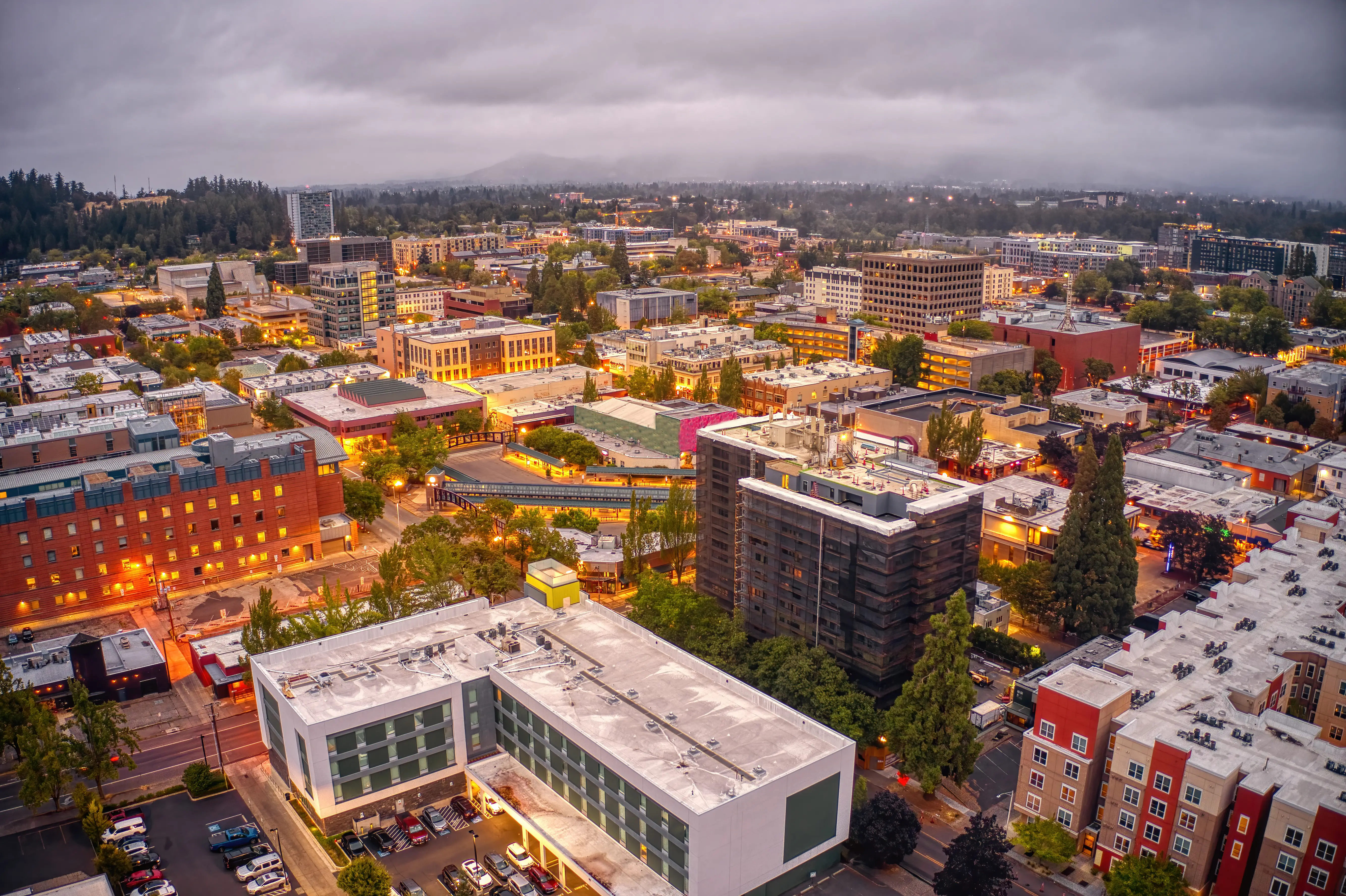
The range of elementary options in 4J is one of its genuine selling points. Alongside traditional neighborhood schools, families can apply to five language immersion programs, two Waldorf-inspired and Montessori charter schools, and a network-based alternative school downtown.
Charlemagne is the academic standout of the entire 4J elementary system — full stop. It consistently ranks in the top 5% of Oregon's 1,174 elementary schools, with math and reading proficiency rates that land in the top 1% statewide: roughly 75–79% of students test proficient in both subjects, compared to a state average that hovers around 31% in math and 44% in reading. It draws students by application from across Eugene rather than by attendance zone, which means access isn't determined by your zip code — but demand is high and families typically plan ahead. The honest limitation is that the immersion model is intensive: children spend a significant portion of their early years learning in French, and students who enter without family support for language practice at home tend to have a steeper adjustment curve.
Yujin Gakuen serves 250 students in a full Japanese immersion program and ranks in the top 10% of Oregon elementary schools, with roughly 55–59% math proficiency and 60–64% reading proficiency — both well above state averages. Families drawn to Yujin tend to be deeply committed to multilingual development and often have some connection to Japanese language or culture, though that's not a requirement. Like Charlemagne, it's application-based and draws citywide, but families should know that the pool of qualified teachers for Japanese immersion is smaller than for other programs, which occasionally affects staffing.
One of the top three publicly ranked elementary schools in Eugene, the Chinese Language Immersion School is a Mandarin program operating K–8 as of the 2024–25 school year and adding one grade per year as it scales. Academic performance tracks well above district and state averages, and it offers an immersion experience that's increasingly sought after by families thinking about their kids' long-term career landscape. Because it's still expanding, families entering at the middle grades are among the first cohorts at those levels, which means the program is newer and less established there than at the lower grades.
One of Oregon's original public charter schools, Ridgeline Montessori has operated since 2000 on the Montessori educational philosophy and serves K–8. It consistently outperforms district averages and draws families who prioritize self-directed learning and mixed-age classrooms. Parents who've had kids in both traditional 4J schools and Ridgeline often describe the difference in terms of environment and approach as much as academics — it suits independent learners who thrive with less structure, but families accustomed to conventional benchmarks sometimes find the lack of traditional grading a difficult adjustment.
Edgewood is one of the stronger neighborhood elementary schools in the district — a traditional attendance-zone school that consistently outperforms peers and draws particular attention from families in the south Eugene corridor. It tends to serve a relatively stable, engaged parent community, and its academic numbers put it comfortably above the district average. Families in the Fairmount and Amazon neighborhoods who don't pursue immersion programs often land here, and by most accounts they're pleased with the experience. Class sizes are typical for the district, and while the school doesn't have a specialized program hook, its staff continuity and parent culture make it one of the more reliable neighborhood school bets in 4J.
River Road/El Camino is one of 4J's Spanish immersion programs and serves the River Road community in north Eugene. It's a genuinely bilingual school with deep roots in the neighborhood's Latino community, and it performs better than its surrounding demographic profile might lead outsiders to expect. Families who move to the River Road corridor and have an interest in Spanish immersion often find this a meaningful part of what makes that neighborhood work for them. The honest trade-off is that River Road as a neighborhood is lower-income and less resourced than the south Eugene corridors, and the school reflects both the community's strengths and its challenges.
The broader network of 4J neighborhood schools covers a wide range of academic performance. Adams Elementary serves the Friendly Area and tends to attract a stable, community-oriented parent population. Buena Vista is another of the Spanish immersion options. Gilham and Willagillespie serve the Cal Young and Harlow corridors in north-central Eugene and are generally regarded as solid performers that reflect the more stable demographics of those neighborhoods. None of these schools rank at Charlemagne's level, but families who've moved into those areas typically report satisfaction — particularly with teacher quality and school culture — even if test scores don't tell the most dramatic story.
The transition from elementary to middle school is where some of the district's performance gaps widen. 4J operates eight middle schools across the city, and the quality variation between them is real. Monroe Middle School, which feeds into South Eugene High School, and Arts and Technology Academy are frequently mentioned by parents as standouts at the middle school level. Families who've been in an immersion program typically continue into dedicated immersion tracks at the middle school level, which helps maintain that cohort's strong performance.
South Eugene is the district's crown jewel — a genuine academic powerhouse that competes on a state and national level. Located at 400 E. 19th Ave., it ranks among the top high schools in Oregon and hosts the Eugene International High School's IB Diploma program, giving motivated students access to one of the most rigorous college-prep tracks available at a public school anywhere in the state. Roughly 44% of students take AP coursework, and 11th-grade proficiency rates run approximately 79% in English Language Arts and 52% in math — well above both state and national averages. The graduation rate typically runs around 90%, above Oregon's state average of 81%. South Eugene is classified in OSAA's highest competitive tier and draws students from the south and east portions of the city, particularly the Fairmount, Amazon, and South University neighborhoods. Students who thrive here tend to be academically motivated, comfortable in a somewhat competitive environment, and interested in taking advantage of IB or AP offerings — students who need more individualized support or a smaller school culture sometimes find the size and pace overwhelming.
Looking to buy in Eugene? Estimate your payment.
Enter your numbers to see an estimated monthly mortgage payment.
Estimate only. Excludes HOA fees and mortgage insurance.
A 5/10 district rating from GreatSchools tells you almost nothing useful about your child's day-to-day experience in 4J — because it's an average of schools that range from 3/10 to 9/10. The rating reflects socioeconomic factors as much as instructional quality, and within 4J, the gap between schools is wide enough that two families living six blocks apart can have completely different educational experiences.
The magnet and immersion programs are the most consistent high-performers in the district. The Spanish immersion programs at Gilham and Fox Hollow consistently draw strong ratings and strong family engagement. The Chinese immersion program at Yujin Gakuen, which also offers a Japanese track, has a waiting list that fills early. If language immersion is a priority, the application process opens in January for the following fall — don't wait.
For traditional neighborhood schools, the pattern tracks closely with geography. Schools in the south and southeast parts of Eugene — South Eugene High's feeder elementaries in particular — tend to post stronger academic outcomes than schools in the west and northwest. This isn't a judgment; it's a reflection of the income gradient across the city. Families with flexibility on neighborhood should factor school assignment into the location decision early, not after they've fallen in love with a house.
The ratings also don't capture what 4J does reasonably well: arts programming, access to outdoor and environmental education through the surrounding Willamette Valley landscape, and a genuine commitment to inclusive programs for students with disabilities. Eugene has a higher-than-average rate of families who prioritize progressive education models, and the district has responded to that over time.
Families relocating from high-performing suburban districts — Beaverton, Lake Oswego, Tigard-Tualatin — will find 4J's average outcomes a step down from what they're accustomed to. If academic performance metrics are the primary filter, the honest answer is that 4J's neighborhood school system, at the median, will not match what those districts deliver.
Families who need highly specialized special education services should research specific school placements carefully before committing to a neighborhood. 4J has inclusive programs, but availability varies by school and waitlists can affect placement timelines.
High school students who are strongly academically oriented and come from schools with robust IB or AP programs will find 4J's offerings uneven. South Eugene High has a strong IB program and is the clear standout for academically driven students. Sheldon and Churchill are solid. The newer high schools in the district have fewer specialized tracks.
Eugene has a reasonably developed private school ecosystem for a city its size, anchored by a mix of faith-based, Montessori, Waldorf, and college-prep options.
| School | Type | Grades | Notes |
|---|---|---|---|
| Saint Mary School | Catholic | K–8 | Established parish school, strong community |
| Marist Catholic High School | Catholic | 9–12 | College prep, strong athletics and academics |
| Eugene Waldorf School | Waldorf | PK–8 | Arts-integrated curriculum, small class sizes |
| Willamette Valley Montessori | Montessori | PK–6 | AMI-affiliated, strong early childhood program |
| Faith Bible Christian School | Christian | K–12 | Classical/Christian curriculum |
Preschool and childcare access in Eugene is competitive — the same undersupply affecting most Oregon metro areas applies here. University of Oregon's Child and Family Center has a strong reputation but a long wait list, and priority goes to UO affiliates. The Eugene YMCA operates childcare programs with multiple locations. Families relocating with children under 5 should begin childcare research well before their move date; waiting until arrival is a significant mistake in this market.
Eugene's appeal for families extends well beyond the schools. The Willamette River runs through the city, and the network of bike paths, riverside parks, and open spaces gives kids genuine room to move in a way that's unusual for a city this size. Alton Baker Park and the adjacent Pre's Trail system are accessible from most parts of the city and function as a de facto backyard for a large share of Eugene families.
Youth sports infrastructure is strong, anchored by Eugene's long identity as "Track Town USA." The Lane County youth athletics programs, the Willamalane Park and Recreation District (serving adjacent Springfield, which many Eugene families access), and a robust club sports scene in soccer, basketball, and swimming give families a lot of options. The UO Ducks create a genuine big-event culture — football Saturdays at Autzen, track meets at Hayward Field — that younger kids absorb and older ones participate in.
The arts scene is genuinely accessible for families. The Hult Center hosts touring Broadway productions and family concerts. The Jordan Schnitzer Museum of Art on the UO campus has free admission. The Eugene Symphony and Eugene Ballet both run education programs. For a mid-sized Oregon city, the cultural programming available to kids here is a meaningful quality-of-life factor that doesn't show up in school ratings.
Local Expert Takeaway
The question I get from families moving to Eugene is almost always "are the schools good?" The honest answer is: it depends entirely on which schools. 4J's magnet and immersion programs are genuinely excellent — if you can get your kids in, and if you apply early enough, you will be happy. The traditional neighborhood school system is more mixed, and where you land on that spectrum correlates pretty directly with which part of the city you buy in. My advice: decide on your school priorities first, then let that drive your neighborhood search, rather than the other way around. South Eugene's feeder schools and the immersion programs are the strongest consistent performers. Start there.
Is Eugene 4J a good school district? It's a mixed district with high variance. The magnet, immersion, and IB programs are strong. Traditional neighborhood school quality correlates closely with the income levels of the surrounding neighborhood. The average rating understates the best schools and overstates the worst.
What are the best elementary schools in Eugene? Gilham (Spanish immersion), Fox Hollow (Spanish immersion), and Yujin Gakuen (Chinese/Japanese immersion) consistently draw strong ratings. Among traditional neighborhood schools, elementaries feeding into South Eugene High tend to be the strongest performers.
Does Eugene have private school options? Yes — Marist Catholic High School is the most established private option for high school. Saint Mary provides K–8 Catholic education. Eugene Waldorf and Willamette Valley Montessori serve families looking for alternative pedagogical approaches.
How competitive is childcare availability in Eugene? Very competitive. Start your search before you move. UO-affiliated families have priority at the university's program; community options fill quickly. The YMCA and several private Montessori preschools are the most consistent options for non-UO families.
What's the high school situation? South Eugene High is the standout for academically oriented students — it has Eugene's only IB program and consistently the strongest outcomes. Sheldon and Churchill are solid comprehensive high schools. The district's newer high schools are less differentiated academically.
Explore the full Eugene series: The Ultimate Eugene Relocation Guide · Is Eugene Safe? · Cost of Living in Eugene · Best Neighborhoods in Eugene · Eugene Schools & Family Life · Eugene Youth Sports · Eugene Parks & Recreation · Retiring in Eugene · 1031 Tax-Deferred Exchange in Eugene · Eugene First-Time Homebuyers Guide · · Moving to Eugene from California
Tell us what you need help with and we'll connect you with local resources.

About the Author
Todd Davidson is the founder of Living in Oregon and Living in Washington, where he publishes in-depth city guides, neighborhood resources, and local market insights covering more than 180 communities across the Pacific Northwest. While his background is in home financing and real estate, he created these digital platforms to help families research and compare regions before making a move.