Southern Oregon · Oregon
Retiring in Myrtle Creek: Is It the Right Fit for Your Next Chapter? (2026)
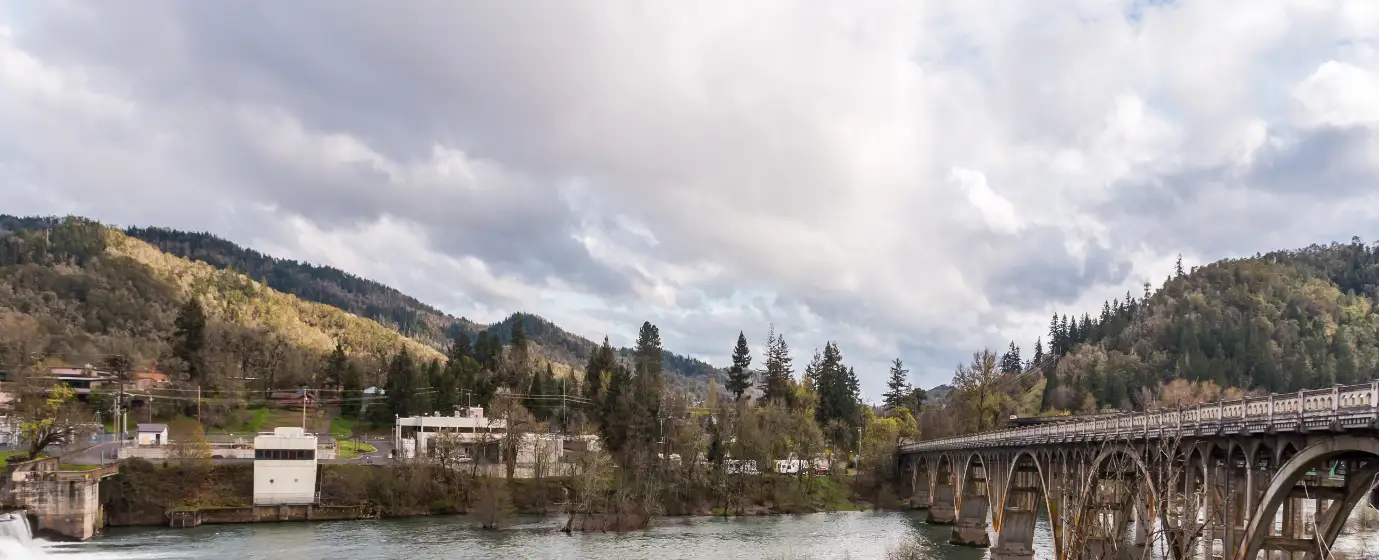
Myrtle Creek doesn't try to be a retirement destination. There's no golf cart parade down Main Street, no planned senior community with a clubhouse and pickle-ball courts, no marketing campaign aimed at California snowbirds. What it offers instead is something harder to manufacture: a genuinely affordable small town along the South Umpqua River, where a retired couple can own a house outright on a modest fixed income and spend weekday mornings walking the riverbank without fighting for a parking spot.
The retiree who thrives here is someone who has consciously chosen quiet over convenience. Myrtle Creek rewards people who want low housing costs, mild Pacific Northwest weather, and access to the kind of outdoor landscape — forested hills, river walks, covered bridges — that doesn't require a trail permit or a two-hour drive. It's less suited for retirees who depend on walkable urban amenities, proximity to a major medical center, or a robust cultural calendar.
This guide covers the Oregon tax picture for retirees, healthcare infrastructure both in town and in nearby Roseburg, the senior living options that actually exist here, what daily life looks like without a car, and how Myrtle Creek stacks up against other Southern Oregon retirement options. By the end, you'll have a clear picture of whether this is your next chapter or just a scenic detour.

Oregon's tax treatment of retirement income is a genuine mixed bag — and understanding it before you move matters more than the sticker price on any house. The table below captures the key categories.
| Income Type | Oregon Tax Treatment |
|---|---|
| Social Security Benefits | Fully exempt — Oregon does not tax Social Security |
| Federal pension / military retirement | Partial exemption up to $6,250 per person; excess taxed as ordinary income |
| Private pension / 401(k) / IRA withdrawals | Fully taxable as ordinary income |
| Oregon Public Employee Retirement (PERS) | Taxable for benefits accrued after October 1991 |
| Investment income (dividends, capital gains) | Taxed as ordinary income — no preferential capital gains rate |
| Property tax | Approximately 0.58% effective rate in Myrtle Creek |
| Sales tax | None — Oregon has no statewide or local sales tax |
Oregon's Property Tax Deferral Program is worth knowing about before you finalize your move. Homeowners 62 and older with household income at or below $46,500 can defer property taxes on their primary residence — the state essentially covers the bill and places a lien on the property, repaid when the home is sold or transferred. At Myrtle Creek's median sold price of $299,000 and a 0.58% rate, that's roughly $1,734 in annual taxes that can be deferred rather than paid out of pocket. For retirees on tight fixed incomes, this program can be the difference between staying in a home and being forced to sell it.
For a town of 3,500, Myrtle Creek has meaningfully more primary care access than you'd typically expect. Aviva Health's Myrtle Creek Family Medicine Clinic expanded its care team in late 2025, adding two physician associates through a rural Oregon residency program — a notable improvement for a town this size. Aviva also runs a dental clinic on Division Street with weekday hours. The Umpqua Community Health Center at 790 S Main Street provides primary care, behavioral health, dental, and chronic disease management under one roof, with the backing of a larger regional network. Dr. Mark C. Phillips, MD maintains a family medicine practice at 860 N Myrtle Road.
What Myrtle Creek does not have is a hospital. For anything beyond a clinic visit — imaging, surgery, cardiac care, orthopedics, emergency services — you're driving to Roseburg. The primary facility there is CHI Mercy Health's Mercy Medical Center at 2700 NW Stewart Parkway, Roseburg, roughly 18 miles north via I-5. Mercy operates a Level III trauma center with 24/7 emergency services, surgical suites, cardiac care, maternity, intensive care, and rehabilitation. It has earned an "A" grade from the Leapfrog Group for patient safety six consecutive times — a meaningful credential in a region where options are limited.
For retirees who experience a genuine medical emergency, 20 minutes to a Level III trauma center is a reasonable rural reality, but it's worth understanding the hierarchy. Mercy is well-regarded regionally but is not an academic medical center. Complex cancer cases, advanced cardiac procedures, and neurosurgical care typically route to PeaceHealth Sacred Heart Medical Center in Eugene, about 90 miles north on I-5 — a 90-minute drive. For routine cardiology follow-ups, specialist consultations, and outpatient procedures, Roseburg handles the majority of cases without requiring that longer trip.
For retirees who no longer drive, U-Trans bus service connects Myrtle Creek to Roseburg five times daily for one dollar each way. It's not on-demand convenience, but it makes medical appointments in Roseburg accessible without depending on family or a rideshare.
The senior living inventory here is small but covers the core care spectrum. Independent living, assisted living, and memory care are all represented within or immediately adjacent to the city.
| Community | Type | Location | Est. Monthly Cost |
|---|---|---|---|
| Valley View Retirement Center | Independent Living | Myrtle Creek | $1,200–$1,800 |
| Plaza Retirement Community | Assisted Living | 265 SE Plaza Dr, Myrtle Creek | $3,500–$5,000 |
| Adams House Assisted Living | Assisted Living / Memory Care | Myrtle Creek area | $4,500–$6,500 |
| Myrtle Terrace Apartments | Senior Apartments | Myrtle Creek | $800–$1,200 |
| Meadowlark Court | Senior Housing | Myrtle Creek area | $900–$1,400 |
| Clearwater Manor | Senior Housing | Myrtle Creek area | $1,000–$1,500 |
Plaza Retirement Community at 265 SE Plaza Drive and Adams House represent the assisted living and memory care end of the spectrum. Adams House offers secure memory care environments with structured cognitive programming — an important option for couples where one partner is navigating early dementia and the other is still largely independent.
Oregon's assisted living costs run higher than the national average, with the state figure coming in around $6,490 per month for assisted living and over $10,000 for nursing home care. What mitigates that reality in Myrtle Creek is the housing equation: retirees who arrive owning their $299,000 home outright have an asset that can partially fund care costs without the same financial pressure they'd face in Eugene or Medford, where the same asset would cost twice as much to acquire.

Looking to buy in Myrtle Creek? Estimate your payment.
Enter your numbers to see an estimated monthly mortgage payment.
Estimate only. Excludes HOA fees and mortgage insurance.
The honest answer to walkability in Myrtle Creek is: limited, but functional if you live in the right part of town. There is no downtown shopping district in the traditional sense. What the city offers is a cluster of basic services — a dollar store, a Subway, a Tractor Supply, a pharmacy — accessible on foot for anyone living near the Plaza Drive or Main Street corridors. For full grocery shopping, most residents drive to Roseburg.
The outdoor calendar is Myrtle Creek's strongest daily-life asset. Millsite Park sits at the edge of the South Umpqua River and draws walkers, anglers, and picnickers throughout the spring and summer. The Horse Creek Covered Bridge, one of Douglas County's historic covered bridges, makes for an easy half-day outing that never loses its appeal. Cougar Canyon Golf Course offers 9 holes in a setting that wouldn't feel out of place in a travel magazine — for retirees who golf, it's one of the legitimately good things about living here. Evergreen Park and Myrtle Creek Memorial Park provide additional green space for low-impact exercise, and the Neal Lane Bridge corridor along the South Umpqua is one of the quieter river walking routes in Southern Oregon.
Social infrastructure is thin. There is no performing arts center, no wine bar, no year-round farmers market. What replaces it is the kind of community that forms around churches, the local volunteer fire auxiliary, and informal gatherings at the river. Douglas County events in Roseburg — the County Fair, the Wine Country Classic, the Saturday farmers market at Stewart Park — become the cultural anchors for Myrtle Creek residents willing to make the 20-minute drive. For retirees who have moved past needing an urban cultural calendar, this trade-off is easy to accept. For those who assumed Southern Oregon meant Ashland, it's an adjustment.
Getting around without a car is genuinely possible for medical appointments and basic errands, but it requires planning. The U-Trans bus to Roseburg is the backbone of transit access here. Uber and Lyft coverage exists but is inconsistent in a town this small. The most realistic retirement scenario in Myrtle Creek involves at least one driver in the household, or a living situation close enough to town services to walk for the basics.
What surprises most people after six months of living here is how much the pace changes their sense of time. Retirees who moved from Portland or the Bay Area commonly describe Myrtle Creek as the first place they've lived where the weekend genuinely feels different from the weekday.
| City | Median Home Price | Nearest Hospital | Walkability | Senior Living Depth | Overall Retirement Fit |
|---|---|---|---|---|---|
| Myrtle Creek | $299,000 | Mercy Medical (Roseburg, 20 min) | Low | Moderate | Budget-focused, outdoors-oriented |
| Roseburg | ~$330,000 | Mercy Medical (in-city) | Moderate | High | More amenities, higher cost |
| Canyonville | ~$250,000 | Mercy Medical (Roseburg, 25 min) | Very low | Limited | Most affordable, least infrastructure |
| Winston | ~$280,000 | Mercy Medical (Roseburg, 15 min) | Low | Limited | Similar profile to Myrtle Creek |
| Grants Pass | ~$370,000 | Three Rivers Medical Center (in-city) | Moderate | High | Better services, higher price |
| Ashland | ~$540,000 | Asante Rogue Regional (Medford, 20 min) | High | Moderate | Cultural richness, premium cost |
Ashland sits at the opposite end of the spectrum — culturally rich, walkable by Oregon small-city standards, with the Oregon Shakespeare Festival and a lively restaurant scene. The catch is that median prices are nearly double Myrtle Creek's, and the demographic pressure of a well-known retirement destination means prices have stayed elevated even as other Southern Oregon markets have softened.

Local Expert Takeaway: Myrtle Creek makes the most sense for retirees who arrive with the home purchase fully funded — no mortgage, no monthly payment eating into Social Security income — and who value outdoor access over urban convenience. If you're choosing a neighborhood, focus on the south end of town near Stinebaugh Park or the River Road corridor for the best combination of lot size, condition, and proximity to the South Umpqua trail access. Retirees who need reliable specialist care more than twice a year, who don't drive, or who are moving from a walkable urban environment should look seriously at Roseburg before committing to Myrtle Creek — the 20-minute drive sounds trivial until it isn't.
Is Myrtle Creek a good place to retire?
For the right profile of retiree, yes. A retired couple who wants to own a home without a mortgage, spend time outdoors along the South Umpqua River, and live somewhere genuinely quiet will find Myrtle Creek checks their boxes in ways that more expensive Oregon cities don't. It works best for people who are healthy and mobile, own their home free and clear, and have already made peace with driving to Roseburg for anything beyond primary care.
What senior living options are available in Myrtle Creek?
The city has a modest but complete spectrum of senior housing — Valley View Retirement Center handles independent living with on-site amenities, Plaza Retirement Community at 265 SE Plaza Drive provides assisted living support, and Adams House covers assisted living and memory care including secure dementia environments. Several senior apartment options including Myrtle Terrace Apartments and Meadowlark Court round out the independent end of the market at lower monthly costs.
How does Myrtle Creek compare to Roseburg for retirement?
Roseburg offers substantially more — in-city hospital access, greater senior living depth, more dining and retail, and a community college with adult programming — for a median home price that runs roughly $30,000–$40,000 higher. Myrtle Creek is the better fit for retirees who are prioritizing affordability and quiet over services. Roseburg is the better fit for retirees who anticipate needing regular specialist care, who want more social infrastructure, or who are moving with a partner whose health situation may evolve over the next decade.
Explore the full Myrtle Creek series: The Ultimate Myrtle Creek Relocation Guide · Is Myrtle Creek Safe? · Cost of Living in Myrtle Creek · Best Neighborhoods in Myrtle Creek · Myrtle Creek Schools & Family Life · Myrtle Creek Youth Sports · Myrtle Creek Parks & Recreation · Retiring in Myrtle Creek · 1031 Tax-Deferred Exchange in Myrtle Creek · Myrtle Creek First-Time Homebuyers Guide · · Moving to Myrtle Creek from California
Tell us what you need help with and we'll connect you with local resources.

About the Author
Todd Davidson is the founder of Living in Oregon and Living in Washington, where he publishes in-depth city guides, neighborhood resources, and local market insights covering more than 180 communities across the Pacific Northwest. While his background is in home financing and real estate, he created these digital platforms to help families research and compare regions before making a move.