Southern Oregon · Oregon
Moving to Myrtle Creek from California: The Honest Comparison (2026)
The California-to-Oregon move rarely starts with a spreadsheet. It starts with a moment — the Bay Area software engineer who opens Zillow one night and realizes the $299,000 median price in Myrtle Creek is less than the down payment on a San Francisco condo. The San Diego family who got their July utility bill again and did the math. The Sacramento couple who sold their 1,400-square-foot townhome and discovered they could buy a craftsman on half an acre in Southern Oregon and still have six figures left over. Myrtle Creek keeps appearing in these searches because the numbers are genuinely hard to ignore — and for remote workers especially, the geographic distance from California has become largely irrelevant.
The hard part deserves equal billing. Myrtle Creek is not a California suburb with Oregon trees. The pace is different, the food scene is different, the winters are grayer than most transplants expect, and the cultural reference points shift in ways that take time to absorb. People who move here thinking they're getting a cheaper version of Northern California tend to land differently than people who move here wanting something fundamentally quieter, slower, and more rural. The gap between those two expectations is where most of the adjustment friction lives.
This guide covers the full picture: cost comparisons across four California origin markets, what your specific equity level actually buys here, the real tax math, a weather comparison that doesn't gloss over December, and the four most common mistakes California buyers make before or after signing.
| Myrtle Creek, OR | Bay Area | Southern CA | Sacramento Metro | Central Valley | |
|---|---|---|---|---|---|
| Median Home Price (approx. 2026) | $299,000–$313,000 | $1.7M–$2.15M | $1.0M–$1.15M | $500,000 | $320,000–$400,000 |
| Property Tax Rate (effective) | ~0.58% | ~1.1%–1.25% | ~1.1%–1.25% | ~1.1%–1.25% | ~1.0%–1.2% |
| State Income Tax (top bracket) | 9.9% | 13.3% | 13.3% | 13.3% | 13.3% |
| State Sales Tax | None | 7.25%–10.75% | 7.25%–10.50% | 7.25%–8.75% | 7.25%–9.00% |
| Avg Utilities (monthly est.) | $150–$200 | $200–$300 | $220–$320 | $180–$260 | $160–$240 |
| Avg 1BR Rent | $900–$1,100 | $2,800–$3,600 | $2,200–$3,200 | $1,400–$1,900 | $900–$1,300 |
The Sacramento comparison is less dramatic but still compelling. A buyer selling a median Sacramento home around $500,000 with a standard down payment already in equity position can land in Myrtle Creek with their mortgage at a fraction of what they were paying — or zero — while picking up meaningfully more square footage, land, and quiet. The Central Valley buyer has the smallest relative gain, but they're arriving in a market where their dollar-per-acre ratio still improves substantially and Oregon's lack of sales tax starts showing up immediately in everyday spending.
| Tax Item | California | Oregon | Net Impact |
|---|---|---|---|
| State Income Tax (top bracket) | 13.3% | 9.9% | Save ~3.4 pts at high income |
| State Sales Tax | 7.25%–10.75% | None | Save 7–11% on taxable purchases |
| Property Tax Rate | ~1.1%–1.25% effective | ~0.58% effective | Pay less in OR |
| Property Tax Growth Cap | Prop 13 (2% annual cap) | Measure 50 (3% annual cap) | Similar long-term protection |
| Senior Property Tax Deferral | Varies by county | Available at 62+ | OR advantage for retirees |
| Capital Gains Tax | Up to 13.3% state | Up to 9.9% state | OR is lower at high brackets |
Oregon's Measure 50 caps assessed value increases at 3% per year after purchase, similar in spirit to California's Proposition 13. For long-term owners, that's a meaningful protection against runaway tax bills as the market appreciates around you. At the $299,000 median price, annual property taxes in Myrtle Creek run approximately $1,734 — lower than what a California homeowner would pay even on a Prop 13-locked assessment, and dramatically lower in absolute dollars than what a $1.5 million California home generates even at the lower California effective rate. A California transplant earning $150,000 annually moves from a state marginal income tax of up to 9.3%–10.3% at that income level down to Oregon's 9%–9.9% range — meaningful but not transformational at that bracket. The bigger wins are the sales tax elimination and the absolute reduction in housing cost.
A buyer leaving San Francisco or the peninsula with $1.5 million in equity doesn't just enter the Myrtle Creek market — they own it outright in cash. The entire city's active listing range runs from $25,000 to $1,195,000, with the upper end representing rural acreage properties and custom builds on private land with river or mountain views. At the $400,000–$800,000 tier, Bay Area equity buys finished craftsman homes on 5+ acres, properties with water rights dating back over a century, concrete shops, barns, guest quarters, and the kind of land that doesn't exist in California at any price point accessible to the median buyer.
The Wood Crest neighborhood represents the most polished residential option in Myrtle Creek — corner lot estates with valley and mountain views, 1,900+ square feet, and a level of finish that surprises buyers expecting a rural compromise. A Bay Area seller arriving with $1.8 million in equity can purchase here in cash, invest the remainder, and pay zero mortgage for the rest of their working life. That's not a hypothetical — it's the scenario playing out for remote workers in tech who made the shift to distributed work and discovered that Southern Oregon is four hours from San Francisco by car, not by obligation.
A buyer leaving Pasadena or Irvine with $900,000 in equity lands in Myrtle Creek at the absolute top of the local market. Custom-built homes from 2023 on 5+ private acres with river and mountain views are available in the $600,000–$700,000 range — the kind of property that would list at $3 million in Malibu or $1.5 million in Temecula. At $800,000, you're looking at multi-structure rural compounds with outbuildings, workshop space, and acreage that functions as both primary residence and agricultural use.
SoCal buyers in this equity range typically arrive having made a deliberate lifestyle choice, not just a financial one. They've priced out of coastal cities, found suburban Inland Empire increasingly congested, and are ready for something with actual land and quiet. Myrtle Creek delivers that in spades — the catch is that you're trading year-round beach access and LA's dining infrastructure for Southern Oregon's rivers, trails, and a pace of life that genuinely slows down in ways that either feel like freedom or frustration, depending on who you are.
This buyer has the most interesting math. A Sacramento seller walking away from a $500,000 home with $400,000 in equity can buy the median Myrtle Creek property in the mid-$300,000s with a small conventional mortgage, or stretch into rural acreage in the $380,000–$450,000 range with a down payment in the 40–50% range. The monthly payment drops dramatically even with Oregon's slightly higher property tax rate, because the principal itself is so much lower.
The Inland Empire buyer — leaving Riverside or San Bernardino with equity in the $400,000–$550,000 range — typically lands with more financial cushion than they expect. Rural acreage listings near North Myrtle Road, with 8+ acres, vaulted ceilings, updated kitchens with quartz countertops, and outbuildings, list in the $380,000–$500,000 range. There's also the land-only option: raw land near Myrtle Creek averages around $9,100 per acre across active listings, putting a 5-acre parcel within reach of a buyer who wants to build over time.
This buyer has the smallest spread but still finds the move financially workable. A Fresno or Stockton seller with $350,000 in equity isn't arriving with Bay Area leverage, but they can still purchase a solid 3-bedroom, 2-bath home near I-5 at Exit 106 — within walking distance of restaurants and grocery access — in the $250,000–$320,000 range with a manageable down payment. The elimination of California's sales tax provides immediate, recurring relief that compounds over time. And the property tax on a $299,000 Myrtle Creek home, while at a higher rate, is still a lower absolute dollar amount than what they're likely paying on a California home that's appreciated well past assessed value.
Looking to buy in Myrtle Creek? Estimate your payment.
Enter your numbers to see an estimated monthly mortgage payment.
Estimate only. Excludes HOA fees and mortgage insurance.
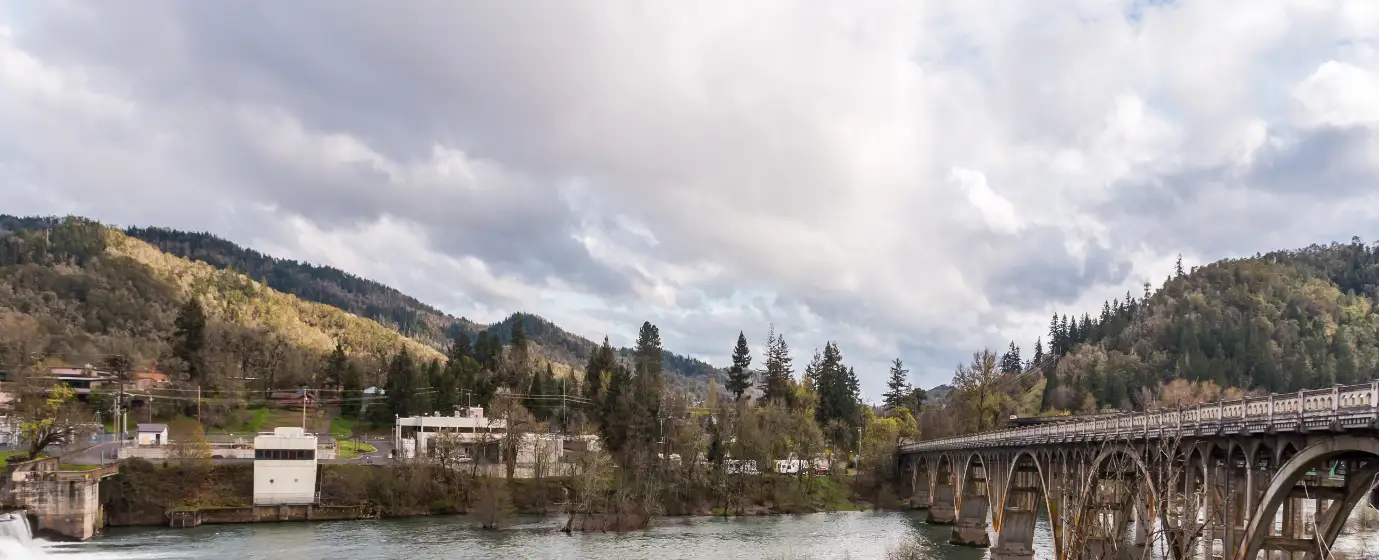
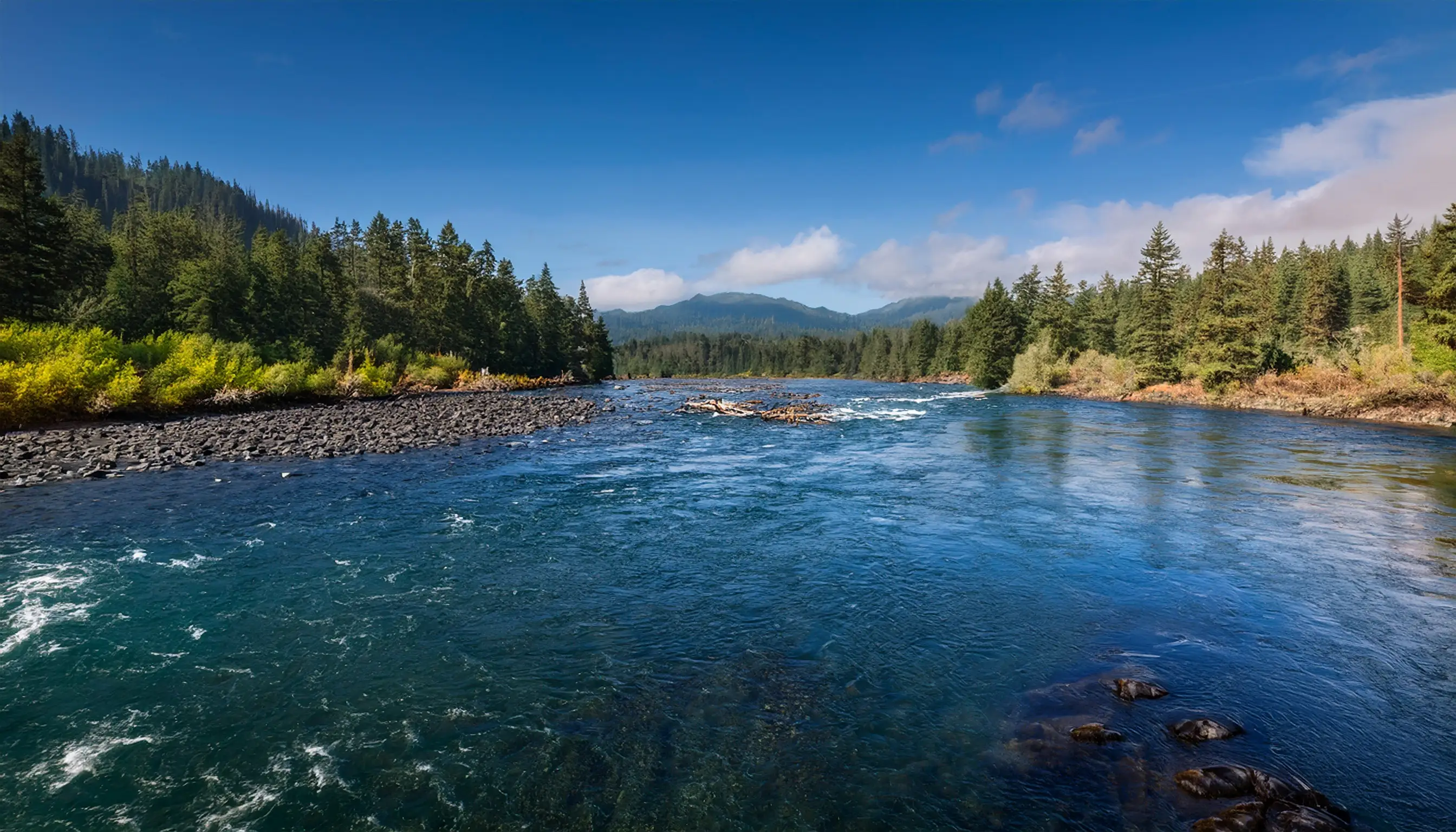
Nobody from San Diego is going to pretend that Myrtle Creek's December isn't a shock. The city gets approximately 35–40 inches of rain annually, most of it between October and April, and December averages just under three hours of daylight sun. Winters are genuinely gray, genuinely cold, and nothing like the California shoulder seasons that transplants tend to imagine as "Oregon winter." The upside is that the city sits in a warm-summer Mediterranean climate zone — July and August are legitimately spectacular, dry, and sunny, with clear skies roughly 83% of the time and daytime highs reaching the mid-to-upper 80s. Summer in Myrtle Creek, with the South Umpqua River running through town and Cougar Canyon Golf Course accessible, genuinely delivers on the Pacific Northwest outdoor promise.
What California transplants most commonly report loving after their first full year is the summer. Not just the weather, but what it produces socially — the slower pace, the ability to actually get to a trailhead without an hour of traffic, the sense that you're not competing for outdoor space. The South Umpqua River corridor and the surrounding Douglas County hills feel accessible in a way that California's crowded state parks stopped feeling years ago. Housing space — having an actual yard, a garage, room for a workshop or garden — also ranks high in what people say they stopped taking for granted.
What they genuinely miss is harder to name briefly. Year-round beach access is the most common. The dining density of even a mid-sized California city. The social energy of a place where there are simply more people doing more things on any given weekend. Myrtle Creek has a population of about 3,500 — Friday night here is structurally different from Friday night in Sacramento. That's not a criticism; it's a fact. Buyers who arrive having made peace with that trade are consistently happier at the 18-month mark than buyers who expected the cost savings without the lifestyle recalibration.
If you want to see how Myrtle Creek stacks up directly against the city you're leaving, use the comparison tool below. It covers the 120 largest California cities with current housing and tax data.
Home prices: Redfin median sale data, Q1–Q2 2026. Select your city to compare.
Ready to talk through what your specific California equity could do in Myrtle Creek? Todd can model your exact scenario in a single call.
Mistake 1: Assuming the whole city is homogenous. Myrtle Creek has meaningful character differences between its areas. The neighborhoods near I-5 at Exit 106 are more accessible and walkable — closer to services, faster to Roseburg, easier for everyday errands. The rural acreage zones along North Myrtle Road and the surrounding hills feel like an entirely different lifestyle proposition: private, quiet, and beautiful, but genuinely remote in ways that affect school transportation, emergency response times, and winter road conditions. Buyers who tour a polished rural listing and then compare it to city-adjacent inventory without accounting for the practical implications of that distance commonly regret the choice in month eight.
Mistake 2: Not testing for radon. Oregon has elevated radon zones, and Douglas County properties — particularly those with basements or crawl spaces built on older foundations — test at elevated levels more frequently than California buyers expect. California's radon risk profile is generally low, so most transplants have never ordered a radon test in their lives. In Myrtle Creek, it's a standard due diligence item. A mitigation system isn't expensive, but discovering the issue without testing first is a negotiation you don't want to have after closing.
Mistake 3: Underestimating the winter commute reality. The 20-minute drive to Roseburg on I-5 is fast and easy in September. In January, with fog in the valley and frost on the overpass bridges, it's a different experience. California transplants who have never driven in sustained winter wet conditions on roads that occasionally ice without warning tend to misjudge this. Neal Lane Bridge and the surface roads off the interstate deserve particular attention when temperatures drop overnight — this is the kind of thing longtime residents know without thinking about it, and new arrivals learn the hard way.
Mistake 4: Expecting California-speed services. In the Bay Area or LA, same-day delivery, 30-minute restaurant apps, and dense retail infrastructure are invisible infrastructure. In a city of 3,500, they're not. The nearest Costco and expanded retail options require the Roseburg drive. That 20-minute commute is easy on a Saturday — it's a different mental calculation when you realize you've made it four times this week for different errands. Buyers who build this reality into their planning before they close are far better positioned than those who discover it after moving their furniture in.
Bay Area sellers with $1.2 million or more in equity are frequently paying all-cash in Myrtle Creek — the entire city's inventory falls well below that figure. For these buyers, rate discussion is largely irrelevant; the more important considerations are 1031 exchange eligibility if the California property was held as an investment, and the speed advantage that a cash offer provides in a thin-inventory market. If you've been holding a California rental and are considering a like-kind exchange into an Oregon investment property, the timeline constraints are strict — the 1031 exchange guide for Myrtle Creek covers the mechanics.
SoCal sellers in the $700,000–$1.2 million equity range typically arrive in Myrtle Creek positioned for a conventional loan with a substantial down payment. Because Myrtle Creek's prices sit well below the conventional conforming loan limit, none of these buyers will need jumbo financing — a structural simplification compared to what they were navigating in California. Down payments in the 40–60% range produce monthly payments that often feel almost impossibly low to someone accustomed to a Southern California mortgage, which is partly disorienting and partly the point.
Sacramento and Inland Empire buyers with $400,000–$650,000 in equity have strong conventional loan positioning, particularly if the target property falls at or under $350,000. Oregon's OHCS programs and other low-down-payment options exist for buyers whose purchase price qualifies and who meet income thresholds — a meaningful option for buyers arriving with equity but wanting to preserve liquidity after closing. If you're buying near the $299,000 median, you have access to the full range of conventional and state-backed programs, which makes for a clean, fast loan process.

Local Expert Takeaway: The single thing most California buyers underestimate about Myrtle Creek is how quickly the best properties move relative to the market average. The 78-day market average is pulled up significantly by rural acreage listings that sit until the right buyer arrives — well-priced, move-in-ready homes in established neighborhoods like Wood Crest or near Exit 106 frequently go under contract within 30 days. California cash buyers who fly in for a weekend of showings and expect to deliberate for two weeks back home commonly lose the home they wanted. Have your proof-of-funds or pre-approval ready before you land, and be prepared to make a decision on-site.
✅ California equity goes dramatically further here. Bay Area and SoCal sellers can eliminate their mortgage entirely at Myrtle Creek's $299,000–$313,000 median sold price, often with six figures remaining. Even Sacramento buyers see a substantial improvement in monthly payment, land per dollar, and immediate sales tax relief.
⚠️ The lifestyle adjustment is real. Myrtle Creek is a city of 3,500 with limited services on-site. Winters are gray, long, and nothing like California's shoulder seasons. The people who thrive here are the ones who came for something different — not the ones who came for cheaper California.
📍 Cash buyers have structural leverage. In a thin-inventory market where well-priced homes go under contract in under 30 days, arriving pre-positioned as a cash buyer is a meaningful competitive advantage. Test for radon, budget for the Roseburg commute as part of daily life, and tour both the city-adjacent and rural acreage areas before deciding which version of Myrtle Creek actually fits your life.
Is moving from California to Myrtle Creek worth it?
For the right buyer, the answer is clearly yes — but "worth it" depends on what you're optimizing for. If you're a remote worker leaving a Bay Area or SoCal market with substantial equity, the math is transformative: you can eliminate your mortgage, own property with actual land, and significantly reduce your state income tax burden. If you're expecting a seamless lifestyle transplant with California-level amenities at Oregon prices, the adjustment will be harder. The buyers who report the highest satisfaction at the two-year mark are the ones who moved toward something — quieter pace, outdoor access, financial stability — not just away from California's cost.
How much cheaper is housing in Myrtle Creek vs. California?
The gap is substantial across every California origin market. The median sold price in Myrtle Creek runs approximately $299,000–$313,000 against San Francisco's $1.7 million, Los Angeles's $1.0 million, and Sacramento's $500,000. A buyer leaving a median LA property gets roughly three times more home value per dollar in Myrtle Creek; a buyer leaving San Francisco gets more than five times as much. Even relative to Sacramento — the California comparison that creates the smallest spread — a Myrtle Creek buyer is paying about 60 cents on the Sacramento dollar and receiving more land, more square footage, and considerably more quiet.
What do I need to know about moving from California to Oregon?
Oregon has a state income tax (up to 9.9% at the top bracket), so the "escape California taxes entirely" framing only applies partially. What disappears entirely is state sales tax — California's 7.25–10.75% baseline goes to zero the moment you cross the state line, which adds up to thousands of dollars annually on typical household spending. Oregon's Measure 50 caps property tax assessment increases at 3% per year, providing long-term protection similar in structure to California's Proposition 13. Beyond taxes, the practical realities that catch transplants off guard most often are winter weather, service density (Myrtle Creek is small — Roseburg is the regional hub for most major shopping), and the adjustment to a genuinely slower social pace.
Explore the full Myrtle Creek series: The Ultimate Myrtle Creek Relocation Guide · Is Myrtle Creek Safe? · Cost of Living in Myrtle Creek · Best Neighborhoods in Myrtle Creek · Myrtle Creek Schools & Family Life · Myrtle Creek Youth Sports · Myrtle Creek Parks & Recreation · Retiring in Myrtle Creek · 1031 Tax-Deferred Exchange in Myrtle Creek · Myrtle Creek First-Time Homebuyers Guide · · Moving to Myrtle Creek from California
Tell us what you need help with and we'll connect you with local resources.

About the Author
Todd Davidson is the founder of Living in Oregon and Living in Washington, where he publishes in-depth city guides, neighborhood resources, and local market insights covering more than 180 communities across the Pacific Northwest. While his background is in home financing and real estate, he created these digital platforms to help families research and compare regions before making a move.