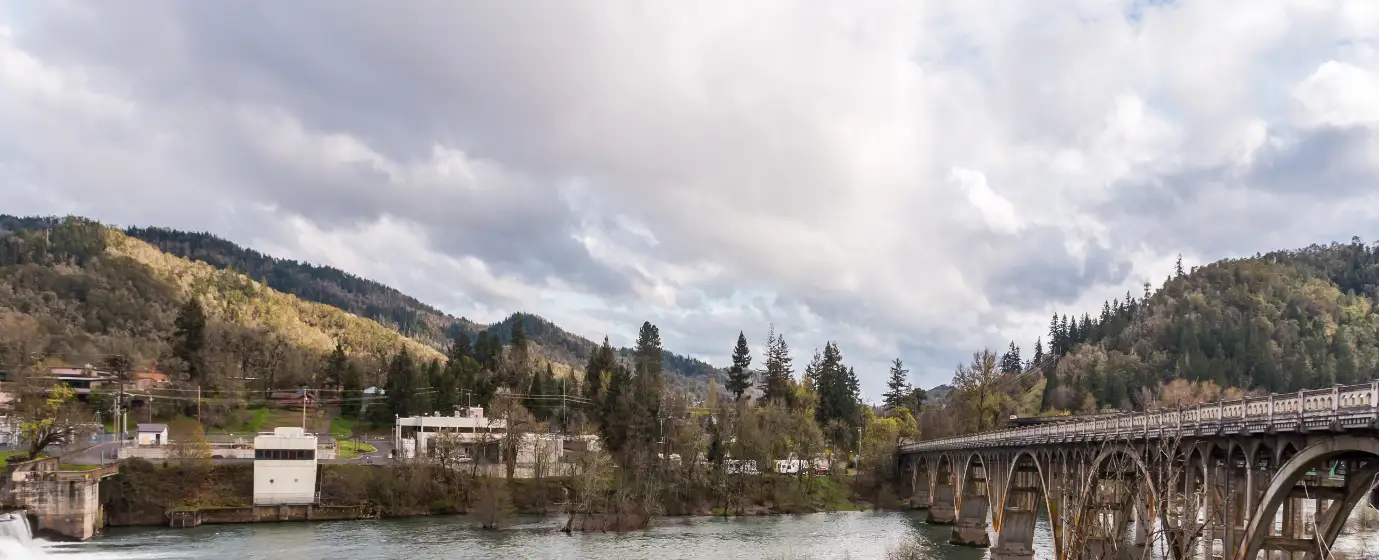
Southern Oregon · Oregon
There's a specific moment most first-time buyers describe: you've been watching the market for months, doing the math in your head, and then one afternoon you walk through a house in Myrtle Creek that actually fits your life — three bedrooms, a yard, a view of the ridgeline — and the price is under $310,000. That moment is when the abstract idea of homeownership becomes a real decision. Myrtle Creek doesn't get much press in Oregon real estate conversations, but for buyers who've been watching Portland, Eugene, or even Roseburg prices outpace their savings, this town along the South Umpqua River is where the math finally works.
The median sold price in Myrtle Creek sits at approximately $299,000 — and that figure is real, not a data artifact. At that price point, you're typically looking at a three-bedroom home between 1,200 and 1,700 square feet, often on a modest lot with mature landscaping, in a neighborhood where your neighbors have lived for years. Renting a comparable space in Douglas County runs $1,100–$1,400 per month with nothing to show for it. Owning at $299,000 with a conventional loan puts your principal and interest payment in a range many renters are already spending — the gap between renting and owning here is narrower than almost anywhere else in Oregon.
This guide walks you through the entire process of buying your first home in Myrtle Creek: what your budget actually gets you, how the offer and inspection process works in Douglas County's slower market, what credit and income you actually need to qualify, and the five mistakes that cost first-time buyers in this specific market. If you've been reading general Oregon real estate advice and wondering how it applies here, this is the specific version.
For a buyer prioritizing affordability over everything else, Myrtle Creek makes an unusually strong case. Homes that would cost $450,000–$550,000 in Roseburg — just 20 minutes north on I-5 — frequently sell here for $280,000–$330,000. That's not because the houses are worse; it's because Myrtle Creek is a smaller, quieter town with fewer amenities and a school district that carries a low rating. If you're a buyer without school-age children, or one who plans to supplement public school with private options, the price gap is an enormous advantage. The commute to Roseburg is genuinely easy — 20 minutes on the interstate with no meaningful traffic — so buyers who work in Roseburg aren't giving up much in terms of daily life.
Where Myrtle Creek gets harder to recommend is when buyers have specific expectations about neighborhood polish, walkable commercial streets, or a competitive resale market years down the road. This is a working-class rural town with genuine character, but it doesn't have a revitalized downtown corridor or a tech-sector migration story driving appreciation. Entry-level homes are abundant under $350,000, with a mix of manufactured homes, 1970s-era ranches, and the occasional craftsman-style build. For a first-time buyer whose goal is equity-building and stable housing rather than a 10-year flip, Myrtle Creek is a legitimate and underused option. For someone expecting West Eugene prices with Bend amenities, it won't land that way.
| Price Range | What You Typically Find | Neighborhood Examples | Competition Level |
|---|---|---|---|
| Under $350K | 3–4 bed manufactured homes, older ranch-style on city lots, some fixer opportunities | Central Myrtle Creek, residential streets near Evergreen Park | Low — multiple offers rare |
| $350K–$450K | 3 bed updated ranches, craftsman-style builds, some acreage parcels entering this range | Wood Crest area, mid-town residential | Low to moderate |
| $450K–$550K | Larger square footage, newer construction, some rural acreage properties with outbuildings | South Myrtle Creek, rural fringe parcels | Low — longer days on market |
| $550K–$650K | Acreage estates, custom builds, properties with creek frontage or outbuildings | Rural Douglas County parcels near Myrtle Creek | Very low |
| $650K+ | Small ranches, hobby farms, substantial acreage — rare in city limits | Rural parcels, outlying areas | Minimal competition |
One detail worth understanding: the median list price in Myrtle Creek runs significantly higher than the median sold price, largely because rural acreage listings with outbuildings and land skew the asking-price data upward. Don't let a Zillow headline number discourage you. The homes that are actually selling in the $265,000–$313,000 range are the realistic market, and first-time buyers are well-positioned in that inventory.
| Step | What Happens | Typical Timeline | What First-Timers Get Wrong |
|---|---|---|---|
| Get finances in order | Pull credit, pay down revolving debt, gather 2 years of tax returns and pay stubs | 1–3 months before searching | Starting this too late — surprises at pre-approval |
| Pre-approval | Lender reviews income, assets, credit; issues a commitment letter | 1–5 business days | Confusing pre-qualification with pre-approval |
| Find an agent | Interview 1–2 agents familiar with Douglas County and rural property quirks | Before active search begins | Using an out-of-area agent unfamiliar with local norms |
| Active search | Tour homes, assess condition on older stock carefully | 2–8 weeks in this inventory | Not accounting for days-on-market reality |
| Making an offer | Submit with earnest money, contingencies, and a closing timeline | Same day or next day after touring | Offering too far below list on homes that are already priced near sold comps |
| Under contract | Earnest money deposited, timelines locked in | Within 48 hours of acceptance | Missing deadline dates on contingencies |
| Inspection | Licensed inspector evaluates structure, systems, roof | Within 10 days typically | Skipping or waiving on older homes to look competitive |
| Appraisal | Lender orders appraisal; must meet or exceed purchase price | 1–3 weeks | Not understanding what happens if it comes in low |
| Final walkthrough | Confirm condition matches contract; verify agreed repairs | 24–48 hours before close | Skipping this step entirely |
| Closing | Sign documents, wire funds, get keys | 30–45 days from contract | Changing jobs or opening credit lines between contract and close |
Inspections should never be waived in this market. Myrtle Creek's older housing inventory includes a lot of 1970s–1980s construction where deferred maintenance is common, and the slower market means sellers are often not investing in pre-listing repairs. Waiving inspection doesn't strengthen your offer in a meaningful way here — sellers aren't choosing between competing offers in most cases. What it does is eliminate your ability to negotiate repairs or walk away from a money pit. Use the contingency.

Looking to buy in Myrtle Creek? Estimate your payment.
Enter your numbers to see an estimated monthly mortgage payment.
Estimate only. Excludes HOA fees and mortgage insurance.
A conventional loan requires a minimum 620 credit score, but the rate difference between a 650 and a 740 is real and adds up. On a $299,000 purchase with 5% down — roughly a $284,000 loan — the difference between a 7.0% rate (roughly what a 650 score might get today) and a 6.5% rate (available with a 740+ score) is approximately $85–$90 per month. Over five years, that's more than $5,000 in additional interest paid, entirely because of credit score. If your score is in the 650–680 range, spending three to six months paying down credit card balances before applying is often the single highest-return financial move available to you.
FHA loans open the door at a 580 credit score with 3.5% down, which on a $299,000 home means roughly $10,500 down plus closing costs. The catch is mortgage insurance: FHA requires an upfront mortgage insurance premium of 1.75% of the loan amount, plus an annual premium paid monthly for the life of the loan in most cases. On a $289,000 FHA loan, that's about $5,058 upfront and roughly $200–$220 per month in ongoing insurance — a real cost that doesn't go away unless you refinance. FHA still makes sense for buyers with limited savings or credit challenges, but go in with clear eyes about the total cost.
For income, the standard rule of thumb is that your monthly housing payment (principal, interest, taxes, and insurance) should not exceed 28% of your gross monthly income. At a $299,000 purchase price with 5% down and a 7% rate, the principal and interest alone run approximately $1,895 per month — add $145 for property taxes at the 0.58% rate and estimated insurance, and you're looking at roughly $2,200–$2,300 per month total. That requires a gross household income of approximately $94,000–$99,000 to stay within the 28% guideline. A household at Myrtle Creek's $56,000 median income would need an FHA loan with a lower price point, a co-borrower, or down payment assistance to bring the monthly payment into range.
Mistake 1: Trusting list prices instead of sold comps. Homes in Myrtle Creek are listed at a median of around $404,000 — but they sell in the $265,000–$313,000 range. That $100,000+ gap exists because rural acreage listings with outbuildings and land are included in list-price data, while the actual closed sales market is priced significantly lower. Buyers who anchor to listing prices either overpay or get scared off from a market that's genuinely more accessible than it looks.
Mistake 2: Skipping inspection on 1970s ranch homes. A significant portion of the under-$350,000 inventory in Myrtle Creek is older construction — original electrical panels that predate modern safety standards, galvanized pipes that corrode from the inside, and crawl spaces that collect moisture against the hillside. These issues don't appear in photos or walk-throughs. A $400–$500 inspection is the best money a first-time buyer spends in this market.
Mistake 3: Shopping at the ceiling of their qualification. A lender pre-approving you for $380,000 means you can technically borrow that much — it doesn't mean you'll be comfortable with that payment when your car needs tires and the furnace acts up. In Myrtle Creek specifically, buyers shopping at their full qualification often find themselves looking at rural acreage properties that require ongoing maintenance they weren't planning for. Buy at the top of your comfort, not the top of your approval.
Mistake 4: Assuming the school district won't affect resale. The South Umpqua School District carries a D rating, and while that affects families with school-age children most directly, it also affects the resale pool when you eventually sell. Buyers with kids prioritizing school quality will pass over Myrtle Creek listings in favor of Roseburg. That narrows your future buyer pool. It doesn't make buying here wrong — but understanding that reality matters when projecting your exit.
Mistake 5: Waiting for prices to drop significantly. Myrtle Creek prices have appreciated roughly 3% year-over-year, which is modest but consistent. The buyers who waited in 2023 are paying 2024 prices; the ones who waited in 2024 are paying 2025 prices. In a slow market with low competition, the psychological pull to wait for a dip is strong. The better question is whether the monthly payment works for your life today — because timing the market from the outside rarely works.
Wood Crest is the neighborhood name that comes up most often when local agents discuss the better-positioned residential pockets in Myrtle Creek. Situated with valley and mountain views, Wood Crest homes tend to run $330,000–$400,000, with three-bedroom craftsman-style builds that show well and hold value steadier than the city average. For a first-time buyer with a slightly higher budget, it's the area where you get the most defensible long-term position.
Central Myrtle Creek near Evergreen Park is the realistic entry point for buyers working with under $320,000. The streets here are established residential — single-family homes on standard city lots, proximity to green space, and a walkable distance to basic services. You'll find more manufactured homes in this tier, and condition varies widely. The value proposition is real, but it rewards buyers who take inspection seriously.
Neighborhoods near Millsite Park and the South Umpqua River corridor attract buyers who want outdoor access woven into daily life. Millsite Park sits along the river and serves as a genuine gathering point for the community, and homes within a few blocks of that area carry a quiet desirability that's hard to quantify but real. Prices in this pocket overlap with the central tier — typically $280,000–$340,000 — with older homes that often have more character than newer construction elsewhere in the city.
For buyers who want more space and don't mind being outside the city core, the rural fringe south toward Canyonville offers occasional acreage parcels in the $350,000–$450,000 range. The catch is that rural properties introduce well, septic, and road maintenance considerations that add complexity for a first-time buyer who doesn't yet know what they don't know. Save the acreage purchase for your second home unless you're already familiar with rural infrastructure.
✅ The median sold price in Myrtle Creek is approximately $299,000 — one of the most accessible first-home markets in Oregon, with genuine three-bedroom inventory under $320,000.
⚠️ The South Umpqua School District carries a low rating, which matters for families with kids and affects your future resale pool — factor this into your long-term planning, not just today's payment.
📍 This is a slow market with homes sitting 150+ days on average — use that to your advantage with proper inspection and thoughtful negotiation rather than rushing an offer.
Can I buy a home in Myrtle Creek as a first-time buyer with a low down payment?
Yes — and Myrtle Creek's price point makes low-down-payment programs particularly effective here. An FHA loan requires 3.5% down with a 580+ credit score, which on a $299,000 purchase means roughly $10,500. Additional low-down-payment and grant programs may be available depending on the lender and loan amount, which can bring that contribution down further on loans at this price point. At these price points, the math works for buyers who haven't had years to build a large savings cushion.
What are closing costs for a first-time buyer in Myrtle Creek?
Closing costs typically run 2–3% of the purchase price on top of your down payment. On a $299,000 home, that's roughly $5,980–$8,970 in lender fees, title insurance, prepaid property taxes, and escrow setup. First-time buyers are often surprised by this figure because it doesn't show up in the pre-approval conversation. Some sellers in Myrtle Creek's slower market will negotiate seller-paid closing costs — worth asking for, especially on homes that have been sitting 60+ days.
Should I get pre-approved before looking at homes in Myrtle Creek?
Yes, and the distinction between pre-qualification and pre-approval matters here. Pre-qualification is a quick estimate based on what you tell a lender — it's not verified and won't hold up in an offer situation. Pre-approval involves submitting actual documentation (tax returns, pay stubs, bank statements) and results in a commitment letter that sellers take seriously. In Myrtle Creek's low-competition market, having a pre-approval letter in hand when you find the right house means you can move within 24 hours rather than scrambling while the seller waits.
Explore the full Myrtle Creek series: The Ultimate Myrtle Creek Relocation Guide · Is Myrtle Creek Safe? · Cost of Living in Myrtle Creek · Best Neighborhoods in Myrtle Creek · Myrtle Creek Schools & Family Life · Myrtle Creek Youth Sports · Myrtle Creek Parks & Recreation · Retiring in Myrtle Creek · 1031 Tax-Deferred Exchange in Myrtle Creek · Myrtle Creek First-Time Homebuyers Guide · · Moving to Myrtle Creek from California
Tell us what you need help with and we'll connect you with local resources.

About the Author
Todd Davidson is the founder of Living in Oregon and Living in Washington, where he publishes in-depth city guides, neighborhood resources, and local market insights covering more than 180 communities across the Pacific Northwest. While his background is in home financing and real estate, he created these digital platforms to help families research and compare regions before making a move.