Portland Metro · Oregon
Cost of Living in Happy Valley: Housing, Taxes, Utilities & Lifestyle (2026)
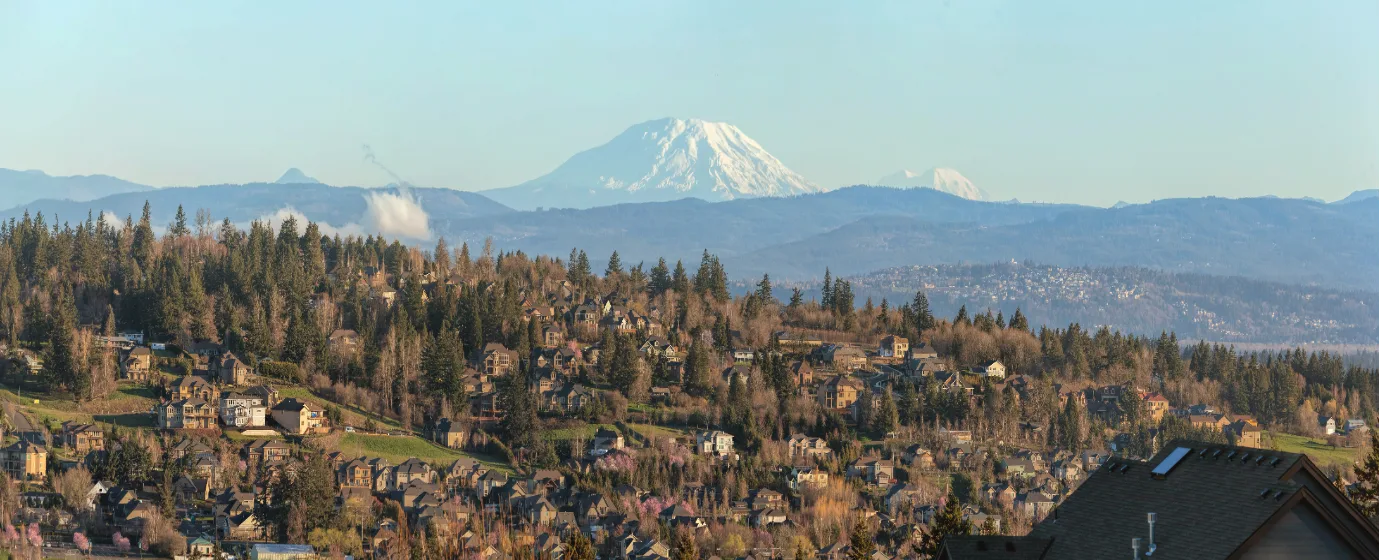
Happy Valley carries a reputation as one of the Portland metro's more affluent suburbs — and the numbers back that up. With a median home price of $658,000 and overall living costs running roughly 25–34% above the national average, this is not a budget relocation. But the city draws buyers from Seattle, Los Angeles, and across the metro not because it's affordable, but because of what that money buys: newer homes on wooded hillsides, top-performing schools, low crime, and a commute to downtown Portland that clocks in around 25 minutes.
What shapes the cost picture in Happy Valley is almost entirely housing. Property values here have been propelled by decades of deliberate land-use choices that kept the housing stock newer and denser development limited. The result is a city where 82% of households own rather than rent, where single-family homes dominate, and where the price floor for a move-in-ready home sits well above the metro median. Oregon's income tax adds another layer that surprises buyers coming from Washington or California, but the absence of sales tax and the state's Measure 50 property tax protections create real offsets over time.
This guide breaks down every major cost category — housing, taxes, rent, utilities, transportation, and everyday expenses — so you can build an accurate picture of what life here actually costs before you start making offers.

At the 1.09% effective rate, a buyer purchasing at the $658,000 median will pay roughly $7,172 per year in property taxes — about $598 per month. That figure sits meaningfully above the national median, but it's anchored by Oregon's Measure 50, which caps annual assessed value increases at 3% regardless of how fast market values rise. Long-term owners in Happy Valley often pay taxes on an assessed value that's well below current market value, which creates a growing buffer over time against Portland metro appreciation cycles.

Happy Valley's housing market in 2026 is one of the more interesting value propositions in the entire Portland metro. I'm seeing buyers who did their research two years ago and kept waiting for a correction — and what they've found instead is a market that stabilized rather than dropped, with prices holding close to the $658,000 median and well-priced homes still going pending in under two weeks. The neighborhoods along the Scouters Mountain corridor and the newer builds in the southern quadrants are generating the most competition right now, partly because inventory in the $600K–$750K range remains tight.
What buyers consistently underestimate is how much newer construction is still entering the market here. D.R. Horton and Holt Homes both have active projects, and the final phase at Scouters Mountain — with homes ranging from roughly 1,600 to 3,370 square feet — is expected to begin in late 2026. For buyers who want new construction at a price that's still meaningfully below what you'd pay in Lake Oswego or the West Hills, Happy Valley continues to be the strongest option in Clackamas County. If you're considering Happy Valley and want insight into which neighborhoods align with your priorities and budget, I'd welcome the opportunity to share what I've learned from helping hundreds of families make this move successfully.
Happy Valley is overwhelmingly an ownership market — roughly 82% of households own their homes, leaving a thin rental inventory by metro standards. Most rentals here are single-family homes or smaller apartment complexes rather than large urban-style buildings. Availability tends to be tightest in the $1,500–$2,000 range, which accounts for the majority of apartment-style units in the area.
| Unit Type | Average Monthly Rent |
|---|---|
| Studio | $1,375–$1,490 |
| 1 Bedroom | $1,615–$1,630 |
| 2 Bedroom | $1,905–$2,000 |
| 3 Bedroom | $2,292–$2,360 |
| Single-family rental (all sizes) | $2,750+ |
The variance between those figures reflects a real split in the rental market. Apartment building averages cluster in the lower range; Zillow and Zumper figures — which include house rentals — run considerably higher. A two-bedroom apartment in Happy Valley runs about 38% above the national average for comparable units. Renters who need more space typically find better value in nearby Clackamas or Milwaukie, where house rental inventory is slightly more abundant.
Portland General Electric (PGE) is the electricity provider for Happy Valley residents. Monthly bills average around $215, adding up to roughly $2,580 annually — about 4% above the national average. The average residential rate sits near 19 cents per kilowatt-hour, slightly above the Oregon statewide average. Natural gas service is provided by NW Natural, and water and sewer are handled through the city and Clackamas County.
Happy Valley is car-dependent. There is no light rail service within city limits, and while some residents use TriMet bus routes connecting to the broader metro system, the practical reality for most households is that two cars are nearly a requirement. The 25-minute drive to downtown Portland is the city's signature selling point, but that calculation assumes you're traveling outside peak congestion windows. Morning commutes along Highway 212 and the Sunnyside Road corridor toward I-205 can stretch considerably during rush hour — the merge onto I-205 northbound near the Clackamas Town Center interchange is a consistent pressure point between 7:30 and 8:45 a.m.
Grocery options are solid but concentrated. Fred Meyer, Safeway, and Walmart anchor the primary shopping corridors near Happy Valley Town Center and the Clackamas Town Center area. Whole Foods and New Seasons shoppers typically head into Milwaukie or southeast Portland. Dining in Happy Valley itself leans toward the chain end of the spectrum; the restaurant scene for independents and breweries is centered nearby in Oregon City or along the Milwaukee corridor. A typical weekday dinner at a mid-range restaurant in the area runs $15–$22 per person before drinks.
💰 Portland Metro Cost of Living Rankings
Wondering how Happy Valley stacks up against all 15 Portland Metro suburbs at once? Our complete rankings guide covers every suburb — home prices, monthly PITI, income needed to buy or rent, and property tax rates by county.
See the Full Portland Metro Cost of Living Rankings →Looking to buy in Happy Valley? Estimate your payment.
Enter your numbers to see an estimated monthly mortgage payment.
Estimate only. Excludes HOA fees and mortgage insurance.
| City | Median Home Price | Approx. Property Tax Rate | Commute to Portland | School Rating |
|---|---|---|---|---|
| Happy Valley | $658,000 | 1.09% | 25 min | B+ |
| Lake Oswego | $780,000+ | ~1.0% | 20 min | A |
| West Linn | $730,000+ | ~1.1% | 30 min | A |
| Milwaukie | $450,000–$500,000 | ~1.1% | 15 min | B |
| Oregon City | $490,000–$540,000 | ~1.0% | 30 min | B |
| Clackamas (unincorporated) | $550,000–$610,000 | ~1.1% | 25 min | B+ |
| Gresham | $400,000–$450,000 | ~1.1% | 20 min | B- |
Happy Valley lands squarely in the middle tier of this comparison — priced below Lake Oswego and West Linn, but well above Milwaukie, Oregon City, and Gresham. The trade-off is a newer housing stock and stronger school performance relative to lower-priced neighbors, without paying the West Linn or Lake Oswego premium. Buyers who are genuinely price-sensitive typically end up in Oregon City or Milwaukie; buyers who are maximizing school quality per dollar frequently land in Happy Valley.
This table reflects a household purchasing at the $658,000 median price with 10% down, financing approximately $592,200.
| Category | Estimated Monthly Cost |
|---|---|
| Mortgage (principal + interest, ~6.75%) | ~$3,840 |
| Property taxes (1.09% / 12) | ~$598 |
| Homeowner's insurance | ~$150–$200 |
| HOA (where applicable) | $0–$250 |
| Electricity (PGE) | ~$215 |
| Natural gas (NW Natural) | ~$80–$120 |
| Internet | ~$70–$90 |
| Groceries (family of four) | ~$900–$1,100 |
| Transportation (2 cars, gas + insurance) | ~$700–$900 |
| Dining out / entertainment | ~$400–$600 |
| Estimated total (family of four) | ~$7,000–$8,000 |
That total aligns closely with the independently reported estimate of $6,836 per month for a family of four in Happy Valley. The median household income of $122,151 — about $10,180 per month gross — means housing costs alone consume roughly 44–47% of gross income at the median purchase price, which is above conventional lending comfort zones. The practical implication: many buyers in Happy Valley are bringing household incomes above $130,000, making a dual-income household close to a baseline requirement at current prices.
Oregon has no sales tax, which is a genuine daily-life benefit that adds up. A $50,000 car purchase in Portland has no added tax burden at the register; the same purchase in Vancouver, Washington carries a state sales tax. For large purchases — appliances, vehicles, home furnishings — the savings are real and compound over time.
The other side of that coin is Oregon's income tax, one of the highest in the country. The top marginal rate reaches 9.9%, and a household earning $122,000 is paying meaningfully above the 8.75% bracket floor. Buyers relocating from Texas, Florida, or Washington State — states with no income tax — routinely underestimate this hit on their take-home pay. A household earning $150,000 can expect to pay roughly $10,000–$13,000 in Oregon state income taxes annually, depending on deductions and filing status.
Oregon seniors have access to a meaningful property tax relief program. Homeowners age 62 and older who meet income requirements can qualify for the state's property tax deferral program, where the Oregon Department of Revenue pays the county tax bill each November and places a lien on the property. For retirees on fixed incomes buying into Happy Valley's price range, this program can make the cost picture substantially more manageable. Oregon also provides partial property tax exemptions for qualified disabled veterans and surviving spouses.
The net picture for most buyers: Oregon's income tax hurts, the lack of sales tax helps on the margin, and Measure 50's 3% assessed value cap provides meaningful long-term property tax protection once you're in the door. Washington State residents considering a cross-river move to Happy Valley often find the income tax shock significant in year one but softer than expected after accounting for sales tax savings and the generally lower cost of real estate compared to the Vancouver metro.
Local Expert Takeaway: The buyers who struggle most with Happy Valley's cost picture are those who anchor to the median income and assume it stretches far enough — at $658,000, you need household income closer to $130,000–$145,000 to stay in conventional lending ratios, which means dual incomes are nearly essential at current prices. If your budget ceiling is $575,000–$620,000, focus your search on Rock Creek, Northview, and the western edge of Sunnyside, where you'll find slightly older inventory that hasn't appreciated quite as fast as the hillside neighborhoods. And don't ignore Measure 50: the longer you stay, the more that 3% cap becomes a genuine financial advantage over homeowners in states without similar protections.
💰 Portland Metro Cost of Living Rankings
Ready to compare all 15 Portland Metro suburbs side by side — home prices, monthly PITI, and income needed to buy? Our complete rankings guide covers every suburb — home prices, monthly PITI, income needed to buy or rent, and property tax rates by county.
Portland Metro Suburbs Cost of Living: Top 15 Ranked →Is Happy Valley affordable compared to other Portland suburbs?
Happy Valley sits in the upper-middle tier of Portland metro affordability — below Lake Oswego and West Linn in price, but well above Milwaukie, Gresham, and Oregon City. The median home price of $658,000 reflects a premium for newer construction, strong schools, and low crime, and buyers who prioritize those factors typically find it competitive with comparable suburbs in the region.
What are property taxes like in Happy Valley?
At the 1.09% effective rate, a homeowner at the median purchase price pays roughly $7,172 per year in property taxes. Oregon's Measure 50 limits annual assessed value increases to 3%, meaning long-term owners build increasing protection against the market appreciation that has pushed asking prices higher. The rate is above the national median but is stable and predictable compared to markets without similar caps.
How does Oregon's lack of a sales tax affect the cost of living in Happy Valley?
The absence of a sales tax is a tangible benefit for everyday purchases and especially for large-ticket items like vehicles and appliances. A $40,000 car purchase, for example, carries no state or local sales tax in Oregon — a savings of $2,000–$3,500 compared to most other states. That savings partially offsets Oregon's income tax burden, though high earners typically come out behind on the net tax comparison versus states with no income tax and a moderate sales tax.
Browse current listings updated daily — filtered for Happy Valley buyers by Elizabeth Davidson, your local expert.
Powered by Elizabeth Davidson · Cascade Hasson Sotheby's International Realty · 503-939-2035
Explore the full Happy Valley series: The Ultimate Happy Valley Relocation Guide · Is Happy Valley Safe? · Cost of Living in Happy Valley · Best Neighborhoods in Happy Valley · Happy Valley Schools & Family Life · Happy Valley Youth Sports · Happy Valley Parks & Recreation · Retiring in Happy Valley · 1031 Tax-Deferred Exchange in Happy Valley · Happy Valley First-Time Homebuyers Guide · · Moving to Happy Valley from California · The Happy Valley Realtor's Perspective · Top 10 Questions a Realtor Gets About Happy Valley
Tell us what you need help with and we'll connect you with local resources.

About the Author
Todd Davidson is the founder of Living in Oregon and Living in Washington, where he publishes in-depth city guides, neighborhood resources, and local market insights covering more than 180 communities across the Pacific Northwest. While his background is in home financing and real estate, he created these digital platforms to help families research and compare regions before making a move.