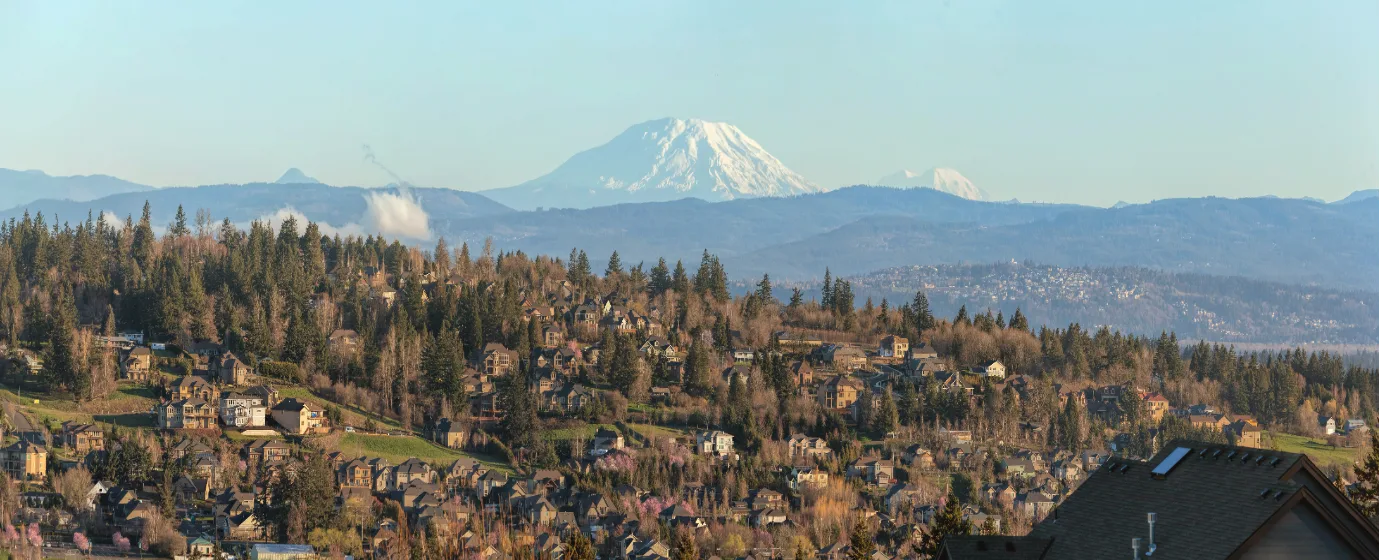
Portland Metro · Oregon
There's a moment every first-time buyer in Happy Valley eventually hits — usually around the third or fourth open house — when the math stops being abstract and becomes very real. The home is nice. The neighborhood is quiet. The schools are excellent. And the asking price is $680,000. That's not unusual here. That's the median. And for a buyer who came in hoping to stretch to $450,000, it can feel like the door just closed. It hasn't. But it does require a different strategy than most people walk in with.
The median home price in Happy Valley sits at $658,000, which puts a standard 20% down payment at just over $131,000 — a figure that stops most first-time buyers cold. At 5% down, you're looking at roughly $33,000, which is more achievable, but that also means a larger loan, mortgage insurance on most loan types, and a monthly payment somewhere north of $3,800 at current rates. Median rent in Happy Valley runs around $2,895 for a single-family home, which means the gap between renting and owning here is narrower than buyers expect — and in some neighborhoods, owning genuinely makes financial sense even at entry level, especially if you're buying a townhome in the $385,000–$450,000 range.
This guide walks through the entire first-time buyer process as it actually works in Happy Valley — not the generic Oregon version you've read elsewhere. You'll get a realistic picture of what each budget tier buys, where the true entry points are in this market, which mistakes trip up buyers in this specific city, and what assistance programs are actually available to you. If you've been told Happy Valley is out of reach, read through before you decide.

Happy Valley makes a genuinely compelling case for first-time buyers who can clear the entry bar. The schools in the North Clackamas School District are consistently rated among the stronger districts in the Portland metro — a B+ overall — which means buying here carries real long-term resale logic. The commute to Portland runs about 25 minutes in normal traffic, which is meaningfully shorter than what you'd tolerate from Gresham or Damascus. And the neighborhoods themselves — especially the established mid-tier areas like Sunnyside and West Mount Scott — offer the kind of quiet, maintained suburban feel that buyers leaving Portland apartments are typically looking for.
The honest challenge is inventory. Happy Valley has very little housing stock under $500,000 in single-family detached form. The sub-$450,000 market is almost entirely townhomes and condos — and there are only around 20 total attached units actively for sale at any given moment. If a detached home with a yard is non-negotiable, the realistic entry point in Happy Valley is closer to $550,000, and more likely $600,000-plus in the most desirable school catchments. Buyers who've been pre-approved up to $400,000 and have their heart set on a house with a garage and a fence need to recalibrate expectations before touring — or consider whether Clackamas or Milwaukie better fits the budget without sacrificing much commute time.

What I tell first-time buyers about Happy Valley is that they're often underestimating the value of buying here early in their career. The city has stayed consistently above Portland metro average appreciation over the last several years, and buyers who purchased in neighborhoods like Sunnyside or Rock Creek three or four years ago have already built meaningful equity. The mistake I see most often is buyers fixating on the citywide median and deciding they can't afford Happy Valley — without realizing that the townhome tier in the $385,000–$480,000 range gives them a real foothold in this market and a property that genuinely appreciates.
What buyers also consistently underestimate is how quickly good properties move in Happy Valley. Homes that are priced well in established neighborhoods like Jackson Hills or Northview will go pending in under a week — sometimes in four days. First-time buyers who are still "thinking about it" when a strong listing hits often lose it to someone with a cleaner offer already prepared. The buyers who succeed here show up pre-approved, clear on their non-negotiables, and ready to write within 48 hours of a first showing. That level of readiness isn't optional in this market — it's the entry fee. If you're considering Happy Valley and want insight into which neighborhoods align with your priorities and budget, I'd welcome the opportunity to share what I've learned from helping hundreds of families make this move successfully.
| Price Range | What You Typically Find | Neighborhood Examples | Competition Level |
|---|---|---|---|
| Under $350K | Lots, land parcels, deeply distressed units — no viable move-in ready product | Not applicable for residential buyers | N/A |
| $350K–$450K | Townhomes and condos only; 1,200–1,500 sq. ft.; HOA fees likely; no yard | Causey Village, townhome communities near SE 122nd | Moderate |
| $450K–$550K | Larger townhomes, occasional entry-level condos with garages; some older attached product | Rock Creek corridor, West Mount Scott edges | Moderate–High |
| $550K–$650K | Entry-level detached SFRs; older ranch homes, 1970s–1990s construction; smaller lots | Sunnyside, West Mount Scott, Morningside | High |
| $650K+ | Modern construction, open floor plans, 3–4 bed, 2-car garage; most Happy Valley neighborhoods | Jackson Hills, Northview, Southgate, Heritage Heights | High |
The townhome tier in the $385,000–$480,000 range represents the most realistic entry point for first-time buyers in Happy Valley today. You won't get a yard, and you will have HOA dues — typically in the $200–$400 per month range depending on the community — but you'll own in a city with strong schools and solid appreciation history, and you'll be building equity instead of paying rent that's not far off your mortgage payment. For buyers with a firm detached-home requirement, the $550,000–$650,000 range is where older single-family homes start appearing, often 3 bedrooms, 1,400–1,800 square feet, with modest lots in established neighborhoods like Sunnyside.
The $650,000-plus tier is where Happy Valley's character really shows itself — newer construction, stone and Craftsman exterior details, open layouts, two-car garages. Most of what you'll tour in neighborhoods like Northview, Jackson Hills, or Southgate lives in this range. It's not unachievable for a first-time buyer with strong income and a gift or assistance program toward the down payment, but it requires honest pre-approval work and a clear-eyed conversation with your lender about what the monthly payment actually looks like before you fall in love with a floor plan.
| Step | What Happens | Typical Timeline | What First-Timers Get Wrong |
|---|---|---|---|
| Get finances in order | Pull credit, pay down revolving debt, gather tax returns and pay stubs | 1–3 months before searching | Waiting until they find a home they love |
| Pre-approval | Lender reviews income, debts, assets, and issues a letter | 1–3 days with a responsive lender | Getting pre-qualified (soft) instead of pre-approved (hard pull, verified docs) |
| Find an agent | Interview 1–2 buyer's agents who know Happy Valley specifically | Before touring any homes | Using a friend's recommendation without verifying local market knowledge |
| Active search | Tour homes, track listings, refine criteria | 4–12 weeks typical | Touring without knowing the offer process — creates expensive hesitation |
| Making offers | Write purchase agreement, set earnest money, review contingencies | 24–48 hours after finding the right home | Offering list price on a home that will receive multiple offers |
| Under contract | Seller accepts; clock starts on contingency timelines | Day 1–3 | Not knowing exactly how long they have for inspection and financing contingencies |
| Inspection | Licensed inspector evaluates structure, systems, roof, plumbing | Scheduled within 10 days of acceptance | Waiving it to compete — especially on 1970s–1990s homes |
| Appraisal | Lender orders appraisal; confirms value supports loan amount | 1–2 weeks after inspection | Surprise when appraisal comes in at or below list — affects loan amount |
| Final walkthrough | Confirm condition matches contract | 24–48 hours before closing | Skipping it — catches last-minute issues |
| Closing | Sign documents, transfer funds, receive keys | 30–45 days after acceptance | Not having cashier's check or wire ready — delays closing day |
In Happy Valley's current market, homes receive an average of two offers and sell in roughly 62 days — but that average is skewed by slower-moving luxury properties. Well-priced homes in the $550,000–$700,000 range routinely go pending in under a week, sometimes in four days. First-time buyers need to be emotionally and financially ready to write an offer the same day they fall in love with a home.
Earnest money in Clackamas County typically runs 1–3% of the purchase price. On a $620,000 home, that means $6,200 to $18,600 held in escrow — real money that demonstrates seriousness. Waiving inspection is increasingly common in competitive situations, but buyers should think carefully before skipping that protection on any home built before 2000. Happy Valley has a healthy inventory of 1980s and 1990s ranch homes in neighborhoods like Sunnyside and West Mount Scott, and those properties can carry deferred maintenance that isn't visible at a showing.
Closing in Clackamas County typically takes 30–45 days from accepted offer. Oregon is a title company state — you won't sit across a table from the seller. Each party signs independently, funds are wired, and the title company handles recording. Your agent will walk you through the timeline, but understanding the sequence before you're in it removes a lot of the anxiety.
Looking to buy in Happy Valley? Estimate your payment.
Enter your numbers to see an estimated monthly mortgage payment.
Estimate only. Excludes HOA fees and mortgage insurance.
Conventional loans require a minimum 620 credit score, but the rate difference between 650 and 740 is meaningful — potentially 0.75 to 1.25 percentage points on a $420,000 loan, which translates to roughly $175–$270 per month. Over 30 years, that's the difference between a comfortable payment and a stressful one. If your score is sitting at 650 right now, spending three to six months paying down credit card balances before applying is often the most effective financial move you can make.
FHA loans accept scores as low as 580 for 3.5% down, or 500–579 with a 10% down payment. The catch is mortgage insurance premium — FHA charges both an upfront fee (typically 1.75% of the loan amount) and an annual premium that stays for the life of the loan unless you refinance. On a $420,000 FHA loan, that's roughly $7,350 upfront and around $200–$250 per month ongoing. It's not a dealbreaker, but it should factor into your total payment calculation.
On income qualification, the standard benchmark lenders use is that your total housing payment — principal, interest, taxes, and insurance — should stay at or below 28% of your gross monthly income. To comfortably buy a $400,000 home with 5% down, you're looking at a loan around $380,000; at current rates, a rough monthly payment around $2,500–$2,700 means qualifying income somewhere around $108,000–$116,000 annually. At $450,000 with similar down payment, that range pushes to $120,000–$130,000. Your debt-to-income ratio (DTI) — which adds your car payment, student loans, and minimum credit card payments to the housing payment and compares the total to your income — is what lenders actually scrutinize. A buyer with a $1,200/month car payment who earns $130,000 may qualify for less than a buyer earning $110,000 with no debt.
Mistake 1: Confusing list price with sale price. In Happy Valley's competitive segments, homes frequently close at or above asking — especially in the $600,000–$750,000 range in neighborhoods like Northview and Jackson Hills. Buyers who write at list price assuming they've met the seller's number often lose to cleaner offers from buyers who came in at $10,000–$20,000 over. Ask your agent for recent sold data, not just active listings.
Mistake 2: Skipping inspection on older homes. Happy Valley has a significant inventory of 1970s and 1980s ranch-style homes in West Mount Scott and Sunnyside. These homes can be wonderful — but they can also carry aging electrical panels, original plumbing, and roofs that are one storm away from a $15,000 replacement. Waiving inspection to compete on a home with deferred maintenance is a gamble that often costs more than it saved.
Mistake 3: Shopping at the ceiling of their qualification. Being approved for $650,000 doesn't mean buying at $650,000 is wise. A buyer approved at that level is typically stretching every financial muscle to get there. When the furnace fails in year two or the car needs replacing, there's no cushion. A more durable first purchase is often $50,000–$80,000 below approval ceiling, which in Happy Valley means the townhome tier or an older detached home in Morningside instead of a new build in Heritage Heights.
Mistake 4: Ignoring school boundary lines. North Clackamas School District serves most of Happy Valley, but attendance boundaries for specific elementary and middle schools vary by address. A home a quarter mile from a school doesn't guarantee attendance there. In areas near the district edges — particularly toward Damascus Road — buyers should verify the specific school assignment before making an offer, because boundary placement affects resale value in ways that show up clearly in the comp data.
Mistake 5: Waiting for prices to fall. Buyers who've been watching Happy Valley for 18 months expecting a meaningful correction have largely missed appreciation cycles and continued paying rent. The market here is not immune to broader rate movements, but the combination of limited inventory, strong schools, and proximity to Portland employment has kept demand consistent. Waiting for the "right time" tends to cost more than it saves.
Sunnyside is the most realistic entry point for buyers looking for a detached single-family home under $650,000. Older construction, modest lot sizes, and a location close to Sunnyside Road's commercial corridor make it one of the more affordable pockets in the city. It's not the newest housing stock, but it's established, well-maintained, and within a short drive of the Happy Valley Town Center.
West Mount Scott offers a similar entry price profile with slightly more varied topography and a mix of 1980s ranches and more recent infill. The neighborhood sits close to Mount Talbert Nature Park, which is a genuine draw for buyers who want green space within walking distance. Buyers willing to take on some cosmetic updates can find meaningful value here compared to newer parts of the city.
Rock Creek and the townhome communities in the eastern portions of Happy Valley near SE 122nd represent the sub-$500,000 attached housing path. These are practical, well-maintained communities — gated in some cases, with shared amenities like pools or clubhouses — that give buyers a foothold without requiring the full $650,000 median. HOA fees apply, but so does a lower purchase price, which often means a net monthly cost close to what comparable detached homes carry.
Morningside is worth a look for buyers who want newer construction at a slightly lower entry than Northview or Heritage Heights. The neighborhood tends to attract families with kids in school, has good access to Clackamas Town Center for everyday shopping, and sits in a part of Happy Valley that has held value consistently.
✅ Happy Valley is a strong long-term buy for first-time buyers who can clear the entry bar — excellent schools, consistent appreciation, and a 25-minute Portland commute make it a durable investment even at stretch prices.
⚠️ The sub-$500,000 market is almost entirely attached housing — plan for HOA fees and a smaller footprint if you're working in that range, and don't walk into open houses expecting a yard at that price point.
📍 Sunnyside and West Mount Scott offer the most realistic entry points for detached single-family homes under $650,000 — both neighborhoods have older housing stock with good bones and genuine upside for buyers willing to take on cosmetic work.
Can I buy a home in Happy Valley as a first-time buyer?
Yes — but the realistic entry point is higher than many buyers expect. Attached housing (townhomes, condos) starts around $385,000, while detached single-family homes typically begin in the $550,000–$600,000 range. First-time buyers with strong income, a solid credit score, and flexibility on property type have real options here, particularly in Sunnyside and the Rock Creek townhome corridor.
Is FHA financing a good option for first-time buyers in Happy Valley?
FHA financing is a strong option for many first-time buyers in Happy Valley, since it allows a lower down payment and more flexible credit requirements than most conventional loans. A local lender can walk you through your specific numbers based on today's rates.
What credit score do I need to buy a house in Oregon?
Conventional loans require a minimum 620, and FHA loans go as low as 580 for 3.5% down. However, the real question isn't the minimum — it's the rate you'll qualify for. A score of 680 or higher will get you meaningfully better pricing than 620, and 740-plus puts you in the best rate tier. If your score is between 620 and 660, spending a few months improving it before applying can save thousands over the life of your loan.
Browse current listings updated daily — filtered for Happy Valley buyers by Elizabeth Davidson, your local expert.
Powered by Elizabeth Davidson · Cascade Hasson Sotheby's International Realty · 503-939-2035
Explore the full Happy Valley series: The Ultimate Happy Valley Relocation Guide · Is Happy Valley Safe? · Cost of Living in Happy Valley · Best Neighborhoods in Happy Valley · Happy Valley Schools & Family Life · Happy Valley Youth Sports · Happy Valley Parks & Recreation · Retiring in Happy Valley · 1031 Tax-Deferred Exchange in Happy Valley · Happy Valley First-Time Homebuyers Guide · · Moving to Happy Valley from California · The Happy Valley Realtor's Perspective · Top 10 Questions a Realtor Gets About Happy Valley
Tell us what you need help with and we'll connect you with local resources.

About the Author
Todd Davidson is the founder of Living in Oregon and Living in Washington, where he publishes in-depth city guides, neighborhood resources, and local market insights covering more than 180 communities across the Pacific Northwest. While his background is in home financing and real estate, he created these digital platforms to help families research and compare regions before making a move.