Portland Metro · Oregon
Living in Tigard: The Ultimate Relocation Guide (2026)
Maybe your company is moving you to the Portland metro and you've been eyeing the suburbs on the southwest side. Maybe you've been priced out of Lake Oswego and someone at work mentioned Tigard as the smarter move. Maybe you drove through on Highway 99W, hit every red light between Barbur Boulevard and Tualatin, and wondered how anyone lives here without losing their mind. All of those reactions are part of the Tigard experience — and none of them tells the whole story.
Tigard sits in Washington County, roughly 24 minutes southwest of downtown Portland on a good day, wedged between Beaverton to the north, Tualatin to the south, and Lake Oswego to the east. At just under 12 square miles and home to approximately 58,400 residents, it's Oregon's 12th largest city — dense enough to have real infrastructure, small enough that you'll start recognizing faces at Cook Park. The Fanno Creek Trail runs through it. Washington Square and Bridgeport Village anchor its retail. Capital One, Kaiser Permanente, and Consumer Cellular employ thousands here. The bones are solid. The median household income sits around $108,823, and the homeownership rate is above 60%.
What this guide will help you figure out is whether Tigard's particular combination of suburban convenience, Portland proximity, and honest tradeoffs actually fits your life. The city isn't trying to be Lake Oswego. It isn't trying to be Portland. It's doing something specific — serving working households who want good schools, real employment nearby, and a home they can actually afford in the Portland metro — and it does that job better than most people expect.
| Best For | Why |
|---|---|
| Portland commuters | 24-minute average drive to downtown; multiple MAX-adjacent Park & Ride options |
| Families with school-age children | Tigard-Tualatin SD ranks among Oregon's top 15 districts; IB programs at both high schools |
| Remote workers | 24% of residents work from home; strong broadband connectivity throughout |
| First-time buyers | Entry-level condos from the $200s; more affordable than Beaverton or Lake Oswego |
| Retirees | Established Summerfield community, flat Fanno Creek Trail access, Legacy Meridian Park nearby |
| Value-focused buyers | $575,000 median buys significantly more here than in comparable Portland suburbs |

Tigard is genuinely one of the most underrated buying opportunities in the Portland metro right now. The $575,000 median price gives buyers real square footage — not the compressed townhome footprint you're stuck with in Beaverton at similar prices — and neighborhoods like Bull Mountain and River Terrace are drawing serious attention from buyers who were originally budgeting for Hillsboro. The Tigard-Tualatin School District has quietly become one of the strongest in Washington County, and that's starting to move prices in the family-oriented pockets near Summerlake Park and the Scholls Ferry corridor.
What buyers consistently underestimate is how much the neighborhood choice matters within Tigard. The difference between a Bull Mountain address and a Tigard Triangle address is not just price — it's commute pattern, walkability, school assignment, and day-to-day feel. I always tell clients to spend a weekday morning in the neighborhoods they're considering before making any decisions. The city rewards that kind of attention. If you're considering Tigard and want insight into which neighborhoods align with your priorities and budget, I'd welcome the opportunity to share what I've learned from helping hundreds of families make this move successfully.
Highway 99W is the street that defines Tigard for most people who haven't lived here — and it's also the thing that most residents learn to route around within their first six months. The commercial strip running through the center of the city is functional and dense, lined with every chain restaurant and service business you'd expect, but it moves slowly during commute hours. The real Tigard — the one that earns resident loyalty — is found in the quiet residential streets climbing Bull Mountain to the west, along the Fanno Creek Trail corridor, and in the neighborhoods tucked behind Washington Square.
The city's geographic logic is worth understanding before you buy. Tigard slopes upward toward the west, where Bull Mountain delivers views, larger lots, and a distinctly quieter residential character. The lower, flatter areas near downtown Tigard and the Triangle feel more urban and commercial. The north end bleeds into Beaverton so gradually that the distinction sometimes matters more for school boundaries than for daily life. That elevation and geography shape everything from commute routes to neighborhood personality.
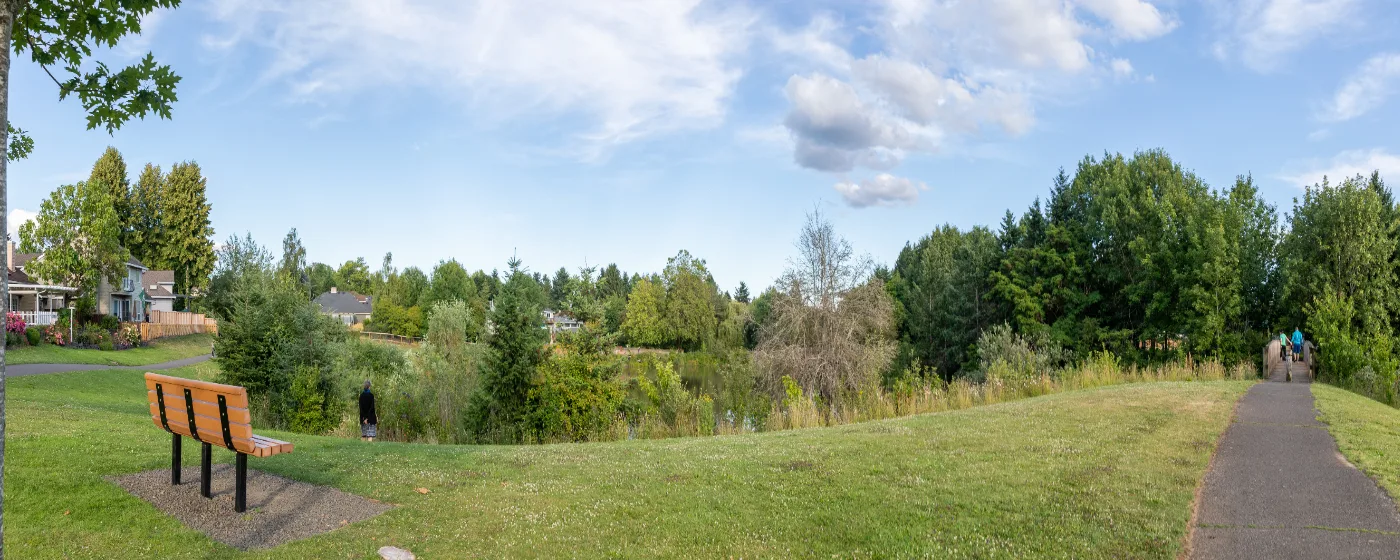
What surprises most people after six months of living here is how much happens on foot along the Fanno Creek Trail. The greenway connects Tigard neighborhoods to the library, to Cook Park, and eventually to a network that stretches toward Beaverton — and on weekday mornings it functions as a kind of informal town square, with dog walkers, cyclists, and work-from-home residents who've built their entire daily routine around it. The trail's 2025 extension from the Tigard Library added meaningful distance and pushed usage noticeably higher.
The community vibe leans practical rather than precious. Tigard isn't performing livability the way some Portland-adjacent suburbs do — it's a working city with real employers, real traffic, and real neighborhood diversity. The Broadway Rose Theatre Company brings genuine cultural programming to a city that could otherwise lean entirely suburban, and the weekly Farmers Market at Tigard Plaza has built a consistent following. The median age of 39 means you're surrounded by households in the thick of careers and child-rearing — people who chose Tigard deliberately and tend to stay.
The school district punches above its weight. The Tigard-Tualatin School District serves roughly 11,500 students across 18 schools and carries a graduation rate of around 86.7% — several points above the Oregon state average. Both Tigard High and Tualatin High offer International Baccalaureate programs, which is not a given at this price point in the metro. The district spends approximately $21,500 per pupil — well above national averages — and 100% of teachers are licensed. For buyers choosing between suburbs based on school quality, this district holds its own against much more expensive zip codes.
The employment base means you might not need to commute at all. Consumer Cellular, Capital One, Kaiser Permanente, and Legacy Meridian Park Medical Center together represent thousands of jobs within or adjacent to the city. The tech workforce here is notably strong — roughly a quarter of residents work from home, and the share of residents employed in computers and mathematics ranks in the top 5% nationally. Tigard isn't just a bedroom community; it has enough employment density that some residents have genuinely short commutes or no commute at all.
Bridgeport Village and Washington Square together create a retail ecosystem that's genuinely useful. This isn't a compliment you'd bother giving most suburbs, but Tigard's combination of high-end outdoor retail, dining, and everyday services within a 10-minute drive of most neighborhoods means residents rarely need to go into Portland for shopping. Nordstrom at Washington Square, the Bridgeport dining corridor, and the everyday grocery and service options along 99W cover most needs without a trip to the city.
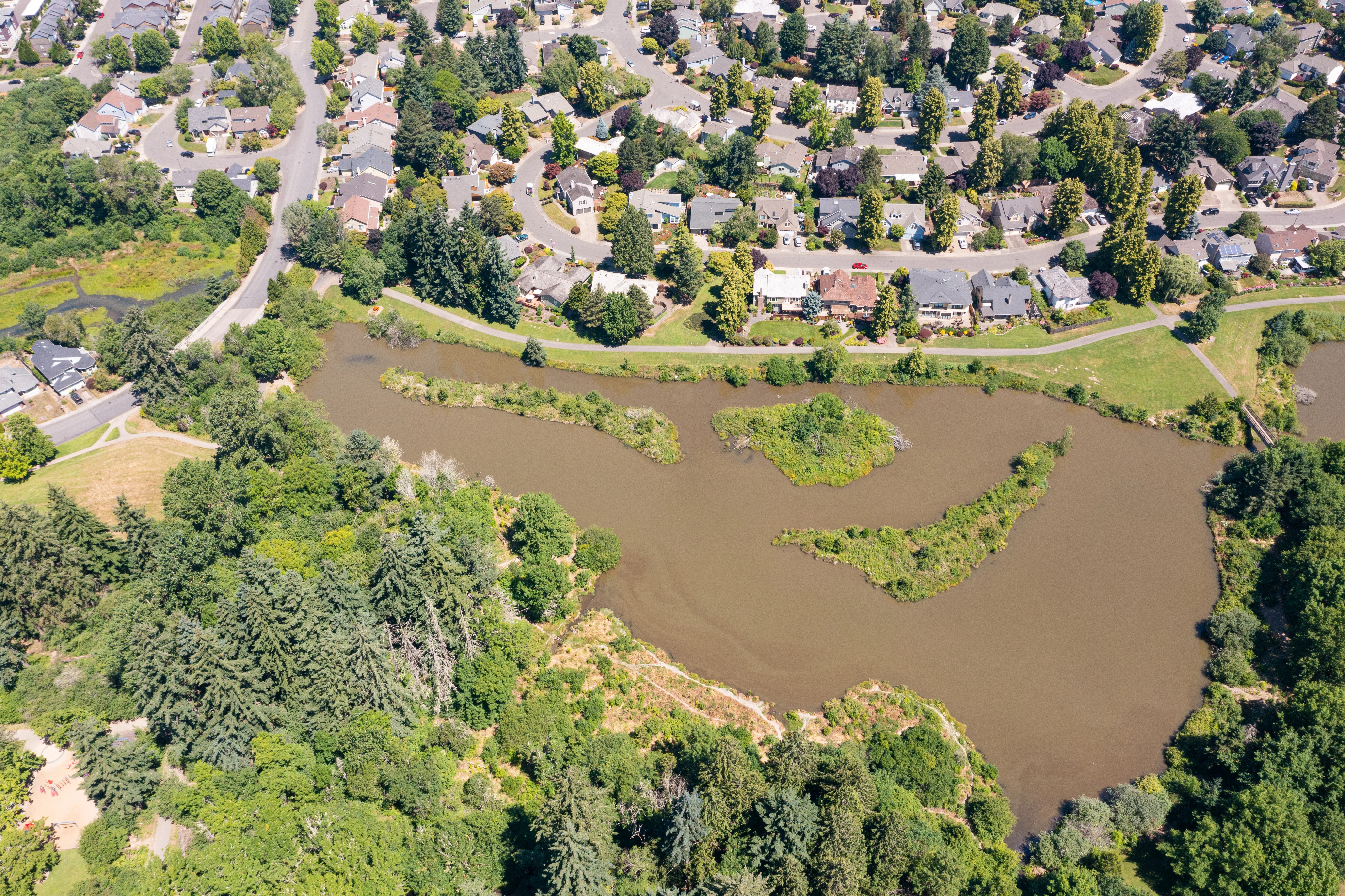
Cook Park is one of the best urban parks in the region. At 79 acres along the Tualatin River, Cook Park offers boat ramps, sports fields, picnic shelters, and one of the most genuinely usable riverfront environments in Washington County. It's large enough that it never feels crowded, well-maintained enough that it draws residents from neighboring cities, and connected enough to the trail network that it functions as the southern anchor of the Fanno Creek greenway. Families with kids regularly cite it as a deciding factor.
The traffic situation on 99W and Hall Boulevard is not a minor inconvenience — it's a structural feature of the city that shapes daily decision-making. During peak commute hours, the stretch between Barbur Boulevard and Durham Road can add 20 minutes to what looks like a 5-minute trip on a map. Residents who don't learn the back-road alternatives — the cuts through residential streets behind Washington Square, the 72nd Avenue corridor — pay for that ignorance daily. The city has been working on traffic mitigation for years, but 99W remains a legitimate frustration.
Walkability is genuinely limited outside specific corridors. Tigard scores low on traditional walkability metrics, and that's honest. Outside of downtown Tigard and the Fanno Creek Trail immediate surroundings, daily errands require a car. Buyers coming from Portland neighborhoods where walking to coffee and groceries is standard will feel the adjustment. The city is making real investments in its trail network and downtown streetscape, but that's a project measured in years, not months.
The city has a personality gap between its commercial and residential faces. Drive 99W and you could be anywhere in suburban America. Walk the Bull Mountain neighborhoods or sit in Cook Park on a summer evening and you're somewhere genuinely pleasant. New residents who form their first impression from the commercial spine sometimes miss the residential quality entirely. The gap is real, and it's worth being honest about.
Why some people leave: Tigard loses residents most commonly to two situations. The first is families who outgrow the city — who wanted more acreage, more rural character, or a tighter small-town feel and eventually move south toward Sherwood or Newberg. The second is buyers who underestimated the traffic and end up spending significant time in the car despite the theoretically short commute to Portland. Neither of these is a fatal flaw, but they're predictable enough that you should pressure-test your expectations before closing.
Bull Mountain is the address buyers typically have in mind when they say they want Tigard without the Tigard traffic. Elevated above the rest of the city on the southwest side, these neighborhoods sit largely outside the 99W corridor chaos and deliver views, newer construction, and lots that run larger than the city average. Prices here range roughly from the low $600s to well above $800,000 depending on the street and vintage, and competition tends to be real in the spring market. The honest catch is that Bull Mountain isn't walkable — nearly every errand requires a car, and the drive down to Scholls Ferry or 99W can feel like a commute in itself.
Best for: Buyers who prioritize space, quiet, and views over walkability and are comfortable being car-dependent.
River Terrace is one of the newest planned communities in the Portland metro, developed largely over the past decade on the western edge of Tigard adjacent to Bull Mountain. Homes here are noticeably newer, with more consistent architectural styles and HOA-maintained common areas, and the price range generally runs from the mid-$600s into the upper $700s for larger single-family homes. The community has its own parks and trail connections that feed into the broader regional network. Buyers who want new construction quality and don't want to drive to Hillsboro to find it frequently land here.
Best for: Families seeking newer construction with HOA amenities and Bull Mountain-adjacent quality without paying Bull Mountain's peak prices.
The Summerlake area, anchored by Summerlake Park on the north end of the city near the Beaverton border, attracts households who want suburban comfort with reasonable access to both Portland and the Beaverton employment corridor. Homes here tend to be well-established single-family properties from the 1980s and 1990s, typically priced in the $500s to low $600s. The park itself is a genuine neighborhood asset — a lake, walking paths, and open lawn that fills up on summer weekends. School assignments here may feed into either the Tigard-Tualatin or Beaverton district depending on the exact address, which is worth verifying before signing.
Best for: Commuters splitting time between Portland and Beaverton who want established neighborhoods with real park access.
Downtown Tigard is in the middle of a deliberate reinvention, and the gap between where it's headed and where it is today is part of what makes buying here interesting. The city has invested in a streetscape along Main Street that has improved the walkable core, and the Farmers Market and Broadway Rose Theatre Company anchor genuine community activity. Home prices in and around the downtown core tend to be lower than in Bull Mountain or River Terrace, with more condos and townhomes in the $200s to $400s for buyers who want proximity to transit and the trail network. The tradeoff is noise, traffic proximity, and a neighborhood that's still mid-transition.
Best for: First-time buyers and remote workers who want a walkable base and don't mind being in a neighborhood that's still finding its footing.
Metzger sits on the northeastern edge of Tigard, bumping up against Beaverton and Portland in a way that makes its identity feel genuinely hybrid. The housing stock here is older — many homes date from the 1950s through 1970s — and prices typically run in the low-to-mid $400s, making it one of the more accessible entry points in the city. Residents get quick access to Washington Square and the Beaverton-Hillsdale Highway corridor, and some parts of Metzger feed into the Beaverton School District rather than Tigard-Tualatin, which matters to buyers with strong school preferences. The neighborhood is functional and affordable but lacks the residential cohesion of Bull Mountain or Summerlake.
Best for: Value-focused buyers willing to sacrifice neighborhood polish for price and access to the Washington Square corridor.
Summerfield is Tigard's established 55+ community, built around a golf course on the southern end of the city near Durham Road. The community has its own clubhouse, pool, and organized social calendar that operates independently of city programming, and the architectural consistency of the neighborhood gives it a distinctly different character from the rest of Tigard. Home prices here are generally lower than the citywide median — often in the $350s to $500s — reflecting the age-restricted nature of the community and older housing stock. For buyers who qualify and want that structure, there's nothing else quite like it in this part of the metro.
Best for: Buyers 55 and older who want an active social community, golf access, and lower price points than the city's family-oriented neighborhoods.
The Tigard Triangle is the commercial and transitional zone bounded by Highway 99W, I-5, and Highway 217 — and it's genuinely different from the residential neighborhoods most buyers are targeting. There's a real mix of light industrial, retail, and residential uses here, and the city has long-term redevelopment plans for the area. Residential options skew toward apartments and townhomes rather than single-family homes, and the freeway adjacency creates the noise and access patterns you'd expect. Buyers who work locally and want lower price points sometimes find value here, but it's not a neighborhood to choose casually.
Best for: Buyers prioritizing commute access and low price over residential character, or investors watching the redevelopment trajectory.
Derry Dell is a quieter, established residential area in central Tigard that sits close to the Fanno Creek Trail corridor and offers solid access to schools and the city's park network. The housing stock is primarily single-family homes from the 1970s and 1980s, with price points that tend to run in the $475,000 to $575,000 range. It's one of the neighborhoods that local safety data consistently places among Tigard's lower-crime areas, which is worth noting for buyers who are weighing the city's property crime averages. The neighborhood doesn't have a dramatic identity — it's comfortable, well-established, and pleasantly unremarkable.
Best for: Buyers who want central Tigard access, trail proximity, and mid-range pricing without the newer-construction premium of Bull Mountain.

Tigard's neighborhoods each tell a different story when it comes to long-term value. Bull Mountain continues to attract strong buyer interest thanks to its elevation, newer construction, and views, with well-priced homes often receiving multiple offers within days of hitting the market. Summerlake-Scholls offers a more suburban feel with established landscaping and community amenities that tend to hold value well through market cycles. Downtown Tigard is worth watching as ongoing revitalization efforts make it increasingly attractive for buyers who want walkability paired with reasonable entry points, generally under $500,000 in many cases.
Before you fall in love with a home during a tour, sit down with a lender first. Your true monthly obligation includes not just principal and interest, but property taxes, homeowner's insurance, and any HOA dues — and that combined number can look quite different from what a basic online calculator shows. I always encourage buyers to identify a comfortable payment, not just a maximum approval, because those two numbers rarely match. Tigard moves fast enough that being fully prepared gives you a real advantage when the right home appears.
| City | Best For | Median Home Price | Commute to Portland | Vibe |
|---|---|---|---|---|
| Tigard | Value + schools + employment mix | $575,000 | ~24 min | Working suburban; genuine infrastructure |
| Beaverton | Tech corridor access; Intel commuters | $520,000 | ~20 min | Dense suburban; more transit options |
| Tualatin | Quiet suburban feel; slightly more space | $600,000 | ~28 min | Family-oriented; less urban energy |
| Lake Oswego | Premium schools; affluent character | $860,000 | ~18 min | Upscale; significantly higher cost |
| King City | Budget entry; 55+ options nearby | $425,000 | ~30 min | Small, quiet; fewer amenities |
| Sherwood | More rural feel; newer development | $595,000 | ~32 min | Suburban-rural; growing rapidly |
| Category | Stat |
|---|---|
| Population | ~58,434 |
| Median Home Price | $575,000 |
| Median Household Income | $108,823 |
| Property Tax Rate | ~0.84% |
| Commute to Portland | ~24 minutes |
| School District | Tigard-Tualatin SD (B+) |
| Violent Crime per 1,000 | 3.7 |
| Property Crime per 1,000 | 32 |
| Median Gross Rent | ~$1,829/month |
| Homeownership Rate | ~60% |
| Remote Work Share | ~24% of workforce |
| Median Age | 39.4 years |
Tigard's relationship with the Fanno Creek Trail borders on civic religion. On dry weekends between April and October, the trail functions as a social layer over the city — the place where neighbors actually meet each other, where dogs develop their own social networks, and where the 2025 library extension has created a new loop that regulars have already worked into their weekly routines. If you move to Tigard and don't find yourself on this trail within your first month, you're missing the city's most authentic daily feature.
The Broadway Rose Theatre Company runs a genuinely ambitious season for a city of this size, staging professional productions in the summer that draw audiences from across the Portland metro. It's been a fixture for over three decades and represents something real about Tigard's investment in community life beyond the commercial strip — a counterpoint to the chain-restaurant image that 99W projects. Attending an opening night at Broadway Rose is one of those experiences that makes new residents recalibrate their sense of what Tigard actually is.
The Farmers Market at Tigard Plaza draws a consistent community crowd through the growing season, and it's become one of the informal gathering points for the neighborhoods immediately surrounding downtown. It's not the size of Portland's Saturday Market, but it has the feel of something that belongs to the people who show up every week — familiar vendors, familiar faces, and a grounded regularity that reflects the city itself.
What I would not do if moving to Tigard: I would not buy in the Tigard Triangle without spending a weeknight there first. The freeway noise from the I-5/217 interchange is constant, and the neighborhood's proximity to three major highway junctions creates a sound environment that doesn't read clearly on a daytime showing. The redevelopment plans are real and the prices can look attractive, but buyers who discover the noise after moving in consistently report wishing they'd spent more time on-site before deciding.
Local Expert Takeaway: If you're narrowing your Tigard search, start with the Bull Mountain and River Terrace corridors for newer construction and quieter streets, then compare carefully against Derry Dell and Summerlake-Scholls if your budget is tighter — those neighborhoods offer genuine value without the 99W proximity that frustrates buyers who didn't account for it. The Tigard-Tualatin School District is a real asset that belongs in your decision calculus, but confirm your specific address's school assignment before making any assumptions, especially near the Beaverton border in Metzger and Summerlake. Buy where the trail access and the school boundary align with your household's actual priorities, and you'll find this city rewards the research.
✅ Tigard's school district, employment base, and Cook Park access make it one of the most substantively livable suburbs in the Portland metro at its price point.
⚠️ Highway 99W and Hall Boulevard traffic is genuinely challenging during commute hours — budget time, learn the back routes, and don't rely on straight-line distance estimates.
📍 Neighborhood choice within Tigard matters enormously: Bull Mountain and River Terrace deliver quiet residential character; downtown Tigard and the Triangle offer lower prices with more urban friction. Know which trade-off fits your life before you make an offer.
Is Tigard a good place for families?
Tigard is a strong choice for households with school-age children. The Tigard-Tualatin School District carries a graduation rate above the Oregon state average, offers IB programs at both high schools, and spends significantly more per pupil than national averages. Neighborhoods like Bull Mountain, River Terrace, and Summerlake-Scholls are particularly well-suited to families, with park access, established community patterns, and relatively lower crime profiles within the city.
What is the crime rate in Tigard?
Tigard's violent crime rate runs approximately 3.7 incidents per 1,000 residents — lower than many comparable cities in the Portland metro. Property crime is the more relevant concern at around 32 per 1,000, consistent with suburban cities that border major commercial corridors. Neighborhoods on the west side of the city, including West Tigard, East Bull Mountain, Summerfield, Derry Dell, and Southview, tend to report lower crime activity than areas adjacent to the highway commercial corridors.
How does Tigard compare to Beaverton and Tualatin?
Tigard sits between its two closest neighbors in both price and character. Beaverton offers more robust transit access and slightly lower median prices, but denser development and stronger Intel-corridor orientation. Tualatin skews a bit quieter and slightly more expensive, with more of a small-town residential feel. Tigard offers the most diverse employment base of the three, stronger retail infrastructure, and the Fanno Creek Trail — but it carries the most significant traffic burden along 99W. Buyers who land in Tigard typically chose it because the school district, the park system, and the price-to-space ratio lined up better than the alternatives.
Browse current listings updated daily — filtered for Tigard buyers by Elizabeth Davidson, your local expert.
Powered by Elizabeth Davidson · Cascade Hasson Sotheby's International Realty · 503-939-2035
Explore the full Tigard series: The Ultimate Tigard Relocation Guide · Is Tigard Safe? · Cost of Living in Tigard · Best Neighborhoods in Tigard · Tigard Schools & Family Life · Tigard Youth Sports · Tigard Parks & Recreation · Retiring in Tigard · 1031 Tax-Deferred Exchange in Tigard · Tigard First-Time Homebuyers Guide · Tigard Down Payment Assistance Guide · Moving to Tigard from California · The Tigard Realtor's Perspective · Top 10 Questions a Realtor Gets About Tigard