
Portland Metro · Oregon
Moving to Oregon City from California: The Honest Comparison (2026)
The Bay Area software engineer who finally bought a yard. The San Diego family who stopped wincing at summer utility bills. The Sacramento buyer who walked away from a cramped townhome and into a four-bedroom house with a garage — for less money. These are real people, and Oregon City shows up in their searches for a specific reason: the math works in a way that few other Pacific Northwest cities can match. At a $615,000 median home price, an equity-rich California seller isn't just downsizing their mortgage — they're often eliminating it. Oregon City is the county seat of Clackamas County, sitting 25 minutes south of Portland on the Willamette River, and it carries something most Portland-adjacent suburbs don't: genuine history, a distinct identity, and price points that still feel like 2019 by California standards.
The hard part deserves naming upfront. Oregon City is not California. The winters here run gray from November through March in a way that no amount of preparation fully captures until you've lived through one. The food scene is smaller, the social energy quieter, and if you're leaving San Diego or the South Bay, the cultural density you took for granted — the breadth of restaurants, the constant outdoor warmth, the sense that everything is open and accessible year-round — shrinks noticeably. These aren't reasons not to move. They are reasons to go in clear-eyed rather than surprised.
This guide walks California buyers through the actual cost comparison broken down by origin market, what your home equity concretely buys at Oregon City's price points, the real tax picture (including what Oregon does and does not offer compared to California), the honest weather reality, and an interactive tool to compare your specific California city directly. By the end, you'll have enough information to know whether Oregon City is a genuine fit — or whether the spreadsheet math is more compelling than the daily reality.

| Category | Oregon City, OR | Bay Area | Southern CA | Sacramento Metro | Central Valley |
|---|---|---|---|---|---|
| Median Home Price (approx. 2026) | $615,000 | $1,300,000–$1,800,000 | $750,000–$1,100,000 | $480,000–$580,000 | $340,000–$430,000 |
| Property Tax Rate (effective) | ~0.87% | ~1.1–1.3% (older Prop 13 owners far lower) | ~1.1–1.25% | ~1.0–1.2% | ~0.9–1.1% |
| State Income Tax (top bracket) | 9.9% | 13.3% | 13.3% | 13.3% | 13.3% |
| State Sales Tax | 0% | 7.25–10.25% | 7.25–10.75% | 7.25–8.75% | 7.25–8.25% |
| Avg Utilities (monthly est.) | $150–$190 | $220–$310 | $230–$320 | $200–$280 | $200–$270 |
| Avg 1BR Rent | $1,400–$1,700 | $2,800–$3,800 | $2,100–$3,000 | $1,500–$1,900 | $1,100–$1,500 |
The utility comparison deserves particular attention for anyone leaving Southern California. Oregon City's temperate marine climate means neither extreme summer cooling nor brutal winter heating — monthly utility bills in the $150 to $190 range are typical for a mid-size home, compared to the $230 to $320 range common in hotter California metros. The aggregate annual savings on utilities, sales tax, and property taxes can easily reach $8,000 to $14,000 depending on origin city — money that compounds over a decade into a figure that dwarfs most people's mental accounting of "how much" they saved by moving.
The single biggest misconception California transplants carry across the border is that Oregon is a low-tax state. It isn't — not on income. Oregon's graduated income tax reaches 9.9% at the top bracket, which applies to income over $125,000 for single filers. California's top bracket hits 13.3%. For a household earning $150,000 in adjusted gross income, that difference amounts to roughly $5,000 to $6,500 in annual state income tax savings — meaningful, but not transformative on its own. What genuinely changes the financial picture is the combination of factors, not any single line item.
Oregon's zero state sales tax is real and consequential. A family spending $70,000 annually on taxable purchases — groceries, clothing, home goods, vehicles, electronics — saves somewhere between $5,000 and $7,500 per year compared to living in a high-sales-tax California county. Over ten years, that figure compounds into the range of a car, a home addition, or a meaningful retirement contribution. Oregon also operates under Measure 50 property tax protections: once you purchase a home, the assessed value used for tax purposes can only increase by 3% per year, regardless of what the market does. In a city where values have appreciated meaningfully over the past decade, this is a substantial long-term benefit for homeowners who plan to stay.
| Tax Item | California | Oregon | Net Impact |
|---|---|---|---|
| Top State Income Tax Rate | 13.3% | 9.9% | Oregon saves ~3.4 pts |
| State Sales Tax | 7.25–10.75% | 0% | Oregon saves 7–11% on purchases |
| Effective Property Tax Rate | Varies; Prop 13 locks older owners low; new buyers ~1.1–1.3% | ~0.87% | Oregon saves on new purchases |
| Assessed Value Cap | Prop 13: 2%/yr after purchase | Measure 50: 3%/yr after purchase | Similar protection; OR slightly higher cap |
| Capital Gains (state) | Up to 13.3% (ordinary income rate) | Up to 9.9% (ordinary income rate) | Oregon saves ~3.4 pts |
| Senior Property Tax Deferral | Limited circuit breaker programs | Available at age 62+ | Oregon advantage for retirees |

I've worked with California buyers across every equity tier, and the Oregon City market consistently surprises them in one direction: it moves faster than they expect. California buyers often arrive thinking they have time to be deliberate. They want to see twenty homes, run the numbers twice, and take a weekend to decide. In Oregon City's competitive pockets — McLoughlin, Park Place, the newer construction in Barclay Hills — that approach costs them two or three homes before they recalibrate. The buyers who do best here come prepared to move in the 11-to-14-day window that well-priced homes demand.
What California buyers consistently underestimate is the value premium already embedded in Oregon City's proximity to top-tier Clackamas County infrastructure — without the price tag of Happy Valley or West Linn. Buyers leaving Pleasanton or Irvine are used to paying a premium for safe, well-run suburban environments. Oregon City delivers that same quality-of-life profile at a meaningful discount, and savvy buyers recognize it fast. The ones who hesitate, thinking they'll find something even cheaper farther out, often end up in Canby or Molalla and discover that the commute trade-off was steeper than the price savings justified. If you're considering Oregon City and want insight into which neighborhoods align with your priorities and budget, I'd welcome the opportunity to share what I've learned from helping hundreds of families make this move successfully.
A seller leaving San Jose, Fremont, or Palo Alto with $1.4 million in equity can purchase any home currently listed in Oregon City outright and retire the concept of a monthly mortgage payment entirely. At the $615,000 median, that leaves $785,000 in liquidity after an all-cash purchase — a figure that represents both a paid-off home and a meaningful investment portfolio. Buyers at this equity level looking for genuine luxury in Oregon City should explore the McLoughlin neighborhood's historic Victorian properties and the elevated ridge-top lots in Tower Vista, where views of the Willamette Valley and custom construction occasionally push into the $800,000 to $950,000 range.
The Bay Area buyer who chooses not to go all-cash has even more strategic flexibility. Putting $400,000 down on a $615,000 purchase at current rates creates a monthly payment that may be less than what they were paying in property taxes alone on their California home. The remaining equity, invested conservatively, can generate passive income that effectively subsidizes the Oregon City mortgage for years. Few relocation decisions in the Portland Metro offer this level of financial restructuring in a single transaction.
A seller departing Irvine, Pasadena, or Torrance with $900,000 in equity lands in the top tier of Oregon City's buyer pool with room to spare. At the $615,000 median, they're looking at a substantial down payment — likely 60% to 80% — on a well-appointed home in Caufield or Park Place, with cash reserves intact. Buyers with this equity range who want the most Oregon City has to offer should look at the newer construction in Hillendale and Barclay Hills, where homes in the $650,000 to $750,000 range represent some of the cleanest inventory in the city.
Southern California buyers are often accustomed to sprawl and car dependency, which makes Oregon City's layout feel immediately familiar. What catches them is the winter, not the housing. The financial case is clean: coming from San Diego or the Inland Empire, the property tax savings alone on a $615,000 home versus a comparable California purchase run $1,300 to $2,400 per year, and that gap only widens over time as Measure 50 caps Oregon assessments while California assessments reset at full market value for new buyers.
Buyers leaving Elk Grove, Roseville, or Riverside with $500,000 in equity face a closer relative comparison — Oregon City's median price isn't a dramatic departure from Sacramento metro pricing, but the advantages stack up differently. Zero sales tax is an immediate quality-of-life change that Sacramento buyers feel quickly, since California's 7.25% to 8.75% range in most Sacramento-area jurisdictions translates to real money on every major purchase. The income tax differential also matters more at this equity level, because these buyers are often still carrying mortgages and earning working-age incomes.
In Oregon City, $500,000 in equity positioned as a 60% down payment puts a buyer into the Canemah historic district or the South End near Clackamette Park — areas with character, river proximity, and price points below the city median. Canemah in particular is one of the few places in the entire Portland Metro where a buyer can purchase a home with genuine historical architecture and Willamette River proximity for well under $600,000. For Sacramento-area buyers who want more land per dollar, the Gaffney Lane and Sunset areas offer larger lots at the city's periphery.
Fresno, Visalia, and Bakersfield buyers have the narrowest relative price advantage coming into Oregon City, but the lifestyle and tax shifts are still compelling. With $350,000 to $450,000 in equity, a buyer is looking at a strong conventional down payment — likely 50% or more — on entry-level Oregon City inventory, particularly older construction in Barclay Hills or the more affordable pockets of South End. These buyers should be realistic that Oregon City at this equity level represents a lateral financial move, not a dramatic wealth acceleration event.
What makes the Central Valley-to-Oregon-City move financially coherent is the aggregate savings over time: no sales tax, a lower state income tax rate, Measure 50 property tax protection, and the long-term appreciation potential of a city that has grown steadily while remaining meaningfully below the pricing of neighboring West Linn and Lake Oswego. Entry-level homes in Oregon City can still be found in the $450,000 to $520,000 range in the right neighborhoods, which puts a Central Valley buyer into homeownership at a price point that would have been unreachable in most Bay Area or Southern California markets.
Looking to buy in Oregon City? Estimate your payment.
Enter your numbers to see an estimated monthly mortgage payment.
Estimate only. Excludes HOA fees and mortgage insurance.
Oregon City averages roughly 143 sunny days per year. Los Angeles averages 284. San Diego clears 266. Even Sacramento — a city California residents think of as searingly hot — logs around 269 sunny days annually. Those numbers are not presented here to alarm you; they're presented because every California transplant who wasn't told this beforehand mentions it at the six-month mark, usually around February, when the gray has been unbroken for eleven consecutive weeks. Oregon City receives precipitation on approximately 170 days per year, concentrated heavily from October through April. The rain itself is rarely dramatic — this isn't Houston thunderstorm territory — but the persistent overcast sky is something that takes genuine psychological adjustment for people who grew up treating sunshine as default.
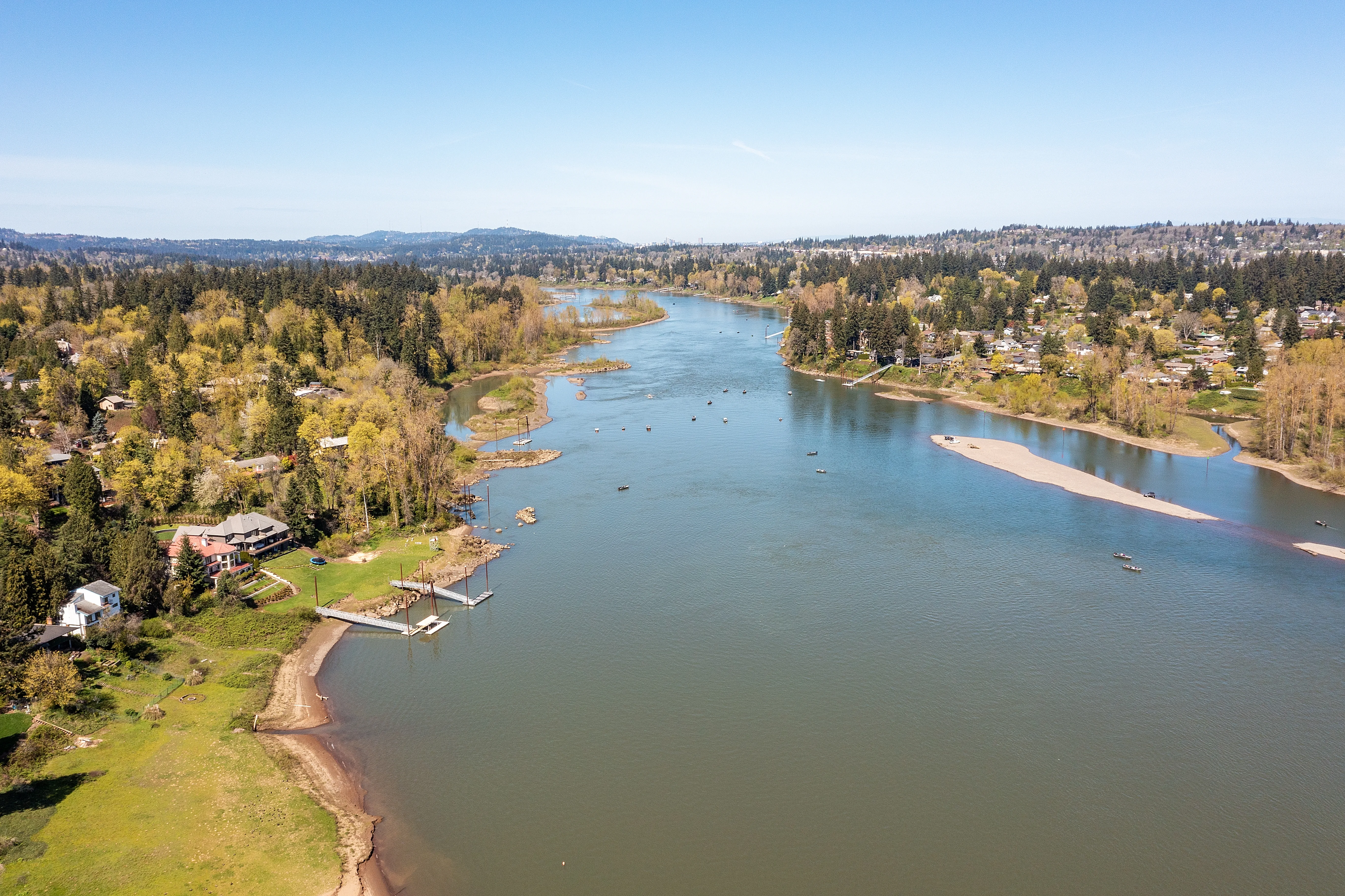
What California transplants consistently love after a year — and this is the part the bad guides skip — is the summer. Oregon City's July and August are nearly flawless: temperatures in the low-to-mid 80s, almost no rain, long daylight hours that stretch past 9 p.m., and access to hiking, kayaking, and cycling that rivals anything in Northern California without the crowds. The Willamette River frontage at Clackamette Park and Jon Storm Park becomes a genuine gathering place. The outdoor culture here in summer months is every bit as active as California — the difference is it's compressed into a five-month window rather than spread across twelve. Transplants who adjust their expectations accordingly tend to love it. Those who fight the winter calendar rarely do.
The lifestyle pace shift surprises most California arrivals regardless of origin city. Oregon City's smaller size — under 40,000 residents — creates a community density where you recognize faces at the Oregon City Farmers Market, where neighbors actually introduce themselves, and where the social calendar is manageable rather than overwhelming. The Singer Hill Cafe on the historic bluff becomes a regular Saturday spot. The End of the Oregon Trail Interpretive Center is a genuinely interesting local institution rather than a tourist trap. What California transplants miss is the cosmopolitan energy of a true large city — the breadth of international cuisine, the density of cultural events, the sense that you're living inside something happening. Oregon City is not Portland, and it's not trying to be. Buyers who want that energy on weekends have it 25 minutes north. Buyers who want quiet and space every other day of the week have found the right city.
If you want to see how Oregon City compares directly to the city you're leaving, use the tool below — it covers the 120 largest California cities with current housing and tax data.
Home prices: Redfin median sale data, Q1–Q2 2026. Select your city to compare.
Ready to talk through what your specific California equity could do in Oregon City? Todd can model your exact scenario in a single call.
Assuming the whole city has the same character. Oregon City divides more sharply than most transplants expect. The historic bluff neighborhoods — McLoughlin, Canemah — feel like a small New England river town with Victorian architecture and walkable streets. The newer planned communities in Barclay Hills and Hillendale feel like contemporary Pacific Northwest suburbia. The industrial corridor near the Willamette south of downtown is a different world again. Buying in Oregon City without understanding these distinct zones means you may purchase in one expecting the feel of another. Drive every neighborhood at both 8 a.m. on a weekday and 2 p.m. on a Saturday before making an offer.
Underestimating radon testing requirements. Clackamas County sits in an elevated radon zone, and California buyers — who rarely encounter radon as a purchase contingency — sometimes skip or discount this during inspection. Oregon homes, particularly those with basements or below-grade construction, warrant radon testing as a standard step. Mitigation systems, when needed, run $800 to $1,500 and are a solved problem — but buyers who waive testing to compete on speed occasionally discover elevated levels post-close.
Expecting California-style year-round outdoor access. A Marin County buyer who hikes twelve months a year will still hike in Oregon City — but the winter version looks like rain gear, mud, and shorter daylight windows, not the dry-trail conditions they're accustomed to. The trails along the Willamette bluff and the regional parks within Clackamas County are genuinely excellent in every season, but they require a wardrobe and mindset shift. Buyers who plan outdoor recreation as a primary quality-of-life factor should budget for proper wet-weather gear and recalibrate their winter expectations before they arrive, not after.
Not accounting for Molalla Avenue and the Highway 213 corridor at commute time. The 25-minute Portland commute is real — during off-peak hours. Highway 99E through Gladstone and Milwaukie during morning rush can stretch that figure to 40 to 50 minutes on bad days. Buyers who are planning on a two-days-a-week office schedule should test their specific commute during peak hours before choosing a neighborhood on the southern or eastern edges of the city, where the extra distance compounds noticeably.
Bay Area sellers with large equity are functionally operating in a different financial category than most Oregon City buyers. An all-cash offer from a Palo Alto or Menlo Park seller carries immediate competitive advantages — no appraisal contingency, faster close, and a seller's preference that can be worth $10,000 to $20,000 in effective purchase price. Buyers at this equity level who want to preserve liquidity should explore portfolio loans or pledged-asset mortgages, which allow them to collateralize investment accounts rather than liquidating them for a down payment. If the California property being sold was an investment property rather than a primary residence, a 1031 exchange into Oregon City real estate is worth exploring before closing — see our Oregon City 1031 Exchange guide for a full breakdown.
Southern California sellers entering Oregon City with $700,000 to $1.2 million in equity are well-positioned for conventional financing at any price point in the city. Oregon City's $615,000 median falls comfortably below the 2026 conforming loan limit, which means most buyers in this range are looking at conventional loans rather than jumbo products — lower rates, simpler qualification, and faster underwriting. A buyer putting 40% down on a $615,000 purchase qualifies for a loan around $369,000, which is straightforward to finance at current conventional rates.
Sacramento and Inland Empire buyers with $400,000 to $650,000 in equity should explore Oregon Housing and Community Services programs if their target price falls under $450,000. The Oregon Bond Residential Loan program offers below-market fixed rates to qualifying buyers, and some income limits align with Oregon City's median household income range. Buyers coming in above those thresholds are still well-served by conventional financing, and the combination of a significant California equity down payment with Oregon City's sub-$615,000 median creates very manageable loan amounts by national standards.

Local Expert Takeaway: The single thing California buyers most consistently underestimate about Oregon City is how quickly well-priced inventory disappears in the $550,000 to $700,000 range. This is the city's most competitive price band — it captures both move-up buyers within Oregon and equity-rich California transplants simultaneously. If you're coming from the Bay Area or Southern California with strong equity and a pre-approval in hand, get your financing structured before you arrive in town. Homes in McLoughlin and Barclay Hills that are priced right are going pending within 11 to 14 days. The buyers who come prepared to make a clean offer on day three win the house. The buyers who still need to finalize their loan structure on day five are writing a second offer on something else.
✅ Oregon City delivers genuine financial gains for most California sellers — the combination of zero sales tax, lower income tax rates, lower property tax on new purchases, and dramatically lower home prices creates a compelling aggregate advantage that compounds over time.
⚠️ The weather adjustment is real and takes about a full year to fully internalize — transplants who arrive in June and buy in September are making their decision during Oregon's best months; they should intentionally research what February looks like before committing.
📍 Oregon City's neighborhood character varies significantly — the historic bluff and riverfront areas feel entirely different from the newer suburban developments on the city's eastern edge, and matching your lifestyle expectations to the right neighborhood matters more than most buyers anticipate.
Is moving from California to Oregon City worth it?
For most equity-rich California sellers, the financial case is genuinely strong. The combination of zero state sales tax, income tax rates 3 to 4 points below California's top bracket, lower effective property taxes on new purchases, and home prices that are dramatically below Bay Area and Southern California medians creates a compounding annual advantage that typically reaches $10,000 to $15,000 or more per year. The lifestyle trade-offs — fewer sunny days, smaller city energy, quieter cultural scene — are real and worth weighing, but for buyers who prioritize financial freedom and outdoor access over cosmopolitan density, Oregon City delivers on its promise.
How much cheaper is housing in Oregon City vs. California?
The gap varies dramatically by origin market. Compared to the Bay Area, where median home prices in desirable suburbs run $1.3 million to $1.8 million, Oregon City's $615,000 median represents a 55% to 65% discount. Compared to core Southern California markets like Irvine or Pasadena, the discount runs roughly 30% to 45%. Even against Sacramento's outer suburbs, Oregon City is often a lateral or modest step down in price — but the tax savings, sales tax elimination, and Measure 50 property tax protections make the net financial position meaningfully better over a 10-year horizon.
What do I need to know about moving from California to Oregon?
Oregon has a state income tax, so the assumption that you're leaving all state income taxation behind is incorrect — though the top rate of 9.9% is still 3.4 points below California's 13.3%. Oregon has no state sales tax, which is immediately felt on every purchase. Property taxes in Oregon are moderated by Measure 50, which caps annual assessed value increases at 3% after purchase — a meaningful long-term protection. Practically speaking, plan for a genuine weather adjustment, budget for radon testing on any home with below-grade space, and research commute routes from your specific neighborhood to your workplace during actual peak hours before finalizing your neighborhood choice.
Browse current listings updated daily — filtered for Oregon City buyers by Elizabeth Davidson, your local expert.
Powered by Elizabeth Davidson · Cascade Hasson Sotheby's International Realty · 503-939-2035
Explore the full Oregon City series: The Ultimate Oregon City Relocation Guide · Is Oregon City Safe? · Cost of Living in Oregon City · Best Neighborhoods in Oregon City · Oregon City Schools & Family Life · Oregon City Youth Sports · Oregon City Parks & Recreation · Retiring in Oregon City · 1031 Tax-Deferred Exchange in Oregon City · Oregon City First-Time Homebuyers Guide · · Moving to Oregon City from California · The Oregon City Realtor's Perspective · Top 10 Questions a Realtor Gets About Oregon City
Tell us what you need help with and we'll connect you with local resources.

About the Author
Todd Davidson is the founder of Living in Oregon and Living in Washington, where he publishes in-depth city guides, neighborhood resources, and local market insights covering more than 180 communities across the Pacific Northwest. While his background is in home financing and real estate, he created these digital platforms to help families research and compare regions before making a move.