
Willamette Valley · Oregon
Living in Monmouth: The Ultimate Relocation Guide (2026)
Maybe you've been priced out of Salem and someone in your Facebook group mentioned Monmouth as the alternative. Maybe Western Oregon University is bringing you here for work, or a job at Central School District landed you on a real estate search that turned up homes at prices you haven't seen in years. Or maybe you just drove through on 99W and thought — this feels quieter than expected, smaller than I imagined, but the hills in the distance and the old downtown core made you pull over and wonder. Whatever brought you here, the central tension in Monmouth is real: this is a college town that doesn't fully act like one, a small city trying to serve families and retirees while its median age sits at 27 and most of its housing stock gets rented by students who'll be gone in four years.
Geographically, Monmouth sits about 12 miles west of Salem in the Ash Creek watershed, tucked into the western Willamette Valley where the Eola-Amity Hills wine appellation begins. It's technically part of the Salem Metropolitan Statistical Area, though the daily reality feels nothing like Salem. You're on 99W, which connects you south toward Corvallis and north toward the Salem metro, but the commute to Salem runs longer than the mileage suggests — more on that below. The city covers just 2.24 square miles, which means you can drive from one end to the other in about four minutes. That compactness is either a feature or a limitation, depending entirely on what you need from a city.
This guide is built for the buyer or renter who wants an honest answer to whether Monmouth is actually the right fit. You'll find a straight look at who thrives here, which neighborhoods are worth knowing, how the market is really moving, and the tradeoffs that don't show up in a Zillow listing. By the end, you'll know whether Monmouth's combination of affordable pricing, university energy, and small-town rhythm matches the life you're trying to build — or whether the compromises are ones you're not willing to make.

Not every buyer is the right fit for Monmouth, and the people who thrive here tend to know exactly why they chose it. The table below gives a fast read on who genuinely benefits — and who may find themselves frustrated within a year.
| Best For | Why |
|---|---|
| First-time buyers | Median home price around $466,000 is among the more accessible in the Willamette Valley; smaller lot sizes and older inventory mean less competition from move-up buyers |
| Remote workers | Affordable housing + quiet lifestyle + reasonable fiber internet access; proximity to Salem for in-person days without paying Salem prices |
| WOU employees and staff | Campus walkability, shorter commute to work, and a genuine connection to the university community |
| Families with school-age children | Small-town safety profile, affordable entry price, and access to parks and trails — though school ratings should be factored in |
| Retirees downsizing | Lower cost base than Salem or Corvallis, manageable city scale, and a quieter pace without full rural isolation |
| Outdoor-oriented buyers | Ash Creek Trail System, proximity to the Eola-Amity Hills, and wine country access make weekends genuinely appealing |
The first thing most newcomers notice is the scale. Monmouth's walkable downtown is genuinely compact — a few blocks of Main Street with local businesses, the historic library, the beloved Main Street Ice Cream Parlor, and the kind of civic quiet that bigger cities try to manufacture. On a weekday afternoon, it feels unhurried in a way that can read as either peaceful or sleepy depending on your energy level. On a WOU home game weekend, that same downtown core briefly buzzes with foot traffic, food, and the kind of spontaneous street energy the city doesn't always sustain.
The commute reality is important to understand before you buy. The starting data lists the commute to Salem at 73 minutes — and while that may reflect peak-hour driving conditions, even off-peak runs on 99W can stretch to 35 or 40 minutes depending on Salem-side congestion near the Lancaster Drive corridor. Monmouth doesn't have a direct freeway connection, which means every Salem commute runs through surface streets. Buyers who are planning to commute to Salem five days a week should factor that into their decision with clear eyes. Those working in Corvallis, which sits about 25 miles south, often find that commute more manageable and more consistent.
The community vibe skews younger than almost any comparable Oregon city — with a median age of 27.1, the demographic reality is that a meaningful share of daily life is shaped by the student population. That's not a problem for everyone. The university brings visiting speakers, arts events, athletic competitions, and a steady influx of young energy. But it also means a homeownership rate of roughly 47% — most residents rent — and neighborhood turnover that can feel high compared to Salem's established residential corridors. Where families and longer-term residents tend to cluster is in the southern residential neighborhoods, around Edwards Addition and Griffin Estates, where the university's footprint is less dominant.
One thing that genuinely surprises people after six months here: how much the Eola-Amity Hills wine country affects daily life in a positive way. Within 10 minutes of downtown Monmouth, you're surrounded by working vineyards, small-production wineries, and the kind of rural scenery that people in Portland pay weekend travel costs to access. That proximity is baked into the price of living here and becomes, for many residents, one of the most compelling reasons they stay.
The affordability floor is real. At approximately $466,000, Monmouth's median home price gives buyers who've been watching Salem's south-side neighborhoods — where comparable homes often approach $550,000 — a meaningful entry point without retreating to truly rural areas. The property tax rate of approximately 0.71% is also notably low, which translates to meaningful savings on carrying costs over the life of a mortgage. A home at the median price generates roughly $3,300 annually in property taxes — a number that would be almost double in parts of the Portland metro.
The Ash Creek Trail System is one of Monmouth's most underrated assets. The trail network follows the creek through the heart of the city, connecting residential neighborhoods to downtown and providing paved and natural-surface routes that actually get used daily by walkers, joggers, and cyclists. Main Street Park and Madrona Park give families and dog owners additional greenspace without leaving the city limits. For a city of under 12,000 people, the parks and trail infrastructure is genuinely well-developed.
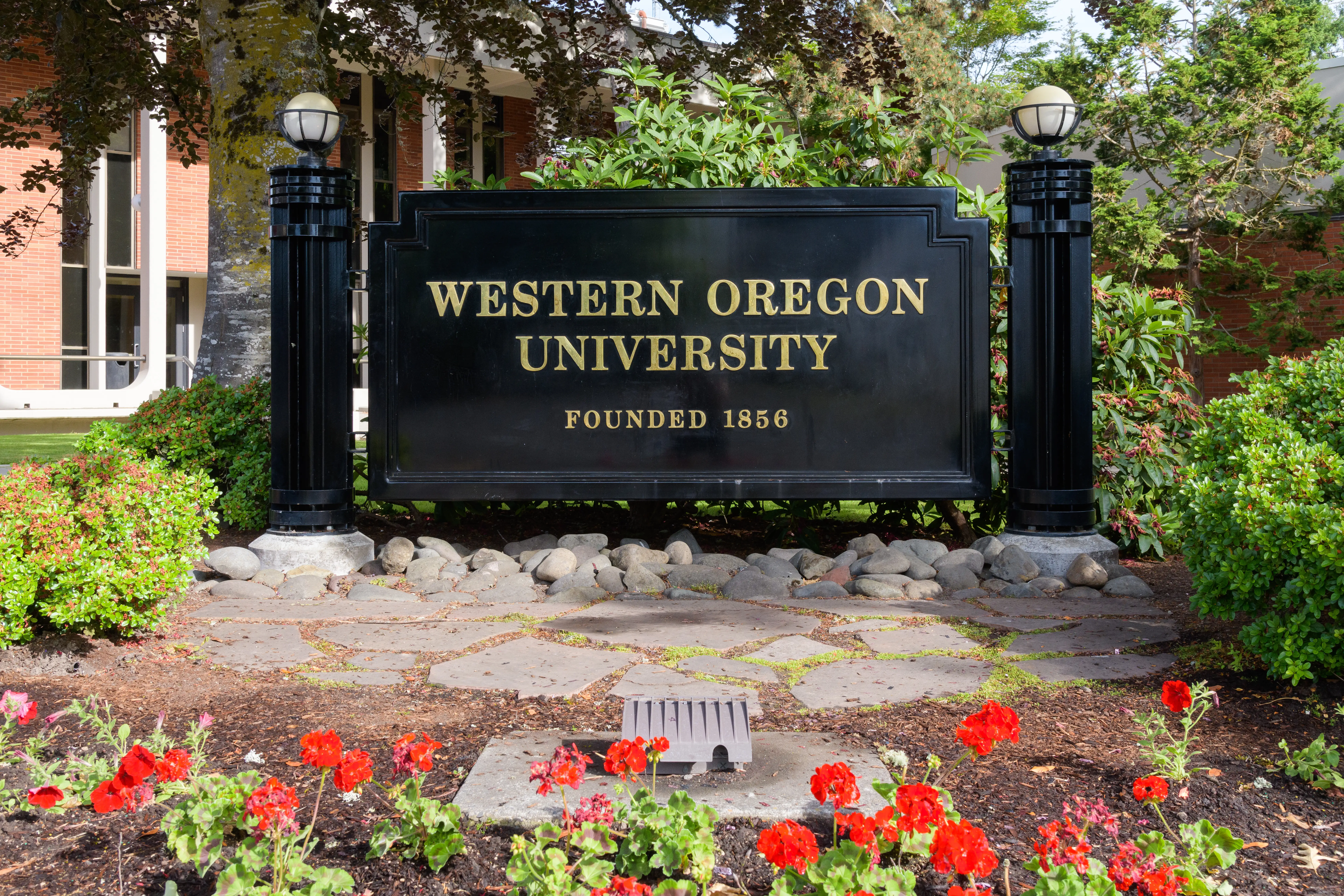
Western Oregon University is both an employer and a community anchor in ways that extend beyond its student population. WOU employs several hundred staff and faculty, making it the city's largest single employer by a significant margin. It also hosts public events, lectures, theater productions, and athletic competitions that are open to the broader community. The university's 157-acre campus is walkable from most of the city's western neighborhoods, and the presence of a physical library branch downtown (Monmouth Public Library) complements what the campus offers.
The surrounding Willamette Valley terrain gives Monmouth residents access to some of the state's most productive agricultural land and most beautiful wine country. The Eola-Amity Hills appellation — recognized internationally for Pinot Noir and Pinot Gris — essentially wraps the city's western edge. Saturday drives in this area are a legitimate weekend activity for year-round residents, and the hop farms to the west and south add an agricultural texture to the landscape that feels distinctly Pacific Northwest. That rural-meets-university-town combination is genuinely unusual in Oregon and is a meaningful part of why longer-term residents find Monmouth worth staying in.
Looking to buy in Monmouth? Estimate your payment.
Enter your numbers to see an estimated monthly mortgage payment.
Estimate only. Excludes HOA fees and mortgage insurance.
The school picture is the most significant practical concern for families with children. Central School District carries a C- rating on commonly used grading frameworks, which reflects performance metrics that land below state and national averages. That doesn't tell the whole story of individual teacher quality or community involvement, but it is a real data point that families relocating from higher-performing districts in the Willamette Valley — Central School District 13J (Independence-Monmouth), covering both cities — should research carefully before committing. Families who prioritize school ratings and have flexibility often find that nearby Independence shares the same district, while Salem's districts offer more varied performance profiles at moderately higher price points.
The thin retail and dining infrastructure is a daily reality. Monmouth's commercial base is limited to smaller local businesses, a handful of fast food options (Little Caesars, Burgerville, Dairy Queen), and the kinds of services that support a small city and a university. For grocery shopping beyond basics, most residents drive to Salem or use Independence's options. There's no large-format grocery store, no Target, no hospital-level healthcare within Monmouth itself — Independence Health and Rehabilitation is the primary local healthcare employer, but for acute care, Salem is the destination. This isn't unique to Monmouth, but buyers accustomed to Salem or Corvallis-level retail access will feel the gap.
Why some people leave comes down to a straightforward calculus: the savings on housing aren't always enough to offset the friction of a daily Salem commute, limited local services, and — for families — the school district performance gap. Buyers who move here from out of state, particularly from California where they may have sold a home at a significant profit and aren't feeling mortgage-rate pressure, often stay long-term. Buyers who moved here primarily because of the price and are commuting to Salem five days a week tend to reconsider within two to three years.
The rental-heavy demographic also has a practical effect on neighborhood maintenance and community investment in some blocks. Roughly half of Monmouth's housing stock is renter-occupied, and in areas closest to the university, turnover is high enough that you may have a different set of neighbors each September. That's a real consideration for buyers who are drawn to the idea of an established neighborhood community — it exists in Monmouth, but it's more concentrated in specific areas than it is citywide.
Downtown is the civic and social core — Main Street Park, the public library, the Main Street Ice Cream Parlor, and WOU's campus edge all converge within a few walkable blocks. Housing here skews older, often smaller-lot single-family and some multifamily stock, with pricing that typically runs at or slightly below the city median given the age and condition of the inventory. The catch is that proximity to the university and downtown activity means more foot traffic, more rental turnover on surrounding streets, and a neighborhood character that shifts noticeably between the academic year and summer.
Best for: Buyers who want genuine walkability and don't mind a more dynamic, student-adjacent neighborhood feel.
Edwards Addition is one of Monmouth's more established residential corridors, located south of downtown and attracting a mix of faculty families, longtime residents, and buyers looking for a quieter setting with reasonable proximity to the university. Homes here tend to be mid-century single-family construction with mature trees and a more settled neighborhood character than blocks closer to campus. Pricing generally aligns with the city median around $466,000, though condition and lot size vary considerably by block.
Best for: Families and university-connected households who want neighborhood stability without being directly on the campus perimeter.
The neighborhoods immediately surrounding WOU's campus are among the most walkable in the city and the most rental-dense. Single-family homes on these blocks frequently operate as student rentals, which means buying here as an owner-occupant puts you in an environment with high seasonal turnover. For investors, this area has consistent demand; for owner-occupants, the appeal depends entirely on your tolerance for the rhythms of student housing nearby.
Best for: Investors seeking rental income, or buyers employed by WOU who want a 10-minute walk to work.
The Ash Creek neighborhood takes its name from the trail system that runs through it and benefits directly from that proximity. Residents here have easy daily access to the trail without driving, which is a meaningful lifestyle advantage in a city this size. Housing stock is a mix of eras and sizes, with the trail access adding premium appeal for buyers who prioritize outdoor recreation. This area sits among the more sought-after locations for buyer types who do their research.
Best for: Outdoor-oriented buyers and families who want trail access as part of their daily routine.
The 99W corridor through Monmouth is where most of the city's commercial activity concentrates — fast food, small retail, service businesses. Housing along and immediately adjacent to the corridor is typically the most affordable in the city, with the noise and traffic tradeoff built into the price. City-Data figures show mobile home median values in the broader Monmouth area around $232,000, and some of the corridor's most affordable residential options are in this range.
Best for: Buyers with the tightest budgets who prioritize price over setting, or investors looking at commercial-adjacent residential.
The neighborhoods at Monmouth's eastern edge, closest to the city of Independence, offer an interesting in-between position: access to both cities' services, slightly more commercial and retail options than deep Monmouth residential neighborhoods, and a pricing profile that mirrors the broader city median. Independence's downtown and Riverview Park are a short drive east, giving these residents effectively two small-city downtowns within easy reach.
Best for: Buyers who want Monmouth's price point but value being close to Independence's riverfront and additional services.
Griffin Estates is among the newer residential developments in Monmouth, featuring larger homes on more generous lots compared to the city's older inventory. Buyers here typically find more recent construction, updated finishes, and a more conventional suburban layout. Pricing in this area can edge above the city median given the newer stock, but the quality gap relative to older Monmouth inventory is notable.
Best for: Families who want newer construction and more space without leaving the city.
Gentle Woods is a smaller residential cluster that offers a quieter, more removed feel while remaining within city limits. It tends to attract buyers looking for a calmer street environment and slightly more separation from the university's daily rhythm. Lot sizes and home styles are varied, and the neighborhood has a lower-profile character that suits buyers who prefer to stay out of the busier parts of the city.
Best for: Buyers who prioritize quiet and privacy and don't need to be close to downtown or campus.
| City | Best For | Median Home Price | Commute to Salem | Vibe |
|---|---|---|---|---|
| Monmouth | Affordability, university access, wine country proximity | $466,000 | ~35–45 min | College town quiet |
| Independence | Riverfront lifestyle, slightly more retail, same school district | ~$390,000–$430,000 | ~25–30 min | Small-town riverfront |
| Salem | Full metro services, employment hub, school variety | ~$400,000–$500,000 | 0 min | Mid-size city |
| Dallas | Rural-edge feel, lower price points, Polk County character | ~$360,000–$410,000 | ~30–35 min | Rural-suburban blend |
| Corvallis | OSU community, stronger retail, higher-rated schools | ~$520,000–$570,000 | ~40 min south | University city |
| Rickreall | Truly rural, agricultural setting, maximum quiet | ~$380,000–$430,000 | ~25 min | Rural |
| Category | Detail |
|---|---|
| Population | Approximately 11,904 (2026 estimate) |
| Median Home Price | $466,000 (Zillow index, mid-2026) |
| Median Household Income | $69,170 |
| Property Tax Rate | Approximately 0.71% |
| Median Gross Rent | Approximately $1,268/month |
| School District | Central School District (Independence-Monmouth) |
| Violent Crime Rate | 1.8 per 1,000 residents |
| Property Crime Rate | 14.7 per 1,000 residents |
| Commute to Salem | 35–45 minutes (off-peak); longer during peak hours |
| Median Age | 27.1 years |
| Cost of Living Index | 95.2 (below U.S. average of 100) |
Monmouth spent over 100 years as Oregon's last dry town — alcohol was banned within city limits from its founding in 1856 until residents voted to lift the prohibition in November 2002. That history shapes something real about the city's character: it was founded by Christian Church pioneers who literally wrote a college into the original land allocation, and the civic seriousness of that founding is still visible in how the community approaches its public institutions. You'll hear longtime locals reference the "dry town" history not with embarrassment but with a kind of wry affection.
The WOU graduation-weekend tradition in June brings an unusual number of out-of-town families into Monmouth for a brief but genuine civic celebration. Main Street sees more foot traffic than almost any other weekend of the year, local restaurants run at capacity, and the downtown core comes alive in a way that gives a preview of what Monmouth could feel like at a larger scale. Convocation weekend in the fall has a similar energy, though smaller. If you're moving here, those weekends are worth experiencing before you assume the downtown is always as quiet as it looks on a Tuesday in January.
The Eola-Amity Hills wine harvest season — roughly September through October — is another calendar anchor for Monmouth residents. Harvest events, winery open days, and the crush-season energy at nearby vineyards give fall a texture that distinguishes this area from other parts of the Willamette Valley. The hop harvest earlier in the season, visible on the agricultural roads west of the city, is a more working-agricultural tradition that doesn't involve tastings but is striking to witness.
What I would not do if moving to Monmouth: Don't buy on or immediately adjacent to 99W without spending time there during weekday afternoon traffic hours. The corridor noise is consistent, the commercial character of that strip is unlikely to improve in the near term, and the savings relative to a quieter street two blocks away are rarely significant enough to justify the daily environment. Buyers who stretch to be on a residential street rather than a highway-adjacent lot consistently report being glad they waited for the right address.

Local Expert Takeaway: Monmouth rewards buyers who understand its specific math. The combination of a $466,000 median, a 0.71% property tax rate, and a cost-of-living index below 100 creates a carrying-cost profile that's genuinely hard to find this close to the Willamette Valley wine country. If you're targeting a neighborhood specifically, Edwards Addition and Griffin Estates are where owner-occupied households tend to concentrate — both offer a more stable neighborhood character than the university-adjacent blocks. Get pre-approved before the spring listing season opens; Monmouth's thin inventory means the homes worth buying move in under three weeks when they're priced right.
✅ Monmouth's affordability is real. At $466,000 median with a sub-1% property tax rate and a cost-of-living index below the national average, this is one of the Willamette Valley's most accessible markets for buyers who don't need Salem-level retail access.
⚠️ The school district and commute are the two non-negotiables to research before committing. Central School District's C- rating and a Salem commute that runs longer than the mileage suggests are the two most common reasons buyers ultimately redirect to Salem or Corvallis.
📍 The university shapes everything — seasonally, demographically, and commercially. If you embrace that, Monmouth's college-town energy is a feature. If you need a more established residential feel, target the southern neighborhoods and plan accordingly.
Is Monmouth a good place for families?
Monmouth offers families affordable homeownership, genuine trail and park access, and a safe, small-town environment — the violent crime rate of 1.8 per 1,000 is well below state averages. The honest caveat is Central School District's performance ratings, which sit below the statewide average and are a real consideration for families relocating from higher-performing districts. Families who do their due diligence on specific schools and supplement with available resources tend to settle in comfortably; those who prioritize school ratings above all else often find the nearby Salem and Corvallis districts worth the additional housing cost.
What is the crime rate in Monmouth?
Monmouth's violent crime rate of 1.8 per 1,000 residents is low by Oregon standards and reflects the generally safe, small-city character of the community. The property crime rate of 14.7 per 1,000 is more notable — consistent with what you'd see in a college town with significant rental turnover and a younger demographic. Most property crime in college towns clusters around vehicle break-ins and petty theft near high-density rental blocks, rather than residential burglary in owner-occupied neighborhoods.
How does Monmouth compare to nearby Independence?
Monmouth and Independence share the same school district and sit about three miles apart, which means the choice between them often comes down to lifestyle preference rather than practical infrastructure. Independence offers a riverfront downtown on the Willamette, slightly lower home prices in many segments, and a bit more retail variety along its main commercial corridor. Monmouth offers university access, the Ash Creek trail network, and the wine-country proximity that comes with its western Eola Hills position. Many buyers research both simultaneously — they're different enough to matter, similar enough to require a second look at both.
Explore the full Monmouth series: The Ultimate Monmouth Relocation Guide · Is Monmouth Safe? · Cost of Living in Monmouth · Best Neighborhoods in Monmouth · Monmouth Schools & Family Life · Monmouth Youth Sports · Monmouth Parks & Recreation · Retiring in Monmouth · 1031 Tax-Deferred Exchange in Monmouth · Monmouth First-Time Homebuyers Guide · · Moving to Monmouth from California
Tell us what you need help with and we'll connect you with local resources.

About the Author
Todd Davidson is the founder of Living in Oregon and Living in Washington, where he publishes in-depth city guides, neighborhood resources, and local market insights covering more than 180 communities across the Pacific Northwest. While his background is in home financing and real estate, he created these digital platforms to help families research and compare regions before making a move.