
Portland Metro · Oregon
1031 Exchange & Investment Real Estate in Lake Oswego (2026)
Not every investor doing a 1031 exchange is a seasoned portfolio landlord. A significant share of the capital flowing into the Portland metro right now comes from California homeowners — people who finally sold a Bay Area craftsman or a Southern California Spanish-style they'd owned for two decades, and now find themselves sitting on $800,000 to $1.4 million in taxable gains they'd rather not hand to the IRS. Lake Oswego keeps surfacing in those conversations for a specific reason: it's a high-income, low-vacancy market where the tenant pool is educated and stable, and where the long-term appreciation case is backed by constrained supply and persistent demand.
The Lake Oswego rental market runs on a fundamentally different dynamic than most Portland suburbs. Roughly 31% of households here are renters — a meaningful segment in a city known primarily for owner-occupied single-family homes — and the residential vacancy rate sits near 1%, compared to a statewide average closer to 7%. What keeps that vacancy so tight is the same thing that makes Lake Oswego desirable in the first place: the school district, the lake access, the 22-minute commute to downtown Portland, and a shortage of available rentals in a city where SFR homes make up nearly 63% of the housing stock. The investment properties that do trade here tend to be single-family rentals, the occasional duplex, and condos near the town center corridor.
This guide covers the full picture for a 1031 investor evaluating Lake Oswego as a replacement property market: the federal mechanics of the exchange, how local property types and pricing translate into cap rates and gross rent multipliers, the Oregon-specific tax environment, property management realities, and a due diligence checklist built for someone operating on a 45-day identification window. If you've already relinquished — or you're about to close — read every section before you make an offer.

The Internal Revenue Code Section 1031 allows you to defer capital gains taxes on the sale of investment real estate by reinvesting the proceeds into a "like-kind" replacement property. Like-kind is broader than most people expect — any U.S. real property qualifies as like-kind to any other U.S. real property, meaning you can exchange a commercial warehouse in Fresno for a duplex in Lake Oswego without issue. The two deadlines that govern the entire exchange are non-negotiable: you have 45 days from the close of your relinquished property to identify replacement properties in writing, and 180 days from that same closing to actually take title to your replacement property.
The qualified intermediary — a third-party escrow holder who receives your sale proceeds and holds them until the replacement purchase closes — is not optional. If the funds touch your bank account at any point before the replacement closes, the exchange is disqualified. Most experienced title companies and real estate attorneys maintain QI relationships, but you should establish this before you list your relinquished property, not after. The boot trap is the other common failure point: if the replacement property's purchase price is lower than the net sale price of the relinquished property, the difference is "boot" — taxable in the year of the exchange. Buying up in value, or very close to equal value, keeps the exchange fully tax-deferred.
The depreciation basis does not reset in a 1031 exchange. Your adjusted basis in the relinquished property carries into the replacement, which means your future depreciation deductions are calculated on a lower basis than the new purchase price. For a California investor swapping into a $1.1 million Lake Oswego property, this is a meaningful number — one worth a conversation with your CPA before you close.

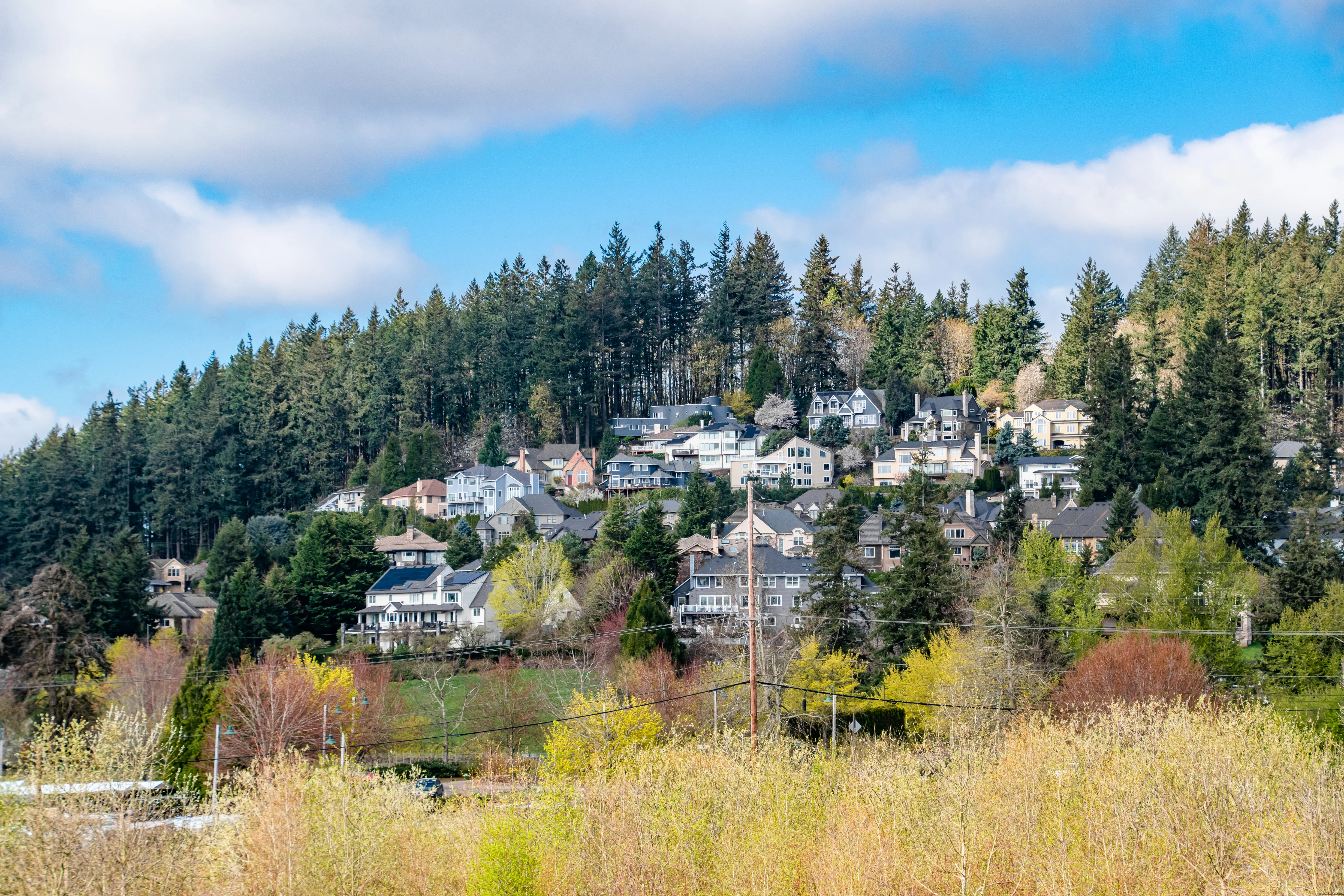
Lake Oswego is a market where out-of-state investors consistently underestimate the entry price. When California buyers hear "Portland suburb," they anchor to the broader metro median, and then they start their search and realize that a well-maintained SFR in First Addition or Lake Grove is going to open at $950,000 to $1.1 million — not the $769,000 blended average they may have seen quoted in national aggregators. The investable product here is premium, and the rents reflect it: single-family rentals routinely achieve $3,000 to $3,200 per month, which supports the investment thesis even if the initial yield looks modest compared to an inland market. The investors who do best in Lake Oswego are the ones who come in with realistic price expectations and a 7-to-10 year hold strategy — they're not here for immediate cash flow, they're here for appreciation and tenant quality.
What I watch for in investment-grade properties here is the combination of school district proximity, lot size, and ADU feasibility. Lake Oswego allows accessory dwelling units on most residential lots, and a well-positioned property with a detached garage or a large basement has the potential to add a legal ADU that substantially changes the income picture. A buyer who closes on a $1.05 million SFR in Hallinan or Westlake with ADU potential is buying a different asset than the purchase price alone suggests. On a 45-day identification clock, that's the analysis you need to run in week one, not week six. If you're considering Lake Oswego and want insight into which neighborhoods align with your priorities and budget, I'd welcome the opportunity to share what I've learned from helping hundreds of families make this move successfully.
The Lake Oswego investment market is effectively three markets layered on top of each other. There's the attached and condo segment — the most accessible price point, concentrated near Boones Ferry Road and the town center corridor. There's the mid-market single-family rental, where the bulk of 1031 exchange activity happens, priced between $900,000 and $1.3 million. And then there's the lakefront and luxury segment, which trades above $2 million and follows its own absorption timeline. For a 1031 investor on a 45-day clock, the mid-market SFR is where the realistic inventory lives.
As of mid-2026, the median sold price for a detached single-family home in Lake Oswego runs in the $1,050,000–$1,100,000 range based on RMLS-tracked closed sales data. Well-priced homes under $1.5 million move in under three weeks; luxury properties above $2 million routinely sit for 60 to 120 days. The sale-to-list ratio is approximately 98.2%, and about 65% of homes close below list price — which means there's negotiating room if you're not in a bidding war, though competitive properties under $1.2 million can still draw multiple offers. Multifamily inventory is genuinely scarce: in a typical month, fewer than two multi-family units come to market citywide, and when they do, the days-on-market number stretches significantly because buyer and seller expectations rarely align quickly.
| Property Type | Typical Price Range | Est. Cap Rate | Avg Days to Close |
|---|---|---|---|
| SFR (mid-market) | $950,000–$1,300,000 | 2.5%–3.5% | 21–42 days |
| SFR (luxury/lakefront) | $1.5M–$5M+ | 1.5%–2.5% | 60–120+ days |
| Duplex / Small Multifamily | $1,100,000–$1,400,000 | 3.5%–4.5% | 45–90 days |
| Condo / Attached | $375,000–$650,000 | 3.0%–4.0% | 21–35 days |
Single-family rentals move fastest and hold the deepest tenant demand. Condos offer the lowest entry price and are worth considering for investors who want to stay below $650,000, though some associations restrict rentals — verify HOA documents before you identify them during your 45-day window.

A Bay Area homeowner selling a modest bungalow in San Jose or Oakland at $1.3 million to $1.6 million can realistically enter Lake Oswego with enough exchange proceeds to acquire a well-maintained SFR debt-free — and still have capital left over to identify a second, smaller replacement property such as a condo or townhouse. That debt-free structure eliminates the DSCR pressure that makes low-cap-rate markets uncomfortable on leverage, and the $3,000-per-month rental income on a free-and-clear $1.1 million home produces a real yield without a mortgage payment eating into it.
Los Angeles and San Diego investors are increasingly frustrated with California's landlord-tenant environment — rent control, just-cause eviction requirements, and assembly bill provisions that have progressively tightened owner rights. Oregon has its own tenant protections, covered in the property management section below, but the cap rate differential between a Culver City rental at 2% and a Lake Oswego SFR at 3% to 3.5% is meaningful when the tenant quality and vacancy risk are comparable. Southern California capital tends to look at Lake Oswego alongside Bend and the Willamette Valley, and the 22-minute Portland commute is what tilts the decision toward Lake Oswego for investors who prioritize tenant pool depth.
Sacramento investors selling at $650,000 to $900,000 are landing in a more nuanced position. The exchange proceeds may not fully cover a Lake Oswego SFR debt-free, but a DSCR loan layered on top of a substantial down payment can make the math work without touching personal DTI. Inland Empire sellers at the higher end of that range, particularly those holding multi-unit properties, often find that Lake Oswego offers an upgrade in tenant demographic and long-term appreciation profile that justifies the price step-up.
Looking to buy in Lake Oswego? Estimate your payment.
Enter your numbers to see an estimated monthly mortgage payment.
Estimate only. Excludes HOA fees and mortgage insurance.
Oregon carries no state sales tax, which is a material advantage during a rental rehab or a property turnover. Every dollar spent on materials, appliances, fixtures, and furnishings for a Lake Oswego rental goes further than it would in California, Nevada, or Washington — no 8% to 10% add-on at checkout. For an investor doing a meaningful rehab on a $1.1 million property, that can represent $15,000 to $30,000 in avoided costs depending on the scope of work.
Oregon does impose state income tax on net rental income, with a top marginal rate of 9.9% — one of the higher rates in the West. However, for a leveraged property, depreciation and operating expense deductions typically offset most or all of the net taxable income in the early years of ownership. The property tax rate in Clackamas County sits at approximately 0.96% — meaningful for a $1.1 million asset (roughly $10,560 annually), but still substantially below what a California buyer would pay on a newly purchased property subject to current assessed value under Prop 13 reset rules.
| Tax Item | California | Oregon |
|---|---|---|
| State income tax on rental income | Up to 13.3% | Up to 9.9% |
| Property tax rate (new purchase) | ~1.1%–1.25% (assessed value reset) | ~0.96% (Clackamas County) |
| State sales tax | 7.25%–10.75% | None |
| Capital gains treatment | Taxed as ordinary income at state level | Taxed as ordinary income at state level |
| 1031 eligibility | Federal only; CA may require installment reporting | Oregon conforms to federal 1031 rules |
For investors who want the tax deferral benefits of a 1031 exchange but don't want the management burden of a direct real estate purchase, a Delaware Statutory Trust (DST) qualifies as a like-kind replacement property under federal rules. DSTs allow passive fractional ownership in institutional-grade assets — apartment complexes, commercial properties — without landlord responsibilities. This is worth a brief conversation with your QI if you're not prepared to manage an active rental in the Pacific Northwest.
Oregon has some of the strongest tenant protections in the country, and Lake Oswego investors need to understand this before closing. Statewide rent increase caps limit annual increases for existing month-to-month tenants, and no-cause eviction without relocation assistance is restricted under Oregon's 2019 rent control legislation — provisions that remain in effect in 2026. For a 1031 buyer acquiring a tenant-occupied property, the lease status and any existing rent levels need to be verified during due diligence, not assumed. Inheriting a below-market tenant in a high-price city with limited ability to adjust rent quickly is one of the most common surprises for out-of-state investors entering this market.
Local property management in Lake Oswego is handled by several established firms operating throughout the Portland metro. Portlandia Property Management and Holt Property Management are among the companies with documented presence in the Lake Oswego area, though any local real estate attorney or title company can provide current referrals. Management fees typically run 8% to 10% of collected gross rent, with leasing fees of one-half to one full month's rent for tenant placement. For an out-of-state owner, that cost is non-negotiable — self-managing a Lake Oswego rental from California while operating under Oregon landlord-tenant law is an invitation to costly mistakes.
What out-of-state owners consistently underestimate is the compliance layer. Oregon requires landlords to follow specific timelines for security deposit accounting, notice periods for entry, and habitability standards that go beyond most other states. The vacancy rate being near 1% means your property will rent quickly — but the tenant you place is protected by a framework that rewards careful screening and professional management.
| Item | What to Verify | Local Resource |
|---|---|---|
| Title search | Clear title, no liens or encumbrances | Clackamas County title company (Fidelity, First American) |
| Sewer / septic status | Connected to public sewer vs. private septic | City of Lake Oswego Public Works |
| Radon testing | Oregon has elevated radon zones — test before close | Oregon DEQ / certified radon inspector |
| Flood zone status | FEMA flood map — especially near Oswego Lake channels | FEMA Flood Map Service Center |
| Rental permit requirements | City of Lake Oswego rental housing licensing status | Lake Oswego Development Services |
| HOA rental restrictions | Does the HOA allow rentals? Short-term rental prohibited? | HOA governing documents / CC&Rs |
| ADU zoning feasibility | Lot size, setbacks, utility capacity for ADU addition | Lake Oswego Community Development |
| School district assignment | Which elementary / middle school zone — affects tenant pool | Lake Oswego School District website |
| Current lease status | Month-to-month vs. term lease, rent level vs. market | Listing agent / current owner disclosure |
| Deferred maintenance inspection | Roof age, HVAC, foundation, electrical panel | Licensed Oregon home inspector |
| Rent control applicability | Is the unit subject to Oregon's rent increase cap? (buildings 15+ years old) | Oregon Revised Statutes 90.600 |
| Property management referral | Identify and vet a manager before close — not after | Local real estate attorney or agent referral |
| Title company recommendation | Use a QI-connected title company familiar with 1031 closes | Ask your QI for preferred vendors |
| Environmental / oil tank | Older Lake Oswego homes may have buried oil tanks | Oregon DEQ tank search tool |
| Insurance quote | Fire, liability, landlord policy — get before financing is locked | Independent insurance broker |
Local Expert Takeaway: The single most common mistake California investors make in Lake Oswego is identifying a mid-market SFR during the 45-day window based on list price alone — without verifying ADU feasibility, current lease status, and the actual achievable rent relative to that specific home's square footage and condition. A $1.05 million home in Westlake that's been a rental for a decade may be carrying deferred maintenance that kills the cap rate, while a comparable home in Hallinan with a large lot and a detached garage could have ADU income potential that changes the investment thesis entirely. Run the ADU analysis and the rent comparables in week one of your identification period, not after you've already committed.
If you're approaching your 45-day identification window and haven't yet arranged financing for the replacement property, that's the first thing to fix. A DSCR loan — where qualification is based on the property's rental income rather than your personal income or debt-to-income ratio — is the tool many investors use to keep the Lake Oswego acquisition off their personal balance sheet and move quickly without waiting on full underwriting. Getting pre-approved before you identify means you can make a credible offer on day one of your window, not scramble for a lender while the clock runs. Todd can connect you with investment-property lenders who understand 1031 timelines and DSCR structures in the Portland metro.
✅ Lake Oswego's ~1% residential vacancy rate and $3,100/month average SFR rent create a durable income floor for long-term holders — the investment thesis here is appreciation and tenant quality, not immediate yield.
⚠️ Small multifamily inventory is extremely thin — fewer than two units typically trade per month — so 1031 buyers targeting duplexes or triplexes should begin their search immediately upon closing the relinquished property and work with a local agent who tracks off-market inventory.
📍 Oregon's landlord-tenant protections are among the strongest in the West. Rent increase caps, just-cause eviction requirements, and strict compliance timelines make professional property management essential for out-of-state investors — budget 8% to 10% of gross rent for management fees from day one.
Does a 1031 exchange work for out-of-state property?
Yes — federal 1031 rules apply to all U.S. real property regardless of state. A California investor can sell a relinquished property in Los Angeles and acquire a replacement property in Lake Oswego without issue, as long as both transactions use a qualified intermediary and meet the 45-day identification and 180-day closing deadlines. Oregon conforms to federal 1031 treatment, so there's no additional state-level complication for the exchange itself.
What is the cap rate on rental property in Lake Oswego?
Single-family rentals in Lake Oswego typically produce estimated cap rates in the 2.5% to 3.5% range, reflecting high purchase prices relative to rents. Small multifamily properties, when they do come available, tend to run closer to 3.5% to 4.5%. The investment case here is built on long-term appreciation and low vacancy rather than strong initial yield — a realistic expectation for a premium Portland metro submarket where home values have held through multiple economic cycles.
Do I need a local property manager for a 1031 investment in Oregon?
For an out-of-state owner, professional property management is strongly advisable. Oregon landlord-tenant law imposes specific notice requirements, rent increase limitations, and habitability standards with real legal consequences for non-compliance. A local property manager familiar with Lake Oswego's market will also handle tenant placement in a low-vacancy environment where high-quality tenants expect responsive, professional communication. Budget 8% to 10% of collected rent for ongoing management, plus a leasing fee when tenants turn over.
Browse current listings updated daily — filtered for Lake Oswego buyers by Elizabeth Davidson, your local expert.
Powered by Elizabeth Davidson · Cascade Hasson Sotheby's International Realty · 503-939-2035
Explore the full Lake Oswego series: The Ultimate Lake Oswego Relocation Guide · Is Lake Oswego Safe? · Cost of Living in Lake Oswego · Best Neighborhoods in Lake Oswego · Lake Oswego Schools & Family Life · Lake Oswego Youth Sports · Lake Oswego Parks & Recreation · Retiring in Lake Oswego · 1031 Tax-Deferred Exchange in Lake Oswego · Lake Oswego First-Time Homebuyers Guide · · Moving to Lake Oswego from California · The Lake Oswego Realtor's Perspective · Top 10 Questions a Realtor Gets About Lake Oswego
Tell us what you need help with and we'll connect you with local resources.

About the Author
Todd Davidson is the founder of Living in Oregon and Living in Washington, where he publishes in-depth city guides, neighborhood resources, and local market insights covering more than 180 communities across the Pacific Northwest. While his background is in home financing and real estate, he created these digital platforms to help families research and compare regions before making a move.