
Portland Metro · Oregon
Is Lake Oswego Safe? Crime Rates, Safest Neighborhoods & Local Reality (2026)
Lake Oswego has a reputation that precedes it — affluent, quiet, the kind of suburb where the biggest complaint is traffic on Boones Ferry Road. That reputation is largely earned, but the full picture is more textured than either the boosters or the skeptics suggest. The city's violent crime rate is genuinely low — low enough that it registers as one of the safer mid-size cities in the Portland metro — but property crime tells a different story, and it's a distinction that matters if you're trying to decide where to buy and how to think about daily life here.
What the numbers mean in practice depends heavily on where in the city you are. The commercial corridors along Kruse Way and State Street generate a disproportionate share of the property crime figures, while the residential neighborhoods south of the lake sit among the quieter stretches in all of Clackamas County. That geographic reality is what gets lost when you paste a city-wide crime rate into a spreadsheet and compare it to Tigard or West Linn.
This guide walks through what the data actually says, how Lake Oswego Police Department has been performing, which neighborhoods give residents the greatest peace of mind, and what locals know about day-to-day safety that the crime apps don't capture.

The first thing worth understanding is that Lake Oswego's crime data looks dramatically different depending on which methodology you use — and both are technically correct. FBI-based estimates (reflected in AreaVibes' 2024 data) find Lake Oswego safer than roughly 83% of Oregon cities and about 68% of cities nationally. CrimeGrade.org uses a different weighting system and lands on a "D" grade, placing the city in the 17th percentile for overall safety. The divergence isn't a data error — it reflects how heavily property crime near the city's retail corridors inflates the aggregate numbers. When you factor in what actually drives that property crime (shoplifting, vehicle break-ins in parking lots, and opportunistic theft near commercial zones), the residential picture looks considerably calmer.
Compared to Oregon and national averages, Lake Oswego's violent crime figures are encouraging by almost any measure. Daily violent incidents run roughly five times lower than the Oregon mean and more than five times lower than the national average, based on available FBI estimates. Property crime sits closer to the middle — lower than Oregon's average and below the national average, but not dramatically so. The city's overall crime index runs meaningfully below the national benchmark, which puts it in a solid position for a suburb of its size and density. What structurally keeps the numbers down: high homeownership rates, tight residential blocks, minimal transient foot traffic in most neighborhoods, and an active police presence across an eleven-square-mile jurisdiction.
The most current data comes from Chief George Burke and Captain Clayton Simon's April 2026 presentation to the Lake Oswego City Council, covering 2025 performance. That report showed a genuine improvement across the board — thefts fell from 347 to 322 year-over-year, burglaries dropped from 83 to 68, and use-of-force incidents declined by 12.5%. Out of 27,685 total incidents logged in 2025, only 56 involved use of force — and officers never discharged a firearm. Those are the numbers of a department operating in a community with a relatively low ceiling on serious crime.
Lake Oswego's violent crime rate — commonly reported around 0.7 per 1,000 residents based on local police data — sits well below both state and national benchmarks. Put practically, the chance of becoming a victim of violent crime here is statistically low enough that it rarely enters residents' daily calculus. Assaults and weapon offenses held roughly steady year-over-year in the 2025 report, which is consistent with the longer-term pattern: this is not a city where violent crime is trending in an alarming direction.
Property crime is where Lake Oswego's numbers get more complicated. Local police data suggests a rate of approximately 11 per 1,000 residents — above average when stacked against all U.S. communities of similar size. The dominant categories are theft and vehicle break-ins, and they cluster predictably near the city's retail areas: the Kruse Way commercial zone, the State Street corridor, and parking areas near Millennium Plaza Park and the Lakewood Center. Burglaries have been trending downward, which is consistent with what residents in quieter neighborhoods report — the kind of crime that reaches most of Lake Oswego is opportunistic and commercial, not targeted and residential.

Lake Oswego is one of those markets where buyers often come in with a vague sense that it's "safe and expensive" without fully appreciating what that means street by street. What I find myself explaining most often is that the city's property crime figures, while real, are doing a lot of work in one part of town. The retail concentration along Kruse Way and near the State Street shops creates friction in the aggregate numbers that simply doesn't exist in First Addition, Palisades, or the neighborhoods wrapping the south end of the lake. Buyers who understand that geography make much better decisions about which blocks to prioritize.
On the investment side, the safety profile in Lake Oswego's residential core has held exceptionally steady even as broader Portland metro markets have seen volatility. The neighborhoods with the strongest long-term performance — Mountain Park, Bryant, Hallinan — are precisely the ones where the property crime numbers are lowest and community cohesion is highest. When I'm working with clients comparing Lake Oswego to nearby Tigard or West Linn, the safety data almost always tilts the conversation toward Lake Oswego's south side, where the combination of school quality, crime profile, and median home value around $769,000 makes a compelling case that this market rewards careful neighborhood selection. If you're considering Lake Oswego and want insight into which neighborhoods align with your priorities and budget, I'd welcome the opportunity to share what I've learned from helping hundreds of families make this move successfully.
| Neighborhood | Safety Profile | Primary Concern | Best Feature |
|---|---|---|---|
| First Addition | Very Low Crime | Minimal | Walkable to downtown, tight residential feel |
| Lake Grove | Low–Moderate | Commercial adjacency | Access without urban density |
| Mountain Park | Very Low Crime | Minimal | Elevation, HOA structure, interior streets |
| Palisades | Very Low Crime | Minimal | Quiet hillside, low traffic volume |
| Westlake | Low Crime | Occasional vehicle break-ins | Established residential, cul-de-sac layout |
| Blue Heron | Low Crime | Minimal | New construction, active street presence |
| Bryant | Very Low Crime | Minimal | South-side quiet, strong community ties |
| Hallinan | Very Low Crime | Minimal | Residential interior, school proximity |
First Addition is the neighborhood immediately north of downtown Lake Oswego, and its walkable street grid and proximity to A Avenue give it a character closer to a small city than a suburb. Crime here runs low despite the downtown adjacency, partly because the commercial activity is concentrated along a handful of blocks rather than sprawling across major arterials. Residents tend to know their neighbors, and the density of foot traffic on the main streets creates natural passive surveillance that keeps the residential blocks calm. Best for: Buyers who want walkability and neighborhood texture without the crime exposure of a denser urban grid.
Lake Grove sits in the northwestern part of the city near Boones Ferry Road and the Kruse Way commercial zone, which is the closest thing Lake Oswego has to a retail hub. That proximity is the primary safety nuance here — not that Lake Grove itself is unsafe, but that the parking areas and commercial streets nearby account for a larger share of the city's property crime than the neighborhood's quiet residential interior would suggest. Once you move a few blocks off the main corridors into the tree-lined streets between Boones Ferry and Quarry Road, the daily reality feels like any other low-crime suburb. Best for: Buyers who prioritize convenience and can accept that their closest grocery run puts them near the city's highest-traffic commercial zone.
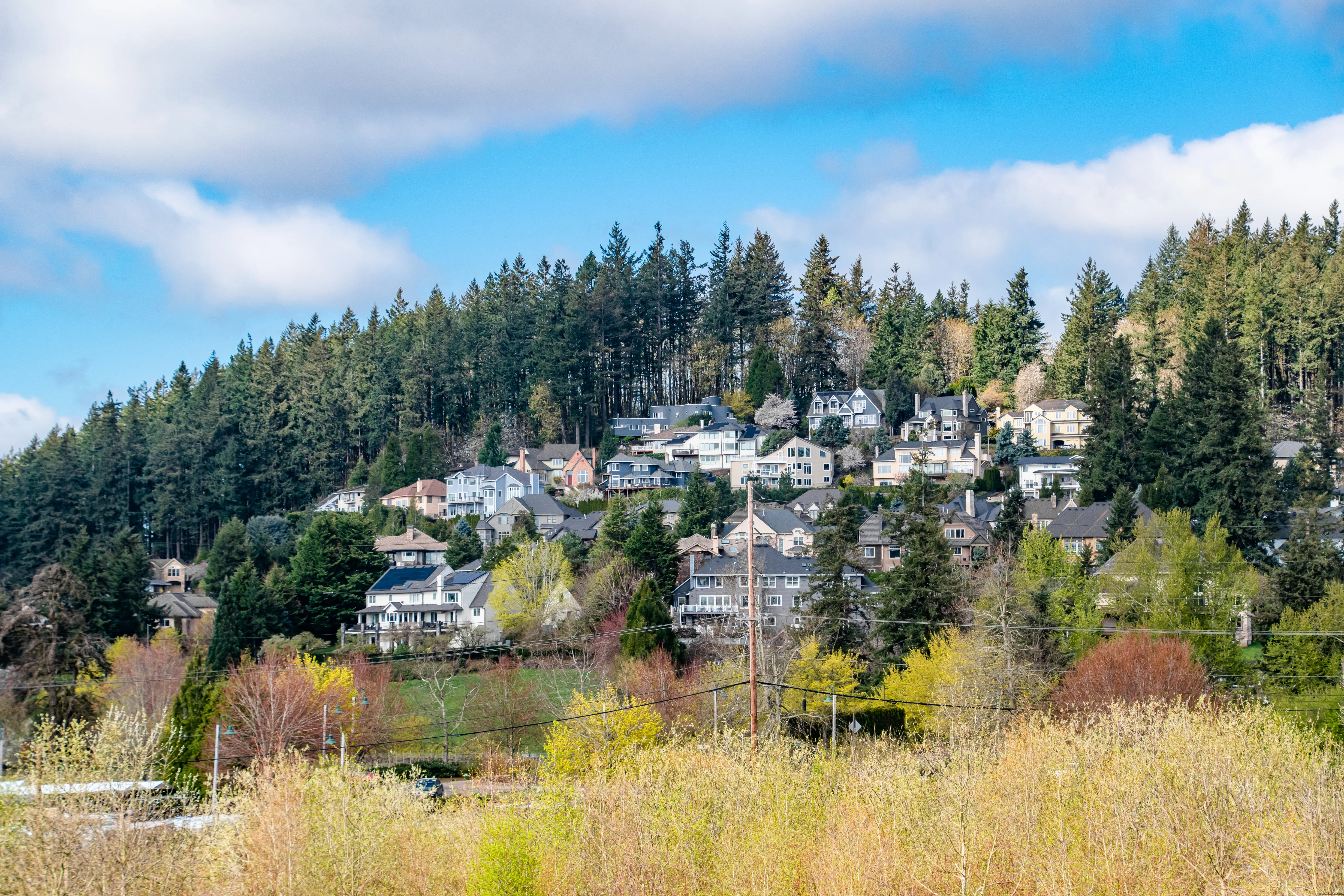
Mountain Park occupies a hillside position in the southwest part of the city and operates partly as a planned community with its own recreation center and HOA infrastructure. The elevation and interior street design naturally limit through-traffic, which is one of the practical factors that keeps opportunistic property crime low here — there aren't many strangers cutting through. The neighborhood's enclosed layout and active HOA presence create a self-reinforcing safety culture that residents consistently cite as one of the reasons they stay long-term. Best for: Families with school-age children who want the quietest possible residential setting combined with community amenities.
Palisades runs along the hillside terrain on the city's west side, with winding roads and a relatively low density that keeps vehicle and foot traffic minimal. It's among the neighborhoods that residents in the south part of the city most commonly identify as feeling particularly safe, which aligns with the general pattern that Lake Oswego's quietest crime numbers track to its hillside and southern residential zones. The limited road access in and out also means that Palisades doesn't attract the kind of drive-through commercial activity that generates most of the city's property crime. Best for: Buyers prioritizing seclusion and a genuinely quiet street environment without sacrificing Lake Oswego's school district access.
Westlake covers a broad residential area on the city's west side, with a mix of cul-de-sac clusters and through streets that connect to the broader neighborhood grid. Vehicle break-ins show up occasionally here, particularly near park-and-ride lots and trailhead parking areas — a pattern common to any neighborhood adjacent to recreational access points. The residential interior blocks, however, see very little crime, and the neighborhood's established street layout and mature tree canopy give it a settled, low-risk character. Best for: Buyers who want a mid-range entry into Lake Oswego's west side with quiet residential streets and trail access built into the commute.
Blue Heron is one of Lake Oswego's newer residential areas, located near the southern end of the city with access to Foothills Park and the Willamette riverfront. New construction brings active street presence during the day and neighbors who are still getting to know the area, which creates a slightly different dynamic than the fully established neighborhoods — but not in ways that affect the safety profile negatively. The crime picture here is low, and the proximity to Foothills Park and the river corridors adds to a sense of open, monitored public space. Best for: Buyers interested in newer construction in one of the city's quieter southern zones.

| City | Violent Crime/1K | Property Crime/1K | Overall Safety Profile |
|---|---|---|---|
| Lake Oswego | ~0.7 | ~11 | Below state average for violent crime; property crime near retail corridors |
| West Linn | ~0.5 | ~8 | Consistently among the lowest crime rates in the metro |
| Tualatin | ~1.2 | ~18 | Higher property crime driven by large retail concentration |
| Tigard | ~2.1 | ~22 | Urban density and commercial volume elevate both metrics |
| Milwaukie | ~2.8 | ~25 | Closer to Portland's crime patterns; improving but above metro median |
| Oregon City | ~2.4 | ~20 | Mixed — quieter residential zones, active corridors push numbers up |
| Portland | ~6.5 | ~38 | Significantly higher across all categories; urban core skews heavily |
The comparison table above reflects commonly reported estimates based on available 2024 FBI data and should be read as directional rather than precise — methodologies vary between reporting agencies. The pattern is clear: Lake Oswego's violent crime rate sits well below most of its neighbors, and only West Linn competes on the property crime front.
Looking to buy in Lake Oswego? Estimate your payment.
Enter your numbers to see an estimated monthly mortgage payment.
Estimate only. Excludes HOA fees and mortgage insurance.
The crime apps that buyers pull up on their phones tend to paint Lake Oswego's eastern end — particularly the stretch of State Street approaching the Kruse Way interchange — as more dangerous than the residential experience actually reflects. Most of what inflates that corridor is retail-adjacent theft: shoplifting incidents from the grocery and drug stores, package theft from apartment complexes near the commercial strip, and occasional vehicle break-ins in the larger parking lots. Locals who live in First Addition or Lake Grove have largely made peace with this as background noise in a city where the alternative is avoiding commercial convenience altogether.
What residents actually do is less about formal precautions and more about common-sense habit. Cars parked overnight near trailhead lots — Iron Mountain Park and the Tryon Creek State Natural Area access points in particular — are occasionally targeted by the same category of opportunistic theft that hits any popular outdoor recreation area in the metro. Locals leave nothing visible on car seats, know which lots see more activity after dark, and don't think much about it beyond that. The LOPD's public calls-for-service map (filterable online) gives residents a real-time sense of what's happening where, and the department's transparency with annual reporting to the city council builds a level of trust that tends to keep residents calibrated rather than anxious.
The one area where locals' private conversations diverge from the public data is the overdose trend. The 2025 LOPD report showed overdose incidents rising from 15 to 27 year-over-year — a jump worth noting even though none were fatal and officers administered Narcan six times successfully. This isn't unique to Lake Oswego — it's a regional pattern across the Portland metro — but it's a reminder that the city isn't sealed off from broader Oregon social pressures. The department's Behavioral Health Unit and its Adult Resource Officer program represent a genuine investment in connecting people to services rather than just cycling them through enforcement, which is the kind of structural response that tends to keep these trends from escalating.
Local Expert Takeaway: If you're choosing between blocks in Lake Oswego, track north-south more carefully than east-west. The south side of the city — particularly Palisades, Bryant, and Hallinan — consistently produces the city's quietest crime numbers, and those neighborhoods sit within the same school district and commute distance as anywhere else in town. Buyers targeting the Lake Grove area should budget an extra walkthrough of the commercial adjacency on Boones Ferry and decide honestly whether the convenience trade-off works for them. And whatever the apps say about the city's eastern edge near Kruse Way, don't let that number discourage you from the residential blocks immediately behind it — they're a different world from the retail corridor data that inflates the zip code average.
✅ Lake Oswego's violent crime rate is among the lowest in the Portland metro — commonly reported around 0.7 per 1,000 residents, well below Oregon and national averages. Daily life in the city's residential neighborhoods feels consistent with that number.
⚠️ Property crime is the real variable — at roughly 11 per 1,000 residents, it clusters near commercial corridors rather than spreading evenly across residential blocks. Buyers in the south side and hillside neighborhoods see very little of it.
📍 The 2025 LOPD annual report shows improvement on nearly every metric — fewer thefts, fewer burglaries, fewer use-of-force incidents, zero officer-involved shootings, and a department that is transparent about both its strengths and its staffing challenges.
Is Lake Oswego a safe place to live?
Yes, by most meaningful measures. The violent crime rate is well below the national average and significantly lower than the Oregon mean, and the 2025 police data shows continued improvement across most categories. The property crime numbers deserve attention, but they're driven largely by the commercial corridors rather than the residential neighborhoods where most families live.
Which neighborhoods in Lake Oswego have the lowest crime?
Residents and local observers consistently identify the south side of the city — including Palisades, Bryant, and Hallinan — as having the lowest crime exposure. Mountain Park's enclosed layout and active HOA structure also produce a notably quiet safety profile. These neighborhoods sit away from the retail concentration that inflates the city's aggregate property crime figures.
How does Lake Oswego compare to Portland for safety?
The comparison is stark. Portland's violent crime rate runs roughly nine times higher than Lake Oswego's commonly reported figure, and property crime in the city runs more than three times higher. For buyers making the move from Portland's inner eastside or closer-in neighborhoods, Lake Oswego typically feels like a significant step down in day-to-day crime exposure — particularly for vehicle security and residential safety.
Browse current listings updated daily — filtered for Lake Oswego buyers by Elizabeth Davidson, your local expert.
Powered by Elizabeth Davidson · Cascade Hasson Sotheby's International Realty · 503-939-2035
Explore the full Lake Oswego series: The Ultimate Lake Oswego Relocation Guide · Is Lake Oswego Safe? · Cost of Living in Lake Oswego · Best Neighborhoods in Lake Oswego · Lake Oswego Schools & Family Life · Lake Oswego Youth Sports · Lake Oswego Parks & Recreation · Retiring in Lake Oswego · 1031 Tax-Deferred Exchange in Lake Oswego · Lake Oswego First-Time Homebuyers Guide · · Moving to Lake Oswego from California · The Lake Oswego Realtor's Perspective · Top 10 Questions a Realtor Gets About Lake Oswego
Tell us what you need help with and we'll connect you with local resources.

About the Author
Todd Davidson is the founder of Living in Oregon and Living in Washington, where he publishes in-depth city guides, neighborhood resources, and local market insights covering more than 180 communities across the Pacific Northwest. While his background is in home financing and real estate, he created these digital platforms to help families research and compare regions before making a move.