
Portland Metro · Oregon
Moving to Hillsboro? Top 10 Questions Realtors Get About Living in Hillsboro, Oregon (2026)

I've been selling real estate in the Portland metro for over a decade, and Hillsboro has become one of the areas where I spend the most time — both professionally and personally. As a top 2% broker by volume with Cascade Hasson Sotheby's International Realty, I work across the entire metro, but there's something about Hillsboro's evolution that keeps drawing me back. I've watched Orenco Station mature from a "new urbanist experiment" into one of the most sought-after walkable communities in Oregon. I've helped Intel engineers find their first homes in South Hillsboro and helped empty-nesters downsize from their Reedville colonials into low-maintenance condos near the MAX line.
This post covers the questions I actually get asked — repeatedly — by people considering a move to Hillsboro. Not the Chamber of Commerce version, but the real stuff: Is the commute as bad as people say? Are the schools good enough? What do buyers consistently get wrong? I'll give you straight answers, including the unflattering ones.
If you're researching Hillsboro seriously, you probably already know it's Oregon's fifth-largest city and home to Intel's largest manufacturing site. What you might not know is how different the neighborhoods feel from each other, or why the property tax bill you see on a listing won't match what you'll pay. Let's get into it.
Hillsboro works exceptionally well for a specific type of buyer, and falls flat for others. Let me be direct about both.
If you work in tech, biotech, or semiconductor manufacturing, Hillsboro is hard to beat. Intel, Genentech, Qorvo, and dozens of smaller firms are here or nearby. You can live five minutes from a world-class semiconductor fab and still have a backyard. The job security this creates has kept the local economy remarkably stable even when other parts of Oregon struggled.
The schools are solid — not elite, but consistently above average. The parks system is genuinely impressive, with over 1,600 acres including the 635-acre Jackson Bottom Wetlands Preserve right within city limits. For families who want space, good schools, and don't need Portland's urban energy, it checks most boxes.
Here's the honest downside: Hillsboro can feel suburban in ways that frustrate some buyers. Outside of Orenco Station, you're driving to most things. The dining and nightlife scene has improved but still can't compete with Portland's east side. And if your job is downtown, you'll spend real time in traffic or on the MAX.
For a deeper dive on expenses, our Cost of Living in Hillsboro breakdown covers housing, utilities, and day-to-day costs in detail.
I consistently recommend three neighborhoods to families, though the right choice depends on what you prioritize.
Orenco Station gets the most attention, and for good reason. It's a master-planned community with genuine walkability — restaurants, shops, the MAX station, and Orenco Woods Nature Park are all accessible on foot. Kids here attend Orenco or Quatama Elementary, then Poynter Middle School (ranked among Oregon's top public middle schools by Niche), and Liberty High School. The downside? Prices run higher than Hillsboro's average, and the density means smaller lots.
Jackson School offers something different — historic charm, tree-lined streets, and a neighborhood that's been settled long enough to have real roots. It's named for Jackson Elementary, a well-regarded school that anchors the community. NeighborhoodScout rates this area among the top 11% of family-friendly neighborhoods in Oregon, citing school quality and above-average safety. Homes here tend to have more character and larger lots than newer developments.
Reedville is where I send families who want a genuine neighborhood feel without Orenco's premium or Jackson School's older housing stock. Long-term residents mix with newer arrivals, people actually use the parks, and there's a friendly, settled quality that takes decades to build.
Our Best Neighborhoods in Hillsboro guide covers all seventeen neighborhoods in detail, including price ranges and school assignments.
Hillsboro School District earns a B rating from Niche and ranks #37 among Oregon school districts — solidly above average but not elite. Here's what that means in practice.
The district just hit a milestone: 90.43% of seniors graduated within four years in 2025, the first time they've crossed 90% since Oregon started tracking cohort graduation rates in 2008-09. Three of the five high schools — Century, Glencoe, and Liberty — individually exceeded 90%. That's meaningful progress.
At the elementary level, schools like Jackson Elementary and Orenco Elementary have strong reputations. Poynter Middle School consistently ranks among Oregon's better public middle schools. The district offers International Baccalaureate programs, dual-language immersion, and solid STEM offerings given the tech industry presence.
What you won't find: the test scores and resources of Lake Oswego or West Linn. If you're coming from a district where 95%+ of students are proficient in math and reading, you'll notice a difference. Hillsboro serves a diverse population with varying needs, and the district-wide averages reflect that reality.
For families prioritizing schools above all else, I'd also suggest looking at the specific school your address feeds into rather than relying on district averages. Our Hillsboro Schools and Family Life post breaks down school-by-school ratings and boundary information.

This is where I have to burst some bubbles. The marketing says "30 minutes to Portland," and that's technically true — at 6:00 AM on a Sunday.
The realistic numbers: Highway 26 is your main corridor, covering about 17-20 miles depending on exactly where you're going. In genuinely good traffic, you're looking at 30 minutes. During rush hour — which in Portland means roughly 7:00-9:00 AM and 4:00-6:30 PM — budget 45 minutes to an hour. When it rains hard (October through April), add another 10-15 minutes. An accident on 26 can double your commute.
The MAX alternative: The Blue Line runs from Hatfield Government Center in downtown Hillsboro to Portland's city center in about 48 minutes. Trains run every 20 minutes, and a ride costs $2.50-$3. It's not fast, but it's predictable — you can read, work, or zone out instead of white-knuckling through traffic. For buyers who work downtown, I strongly recommend prioritizing neighborhoods near MAX stations: Orenco Station, Quatama, and areas near the Hatfield stop.
The reverse commute advantage: If you work in Hillsboro but live in Portland, your commute will often be easier than the other direction. But most of my Hillsboro buyers work locally, which makes traffic a non-issue for their daily life.
The current Hillsboro market has softened from its pandemic peaks but remains active. Here's where we stand in mid-2026:
The median home price is around $520,000, though I've seen recent three-month data showing closer to $502,000 — representing a 3-4% decline year-over-year. That's a meaningful shift from the double-digit appreciation we saw in 2021-2022, but it's not a crash. Homes are selling in an average of 27 days, which indicates steady demand.
The market scores 68 out of 100 on competitiveness metrics — "somewhat competitive" in industry terms. That means well-priced homes in desirable areas still move quickly, sometimes with multiple offers, while overpriced listings sit. Buyers have more negotiating power than they did two years ago, but this isn't a buyer's market in the traditional sense.
What I'm seeing on the ground: South Hillsboro's newer construction is appealing to move-up buyers who want modern finishes and energy efficiency. Orenco Station remains supply-constrained because people don't leave. The older neighborhoods — Reedville, Jackson School, Central Hillsboro — offer better value per square foot but may need updating.
For first-time buyers, Hillsboro's price point is more accessible than the Portland core or Lake Oswego. Our Hillsboro First-Time Home Buyer guide covers strategies specific to this market, and there's also worth exploring.
Yes, and there are more options than most people realize. Hillsboro has approximately 18 active adult communities serving the 55+ demographic, ranging from manufactured home communities to upscale independent living facilities.
Terra Buena is a 55+ age-restricted manufactured housing community on 11 acres with 93 home sites. It's designed for buyers who want affordability and community without the maintenance burden of a traditional single-family home. Monthly lot fees apply, but the entry cost is significantly lower than conventional housing.
For independent living with more services, Merrill Gardens at Hillsboro, MorningStar of Hillsboro, and The Ackerly at Reed's Crossing are the top-rated facilities in the area. These offer amenities like dining, activities, and some level of care coordination. Expect to pay around $4,400 per month on average for independent living in Hillsboro — roughly in line with Portland metro averages.
What I tell retirees considering Hillsboro: the infrastructure is here, but you'll want to think carefully about walkability and access. Orenco Station allows car-free living in ways most Hillsboro neighborhoods don't. Proximity to the MAX matters if you want to visit Portland without driving. And Washington County's healthcare network, including Tuality Healthcare, is solid but not as extensive as what you'd find on the east side.
Our Retiring in Hillsboro guide goes deeper on tax implications, healthcare access, and lifestyle considerations.
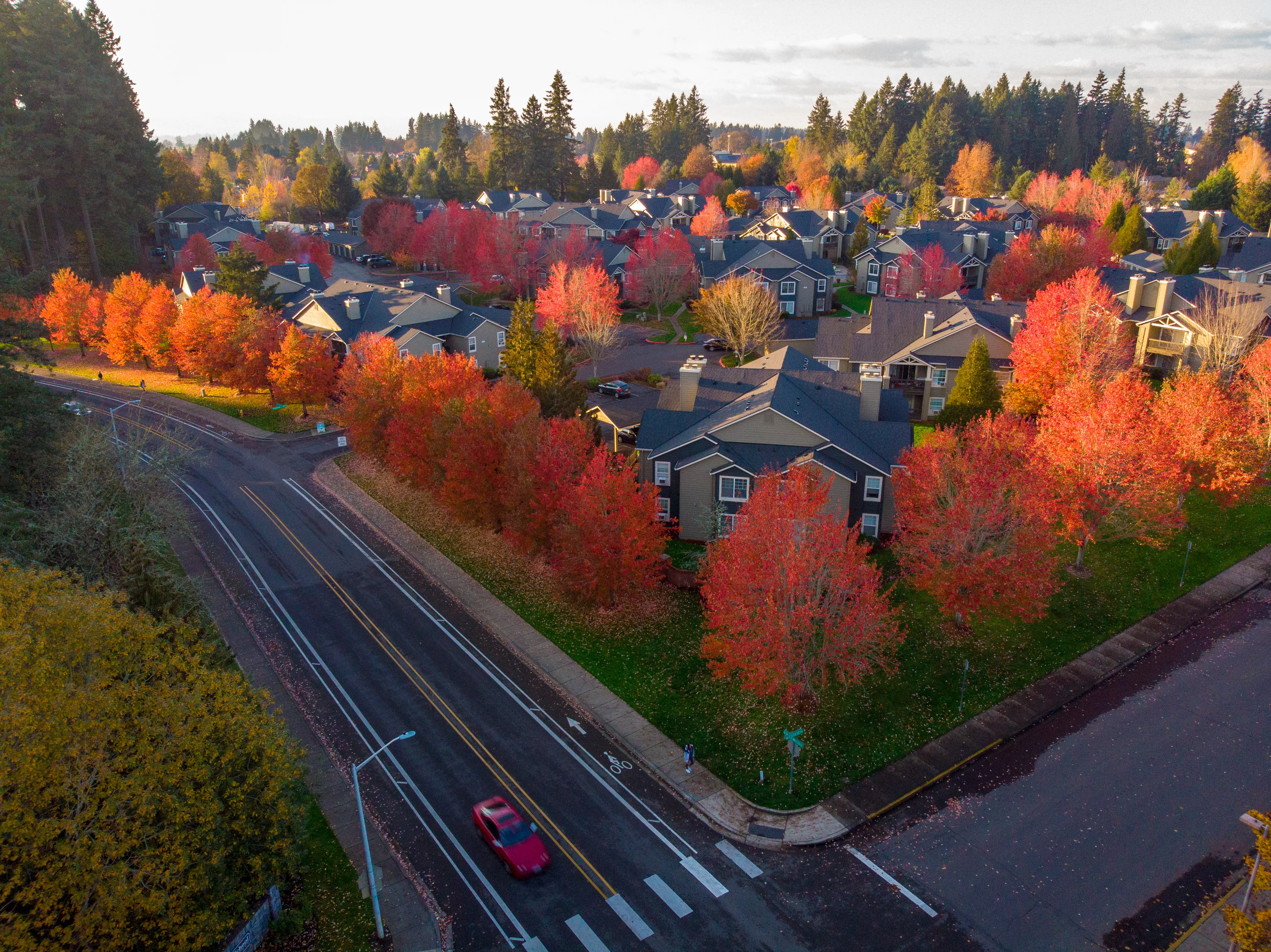
Hillsboro's park system is legitimately impressive — over 30 parks covering 1,600 acres, plus miles of trails. This isn't a city where you're fighting for green space.
Jackson Bottom Wetlands Preserve is the crown jewel. This 635-acre wildlife sanctuary sits within city limits and hosts over 150 bird species, including herons and bald eagles. The 4.5 miles of trails wind through wetlands and upland habitats, and it's genuinely special — most cities this size don't have anything comparable. I take out-of-town clients here when they're skeptical about whether Hillsboro has "nature."
Rood Bridge Park is Hillsboro's largest traditional park at 60 acres along the Tualatin River. It opened in 1999 and offers meeting facilities, playgrounds, tennis courts, hiking trails, a wading stream, a canoe launch, and a rhododendron garden that's stunning in spring. This is where families actually spend their weekends.
Orenco Woods Nature Park provides 42 acres with trails, picnic areas, and playground equipment right in the Orenco Station area. It's the kind of neighborhood park that makes daily life better — kids can walk there after school, and the trails are well-maintained.
The Rock Creek Trail connects multiple parks and neighborhoods, giving you legitimate car-free transportation options for commuting or recreation. Our Hillsboro Parks and Recreation post covers the full system, including sports facilities and community programs.
After hundreds of transactions in this area, I see the same mistakes repeatedly.
Mistake #1: Assuming all of Hillsboro feels the same. The difference between Orenco Station and West Hillsboro is enormous — different housing styles, different walkability scores, different vibes. Buyers who drive through one area and think they've "seen Hillsboro" miss neighborhoods that might fit them better. There are 17 distinct neighborhoods here, and they appeal to different lifestyles.
Mistake #2: Underestimating the Intel factor. When Intel has layoffs or announces expansion, you'll feel it in the housing market. The local economy is more diversified than it was 20 years ago — Genentech, Qorvo, and others provide some buffer — but Intel remains the anchor tenant. If you're buying here specifically for tech employment, understand that concentration risk.
Mistake #3: Not test-driving the commute. I've had buyers purchase homes, move in, and then realize the Highway 26 commute during their actual work hours is 20 minutes longer than they expected. Drive the route at the exact time you'd be commuting, multiple times, before making an offer. Better yet, take the MAX during rush hour and see if that timeline works for you.
Mistake #4: Overlooking South Hillsboro. The newest development area has construction traffic and unfinished amenities, but it also has the most modern housing stock at competitive prices. Buyers who dismiss it as "too new" sometimes regret it when they're competing for older homes that need $50,000 in updates.
Oregon's property tax system confuses almost everyone, so let me break it down clearly.
Under Measure 50 (passed in 1997), your assessed value can only increase by a maximum of 3% per year, regardless of what happens to market values. In Washington County, where Hillsboro sits, the effective property tax rate is approximately 0.86% — one of the lowest in the Portland Metro. This means long-term owners often have assessed values far below their home's actual market value. When you buy that home, the assessed value typically gets reset closer to your purchase price — and your tax bill jumps accordingly.
In Hillsboro (Washington County), effective property tax rates run around 0.95-1.1% of assessed value, depending on your specific location and any local bonds or levies. On a $520,000 purchase, you might pay $5,200-$5,700 annually, though your assessed value at purchase could be set slightly lower than the sale price.
Here's the critical point: the seller's property tax bill on a listing is not what you'll pay. I regularly see listings showing $4,000 in annual taxes where the buyer ends up paying $5,500+ after reassessment. Always calculate your expected taxes based on your purchase price, not the seller's current bill.
Washington County also has various local option levies for schools, parks, and services that add to the base rate. These are voted on periodically, so your taxes can increase beyond the 3% cap if voters approve new levies.
When budgeting for a Hillsboro home, calculate property taxes at 1.05% of your purchase price to be safe. If the listing shows dramatically lower taxes, that's a sign the seller has owned for many years and you'll see a significant increase after closing. Build this into your monthly housing cost calculations from the start.
This is the question every serious Hillsboro buyer should be asking, and most don't until after they've made an offer.
Intel has been Hillsboro's largest employer for decades, and its Ronler Acres campus is one of the company's most significant U.S. manufacturing sites. The company's presence has shaped everything about this market — the tech-heavy employment base, the demographics, the school funding, even traffic patterns. When Intel announces expansion, prices in surrounding neighborhoods often tick up within months. When there are layoffs, you'll see increased inventory and softer pricing.
The proximity premium is real but nuanced. Homes within a 10-minute drive of the Intel campus — particularly in Orenco Station, AmberGlen, and parts of Northwest Hillsboro — command higher prices partly because Intel employees value the short commute. Engineers working odd shifts or long hours don't want a 45-minute drive home. This convenience factor gets priced in.
The concentration risk is also real. About 22,000 people work at Intel's Hillsboro facilities. That's a significant portion of the local workforce. While Genentech, Qorvo, and the healthcare sector provide diversification, Intel's health matters enormously to Hillsboro real estate. During past layoff cycles, I've seen home values in certain neighborhoods dip 5-8% more than the broader market.
My advice: if you're buying here because of Intel employment, that makes sense — the commute savings alone justify some premium. But if you're buying as a pure investment or without local employment ties, understand that Hillsboro's market is more correlated to semiconductor industry cycles than, say, Lake Oswego or inner Portland.
If you work at Intel and are buying nearby, price your maximum budget as if you might need to sell within 2-3 years. Semiconductor employment can be cyclical, and you don't want to be underwater if you need to relocate for a new position. Leave some equity cushion rather than stretching to the absolute maximum approval.
Hillsboro is a genuinely good fit for buyers who want suburban space, solid schools, and proximity to tech employment without paying Lake Oswego prices. It works especially well for families with at least one spouse working locally, for people who appreciate outdoor access (the parks and wetlands are truly exceptional), and for buyers who don't need Portland's urban amenities on a daily basis.
It's not the right fit for everyone. If you crave walkability across your entire life — not just within one neighborhood — Hillsboro will frustrate you outside of Orenco Station. If your job is downtown Portland and you hate commuting, you'll resent the time spent on Highway 26 or the MAX. And if you're worried about economic concentration, the Intel dependency is worth considering carefully.
What I tell clients: visit on a rainy Tuesday in February, not a sunny Saturday in June. Drive the commute during actual rush hour. Walk the neighborhoods you're considering and see if people are outside, using their parks, talking to neighbors. Hillsboro rewards people who commit to it — the community networks are real, the outdoor lifestyle is accessible, and the value proposition compared to closer-in Portland neighborhoods is substantial. If you have questions about specific neighborhoods or want to talk through whether Hillsboro makes sense for your situation, I'm always happy to connect.
Browse current listings updated daily — filtered for Hillsboro buyers by Elizabeth Davidson, your local expert.
Powered by Elizabeth Davidson · Cascade Hasson Sotheby's International Realty · 503-939-2035
Explore the full Hillsboro series: Living in Hillsboro · Is Hillsboro Safe? · Cost of Living in Hillsboro · Best Neighborhoods in Hillsboro · Hillsboro Schools & Family Life · Hillsboro Youth Sports · Hillsboro Parks & Recreation · Retiring in Hillsboro · 1031 Exchange in Hillsboro · Hillsboro First-Time Buyer Guide · · Moving to Hillsboro from California · The Hillsboro Realtor's Perspective · Top 10 Questions a Realtor Gets About Hillsboro