
Portland Metro · Oregon
Moving to Hillsboro from California: The Honest Comparison (2026)
The Bay Area software engineer who finally got tired of paying $4,200 a month for a two-bedroom in Sunnyvale. The San Diego couple who stopped dreading their August electric bill somewhere around year six. The Sacramento family who realized their townhome equity could buy a four-bedroom house with a yard in a city nobody in California had heard of. These are the people who move to Hillsboro, and they're arriving in real numbers. What makes Hillsboro specifically compelling — beyond the generic Oregon pitch — is the combination of Intel, Genentech, and a semiconductor corridor that makes remote-work relocation feel less risky, because the local economy doesn't depend on you working remotely forever.
The hard part is that Hillsboro is genuinely not California. The weather isn't a rumor. Gray starts in October and doesn't fully lift until late May, and some years June is more of a suggestion than a commitment. The food scene is improving but has not caught up to what you left in the Mission District, Culver City, or even midtown Sacramento. The pace of social life is slower in ways that feel peaceful at first and occasionally isolating after month eight. None of this should stop you — but all of it should be understood before you sell your house, rent a moving truck, and discover in February that the rain is not a passing mood.
This guide is built specifically for California buyers who've already done the basic research and want the honest version. You'll find a cost-of-living comparison by California region, a breakdown of what your equity actually buys here, the real tax picture (yes, Oregon has an income tax), a weather comparison that doesn't sugarcoat November, and an interactive tool that lets you compare your specific California city directly to Hillsboro.

| Hillsboro, Oregon | Bay Area (SF/SJ) | Southern CA (LA/SD) | Sacramento Metro | Central Valley (Fresno/Bako) | |
|---|---|---|---|---|---|
| Median Home Price (2026) | $520,000 | $1,300,000–$1,600,000 | $800,000–$1,100,000 | $480,000–$560,000 | $320,000–$420,000 |
| Effective Property Tax Rate | 0.86% | 1.1%–1.25% | 1.1%–1.25% | 1.0%–1.15% | 1.0%–1.15% |
| State Income Tax (top bracket) | 9.9% | 13.3% | 13.3% | 13.3% | 13.3% |
| State Sales Tax | 0% | 7.25%–10.75% | 7.25%–10.75% | 7.25%–8.75% | 7.25%–10.25% |
| Avg Monthly Utilities | $150–$190 | $220–$310 | $250–$350 | $180–$250 | $200–$280 |
| Avg 1BR Rent | $1,950 | $3,000–$4,200 | $2,200–$3,400 | $1,600–$2,000 | $1,100–$1,500 |
A buyer leaving Walnut Creek with $1.4 million in home equity and purchasing in Hillsboro at the city-wide median is likely eliminating their mortgage entirely and pocketing the difference. Even a buyer from Irvine or Torrance with $900,000 in equity is looking at a situation where they own their Hillsboro home outright or carry a very small loan — a financial position most California homeowners have never experienced while living there. That shift in monthly cash flow is why so many California transplants describe the first year in Hillsboro as feeling "rich" even when their household income didn't change.
The sales tax elimination alone deserves real attention. A household spending $80,000 a year on taxable goods and services in a California county with a 9.5% combined rate is effectively paying $7,600 annually that disappears at the Oregon border. On furniture, appliances, cars, clothing, and home renovation materials — the kind of spending that spikes in year one after a move — that number can run significantly higher.

I've worked with a lot of California buyers over the past several years, and the most consistent thing they underestimate isn't the weather or the commute — it's how fast the Hillsboro market moves in the right neighborhoods. Orenco Station and South Hillsboro in particular have drawn serious buyer interest from people relocating for Intel and Genentech positions, and when a well-priced home hits in those areas, it's not sitting for two months. California buyers sometimes arrive with a mindset shaped by watching Portland news, where the market has softened — but Hillsboro's tech employment base creates its own demand layer that insulates certain corridors from the broader slowdown. The buyers I see succeed here are the ones who've done their pre-approval work before they arrive, not after they've already fallen in love with a house.
What I also want California buyers to understand is the specific value proposition at the $480,000–$560,000 range in Hillsboro right now. You are getting four-bedroom homes with garages, in established neighborhoods with good schools, at prices that don't exist in any coastal California market. A buyer coming from Pleasanton or Carlsbad may feel like they're buying well below what they're used to, but the quality of construction, the neighborhood infrastructure, and the proximity to Hillsboro's tech corridor make this a strong long-term hold. The market has softened slightly from its 2022 peak, which actually benefits the California buyer who has equity and time — you're not buying at the top. If you're relocating from California and want a realistic read on what your equity buys here, I'd welcome the chance to help you make this move successfully.
Oregon's tax structure is the most misunderstood part of the California-to-Oregon calculation. The assumption that you're moving to a low-tax state is partially right but also meaningfully wrong in one critical area.
| Tax Item | California | Oregon | Net Impact |
|---|---|---|---|
| State Income Tax (top rate) | 13.3% | 9.9% | Oregon saves ~3.4 points at top bracket |
| State Sales Tax | 7.25%–10.75% | 0% | Full elimination — significant for most households |
| Capital Gains (state) | Up to 13.3% | Up to 9.9% | Oregon lower, but not zero |
| Property Tax Rate | ~1.1%–1.25% effective | ~0.86% effective | Oregon meaningfully lower |
| Property Tax Growth Cap | Prop 13 (2% max/year) | Measure 50 (3% max/year) | Both protect long-term owners |
| Senior Property Tax Deferral | Available (county-level) | Yes, for 62+ homeowners | Comparable benefit |
| Estate / Inheritance Tax | None | Oregon estate tax on estates over $1M | Oregon disadvantage for high-net-worth |
Oregon does not have a sales tax — that's real and valuable. But Oregon does levy a graduated state income tax that tops out at 9.9%, and that rate kicks in at income levels that catch many California transplants who assumed they were escaping high state income tax entirely. A household earning $150,000 in California faces a combined federal-plus-state marginal rate that is genuinely punishing. Moving to Oregon reduces the state portion from roughly 9.3%–13.3% (depending on filing status and income composition) to 8.75%–9.9% — a real but modest improvement at that income level. The savings become more dramatic for households with large capital gains from selling a California home, where California's rate of up to 13.3% drops to Oregon's 9.9% ceiling.
What Measure 50 does for long-term Hillsboro owners is worth understanding before your first property tax bill. Oregon caps assessed value increases at 3% per year, which means a home bought today at $520,000 will not have its tax base growing with market appreciation. A household that buys in 2026 and stays fifteen years can expect significantly lower property taxes than a new buyer would pay on the same home at that future market value. This is a genuine advantage for buyers who intend to stay — and most California buyers who move to Hillsboro do intend to stay.
A buyer leaving Palo Alto or Los Altos Altos with $1.5 million in equity is in a position most Oregonians will never experience: buying the best Hillsboro has to offer in cash. At the top of the Hillsboro market, the luxury tier reaches $850,000–$1.1 million for larger custom homes in areas like Northwest Hillsboro and newer construction in South Hillsboro — meaning Bay Area sellers are often looking at purchasing their next home outright and banking $400,000 to $600,000 in liquid capital. Even at $1.2 million in equity, the math eliminates a mortgage entirely and funds a meaningful renovation budget. For Bay Area buyers, Orenco Station offers the closest thing to the walkable, transit-served neighborhood feel they're used to — MAX Blue Line access, coffee shops, restaurants, and a genuine community identity — at a median around $500,000 to $575,000 for a single-family home.
The surplus equity question for Bay Area sellers is often about what to do with the cash, not whether they can afford the home. Buyers in this position frequently ask about 1031 exchange strategies if they're selling investment property rather than a primary residence — that scenario is covered in detail in the Hillsboro 1031 Exchange guide. For primary residence sellers, the $250,000/$500,000 capital gains exclusion on Oregon's side is worth reviewing with a CPA before closing.
A buyer leaving Torrance, Irvine, or Encinitas with $850,000 in equity is looking at owning a top-tier Hillsboro home with a meaningful down payment on investment real estate if they choose. At that equity level, they can purchase at or above Hillsboro's median, keep $300,000 or more in liquidity, and still be carrying zero mortgage or a very small one. South Hillsboro — a newer master-planned area where homes have been appreciating steadily, with a mid-2025 median around $477,000 — offers Southern California buyers a clean, well-finished neighborhood with modern infrastructure at prices that would feel impossible back home.
The Southern California seller typically lands in the sweet spot of Hillsboro's market: enough equity to be competitive without needing to stretch into the city's highest price tier, and enough left over to invest or hold as a financial cushion during the transition. Buyers from the San Fernando Valley or the Inland Empire (particularly those who bought before 2018) often find themselves with more equity than they expected, putting them functionally in the same position as a mid-tier Bay Area seller.
The Sacramento buyer has a more nuanced case to make, because the price differential isn't dramatic. Hillsboro's median sits at $520,000 — within range of what Sacramento buyers may have purchased with. What the math still provides is a property tax reduction (California's effective rate typically runs around 1.1%–1.15% versus Hillsboro's 0.86%), elimination of state sales tax, and more land per dollar in certain Hillsboro neighborhoods. A buyer from Roseville or Elk Grove with $500,000 in equity and a Hillsboro purchase at $520,000 might carry a small mortgage, but they're entering a market where that home's tax burden is meaningfully lower each year.
For Sacramento buyers at the lower end of this equity range, areas like Southeast Hillsboro — where the median sale price runs around $504,000 — and Central Hillsboro offer the best value. These aren't the flashiest neighborhoods in the city, but they're established, convenient to the Highway 26 corridor, and accessible on budgets that don't require a six-figure down payment on top of closing costs.
Buyers from Fresno, Bakersfield, Stockton, or Modesto are making a lifestyle move more than a pure equity play. The price gap between Central Valley and Hillsboro is real — these buyers may be stepping up in purchase price by $100,000–$200,000. What they're gaining is a city with a diversified tech-and-biotech job base, significantly better air quality (Central Valley air quality issues are severe and underreported), and a housing market that has historically held its value better through downturns. At a $320,000–$380,000 budget, Hillsboro's townhome market — with a citywide median around $429,500 — is the realistic entry point, and condos start in the $290,000 range. The Washington County down payment assistance programs and OHCS products are worth exploring for buyers at this equity level who don't want to exhaust their reserves.
Looking to buy in Hillsboro? Estimate your payment.
Enter your numbers to see an estimated monthly mortgage payment.
Estimate only. Excludes HOA fees and mortgage insurance.
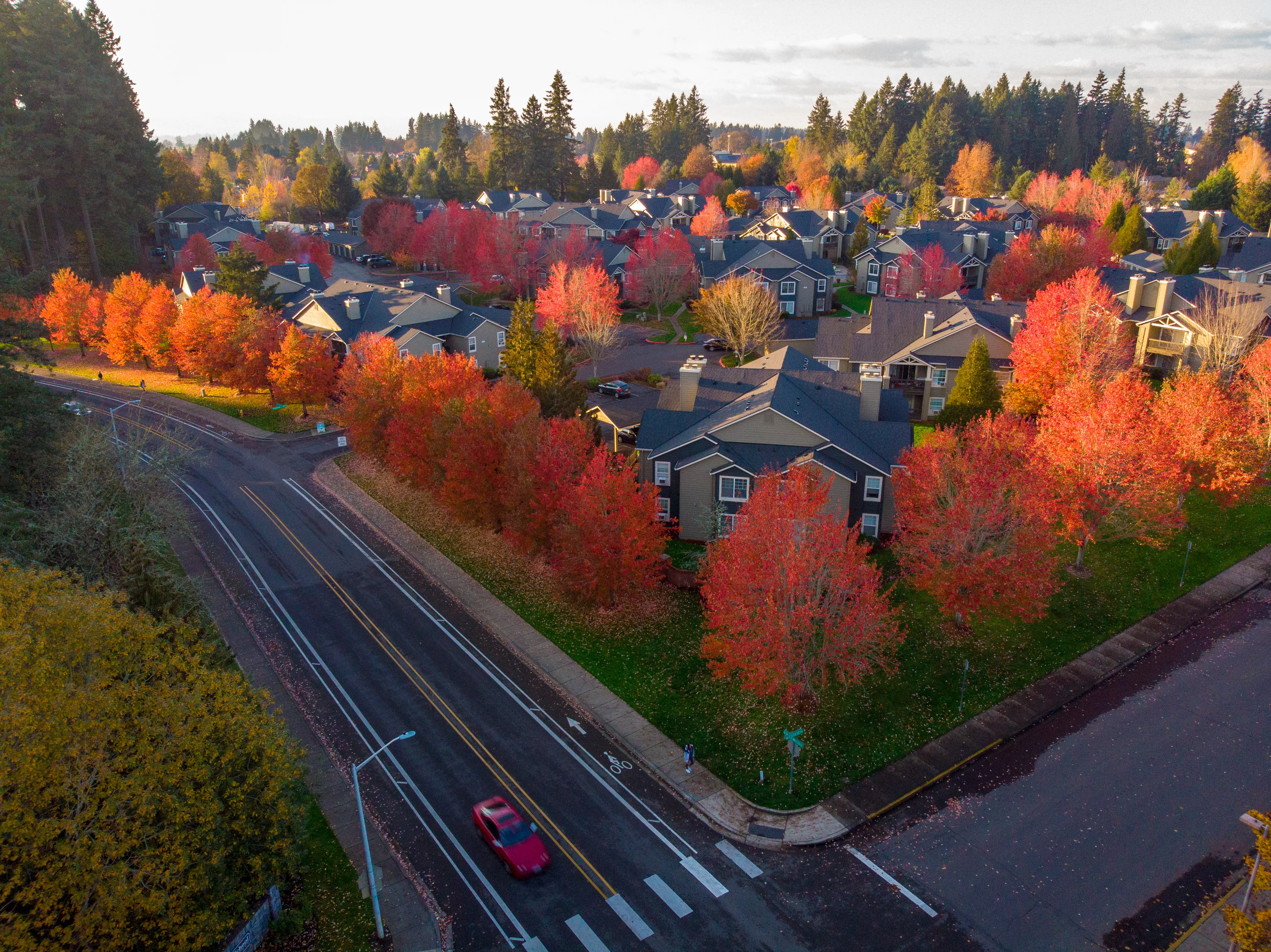
Nobody who grew up in San Jose or San Diego is fully prepared for a Hillsboro winter, no matter how many weather charts they've studied. The city averages 142 sunny days per year — compared to San Diego's 266, the Bay Area's 160–170, and Sacramento's 195. That's not a rounding error. From roughly mid-October through late April, the dominant weather state is overcast with intermittent rain, and the sense that sunshine is the exception rather than the rule affects daily mood and outdoor habits in ways that surprise people who'd only visited Oregon in summer. Hillsboro does get approximately 2,341 sunshine hours annually — roughly competitive with parts of the Bay Area — but those hours are heavily concentrated between June and September, which makes the contrast with the gray months more pronounced.
Summers, on the other hand, are genuinely extraordinary and represent the primary reason California transplants say they'd never move back. June through August in Hillsboro runs dry, warm, and clear — highs in the low-to-mid 80s, low humidity, evenings cool enough for a jacket, and skies that stay light past nine p.m. The region's outdoor culture in summer matches or exceeds what California offers: hiking in the Tualatin Mountains, wine country day trips to the Chehalem Hills and Ribbon Ridge AVA, weekend drives to the coast at Cannon Beach, and a Hillsboro-specific bonus in Ron Tonkin Field, home of the Hillsboro Hops, the city's Minor League Baseball affiliate. Watching a game on a clear July evening is one of those specific local pleasures that California transplants consistently mention in that "why didn't anyone tell me" tone.
What California transplants genuinely miss after a year in Hillsboro usually falls into two categories. The first is year-round outdoor access — not just sunshine but the ability to hike, bike, or spend Saturday at the beach without committing to a full meteorological risk assessment. The second is food scene depth. Hillsboro has good restaurants, and the broader Portland metro adds considerably more options, but if you're coming from a neighborhood-level food culture in the Mission, Silver Lake, or the Midtown Sacramento corridor, the adjustment is real. The pace of social life in Hillsboro is slower, quieter, and more neighbor-oriented than California urbanism — which reads as a feature or a bug depending entirely on what you're running toward.
If you want to see how Hillsboro compares directly to the city you're leaving, use the tool below — it covers the 120 largest California cities with current housing and tax data.
Home prices: Redfin median sale data, Q1–Q2 2026. Select your city to compare.
Ready to talk through what your specific California equity could do in Hillsboro? Todd can model your exact scenario in a single call.
Assuming Hillsboro is uniform. The city spans enough geographic and character diversity that buying without understanding the internal distinctions is a real mistake. Orenco Station is walkable and transit-oriented in a way that feels fundamentally different from West Hillsboro's quieter, more rural-edge character, and South Hillsboro's master-planned newer construction is a completely different experience from Central Hillsboro's older stock near downtown. California buyers who pick a neighborhood based on the city's average metrics — rather than what each specific area actually offers — commonly end up feeling like they bought in the wrong part of town.
Not accounting for Oregon radon. Oregon has elevated radon zones, and Hillsboro and Washington County properties test higher than national averages. California has very low radon prevalence, and California buyers often don't know to ask for a radon test. Skipping it on an older home in Hillsboro — particularly in areas with more mid-century stock like Rock Creek or Central Hillsboro — is a mistake. Mitigation systems exist and are effective, but the test is the step buyers frequently waive when they're moving quickly and don't know the local hazard landscape.
Underestimating the winter commute and outdoor access difference. A California transplant who runs on weekends, bikes to coffee, or generally lives outside from October to April is going to experience a significant behavioral adjustment. The Highway 26 commute west toward Intel's campus at Ronler Acres is manageable in summer but adds real friction in heavy rain, and the back-road alternatives through the Tualatin Mountains are not shortcuts in wet conditions. The question isn't whether you can manage — you can — but whether you've mentally accounted for the lifestyle recalibration.
Waiting too long after arriving to make an offer in the right neighborhoods. California buyers often arrive expecting the same leisurely open-house shopping pace they may have experienced in a slow Sacramento or Inland Empire market. Northwest Hillsboro's median days on market runs around 11 days in competitive windows, and South Hillsboro has clocked single-digit average days. Buyers who spend two months getting oriented while renting commonly watch the neighborhoods they wanted move past them. The buyers who get the homes they want are the ones who complete pre-approval before flying up to tour properties.
Bay Area sellers with $1.2 million or more in equity are frequently the all-cash or near-cash buyers in Hillsboro's market. At that equity level, the conversation with a lender shifts from rate shopping to terms, timeline, and whether a small mortgage (say, $100,000–$200,000) makes more sense than tying up all of the equity in real estate. If the California property is an investment property rather than a primary residence, the 1031 exchange is worth a serious look — Hillsboro's rental market and the broader Washington County corridor offer strong replacement property options. The Hillsboro 1031 Exchange guide covers the mechanics in detail.
Southern California sellers at $700,000–$1.2 million in equity are typically in strong conventional loan territory for most Hillsboro price points. The city's median sits at $520,000 — well below the 2026 conforming loan limit — meaning most SoCal buyers are looking at conventional financing with substantial down payments, not jumbo products. With 30%–50% down on a $520,000 home, the monthly payment profile is dramatically more comfortable than what they carried in California, even at current rates.
Sacramento and Inland Empire buyers at the $400,000–$650,000 equity range may want to explore Oregon Housing and Community Services products if their target purchase falls in the lower range of Hillsboro's market. The covers OHCS programs, income limits, and how they interact with incoming equity from a California sale. Buyers who need to close on their Oregon purchase before their California sale completes should ask about bridge loan options — this scenario comes up often in this equity tier.
Local Expert Takeaway: The single thing California buyers consistently underestimate about Hillsboro is how bifurcated the market is between neighborhoods that move fast and neighborhoods that sit. If you want Orenco Station, South Hillsboro, or Northwest Hillsboro, you need to be pre-approved, decisive, and ready to move within 48–72 hours of finding the right home. If you're targeting Southeast Hillsboro or Central Hillsboro, you have more room to breathe — but those areas will require more neighborhood-specific due diligence on the older housing stock. Do not treat Hillsboro as a uniform buyer's market just because the citywide average days-on-market has crept up — the best homes in the best corridors don't follow the average.
✅ California equity goes significantly further in Hillsboro — Bay Area and SoCal sellers frequently arrive with enough to eliminate their mortgage entirely and still have liquidity remaining.
⚠️ Oregon has state income tax — the top bracket hits 9.9%, which is lower than California's 13.3% ceiling but not zero. Factor this into your net-pay calculations before finalizing your budget.
📍 Neighborhood selection matters more than the city average — Hillsboro's internal diversity means the right home in the right area can look very different from the citywide median picture.
Is moving from California to Hillsboro worth it?
For most California buyers who've run the honest numbers, the answer tends to be yes — but the "worth it" is defined by priorities. If you're chasing home-equity liberation, zero sales tax, and proximity to a serious tech employment corridor, Hillsboro delivers all three. If you're prioritizing year-round sunshine, deep food culture, or urban social energy, the adjustment will be real and should be planned for, not discovered after the moving truck leaves.
How much cheaper is housing in Hillsboro vs. California?
The gap varies dramatically by California origin market. Bay Area buyers are looking at a discount in the range of 60%–70% off coastal California prices, with Hillsboro's median sitting at $520,000 versus $1.3 million to $1.6 million in the greater San Jose/San Francisco corridor. Southern California buyers from coastal markets like San Diego or the Westside of Los Angeles are looking at a 40%–55% reduction. Sacramento buyers are in closer range — the price differential is meaningful but not dramatic, and the more compelling comparison involves annual taxes and cost of goods.
What do I need to know about moving from California to Oregon?
The most important things to understand before your move: Oregon levies a state income tax with a 9.9% top bracket, so update your withholding or quarterly estimates immediately upon establishing residency. Oregon has no state sales tax, which matters most in your first year when you're spending heavily on your new home. If you're buying an older home in Hillsboro, budget for a radon test — it's not standard in California but should be considered standard practice here. And register your vehicles within 30 days of establishing residency, as Oregon has a vehicle title and registration requirement that catches California transplants off guard.
Browse current listings updated daily — filtered for Hillsboro buyers by Elizabeth Davidson, your local expert.
Powered by Elizabeth Davidson · Cascade Hasson Sotheby's International Realty · 503-939-2035
Explore the full Hillsboro series: The Ultimate Hillsboro Relocation Guide · Is Hillsboro Safe? · Cost of Living in Hillsboro · Best Neighborhoods in Hillsboro · Hillsboro Schools & Family Life · Hillsboro Youth Sports · Hillsboro Parks & Recreation · Retiring in Hillsboro · 1031 Tax-Deferred Exchange in Hillsboro · Hillsboro First-Time Homebuyers Guide · · Moving to Hillsboro from California · The Hillsboro Realtor's Perspective · Top 10 Questions a Realtor Gets About Hillsboro
Tell us what you need help with and we'll connect you with local resources.

About the Author
Todd Davidson is the founder of Living in Oregon and Living in Washington, where he publishes in-depth city guides, neighborhood resources, and local market insights covering more than 180 communities across the Pacific Northwest. While his background is in home financing and real estate, he created these digital platforms to help families research and compare regions before making a move.