
Portland Metro · Oregon
1031 Exchange & Investment Real Estate in Hillsboro (2026)
Not every 1031 buyer is a seasoned portfolio landlord. A growing share of exchange buyers in the Portland metro are California homeowners — people who sold a Bay Area bungalow or a San Diego condo for $1.2 to $1.8 million and are now sitting on a capital gain that would take a meaningful chunk of their net worth if they let it realize. Hillsboro keeps coming up in those conversations for a reason: median home prices around $520,000, a rental market underpinned by Intel's 20-billion-dollar expansion footprint, and a city of over 111,000 people where roughly half the households rent. For an out-of-state investor with exchange proceeds in hand, that combination is worth a serious look.
The rental demand story here is not speculative. Hillsboro is the employment anchor of Washington County, drawing engineers, bioscience workers, and healthcare professionals from companies like Intel, Genentech, Qorvo, and Acumed. These are salaried tenants with long lease horizons who pay rent because they're working 10 minutes from the property. The housing stock that trades as investment vehicles skews toward single-family homes in planned neighborhoods, with a growing supply of small multifamily and duplex product in transitional corridors like Brookwood and parts of Southeast Hillsboro. Vacancy in the metro runs around 5.7% — tight enough to keep landlords in a workable position without the zero-vacancy illusions some investors bring from California.
This guide walks through the mechanics of a 1031 exchange, the specific investment property landscape in Hillsboro, why Pacific Northwest markets are drawing California capital, Oregon's tax picture for landlords, and what you need to verify before closing on a replacement property here under a 45-day clock.

The IRS gives you 45 days from the sale of your relinquished property to formally identify replacement properties — in writing, submitted to your qualified intermediary (QI). That window is absolute. Missing it by a day forfeits the exchange entirely. You can identify up to three properties without restriction, or more under the 200% rule, but most investors stick to three to keep the process manageable. The second deadline — 180 days from closing on the sale — is when you must close on at least one of those identified properties.
A qualified intermediary is not optional. The IRS requires that proceeds from the sale never touch your bank account. Your QI holds the funds, and you instruct them to apply the money to the replacement property at closing. Any cash that lands in your possession — even briefly — triggers boot, meaning that portion becomes taxable income immediately. The like-kind rule is broader than most people assume: "like-kind" means real property to real property, so you can exchange a California fourplex for an Oregon single-family rental, or a commercial building for a duplex. Property type differences are fine; what matters is that both properties are held for investment or productive business use.
The boot trap catches investors who don't trade equal or up. If your relinquished property sold for $1.1 million and you replace it with an $800,000 property, the $300,000 difference is boot — taxable in the year of the exchange. To defer 100% of your gain, you need to reinvest all net proceeds and replace or exceed the value of your original property.

What out-of-state investors consistently underestimate about Hillsboro is how fast well-priced investment properties disappear from the market. The average home sells in roughly 46 days across all buyers, but investment-grade product — a duplex on Brookwood Avenue, a clean SFR in Tanasbourne near the MAX line, a newer townhome in Quatama — often goes pending inside three weeks when it's priced right. For a 1031 buyer who doesn't start their property search until they've already closed on the relinquished property, that 45-day identification window feels very short on the ground. My strongest advice to exchange clients is to begin walking properties in Hillsboro before the sale closes, even if you can't make offers yet. Knowing what you're buying before the clock starts is the difference between a strategic acquisition and a panic buy.
The other thing buyers get wrong is interpreting Hillsboro's price point as a compromise. They expect to pay less and get less. What they find instead is a metro market with genuine employer depth — Intel alone has tens of thousands of employees in the Ronler Acres complex off NW 229th — and a tenant pool that skews educated and employed. Properties near the MAX Blue Line stops at Hawthorn Farm and Quatama command rent premiums because tenants who commute to Portland value the option. I specifically watch for SFRs and duplexes within a half-mile of those stations; they rent faster, they hold value through softer markets, and they attract tenants who renew. That's the profile I'd focus any exchange client on in this market. If you're working a 1031 timeline and want a realistic read on what's available in Hillsboro before your identification window closes, I'd welcome the chance to help you move quickly and strategically.
Hillsboro's investment market is primarily single-family, with duplexes and small multifamily properties scattered through older corridors and around the Brookwood and Southeast Hillsboro areas. Commercial product — manufacturing, flex, healthcare — trades at an average cap rate around 5.9%, reflecting the industrial and semiconductor-adjacent demand in Washington County. For residential investors, the picture is more nuanced. At a $520,000 median price and rents running roughly $1,850 to $2,300 per month depending on the unit type and neighborhood, gross cap rates on single-family homes land in the 4.8% to 5.5% range before expenses. Net cap rates for SFR, accounting for management, maintenance, taxes, and insurance, realistically settle between 3.5% and 4.5%.
| Property Type | Typical Price Range | Est. Cap Rate (Net) | Avg Days to Close |
|---|---|---|---|
| Single-Family Rental (SFR) | $460,000 – $620,000 | 3.5% – 4.5% | 45 – 60 days |
| Duplex / Small Multifamily | $650,000 – $950,000 | 4.5% – 5.5% | 50 – 70 days |
| Townhome / Attached | $380,000 – $520,000 | 3.8% – 4.8% | 35 – 50 days |
| Commercial / Flex Industrial | $1.2M – $8M+ | 5.5% – 6.5% | 60 – 90 days |
Townhomes near MAX stations move fastest — a clean, updated unit in Orenco Station or Quatama can go pending inside three weeks. Larger commercial and flex properties take the longest and require more due diligence, making them challenging for buyers under a 45-day identification clock.
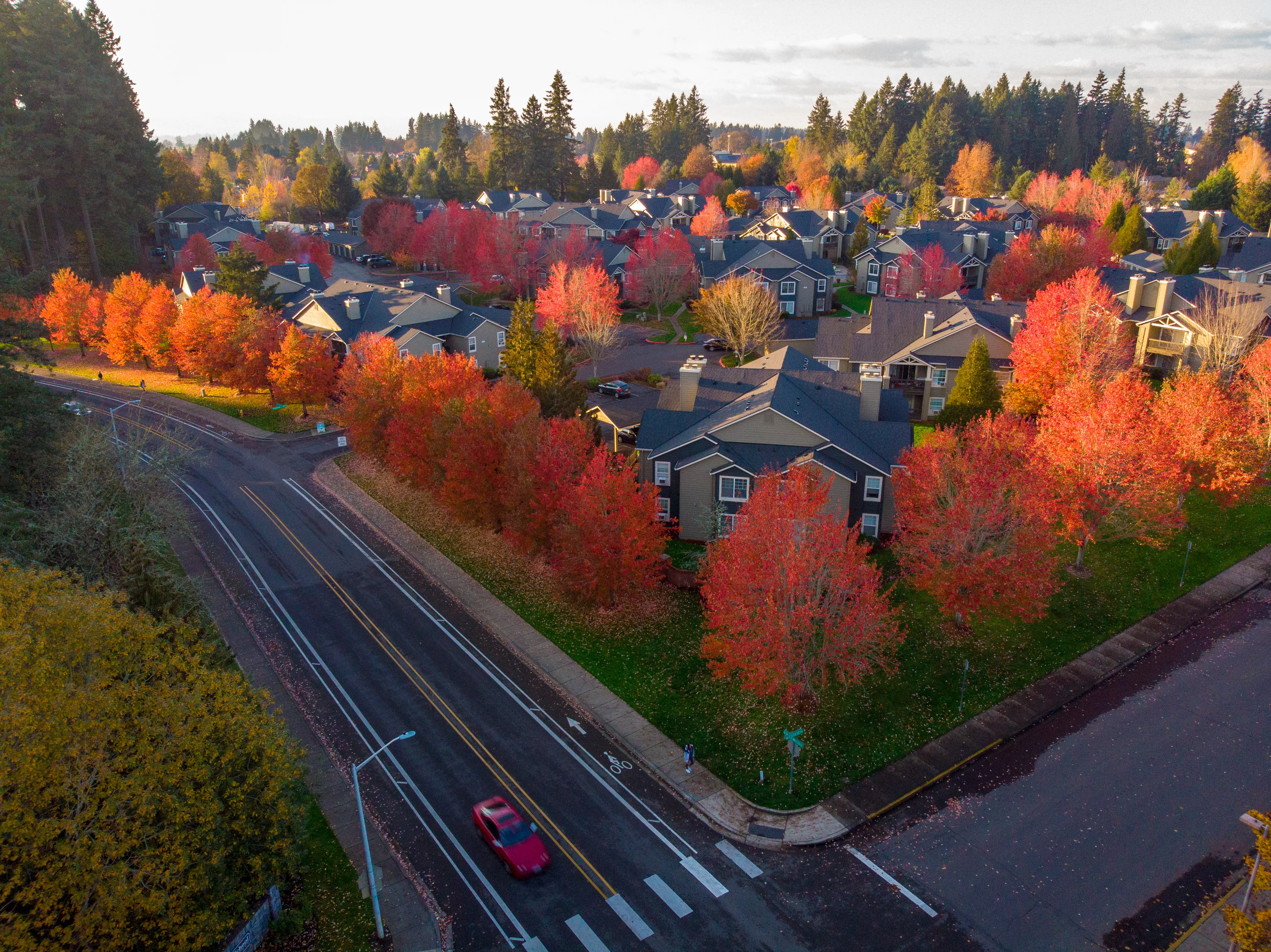
The math driving California capital north starts with a simple comparison: what does a million dollars in real estate equity buy in the Bay Area versus what it buys in Hillsboro? The answer to that question is reshaping where 1031 proceeds are flowing.
A Bay Area homeowner who sells a San Jose or Oakland property for $1.4 million can typically walk away with $900,000 to $1.1 million in equity after fees. At Hillsboro's median price of $520,000, that's enough to acquire a duplex and a standalone SFR in cash — two income-producing properties with no debt service. That combination produces more net monthly income than a single California replacement property financed with a jumbo loan would, even at equivalent cap rates.
Los Angeles and San Diego sellers typically have slightly less equity than Bay Area counterparts but still arrive with enough to buy two Hillsboro properties at or near the median. The appeal for SoCal investors is partly the math and partly the market structure: Hillsboro's tech-sector rental demand feels familiar, Intel and Genentech serving the same workforce anchor role that aerospace and biotech companies play in LA's rental ecosystem. Rent-to-price ratios in Hillsboro are meaningfully better than anything in coastal Southern California.
Sacramento and Inland Empire sellers often have equity in the $400,000 to $700,000 range — enough to execute a clean one-for-one exchange into a Hillsboro SFR or townhome. These buyers are frequently looking to simplify: one property, professionally managed, with a tenant pool that's more stable than what they've experienced in faster-cycling inland California markets. Hillsboro's lower price point makes the exchange straightforward without the need to take on debt to trade equal or up.
Looking to buy in Hillsboro? Estimate your payment.
Enter your numbers to see an estimated monthly mortgage payment.
Estimate only. Excludes HOA fees and mortgage insurance.
Oregon's tax structure creates both opportunities and obligations for out-of-state landlords, and knowing the difference matters before you close.
| Tax Item | California | Oregon |
|---|---|---|
| State income tax on rental income | Up to 13.3% | Up to 9.9% |
| Property tax rate on new purchase | 1.0% – 1.25% (Prop 13 resets) | Approximately 0.86% |
| State sales tax | 7.25% – 10.75% | 0% |
| Capital gains treatment (state) | Taxed as ordinary income | Taxed as ordinary income |
Oregon's 0% sales tax creates a tangible advantage during a rehab or turnover. Every appliance, fixture, flooring material, and contractor supply purchased in-state is exempt — a detail that adds up quickly on a value-add acquisition. Property taxes in Washington County run approximately 0.86% of real market value, which for a $520,000 acquisition translates to roughly $4,470 annually. That figure is well below what a California buyer would pay on a newly purchased replacement property in most coastal markets, where Prop 13 resets on sale mean effective rates on new purchases frequently run above 1%.
Oregon does tax rental income at the state level, with rates reaching up to 9.9% at higher income levels. In practice, depreciation, mortgage interest, property management fees, repairs, and insurance substantially reduce net taxable rental income for leveraged properties. The depreciation basis from a 1031 exchange carries over from the relinquished property rather than resetting to the new purchase price — meaning your depreciation shield may be smaller than you'd expect from a fresh acquisition.
For investors who want income without management obligations, a Delaware Statutory Trust (DST) is worth exploring as a passive 1031 vehicle. DSTs allow investors to hold fractional interests in institutional-grade properties — often multifamily or net-lease commercial — while a sponsor handles all operations. They're not the right fit for everyone, but they're a legitimate option for investors approaching retirement who want to preserve the tax deferral without taking on an active landlord role.
Oregon operates under one of the most comprehensive landlord-tenant frameworks in the country, governed by ORS Chapter 90. For the practical purposes of a Hillsboro rental owner in 2026, this means no-cause eviction is significantly restricted — landlords must generally provide cause for termination after the initial lease term, with limited exceptions. Rent increase notice requirements have also expanded in recent years, and while Hillsboro itself is not under a rent stabilization ordinance as of 2026, statewide provisions apply. Out-of-state owners who assume Oregon operates like Texas or Arizona will be surprised.
Professional property management is not optional for most out-of-state 1031 buyers — it's effectively a cost of doing business responsibly. Expect management fees between 8% and 10% of gross monthly rent, with leasing fees typically equivalent to half a month's rent when placing a new tenant. At a $2,000 monthly rent, that's $160 to $200 in monthly management cost plus occasional leasing fees. Several established property management companies operate in the Washington County market, including Anova Property Management and Columbia Property Management, both of which have documented presence in Hillsboro and the broader Portland metro. Vacancy in the metro hovers around 5.7%, and while Orenco Station shows slightly elevated vacancy due to new supply absorption, most established SFR neighborhoods turn over cleanly within 30 to 45 days.
What out-of-state owners consistently underestimate is the notice and documentation requirements under Oregon law. Lease non-renewals, habitability standards, security deposit procedures, and entry notice requirements all carry specific timelines and written notice obligations. A local property manager who knows Washington County codes is worth every dollar of the management fee — and then some — when a tenant dispute arises.
| Item | What to Verify | Local Resource |
|---|---|---|
| Title Search | Clear title, no encumbrances or liens | Washington County title companies (e.g., Fidelity National Title) |
| Sewer / Septic Status | Public sewer connection vs. septic system | Hillsboro Public Works / City utilities |
| Radon Testing | Oregon has elevated radon zones; test pre-close | Licensed Oregon radon inspector |
| Flood Zone Status | FEMA flood map zone classification | FEMA Flood Map Service Center |
| Rental Permit Requirements | City of Hillsboro rental registration compliance | Hillsboro Community Development Dept. |
| HOA Restrictions on Rentals | Rental caps, lease term minimums, short-term rental prohibitions | HOA CC&Rs / management company |
| ADU / Zoning Potential | R-5/R-6 zoning for detached ADU eligibility | Washington County Planning Division |
| School District Verification | Hillsboro School District boundaries for tenant marketing | Hillsboro School District boundary maps |
| Current Lease Status | Tenant in place? Lease terms, rent amount, security deposit held | Seller disclosure + lease documents |
| Deferred Maintenance Inspection | Roof, HVAC, foundation, drainage | Licensed Oregon home inspector |
| Property Management Referral | Vet 2-3 local PMs before closing | Local investor networks, agent referral |
| Title Company Selection | Experienced in 1031 coordination with QI | QI recommendation or agent referral |
| Intel Campus Proximity | Confirm walkability/drive time to major employer corridors | Google Maps / site visit |
| MAX Blue Line Access | Distance to nearest TriMet station affects rent premium | TriMet.org route maps |
| Washington County Tax Assessment | Verify assessed value vs. market value (post-Intel abatement shift) | Washington County Assessor's Office |

Local Expert Takeaway: The single most common mistake California 1031 buyers make in Hillsboro is purchasing a property based on gross rent estimates without accounting for Oregon's landlord-tenant compliance costs. An SFR at $520,000 renting for $2,100 per month looks like a workable net cap on paper — but if you're self-managing from out of state, or hiring a property manager who doesn't know Washington County's notice and habitability requirements, your first year often looks very different from your pro forma. Focus acquisition dollars on properties within a half-mile of the MAX Blue Line in Orenco, Quatama, or Hawthorn Farm — tenant demand is most durable there, turnover is lower, and rent premiums hold even when the broader market softens.
If you're entering a 1031 identification window and haven't been pre-qualified for an investment property loan, your clock is already ticking against you. Reach out to Todd today to get your financing lined up before the 45-day window opens — including DSCR loan options that let you qualify on the property's income rather than your personal debt-to-income ratio, which matters if you're already carrying a primary mortgage or other obligations. Having a lender and a local buyer's agent ready before day one of your identification window is the difference between a strategic exchange and a scramble.
✅ Hillsboro's rental demand is employment-driven and durable — Intel, Genentech, and Qorvo create a professional tenant base that pays rent because their jobs are literally next door. That's a fundamentally different risk profile than a market driven by lifestyle migration.
⚠️ Oregon's landlord-tenant law is tenant-protective and procedural — no-cause eviction restrictions, documented notice requirements, and habitability standards apply statewide. Budget for professional property management and factor it into your pro forma before you identify properties.
📍 The MAX Blue Line is your rent premium map — properties near the Hawthorn Farm, Quatama, and Orenco Station stops consistently command higher rents and lower vacancy than equivalent properties further from transit. If you're buying blind from California, that proximity matters more than almost any other variable.
Does a 1031 exchange work for out-of-state property?
Yes, a 1031 exchange works for any U.S. real property held for investment or productive business use, regardless of the state where either property is located. You can sell a California rental and replace it with an Oregon property — the like-kind requirement refers to the nature of the asset (real property to real property), not the geography. Your qualified intermediary coordinates the timeline and funds transfer across state lines without issue.
What is the cap rate on rental property in Hillsboro?
Net cap rates on single-family rentals in Hillsboro realistically land between 3.5% and 4.5% after accounting for management, taxes, insurance, and maintenance. Duplexes and small multifamily properties can reach 4.5% to 5.5% net depending on the rent mix and condition. Commercial and flex-industrial product in Washington County trades closer to 5.5% to 6.5%. These are working investor numbers, not pro forma projections from a listing brochure.
Do I need a local property manager for a 1031 investment in Oregon?
For out-of-state owners, professional property management is the practical answer in almost every case. Oregon's landlord-tenant statute (ORS Chapter 90) carries specific notice requirements, habitability standards, and lease termination procedures that differ meaningfully from California and most Sun Belt states. A local property manager who knows Washington County handles compliance, tenant placement, and maintenance coordination — typically for 8% to 10% of gross monthly rent. That cost is also deductible against rental income, reducing your Oregon tax exposure.
Browse current listings updated daily — filtered for Hillsboro buyers by Elizabeth Davidson, your local expert.
Powered by Elizabeth Davidson · Cascade Hasson Sotheby's International Realty · 503-939-2035
Explore the full Hillsboro series: The Ultimate Hillsboro Relocation Guide · Is Hillsboro Safe? · Cost of Living in Hillsboro · Best Neighborhoods in Hillsboro · Hillsboro Schools & Family Life · Hillsboro Youth Sports · Hillsboro Parks & Recreation · Retiring in Hillsboro · 1031 Tax-Deferred Exchange in Hillsboro · Hillsboro First-Time Homebuyers Guide · · Moving to Hillsboro from California · The Hillsboro Realtor's Perspective · Top 10 Questions a Realtor Gets About Hillsboro
Tell us what you need help with and we'll connect you with local resources.

About the Author
Todd Davidson is the founder of Living in Oregon and Living in Washington, where he publishes in-depth city guides, neighborhood resources, and local market insights covering more than 180 communities across the Pacific Northwest. While his background is in home financing and real estate, he created these digital platforms to help families research and compare regions before making a move.