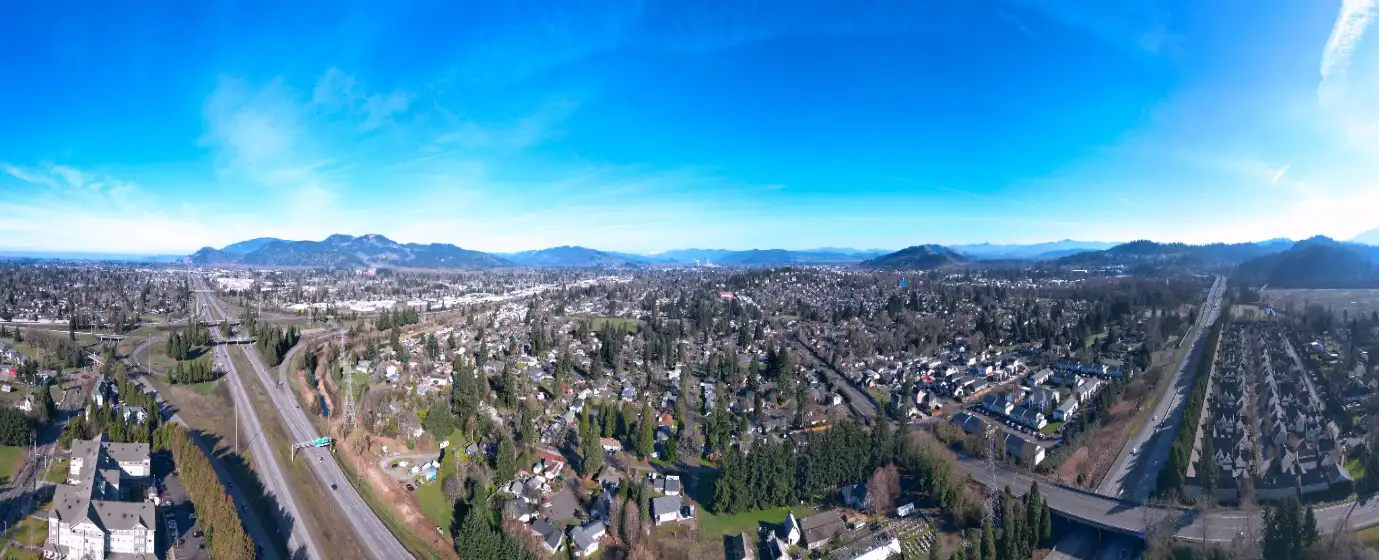
Willamette Valley · Oregon
1031 Exchange & Investment Real Estate in Springfield (2026)
Not every investor entering a 1031 exchange is a seasoned portfolio operator. A significant share of California homeowners who finally sold — in the Bay Area, Sacramento, or the Inland Empire — are sitting on capital gains that would trigger six-figure tax bills if they took the proceeds as cash. Springfield, Oregon enters that conversation as a genuine replacement property market: affordable enough to acquire multiple properties on a single exchange, landlord-accessible enough to generate real cash flow, and undersupplied enough that vacancy rarely becomes your problem.
The rental demand here is structural, not cyclical. Springfield's 60,000-plus residents include a large renter class — roughly 45% of households are renter-occupied — anchored by healthcare workers at PeaceHealth and McKenzie-Willamette Hospital, university-adjacent employees from Eugene, and a manufacturing workforce tied to employers like Swanson Group and Franz Family Bakeries. The city's housing vacancy sits near 2%, with the city's own 2025 housing snapshot reporting an overall vacancy of just 0.4% across all housing stock. The properties that trade most reliably as investment vehicles are single-family rentals in the $380,000–$460,000 range and small multifamily assets — duplexes and fourplexes — that rarely last long on the open market when priced correctly.
This guide covers everything a 1031 investor needs to approach Springfield with confidence: the exchange mechanics that matter most on a deadline, the property types and cap rates that underwrite here, Oregon's tax structure compared to California, the realities of managing a rental remotely, and a due diligence checklist built for buyers on a 45-day clock.

The core mechanic is straightforward: sell a qualifying investment property, move the proceeds through a qualified intermediary (QI), and close on a replacement property — all within a strict federal timeline. You have 45 days from the close of your relinquished property to formally identify your replacement, and 180 days to close on it. Miss the 45-day window by even one day and the entire exchange collapses, making the full gain immediately taxable.
The like-kind rule is broader than most investors initially realize. "Like-kind" means real property exchanged for real property — a California rental house can exchange into an Oregon duplex, a commercial strip, or a raw land parcel. What triggers tax is the boot trap: if you receive cash out of escrow, take back personal property, or buy down in value, the difference becomes taxable. Investors doing a partial exchange or adding debt can still complete the exchange — they just owe tax proportionally on the boot received.
Your qualified intermediary must be in place before your relinquished property closes. The QI holds the sale proceeds in a segregated account and disburses them directly to the closing of your replacement property — you never touch the funds. Choosing a QI with experience in Oregon transactions matters more than most investors expect, because Oregon has its own income tax reporting requirements that interact with the exchange at filing time.
Springfield's investment market in 2026 is defined by one central constraint: the city has built fewer homes in the past decade than in any decade since the 1940s. Only 4.2% of the housing stock was built after 2010, and the city acknowledges it needs 470 new units per year just to meet state housing production goals. For 1031 buyers, that supply ceiling means tenant demand doesn't evaporate — the structural gap between housing production and household formation keeps vacancy near 2% and rents trending upward even as statewide Oregon averages soften.
The median sold price citywide runs approximately $424,000–$440,000, with Thurston-area homes closer to $465,000 and Gateway-area properties trading down near $398,000. For investors underwriting a new acquisition, the Gateway and Midtown corridors represent the most accessible entry points for SFR rentals, while Thurston commands premium rents that support the higher acquisition cost. Small multifamily assets — duplexes and fourplexes — are genuinely scarce on-market and often transact off-market or within days of listing.
| Property Type | Typical Price Range | Est. Cap Rate | Avg Days to Close |
|---|---|---|---|
| Single-Family Rental (SFR) | $370,000–$465,000 | 3.0–3.5% | 30–45 days |
| Duplex / Small Multifamily | $480,000–$650,000 | 4.5–5.5% | 20–35 days |
| 4-Plex / Small Apartment | $700,000–$950,000 | 4.8–5.2% | 30–60 days |
| Short-Term Rental (STR) | $380,000–$500,000 | 6.0–6.5% | 30–45 days |
| Commercial / Mixed-Use | $600,000–$1.2M | 5.5–7.0% | 45–90 days |
Small multifamily and value-add properties move the fastest when priced within market — often before they hit the MLS. STR cap rates are the strongest in the market, though Oregon's regulatory environment around short-term rentals is worth verifying at the city level before underwriting that yield.

The math on Springfield is hardest to argue with for investors coming out of California markets where a single property sale generates $800,000 to $1.4 million in proceeds. Deploying that capital into Eugene-Springfield means acquiring multiple properties — or an entire small apartment building — rather than a single replacement asset in a market that costs three times as much.
A Bay Area investor selling a San Jose rental that appreciated from $600,000 to $1.4 million is facing a capital gains exposure that could exceed $200,000 in combined federal and state tax. That same capital deployed into Springfield can acquire a duplex near $540,000 and a SFR near $440,000 — debt-free — in a single 1031 exchange using the three-property rule to identify both. The combined monthly rent on those two properties runs roughly $3,800–$4,400, with vacancy risk spread across two assets instead of one.
Los Angeles and San Diego investors are often selling properties where cap rates have compressed to 2.5% or below, making reinvestment into the same market economically pointless for anyone focused on cash flow. Springfield's cap rates on small multifamily — in the 4.5%–5.5% range — represent a meaningful yield improvement without moving into tertiary markets that carry elevated management risk. The Eugene metro's economic anchors (university, healthcare, manufacturing) provide a tenant base that Southern California coastal markets can't replicate at this price point.
Sacramento and Inland Empire sellers are often working with proceeds in the $500,000–$850,000 range — enough to acquire one strong SFR in Springfield or make a down payment on a duplex with favorable DSCR financing. The rent-to-price ratio in Springfield, where a $430,000 home rents for $1,900–$2,200 per month, compares favorably to Sacramento's ratio at similar price points, where rents haven't kept pace with recent appreciation.
Looking to buy in Springfield? Estimate your payment.
Enter your numbers to see an estimated monthly mortgage payment.
Estimate only. Excludes HOA fees and mortgage insurance.
Oregon's most underappreciated advantage for rental property owners is one that has nothing to do with income tax: the state has no sales tax. For an investor doing a rehab on a 1031 replacement property — new appliances, flooring, roofing materials, contractor labor on fixtures — there is no sales tax drag on materials purchases. That 0% rate compounds across every improvement cycle the property goes through.
| Tax Item | California | Oregon |
|---|---|---|
| State income tax on rental income | Up to 13.3% | Up to 9.9% |
| Property tax rate on new purchase | 1.1%–1.3% (post-Prop 13 reset) | ~0.85%–0.86% |
| State sales tax | 7.25% (base) | 0% |
| Capital gains treatment | Taxed as ordinary income | Taxed as ordinary income |
| Property value reset at sale | Yes (new assessed value at purchase price) | No (MAV grows max 3%/year) |
Oregon does tax rental income at rates up to 9.9%, but the practical net exposure for a leveraged property with full depreciation is often modest — depreciation on a $440,000 acquisition with a cost-segregation study can generate $12,000–$18,000 in annual paper losses that offset rental income directly. Oregon's property tax structure is particularly investor-friendly on the appreciation side: unlike California, which resets assessed value to purchase price at sale, Oregon's Maximum Assessed Value grows at a capped 3% per year regardless of what the market does. A property acquired at $440,000 today doesn't suddenly generate a $10,000 tax bill when its real market value reaches $600,000 five years from now.
For investors who want the tax deferral of a 1031 without the management burden of direct ownership, a Delaware Statutory Trust (DST) qualifies as like-kind property under IRS rules. DSTs allow fractional, passive ownership of institutional-grade properties with no landlord responsibilities — a meaningful option for investors in their late 60s or beyond who are more concerned with income than appreciation.
Oregon's landlord-tenant law is among the more tenant-protective frameworks in the country, and investors buying Springfield property from out of state need to internalize this before closing. No-cause evictions are significantly restricted under state law, rent increase notices require written notice well in advance, and the City of Springfield may have additional rental housing regulations layered on top of state statute. For 2026, investors should verify current rent increase notification requirements and any city-specific rental registration or inspection programs before acquisition.
The typical property management fee in Springfield runs 8%–10% of gross monthly rent, with leasing fees of 50%–100% of one month's rent on tenant placement. For a $2,000/month rental, that's $160–$200/month in ongoing management plus a one-time placement fee — costs that need to appear in your underwriting, not get added as surprises after year one. Local property management firms operating in the Eugene-Springfield market include Morrow & Keifer Property Management and RPM West Valley, though any investor should interview multiple firms before committing.
What out-of-state investors consistently underestimate is the maintenance response window. Springfield properties, particularly older stock in Midtown and parts of Downtown, were built in the 1960s–1980s and can carry deferred maintenance that isn't visible in listing photos. Budget a capital reserves allowance of 1%–1.5% of property value annually, not 0.5% — the difference between a sustainable operation and a frustrating one is almost always adequate reserves.
| Item | What to Verify | Local Resource |
|---|---|---|
| Title search | Clean title, no liens, easements affecting use | Lane County title companies (First American, Fidelity National) |
| Sewer vs. septic | Confirm city sewer connection — older zones may have septic | City of Springfield Public Works |
| Radon testing | Lane County falls within Oregon's elevated radon zone | Oregon Health Authority radon map |
| Flood zone status | FEMA flood designation — McKenzie River adjacency affects some properties | FEMA Flood Map Service Center |
| Rental permit requirements | City of Springfield rental registration or inspection program | Springfield Development & Public Works |
| HOA restrictions | CC&Rs — some neighborhoods restrict STR or require owner-occupancy | HOA disclosure docs, title report |
| ADU zoning potential | Lot size, setbacks, and zone classification for accessory dwelling unit | Springfield Zoning & Development Code |
| School district | Springfield School District boundary affects tenant profile | Springfield School District website |
| Current lease status | Month-to-month vs. fixed-term, rent amount, deposits held | Estoppel certificate from seller |
| Deferred maintenance inspection | Roof age, HVAC, electrical panel (older fuse boxes common in Midtown), plumbing | Licensed Oregon home inspector |
| Environmental review | Near any industrial corridor? Glenwood and some commercial adjacencies carry risk | Lane County Environmental Health |
| 1031 QI confirmation | Verify QI is in place before close of relinquished property | AAEI-member qualified intermediary |
| Property management referral | Interview 2–3 local PM firms before close | Lane County rental housing association |
| Comparable rents | Verify against actual current listings, not aggregator averages | Zillow rentals, local PM market report |
| Title company recommendation | Experienced with 1031 closings and Oregon vesting structures | First American Title, Eugene branch |

Local Expert Takeaway: The most common mistake California 1031 investors make in Springfield is treating the Gateway corridor and Thurston as interchangeable — they're not. Gateway properties are $60,000–$70,000 cheaper at acquisition but also rent for $150–$200 less per month and attract a different tenant demographic. For investors prioritizing long-term appreciation and tenant stability, Thurston's higher entry price has historically delivered stronger total returns. If cash flow on day one is the priority and you're comfortable with hands-on management, Gateway and Midtown are where the yield numbers work better. Know which investor you are before you start identifying properties on day 1 of your 45-day window.
Getting pre-approved for your investment acquisition before your relinquished property closes isn't optional — it's what keeps your 45-day window from becoming a 44-day panic. DSCR loans are worth understanding here: they underwrite based on the rental income of the property you're buying, not your personal tax returns, which means your existing portfolio's paper losses don't complicate the approval. Talk to a lender who works these products in Oregon before you're in the middle of an exchange.
✅ Springfield's near-2% rental vacancy and structural housing shortage make tenant demand durable — this is one of the more reliable rental markets in Oregon at this price point.
⚠️ SFR cap rates of 3%–3.5% underwrite thin on leverage — the better investment thesis is small multifamily, value-add, or STR if city regulations allow it.
📍 Oregon's property tax structure (no reset at sale, 3% MAV cap) and no state sales tax give Springfield a meaningful long-term advantage over California replacement markets for buy-and-hold investors.
Can I do a 1031 exchange into a duplex or small multifamily in Springfield?
Yes — a duplex or fourplex is like-kind property for 1031 purposes and qualifies as a replacement asset. Small multifamily is actually the most compelling 1031 entry point in Springfield, with cap rates in the 4.5%–5.5% range that significantly outperform SFR yields. The catch is that these properties are scarce on-market and move quickly, so having your QI in place and financing pre-arranged before the 45-day window opens is essential.
Are there 1031-eligible properties under $500K in Springfield?
Plenty. The majority of Springfield SFR inventory trades in the $380,000–$465,000 range, well under the $500,000 threshold. One-bedroom condos start around $253,000 and can work as part of a multi-property identification strategy. The $400,000–$480,000 price band is where the most active investor-grade inventory trades, and properties in that range are routinely cash-flowing at $1,800–$2,200 per month in rent.
What is DSCR lending and can I use it for a 1031 replacement property?
A Debt Service Coverage Ratio (DSCR) loan qualifies you based on the cash flow of the rental property you're purchasing, not your W-2 income or personal debt-to-income ratio. For 1031 investors who have depreciation losses on paper making their personal returns look unfavorable to traditional lenders, DSCR is often the cleanest path to financing a replacement property quickly. It works for SFRs, duplexes, and small multifamily assets — exactly the property types that make sense in Springfield's market.
Explore the full Springfield series: The Ultimate Springfield Relocation Guide · Is Springfield Safe? · Cost of Living in Springfield · Best Neighborhoods in Springfield · Springfield Schools & Family Life · Springfield Youth Sports · Springfield Parks & Recreation · Retiring in Springfield · 1031 Tax-Deferred Exchange in Springfield · Springfield First-Time Homebuyers Guide · · Moving to Springfield from California
Tell us what you need help with and we'll connect you with local resources.

About the Author
Todd Davidson is the founder of Living in Oregon and Living in Washington, where he publishes in-depth city guides, neighborhood resources, and local market insights covering more than 180 communities across the Pacific Northwest. While his background is in home financing and real estate, he created these digital platforms to help families research and compare regions before making a move.