
Portland Metro · Oregon
There's a specific moment most first-time buyers describe — not when they sign the papers, but a few weeks before, when they're staring at a pre-approval letter and a list of active listings and realizing that buying a home is less like shopping and more like learning a new language mid-conversation. The stakes are real, the competition is real, and no amount of Zillow browsing fully prepares you for the gap between what a home looks like online and what it feels like to make an offer you might lose. Milwaukie earns its place in this conversation because it sits at a price point that's genuinely reachable for many Portland-area first-time buyers — not because it's cheap, but because it hasn't yet crossed the threshold where entry-level becomes a euphemism for "condo in a flood zone."
At a median sold price of approximately $500,000, Milwaukie offers something most of its neighbors to the south can't: starter single-family homes that don't require a half-million-dollar portfolio to access. The $520,000 list-price median means a buyer with solid credit and a 5% down payment is looking at roughly $26,000 out of pocket before closing costs — significant, but not the $80,000 down-payment conversation that plays out in Lake Oswego or West Linn. For renters currently paying $2,000–$2,200 a month for a two-bedroom in the area, the gap between renting and owning here is narrower than in most Portland suburbs.
This guide walks through the full first-time buyer process as it actually plays out in Milwaukie — what your budget realistically gets you, what qualification looks like at current rates, which neighborhoods make sense at first-time price points, and exactly where buyers go wrong in this specific market. Oregon real estate has its own quirks, and Clackamas County has its own dynamics that differ from what you've read about the Portland market broadly. By the end, you'll know enough to walk into a buyer's consultation without feeling like you're starting from zero.
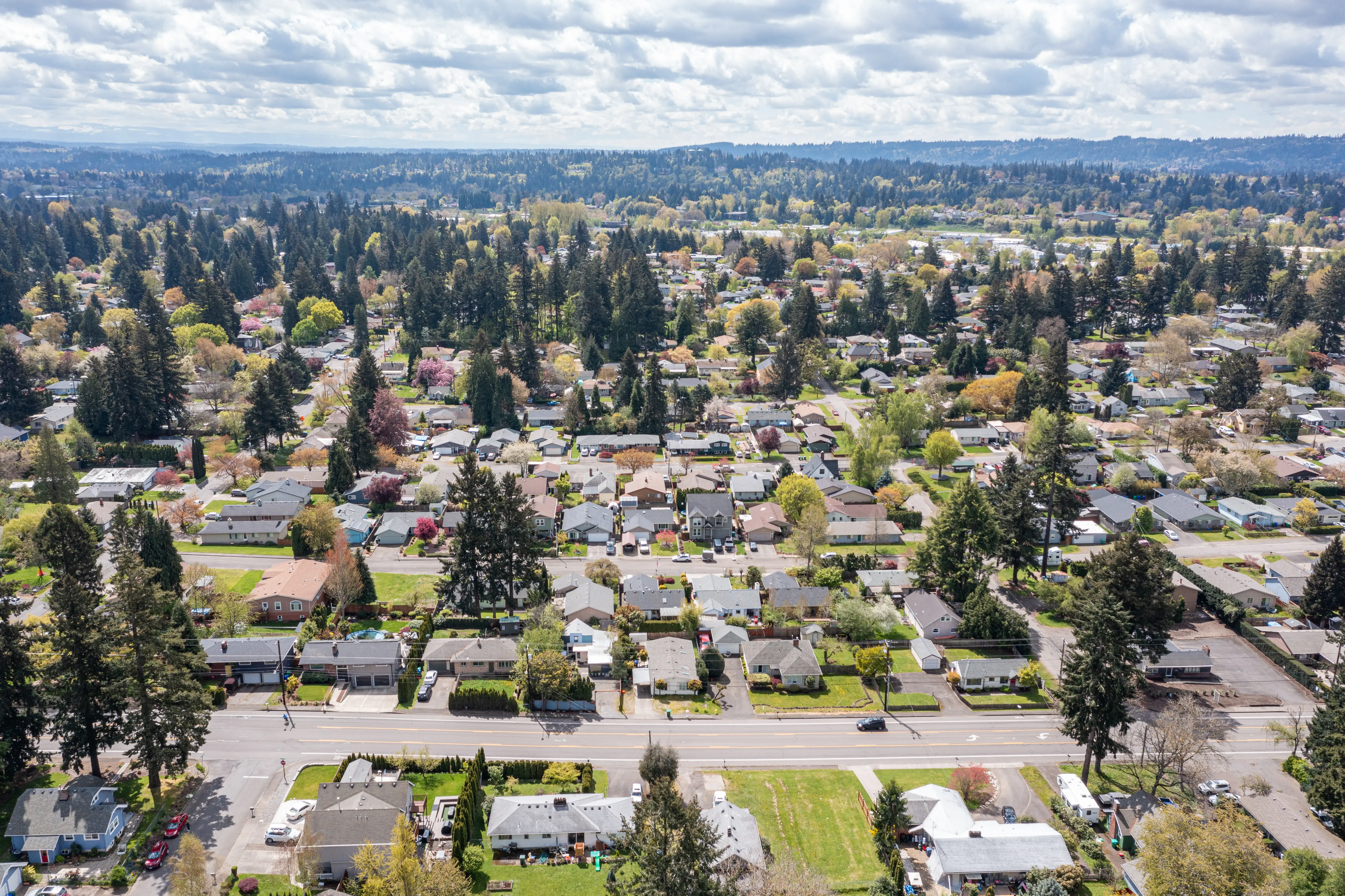
Milwaukie makes a strong case for first-time buyers who want to stay close to Portland without paying Portland's inner-eastside prices. A 26-minute average commute to downtown, a North Clackamas School District rated B by most major school rating services, and a housing stock that still includes genuine starter single-family homes — these are real advantages, not marketing copy. Neighborhoods like Ardenwald-Johnson Creek and Linwood offer 1950s–1970s ranch homes and bungalows in the $420,000–$500,000 range, which gives buyers something to work with. The competition is real — Redfin scores the Milwaukie market at 81 out of 100, classifying it as very competitive — but it's a different kind of competition than inner Southeast Portland, where $600,000 buys you 1,100 square feet and a bidding war.
The honest complication is the sub-$450,000 segment. That price range in Milwaukie skews heavily toward condos, smaller attached units, and homes that need significant updating. Buyers expecting a move-in-ready three-bedroom under $400,000 will find inventory thin — roughly two dozen homes in that range are typically listed at any given time, and many are condos or units in community land trust-style programs with resale restrictions. First-time buyers with realistic expectations and a clear sense of what neighborhoods are worth targeting will fare much better than those chasing a number that the market doesn't quite support.

Milwaukie is one of the markets I get most excited talking about with first-time buyers, and not just because of the price point. What I've watched happen over the past 18 months is that buyers who moved decisively in Ardenwald and the Historic Milwaukie core have already built meaningful equity while their friends are still renting in Portland waiting for the "right time." The homes in the $450,000–$520,000 range here — the 1960s three-bedrooms on the east side of McLoughlin, the updated ranches near Kronberg Park — those are the properties that come up once and don't come back. When a well-priced home in Linwood or Lake Road hits the market on a Thursday, it's under contract by Monday in most cases.
The thing first-time buyers consistently underestimate in Milwaukie is how different the experience feels compared to Portland proper. They come in expecting the same waived-everything, no-inspection chaos of the 2021–2022 era, and what they find instead is a market that's competitive but navigable — where a strong pre-approval, a clean offer, and a reasonable escalation clause can absolutely win without giving up every protection. What I tell buyers is this: don't let the Redfin "very competitive" label scare you into overbidding. Know your number, know your neighborhood, and have a lender who can pick up the phone on a Saturday. If you're considering Milwaukie and want insight into which neighborhoods align with your priorities and budget, I'd welcome the opportunity to share what I've learned from helping hundreds of families make this move successfully.
The table below reflects active market conditions as of mid-2026. What you find in each range depends heavily on the specific neighborhood and whether you're targeting condos, townhomes, or detached single-family homes.
| Price Range | What You Typically Find | Neighborhood Examples | Competition Level |
|---|---|---|---|
| Under $350K | Condos, manufactured homes, permanently affordable program units | Ardenwald (community land trust cottages), scattered condo complexes | Low–Moderate |
| $350K–$450K | Entry condos/townhomes, small SFRs needing updates, 1–2 BR detached | Historic Milwaukie fringe, Linwood, pockets near SE Freeman Way | Moderate |
| $450K–$550K | 2–3 BR starter SFRs, 1950s–1970s ranches, 900–1,400 sq ft | Ardenwald-Johnson Creek, Linwood, Lake Road, Lewelling | High |
| $550K–$650K | Updated 3 BR, larger lots, move-in ready condition | Milwaukie Heights, Historic Milwaukie, Island Station | High |
| $650K+ | Larger SFRs, remodeled homes, premium lots, riverfront proximity | Island Station, Lake Road upper tier, Milwaukie Heights | Very High |
The realistic entry point for a first-time buyer targeting a detached single-family home in Milwaukie is approximately $450,000–$520,000. That range gets you a 2–3 bedroom home with 1–1.5 bathrooms, likely 1,000–1,300 square feet, with original or partially updated finishes — the kind of home that needs a new roof within five years but gives you something to improve on your own terms. At $307 per square foot (the current Milwaukie median), you're not getting spacious; you're getting a foothold.
The $450K–$550K band is where first-time buyers find the best value right now. Below that, you're mostly in the condo and attached-unit world. Above $550,000, you're competing with buyers who've sold a previous home and are bringing equity to the table. That middle band — the ranches on SE Harvey Street, the bungalows off Johnson Creek Boulevard — is where patient, prepared buyers can still win in this market.
| Step | What Happens | Typical Timeline | What First-Timers Get Wrong |
|---|---|---|---|
| Get finances in order | Pull credit, reduce card balances, gather 2 years of tax returns and pay stubs | 1–3 months before searching | Starting this step after finding a house |
| Pre-approval | Lender reviews income, credit, assets; issues a letter with max loan amount | 1–3 business days | Confusing pre-qualification (soft pull) with pre-approval (hard pull, verified) |
| Find an agent | Interview 1–2 buyer's agents who specialize in Clackamas County | Before active searching | Using a friend-of-a-friend who covers 8 counties |
| Active search | Tour homes, track price histories, understand neighborhood micro-markets | 2–8 weeks | Waiting for the "perfect" home instead of acting on "strong enough" |
| Making offers | Submit purchase agreement with earnest money, terms, contingencies | Same day as tour in hot cases | Offering below list price on a home that's been on market for 8 days |
| Under contract | Seller accepts; clock starts on inspections and due diligence | Days 1–5 post-acceptance | Not scheduling inspection immediately |
| Inspection | Licensed inspector walks property; report delivered within 24–48 hours | Days 5–12 | Skipping it to "stay competitive" on older homes |
| Appraisal | Lender orders appraisal to confirm home value supports loan amount | Days 10–21 | Not understanding what happens if appraisal comes in low |
| Final walkthrough | Buyer verifies condition matches contract terms before closing | 24–48 hours before closing | Skipping it; sellers sometimes remove fixtures |
| Closing | Sign documents, funds transfer, keys handed over | 30–45 days after accepted offer | Being surprised by closing costs (typically 2–3% of loan) |
In Milwaukie specifically, the earnest money norm in Clackamas County runs between 1% and 2% of the purchase price — on a $500,000 home, plan on $5,000–$10,000 that goes into escrow and counts toward your down payment at closing. Hot homes here can go pending in five days, so buyers who need two weekends to think about it will frequently lose. That doesn't mean you rush blindly — it means your financing, your agent relationship, and your sense of your own priorities need to be settled before you start touring.
Waiving inspection entirely is less common in Milwaukie than it was during the 2021–2022 frenzy, but inspection contingency timelines have compressed. Many accepted offers here include a 5–7 day inspection window rather than the standard 10. For a 1960s ranch in Linwood or a postwar bungalow in Ardenwald, a professional inspection isn't optional — these homes commonly have aging electrical panels, older plumbing, and original windows that a $400 inspection can surface before they become your problem.

Looking to buy in Milwaukie? Estimate your payment.
Enter your numbers to see an estimated monthly mortgage payment.
Estimate only. Excludes HOA fees and mortgage insurance.
A conventional loan technically requires a 620 minimum credit score, but that number doesn't tell the whole story. The difference between a 650 and a 740 credit score on a $420,000 loan can easily translate to a 0.5–0.75 percentage point difference in your interest rate, which works out to roughly $150–$200 more per month. On a 30-year loan, that's tens of thousands of dollars. If your score is in the low-to-mid 600s, spending 3–6 months paying down revolving balances before applying can be one of the highest-return moves you make.
FHA loans allow a 580 minimum for 3.5% down — on a $500,000 home, that's $17,500 down rather than $25,000 — but FHA mortgage insurance (MIP) stays on the loan for the life of the loan if you put down less than 10%. That ongoing cost matters over time. For a rough income qualification guide: qualifying for a $400,000 loan at current rates requires roughly $80,000–$85,000 in gross annual income using a 28% front-end debt-to-income ratio; a $450,000 loan requires approximately $90,000–$95,000; a $500,000 loan requires approximately $100,000–$105,000. These figures assume you have no significant existing debt obligations eating into your DTI.
Debt-to-income ratio — DTI — is the number lenders care about most, and many first-time buyers underestimate how much existing debt limits their buying power. Your front-end DTI is just your housing payment divided by your gross income. Your back-end DTI adds in all monthly debt payments — car loans, student loans, credit cards. Most conventional lenders want to see back-end DTI below 43–45%. If you're carrying a $450/month car payment and $200/month in student loans, those directly reduce the home price you can qualify for. Deal with the car payment before you apply if at all possible.
Mistake 1: Confusing list price with closed price. In Milwaukie's competitive segments, particularly the $450K–$550K range in Ardenwald or Linwood, homes routinely close at or slightly above list. Buyers who anchor to list price and write offers $10,000–$15,000 below asking on a home with multiple showings will lose consistently — and often can't figure out why.
Mistake 2: Skipping inspection on 1960s–1970s ranches. A significant portion of Milwaukie's starter-home inventory was built between 1950 and 1980. These homes have character and solid bones, but they also commonly have original electrical panels, cast iron or galvanized plumbing, and roofs approaching end of life. In the Historic Milwaukie and Lewelling areas especially, a thorough inspection can surface $15,000–$30,000 in deferred maintenance that can be negotiated or budgeted for — but only if you find it before you own it.
Mistake 3: Shopping at the top of their qualification. Being pre-approved for $550,000 and shopping at $549,000 is a recipe for being permanently house-poor. Milwaukie's property tax rate of approximately 0.98% on a $520,000 home adds roughly $425 per month to your carrying costs before you've touched a utility bill. First-time buyers who treat their maximum approval as their budget target frequently find out in month four that the math doesn't work the way they planned.
Mistake 4: Underestimating school district boundary lines. The North Clackamas School District serves Milwaukie, but the specific elementary school a home feeds into matters for resale — particularly in neighborhoods near the Oak Grove or Gladstone boundaries. Buyers who don't check school assignment before making an offer sometimes find that a home they thought was in a strong feeder zone is actually just outside it, which affects both their own experience and future buyers' interest.
Mistake 5: Waiting for prices to drop. Milwaukie's sold prices have softened modestly from their 2022 peak — roughly 2.5–3% year-over-year as of early 2026 — but buyers treating this as the beginning of a significant correction have been consistently wrong. The market is competitive, inventory is low relative to demand, and the proximity to Portland employment ensures a baseline of sustained buyer interest. Waiting for prices to drop 10–15% in Milwaukie is a thesis that hasn't been supported by what's actually happened.
Ardenwald-Johnson Creek is one of the more accessible entry points in the city, with a mix of older ranches and newer attached cottages. The permanently affordable units here represent Milwaukie's lowest-price ownership opportunity, though buyers should understand the resale restrictions before pursuing that route. Standard market homes in the $440,000–$510,000 range give buyers proximity to Johnson Creek Trail and manageable commutes east into Clackamas or north into Portland.
Linwood sits on the northeast edge of the city and offers some of the most straightforward starter inventory in Milwaukie — 1950s–1970s single-family homes on modest lots in the $430,000–$500,000 range. The neighborhood is quieter than the city's central core, and the commute north on SE McLoughlin Boulevard to Portland is direct if not always fast during peak hours.
Lewelling offers a residential pocket with slightly more competitive pricing given its proximity to the Lake Road corridor and better access to grocery and retail. Buyers in the $460,000–$530,000 range will find updated and partially updated ranches here, with the trade-off being that desirable homes move quickly and attract multiple offers.
Historic Milwaukie represents a step up in character — craftsman bungalows, tree-lined streets, walkable access to downtown Milwaukie's small commercial core. Entry-level homes here start closer to $480,000–$520,000 for something that needs work, and well-maintained homes push into the $550,000–$600,000+ range. For a first-time buyer who wants established neighborhood feel and long-term resale strength, it's worth stretching the budget slightly if the numbers still work.
✅ Milwaukie's approximately $500,000 median sold price is meaningfully below Lake Oswego and West Linn, making it one of the more accessible Portland-area markets for first-time buyers targeting a detached home.
⚠️ The sub-$450,000 single-family inventory is thin — most homes in that range are condos, attached units, or properties with significant deferred maintenance. Plan your budget accordingly.
📍 Ardenwald-Johnson Creek, Linwood, and Lewelling offer the clearest first-time buyer entry points, with ranches and bungalows in the $440,000–$510,000 range and reasonable commutes to Portland.
Can I buy a home in Milwaukie as a first-time buyer?
Yes — Milwaukie is one of the more realistic Portland-area options for first-time buyers specifically because it still has detached single-family homes in the $450,000–$520,000 range. The market is competitive, but buyers with strong pre-approvals and clear neighborhood focus can win offers without waiving every protection.
Is FHA financing a good option for first-time buyers in Milwaukie?
FHA financing is a strong option for many first-time buyers in Milwaukie, since it allows a lower down payment and more flexible credit requirements than most conventional loans. A local lender can walk you through your specific numbers based on today's rates.
What credit score do I need to buy a house in Oregon?
A 580 minimum credit score qualifies for FHA financing with 3.5% down. Conventional loans start at 620. Practically speaking, buyers in the 680–740+ range access meaningfully better rates, and the monthly payment difference on a Milwaukie-priced home between a 650 and a 740 score is real money over time — typically $150–$200 per month at current rate spreads.
Browse current listings updated daily — filtered for Milwaukie buyers by Elizabeth Davidson, your local expert.
Powered by Elizabeth Davidson · Cascade Hasson Sotheby's International Realty · 503-939-2035
Explore the full Milwaukie series: The Ultimate Milwaukie Relocation Guide · Is Milwaukie Safe? · Cost of Living in Milwaukie · Best Neighborhoods in Milwaukie · Milwaukie Schools & Family Life · Milwaukie Youth Sports · Milwaukie Parks & Recreation · Retiring in Milwaukie · 1031 Tax-Deferred Exchange in Milwaukie · Milwaukie First-Time Homebuyers Guide · · Moving to Milwaukie from California · The Milwaukie Realtor's Perspective · Top 10 Questions a Realtor Gets About Milwaukie
Tell us what you need help with and we'll connect you with local resources.

About the Author
Todd Davidson is the founder of Living in Oregon and Living in Washington, where he publishes in-depth city guides, neighborhood resources, and local market insights covering more than 180 communities across the Pacific Northwest. While his background is in home financing and real estate, he created these digital platforms to help families research and compare regions before making a move.