
Portland Metro · Oregon
The Beaverton, Oregon Realtor's Perspective

I'm Elizabeth Davidson, a broker with Cascade Hasson Sotheby's International Realty, and I've consistently ranked in the top 2% of REALTORS® in the Portland Metro by volume sold. Beaverton and Washington County have been a core part of my practice for years — I've worked with buyers and sellers across Cedar Hills, Bethany, Sexton Mountain, Murrayhill, and the corridors in between, and I know the micro-market differences that don't show up in any citywide summary.
What I've learned working this market is that Beaverton attracts serious buyers — people who've done their research, know what commute corridors matter, and often have school priorities locked in before they ever call me. My job is to take that homework and translate it into the right neighborhood, not just the right price range. I'm not here to sell you on Beaverton. I'm here to tell you what you'll actually find.
In this guide, I'll walk you through the neighborhoods that matter most right now, what your budget realistically buys in each one, the mistakes I see buyers make before they work with me, and who Beaverton genuinely fits — and who might be better served looking elsewhere.
South Beaverton is the neighborhood I watch most closely right now, and for good reason. While much of the city has seen prices soften, South Beaverton has held its ground — and on a weekday afternoon, you understand why: it's a quick left turn onto Scholls Ferry Road to Cooper Mountain Nature Park, where the trails through the oak meadows feel nothing like a suburb. Families with kids in the Beaverton School District keep coming back to this pocket specifically, and it sits in the middle tier — roughly $550K to $700K for most single-family product, with move-in-ready homes going under contract in under two weeks.
Sexton Mountain is where buyers come when they want elevation — literally and figuratively. The hillside lots, the craftsman detailing, and the territorial views toward the Tualatin Valley attract buyers who want a premium product without crossing into Bethany prices. Sexton Mountain Elementary consistently earns some of the highest ratings in the district, which drives sustained demand from families willing to pay for it. Most of what sells here lands in the top tier — $700K and up — and the better-positioned homes push well past that.
Murrayhill is the neighborhood that surprises buyers once they actually spend time there. Progress Ridge TownSquare puts an AMC Theater, dining, and walkable errands within a short drive of most homes, and on a Saturday evening the energy there feels genuinely town-center, not strip-mall. The price range is wide — townhomes bring entry-tier buyers in, while larger single-family homes on bigger lots push into the middle tier and beyond — which makes Murrayhill unusually flexible depending on what you're optimizing for.
West Beaverton moves faster than anywhere else in the city right now. Homes here regularly go under contract in under two weeks, often with multiple offers, which tells you something about how buyers value the combination of price, location, and access to US-26. The housing stock skews toward well-maintained ranches and split-levels, and most of what's available lands in the middle tier — $550K to $700K — with occasional entry-tier finds if you move quickly.
Central Beaverton is the neighborhood I recommend buyers look at before they write it off. Prices here are generally in the entry tier — under $550K — and you're close to the MAX light rail, Beaverton Town Square, and the Saturday Farmers Market on Hall Boulevard, where the crowd starts gathering before 9 AM and the local produce vendors sell out by noon. The tradeoff is that homes here are older and the product mix includes more condos and attached housing, so buyers need to be clear on what type they're looking for.
Bethany is Beaverton's northeastern edge, technically within city limits but feeling distinct — newer construction, larger lots, and some of the city's best-regarded schools. The neighborhood sits firmly in the top tier, with most single-family homes at $700K and up, and the newer builds push higher. Buyers coming from higher-cost markets often land here first because the product looks familiar and the school profile is strong, but I always make sure they've compared it against Sexton Mountain before they commit.
The biggest mistake I see is treating Beaverton as a single market with a single price. The spread between a condo in Central Beaverton and a hillside home in Sexton Mountain is enormous — we're talking entry tier versus well into the top tier — and buyers who anchor to the citywide median often walk into the wrong conversations expecting the wrong product.
The second thing I correct regularly is the assumption that slower citywide price trends mean every neighborhood is cooling. South Beaverton and West Beaverton have been moving in the opposite direction of that narrative. When buyers see broad headlines about Beaverton prices softening, they sometimes wait for deals in sub-markets that aren't actually softening.
Third: buyers often assume Beaverton is entirely car-dependent. The neighborhoods closest to the MAX Blue and Red Lines — Central Beaverton especially — offer genuine transit access into Portland. That doesn't describe every ZIP code, but if walkability and transit matter to your daily life, the answer isn't "Beaverton doesn't have that" — it's "let's get you into the right part of it."

| Budget | What You'll Typically Find | Where to Look |
|---|---|---|
| Under $550K | Condos, townhomes, older ranches; some entry-level single-family with deferred maintenance | Central Beaverton, Five Oaks, older pockets of Cedar Hills |
| $550K–$700K | Solid single-family homes, 3–4 bedrooms, good school access, some updating done | West Beaverton, South Beaverton, Murrayhill, newer-end Cedar Hills |
| $700K and up | Larger lots, newer construction, hillside settings, premium school zones | Sexton Mountain, Bethany, top-end Murrayhill |
The middle tier is where I spend most of my time with buyers, and it's genuinely competitive — West Beaverton and South Beaverton in particular reward buyers who move with a clear head and pre-arranged financing. The entry tier has more room to negotiate, but the product requires more scrutiny on condition.
Beaverton's median sold price sits around $595K as of mid-2026, which is roughly flat to slightly down from the peak of about $611K in early 2025. The more useful signal is volume: April 2026 saw 267 homes sold, up from 240 the prior April, which tells me buyers are active even as prices have pulled back modestly. This is a balanced market that still rewards prepared buyers — not a buyer's market where you can lowball freely, but not the frenzy of 2021 either.
Beaverton fits best if your life is oriented around the western Portland Metro — you work at Nike, Intel, or one of the other major employers on the US-26 corridor, you care about school quality, and you want a city with real amenities without paying Portland prices. The 20-minute commute to Portland is real during off-peak hours, and the Beaverton School District delivers — for families with kids, that A- district rating translates to concrete value in resale and quality of daily life.
It's a weaker fit if you want walkable urban density as your baseline. Beaverton's core neighborhoods near the MAX are functional and improving, but buyers who thrive in close-in Portland neighborhoods like Alberta Arts or Mississippi often find Beaverton's suburban texture a genuine adjustment. If that's your priority, I'd recommend looking harder at Portland proper or at areas closer to Multnomah Village before committing to Beaverton.
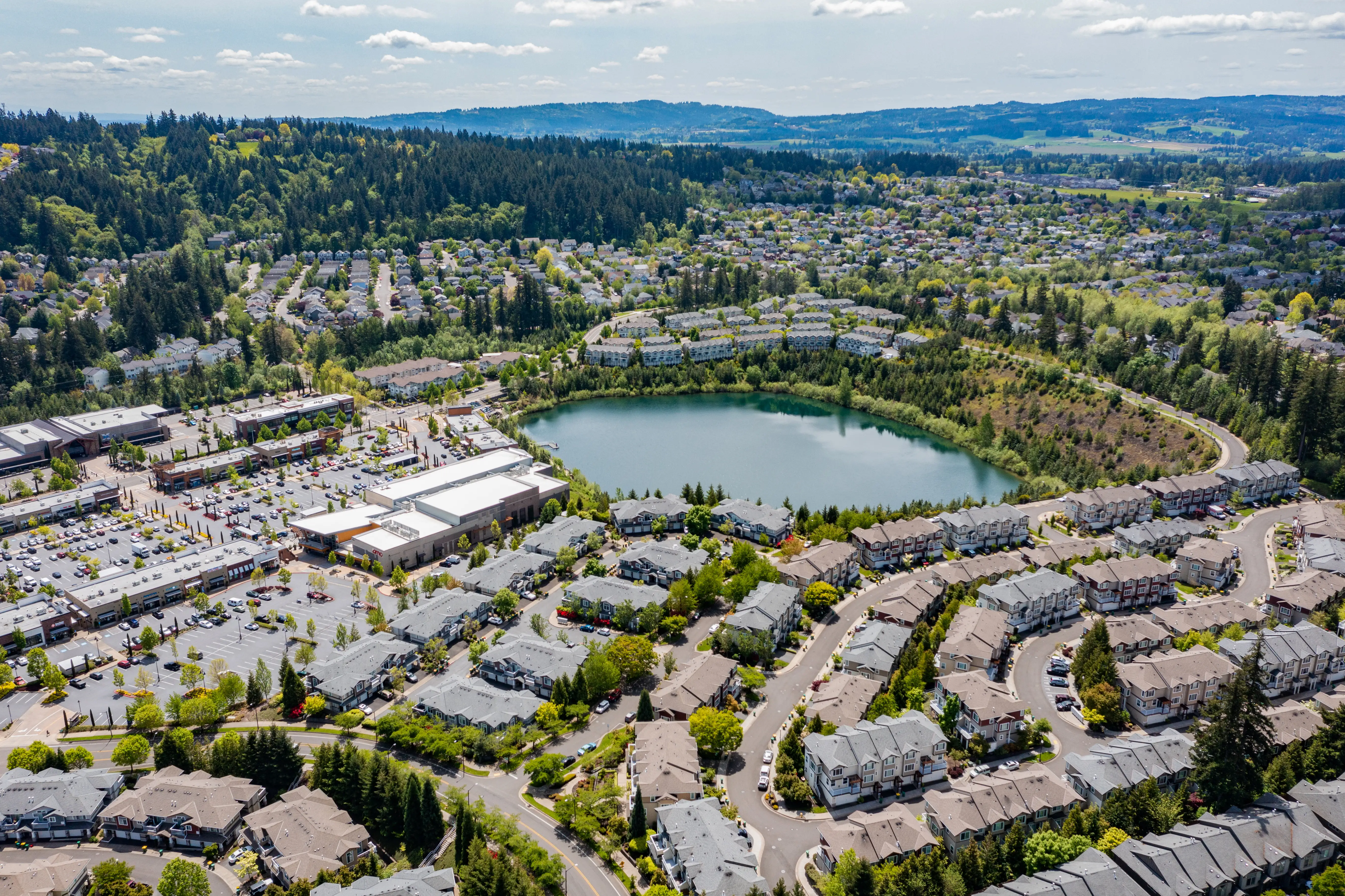
Buyers relocating from California consistently underestimate how varied Beaverton's neighborhoods are. Many arrive expecting a uniform suburb and are genuinely caught off guard by the difference between a hillside lot in Sexton Mountain with views toward the valley and a flat-streets, transit-close block in Central Beaverton. The physical diversity — elevation, tree cover, lot sizes — is real and it matters to how a home feels day to day.
The other consistent surprise is Oregon's property tax structure. Buyers coming from California, Texas, or Arizona often arrive with assumptions built around their home state's system. Washington County's effective rate is meaningfully lower than what many out-of-state buyers expect, and that math often shifts the conversation about what monthly ownership actually costs once they run the real numbers. The Oregon income tax is the offset buyers need to account for, but on the housing cost side, Beaverton consistently comes in under what relocating buyers initially budget for.
| City | Schools | Commute to Portland | How It Compares |
|---|---|---|---|
| Beaverton | A- (Beaverton SD) | ~20 min | Strong schools, lower prices than Portland, broad neighborhood variety |
| Portland | Mixed (PPS, A–B range) | In-city | More walkable core; higher prices for comparable homes in desirable neighborhoods |
| Hillsboro | B+ (Hillsboro SD) | ~30–35 min | Lower prices; Intel is here too; less amenity density than Beaverton |
| Tigard | B+ (Tigard-Tualatin SD) | ~25 min | Good value; less urban feel; competitive with Beaverton in the middle tier |
| Aloha | Served by Beaverton SD | ~25 min | More affordable, less established neighborhood feel; entry-tier buyer territory |
The practical read: Beaverton threads the needle between Portland's prices and Hillsboro's longer commute. If school quality and commute time are your two non-negotiables and your budget is in the middle tier, Beaverton is genuinely hard to beat in the western metro. Tigard is a real alternative worth comparing, especially if you work in Tualatin or Lake Oswego instead of Portland.
Is Beaverton actually a good place to live, or is that just realtor talk? I get a version of this almost word-for-word from out-of-state buyers who found Beaverton on a "best places to live" list and want to know if it's real. Here's my honest read: Beaverton isn't a single suburb with one identity — it's genuinely diverse, it has a real job base beyond just being near Portland (Nike, Intel, and Tektronix all anchor it), and there are pockets with real gathering-place energy, like Cedar Hills Crossing on a weekend. What it isn't is uniform. The block-to-block difference in feel is bigger than people expect from a city this size, which is exactly why I push buyers to pick a neighborhood before they fall in love with a number.
What's the real commute into Portland — is the "20 minutes" you see everywhere actually true? Off-peak, yes — 20 minutes from central Beaverton into downtown is realistic. But that number only tells half the story. US-26 and OR-217 are the two corridors almost everyone funnels through, and commuters have flagged the same pattern for years: both bog down hard in the evening window, and that congestion hasn't meaningfully eased. If your job has you driving home at 5pm, budget closer to 35–45 minutes some days, not 20. The honest workaround is the MAX Blue Line — it's slower door-to-door than driving on a good day, but it's the same length every day, which matters more than raw speed if you hate unpredictability.
Every Beaverton neighborhood looks the same on a map — how do I actually tell them apart? This is the question I wish more buyers asked before touring instead of after. The differences are real but they don't show up on Zillow's map view: Sexton Mountain sits on hillside terrain with territorial views and a noticeably different feel than the flat streets of Central Beaverton. Walkability swings hard by pocket too — Central Beaverton scores a 73 on Walk Score with real bus and MAX access, while South Beaverton and West Beaverton sit in the high 30s, meaning you're driving for almost everything. Housing stock age varies just as much, with older product concentrated in Central Beaverton and Five Oaks versus newer builds in Bethany and parts of Murrayhill.
Is the Beaverton School District actually worth the premium, or is that a sales pitch? This is where I push back on my own industry a little. "A- district" is a real, sourced rating — but it's a district-wide average, and the district covers 50-plus public schools that genuinely don't perform the same. Independent ratings on individual schools in the district show meaningfully more spread than the headline grade suggests. So the district rating is a fine starting filter, but it's not the actual diligence. The real work is pulling the specific elementary, middle, and high school assigned to the address you're considering — not the city, the address — and comparing those individually. I do this for every buyer before we write an offer near a school boundary.
How does Beaverton really compare to Hillsboro, Tigard, and Portland — not the marketing version? Three different answers, because they're three different trade-offs. Versus Portland, the price gap has actually narrowed more than most people realize — recent data has Beaverton's median home value sitting almost on top of Portland's citywide median. That surprises buyers who assumed Beaverton was automatically the budget option. Versus Hillsboro, it's genuinely cheaper — often $75K to nearly $100K lower on median price — and leans newer construction with planned communities like Orenco Station as its walkable comparison point to Beaverton's Central Beaverton. Beaverton wins on established neighborhoods and a shorter hop into Portland. Versus Tigard, pricing is close enough that it usually comes down to lifestyle — Tigard leans more classically suburban with bigger yards and relies on TriMet buses and the WES commuter rail rather than MAX, and school zoning falls under a different district, so I always verify by exact address before a buyer assumes either way.
Is Beaverton's crime rate actually as bad as some of those ranking sites make it look? It's a mixed picture, and I'd rather give you the mixed version than a clean talking point. Beaverton's overall crime rate does run above the national average, and that's almost entirely driven by property crime, not violent crime — Beaverton's violent crime rate is actually below the national average. Resident surveys back that up: the large majority of people living here report feeling safe day to day. And relative to Portland specifically, Beaverton is meaningfully safer on property crime. Like any city this size, safety varies block by block — southwest Beaverton consistently rates as the safer end of the city.
Can I actually live here without a car? In a few pockets, yes. Central Beaverton is the standout — a 73 Walk Score with multiple bus lines plus MAX Red and Blue Line access, genuinely the most car-light part of the city. Outside of that core, the honest answer is no: West Beaverton scores around 39, South Beaverton around 37, which means daily errands assume a car. If car-free living is a real requirement and not a nice-to-have, I narrow your search to Central Beaverton, Raleigh West, or Vose from the start rather than letting you discover the gap after closing.
With prices down right now, is this actually a good time to buy for the long term? I won't pretend to be a market forecaster — I'm a broker, not an economist — but here's what the data actually shows rather than what either a bull or a bear would want you to hear. Prices have softened for roughly the past year, with the median down a few percent year-over-year and the decline gradually flattening rather than accelerating. At the same time, inventory is genuinely tight — under three months of supply — and the large majority of homes are still selling close to asking price, which isn't the profile of a market in real trouble. Most forecasts for the next year point to modest, low-single-digit growth rather than a rebound or a further drop. Beaverton's population growth is also slower than Hillsboro's or Bend's right now, which is part of why price growth here has been more muted than other parts of the metro — less population pressure means less upward push on price. None of that is a guarantee, but it's the honest shape of where things stand.
If you're seriously considering Beaverton in 2026, get specific about your neighborhood before you start touring. The citywide median is a reasonable orientation point, but South Beaverton and West Beaverton are moving faster and holding value better than the headline number suggests, while Central Beaverton has genuine opportunity for buyers with flexibility on product type. Know which tier you're working in before you start writing offers.
What I've seen over years of working this market is that the buyers who end up happiest here didn't just buy the right house — they bought the right commute and the right school zone, and they figured that out before they fell in love with a listing. Beaverton rewards that kind of discipline. The city is large enough to feel different street by street, and the buyers who take that seriously almost always feel better about their decision two years later than the ones who optimized purely on price.
If you're thinking about buying in Beaverton and want a real conversation about where your budget lands and which neighborhoods fit your life, I'd genuinely love to help you work through it.
Browse current listings updated daily — filtered for Beaverton buyers by Elizabeth Davidson, your local expert.
Powered by Elizabeth Davidson · Cascade Hasson Sotheby's International Realty · 503-939-2035
Explore the full Beaverton series: The Ultimate Beaverton Relocation Guide · Is Beaverton Safe? · Cost of Living in Beaverton · Best Neighborhoods in Beaverton · Beaverton Schools & Family Life · Beaverton Youth Sports · Beaverton Parks & Recreation · Retiring in Beaverton · 1031 Tax-Deferred Exchange in Beaverton · Beaverton First-Time Homebuyers Guide · · Moving to Beaverton from California · The Beaverton Realtor's Perspective · Top 10 Questions a Realtor Gets About Beaverton