
Portland Metro · Oregon
1031 Exchange & Investment Real Estate in Beaverton, Oregon (2026)
Not every investor reading this page manages a portfolio of commercial buildings. A large share of the people researching 1031 exchanges into Beaverton right now are California homeowners who finally sold after years of appreciation and are sitting on $800,000 to $1.5 million in taxable gain. They've done the math on what the IRS will take and they're not interested in writing that check. Beaverton keeps appearing in those conversations because it offers what most of California no longer does: reasonable entry prices, durable rental demand anchored by major corporate employers, and a landlord environment that — while not hands-off — is predictably navigable once you understand the rules.
Beaverton's rental market is unusually stable for a city its size. Roughly half of all occupied housing units in the city are renter-occupied — a near-even split that reflects a tenant base dominated by tech and healthcare professionals, not transient renters. Nike, Intel, and Providence Health collectively employ tens of thousands of workers in the immediate area, and many of those workers rent rather than buy. Two-bedroom units make up the dominant share of the rental stock, and roughly 39% of renters hold a bachelor's degree or higher. That's the kind of educated, employed renter pool that keeps vacancy manageable and turnover low.
This guide covers everything a 1031 buyer needs to evaluate Beaverton as a replacement property market: exchange mechanics, local property types and cap rates, the tax environment, Oregon landlord-tenant law, and a due diligence checklist built for someone working against a 45-day identification deadline.

The mechanics of a 1031 exchange are cleaner than most people expect, but the deadlines are unforgiving. From the day you close on your relinquished property, you have exactly 45 days to formally identify your replacement property in writing to your qualified intermediary. That's not 45 business days — it's 45 calendar days. You can identify up to three properties without restriction, or more than three if you follow the 200% rule or the 95% rule. Most investors stick to three and move decisively.
The 180-day closing deadline runs concurrently from the same day your relinquished property closes, not from the end of the identification window. Your qualified intermediary — a third-party entity that holds and transfers your exchange funds — must be in place before you close the sale. You cannot receive the proceeds yourself at any point without triggering recognition of the gain. The like-kind requirement is broadly interpreted: any real property held for investment or business use qualifies as like-kind to any other real property held for the same purpose. A Bay Area duplex can exchange into a Beaverton single-family rental, a small strip of retail space, or an industrial unit — all without issue.
The boot trap catches more investors than any other rule. If your replacement property is worth less than your relinquished property, or if you don't reinvest all of the net proceeds, the difference becomes taxable as "boot." The cleanest exchanges involve trading up in price and reinvesting 100% of proceeds. If you want to pull some cash out at closing, plan for that portion to be taxed — it won't disqualify the rest of the exchange.

What out-of-state investors most consistently underestimate about Beaverton is how quickly investment-grade inventory moves when it's priced correctly. A well-maintained duplex in Cedar Hills or a clean single-family rental in South Beaverton priced at market can generate serious activity within two weeks of listing. If you're on a 45-day identification clock and you haven't built local relationships before your relinquished property closes, you're competing against buyers who have already toured the property twice and have their qualified intermediary ready to wire. The investors I work with who succeed here are the ones who start their Beaverton search 60 to 90 days before they ever list their California property.
What I watch for when evaluating investment-grade properties in this market is the rent-to-price ratio relative to condition. The Beaverton market right now sits in a rare position: prices have softened from their 2025 peak while rents have stabilized rather than collapsed. That gap creates better yields than this market offered 18 months ago. I specifically look at properties in the $480,000 to $650,000 range — older construction SFRs and smaller multifamily in Five Oaks, Central Beaverton, and the Vose neighborhood — where the numbers pencil out in a way they don't in newer construction above $700,000. If you're considering Beaverton and want insight into which neighborhoods align with your priorities and budget, I'd welcome the opportunity to share what I've learned from helping hundreds of families make this move successfully.
Beaverton's investment property market in mid-2026 reads as a balanced market with selective pockets of opportunity. The median sold price sits at approximately $595,000 — essentially aligned with the $594,000 baseline that informed buyers use for underwriting. Prices pulled back from a 2025 peak, and average days on market have extended to the 30–60 day range depending on property type, which creates more negotiating room than investors saw during the 2021–2023 run-up.
The property mix available to 1031 buyers is more varied than most out-of-state investors expect. Single-family rentals dominate the traded inventory, but the city also carries active listings of condos, townhouses, and small multifamily. Condos average around $310,000 at the city-wide level, while single-family homes average closer to $700,000 — a spread that creates real options across different capital deployment sizes. New construction concentrates in Bethany and around Progress Ridge, starting in the mid-$600,000s, but 1031 buyers with a depreciation strategy are often better served by older construction with more basis to depreciate.
| Property Type | Typical Price Range | Est. Cap Rate | Avg Days to Close |
|---|---|---|---|
| Single-Family Rental (SFR) | $480,000 – $750,000 | 3.5% – 4.5% | 30 – 45 days |
| Duplex / Small Multifamily | $600,000 – $950,000 | 4.5% – 5.5% | 30 – 50 days |
| Condo / Townhouse | $285,000 – $420,000 | 4.0% – 5.0% | 25 – 40 days |
| Commercial / Mixed-Use | $800,000 – $2,000,000+ | 6.0% – 9.0% | 45 – 75 days |
Condos and townhouses move fastest in this market, partly because the entry price is lower and the buyer pool is wider. Well-located duplexes — particularly in Five Oaks and Central Beaverton — can generate mid-5% cap rates and are the sweet spot for investors who want meaningful yield without the management complexity of larger buildings. Commercial and office assets offer the highest cap rates on paper, but Beaverton's office vacancy has been elevated — running above 16% in 2024, with the core Beaverton submarket reaching 21% — so underwriting office occupancy assumptions requires extra scrutiny in 2026.
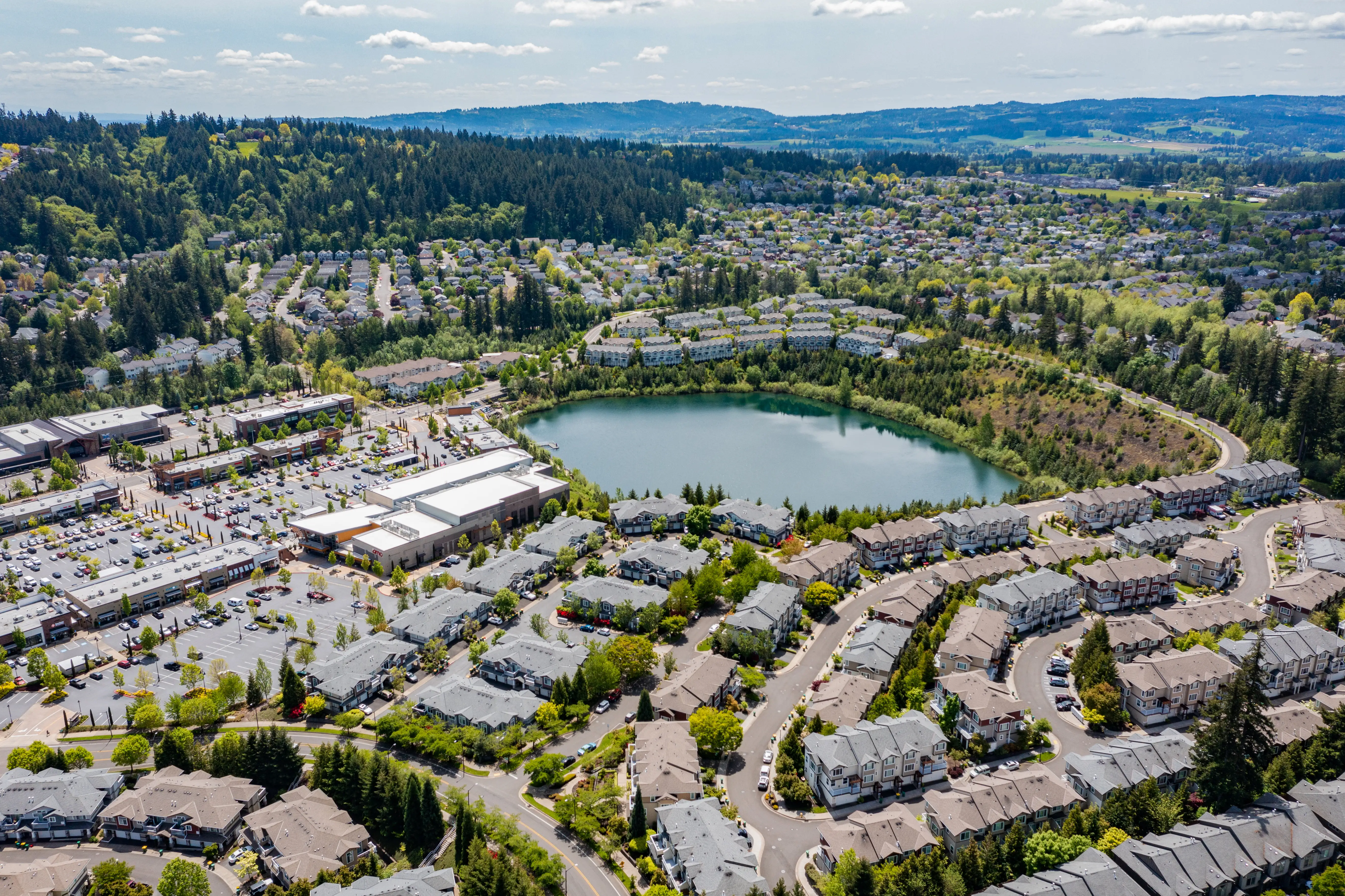
The math that drives California capital into Beaverton starts with price differential. California's coastal markets have appreciated far beyond what rental income can support, compressing yields to the point where buying on fundamentals became nearly impossible. Beaverton offers a functioning price-to-rent relationship and a tenant base that doesn't require subsidized housing programs to fill units.
A Bay Area investor selling a primary residence or rental property at $1.4 million in proceeds can land a well-located Beaverton duplex in the $650,000 to $850,000 range and a separate single-family rental in the $480,000 to $550,000 range — entirely debt-free — with capital left over. That's two income-producing assets, no leverage risk, and an immediate yield that exceeds anything available in San Jose or Oakland at comparable purchase prices. The Beaverton tenant pool of tech-adjacent professionals is familiar terrain for Bay Area investors.
Southern California investors — particularly those exiting rental properties in Los Angeles or Orange County — are arriving with proceeds that translate into two or three Beaverton properties at once. A long-held duplex in the San Fernando Valley that sells for $900,000 maps cleanly onto Beaverton's mid-range multifamily inventory. The absence of California's ongoing rent control expansion is a meaningful part of the conversation for LA landlords who have spent years navigating AB 1482 and local ordinances — though Oregon's own landlord-tenant framework requires equal attention before assuming a more permissive environment.
Sacramento and Inland Empire sellers are often working with proceeds in the $500,000 to $900,000 range, which positions them to acquire a single strong Beaverton SFR or a smaller multifamily asset without stretching. These investors tend to be drawn by the employment base: Beaverton's anchor employers — Nike, Intel, Columbia Sportswear — are household names that signal long-term job stability, and that stability translates directly into tenant quality and retention. The 20-minute commute corridor to Portland broadens the renter pool considerably.
Looking to buy in Beaverton? Estimate your payment.
Enter your numbers to see an estimated monthly mortgage payment.
Estimate only. Excludes HOA fees and mortgage insurance.
Oregon's tax environment for real estate investors is a mix of advantages and obligations that differ significantly from California's structure. The single most immediate advantage is Oregon's complete absence of a state sales tax. For investors doing any renovation or furnishing work on a replacement property — flooring, appliances, fixtures, paint — paying zero sales tax on materials is a real savings that shows up directly in rehab budgets.
| Tax Item | California | Oregon |
|---|---|---|
| State income tax on rental income | Up to 13.3% | Up to 9.9% |
| Property tax rate (new purchase) | ~1.1%–1.3% (Prop 13 reset) | ~1.00% (Washington County) |
| State sales tax | 7.25%–10.75% | None |
| Capital gains treatment | Taxed as ordinary income (state) | Taxed as ordinary income (state) |
| Transfer / documentary tax | Yes (varies by county) | No statewide transfer tax |
Oregon's income tax on rental income reaches a top marginal rate of 9.9%, which matters for high-income investors. The practical offset is that depreciation, mortgage interest, property management fees, and maintenance expenses reduce taxable net income substantially — often to near zero on a leveraged property in the early years of ownership. Washington County's property tax rate of approximately 1.00% compares favorably against what a California buyer would face after a Prop 13 reassessment on a newly purchased replacement property, where effective rates on the new purchase price typically land in the 1.1% to 1.3% range depending on county and local assessments.
One structural note for 1031 investors specifically: your depreciation basis does not reset in an exchange. The depreciation schedule from the relinquished property carries into the replacement property, which means investors who have held long-term appreciated properties arrive with a lower depreciable basis than a buyer who purchased outright. This is a detail your CPA will model before you close. Finally, investors who want the tax deferral of a 1031 without the operational burden of direct property ownership can look at Delaware Statutory Trusts — DSTs allow exchange proceeds to flow into a passive fractional interest in institutional-grade property, which satisfies the 1031 like-kind requirement while eliminating landlord obligations entirely.
Oregon's landlord-tenant law is among the more protective in the country for tenants, and Beaverton investors — especially those arriving from California expecting a friendlier environment — are sometimes caught off guard by the specifics. Oregon eliminated no-cause evictions for month-to-month tenants in many situations, and landlords must provide written notice and documentation for most terminations. Rent increase notices require 90 days' advance notice statewide. While Beaverton itself does not have additional local rent control ordinances layered on top of state law, the state framework applies in full and requires understanding before you execute your first lease.
Typical property management fees in the Beaverton market run 8% to 10% of gross monthly rent, with leasing fees — typically equivalent to 50% to 100% of one month's rent — charged separately when a unit turns over. Local property management firms operating in the Beaverton and Washington County market include Guardian Property Management and The Management Group (TMG), both of which work with smaller landlord portfolios. Out-of-state owners who try to self-manage from California consistently underestimate the coordination required for maintenance calls, the documentation needed for any lease termination, and the cost of tenant turnover in a softening rental market.
Beaverton's overall rental vacancy rate has been trending modestly above 6% in 2026, reflecting some new supply absorption and a seasonal softening in demand. Rents across the city range from approximately $1,650 to $1,830 per month for apartment-style units, with single-family rentals anchoring closer to $2,000 per month. The strongest rent-to-price ratios are found in older stock in Five Oaks and Central Beaverton, where purchase prices remain below the city median but rents track at market rates.
| Item | What to Verify | Local Resource |
|---|---|---|
| Title Search | Clear title, no liens or encumbrances | Washington County title company (e.g., Fidelity National Title) |
| Sewer / Septic Status | Public sewer connection confirmed; septic risks in rural-adjacent areas | Washington County Clean Water Services |
| Radon Testing | Oregon has elevated radon zones; test pre-close | Oregon DEQ radon maps + licensed inspector |
| Flood Zone Status | FEMA flood map check; affects insurance cost and financing | FEMA Flood Map Service Center |
| Rental Permit Requirements | City of Beaverton requires rental housing inspection registration | City of Beaverton Community Development |
| HOA Rental Restrictions | Many Beaverton condo/townhouse HOAs limit rental percentage | Review HOA CC&Rs and current rental cap status |
| ADU / Zoning Potential | Confirm R1/R2 zoning and ADU permissibility — adds long-term value | Washington County Land Use / City of Beaverton Planning |
| School District Assignment | Beaverton School District assignment affects SFR tenant pool quality | Beaverton School District boundary tool |
| Current Lease Status | Month-to-month vs. fixed-term; tenant rights if sale mid-lease | Review lease + Oregon landlord-tenant law (ORS Ch. 90) |
| Deferred Maintenance Inspection | Roof, HVAC, foundation, plumbing — full inspection with licensed Oregon inspector | Oregon Licensed Home Inspectors (CCB-licensed) |
| Property Management Referral | Identify management company before close if out-of-state | Guardian Property Management, The Management Group (TMG) |
| Title Insurance | Owner's and lender's policies; ensure investment property endorsements | Washington County title company |
| Environmental / Lead Paint | Pre-1978 construction requires disclosure; test if renovating | EPA RRP rule + Oregon OSHA |
| Comparable Rent Analysis | Current market rents by unit type and neighborhood | Zillow Rental Manager, Zumper, local PM company |
| QI Coordination Timing | Verify qualified intermediary is in place before relinquished property closes | 1031 exchange company (e.g., IPX1031, Exeter 1031) |
Local Expert Takeaway: The single most common mistake California 1031 buyers make in Beaverton is treating the purchase like a Bay Area acquisition — moving fast on price alone without understanding Oregon's tenant protections. A property with a month-to-month tenant who has lived there over a year carries significant notice and documentation obligations before you can reposition it. Always review the current lease structure and understand Oregon ORS Chapter 90 before you submit an offer, not after inspection removes. In a market where days on market have extended, you have time to be thorough — use it.
Getting pre-approved for your investment purchase before your relinquished property closes isn't just smart — it's the difference between winning the right property and watching it go to someone who was ready. If you want to keep the transaction off your personal debt-to-income ratio, ask about DSCR loans, which qualify based on the property's rental income rather than your W-2. Todd can connect you with investment-focused lenders who work these structures regularly in the Washington County market.
✅ Beaverton's near-50/50 owner-renter split and anchor employer base — Nike, Intel, Providence Health — create durable rental demand that holds up better than markets dependent on a single industry or demographic.
⚠️ Oregon's landlord-tenant law is tenant-protective. No-cause eviction restrictions, 90-day rent increase notice requirements, and documentation obligations make self-management from California a genuine operational risk.
📍 The best cap rate opportunities in 2026 are in older single-family stock and small multifamily in Five Oaks and Central Beaverton — not new construction in Bethany, where purchase prices compress yields below the 4% threshold.
Does a 1031 exchange work for out-of-state property?
Yes, a 1031 exchange works across state lines without restriction. You can sell a relinquished property anywhere in the United States and identify replacement properties in Oregon — or any other state — as long as both properties are held for investment or business use. The same 45-day identification and 180-day closing deadlines apply regardless of where the properties are located.
What is the cap rate on rental property in Beaverton?
Cap rates in Beaverton vary meaningfully by property type. Single-family rentals at the current median price range deliver net cap rates in the 3.5% to 4.5% range. Duplexes and small multifamily in well-located neighborhoods can reach 4.5% to 5.5%. Value-add opportunities in older vintage stock push toward the higher end of that range. Commercial assets carry higher published cap rates but come with elevated vacancy risk in the current office market.
Do I need a local property manager for a 1031 investment in Oregon?
Out-of-state owners are not legally required to use a property manager, but Oregon's landlord-tenant law is detailed enough that managing remotely without local expertise creates real compliance risk. Documentation requirements, notice timelines, and the prohibition on no-cause evictions in many situations require active attention. Most out-of-state 1031 investors operating in Beaverton hire a local property manager from day one — the 8% to 10% management fee is far less expensive than a legal misstep on a termination or rent increase notice.
Browse current listings updated daily — filtered for Beaverton buyers by Elizabeth Davidson, your local expert.
Powered by Elizabeth Davidson · Cascade Hasson Sotheby's International Realty · 503-939-2035
Explore the full Beaverton series: The Ultimate Beaverton Relocation Guide · Is Beaverton Safe? · Cost of Living in Beaverton · Best Neighborhoods in Beaverton · Beaverton Schools & Family Life · Beaverton Youth Sports · Beaverton Parks & Recreation · Retiring in Beaverton · 1031 Tax-Deferred Exchange in Beaverton · Beaverton First-Time Homebuyers Guide · · Moving to Beaverton from California · Beaverton Realtor's Perspective · Top 10 Questions a Realtor Gets About Beaverton
Tell us what you need help with and we'll connect you with local resources.

About the Author
Todd Davidson is the founder of Living in Oregon and Living in Washington, where he publishes in-depth city guides, neighborhood resources, and local market insights covering more than 180 communities across the Pacific Northwest. While his background is in home financing and real estate, he created these digital platforms to help families research and compare regions before making a move.