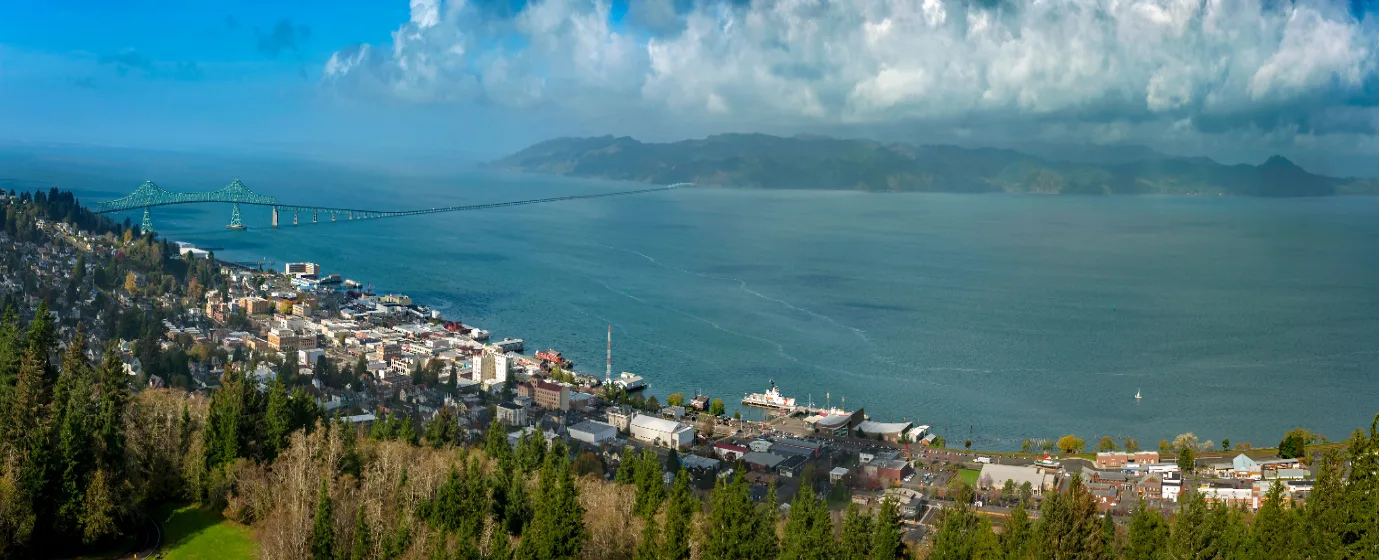
Oregon Coast · Oregon
Astoria, Oregon Schools & Family Life: Top Districts, Academics & Community (2026)
You're six months out from moving to Astoria, and the school question is the one keeping you up at night. The Pacific Northwest coastal lifestyle is compelling. The $487,000 median home price is well below what you'd pay in Portland. But the Astoria School District 1 carries a B-minus grade on Niche, and you need to know what that actually means for your kids — not in the abstract, but on a Tuesday morning when your third-grader is heading off to class.
The district's performance reflects the realities of a small coastal community. Astoria School District 1 enrolls roughly 1,800 students across four schools, and it operates with real constraints: a student population where over a third qualify as economically disadvantaged, chronic absenteeism rates that climbed significantly during the post-COVID years, and academic proficiency scores in math that trail state averages. At the same time, the graduation rate tells a different story — one that suggests the district does something right in the later years, even when the earlier numbers look modest.
What shapes daily school life here is a combination of geography, community size, and institutional history. This is one of Oregon's oldest operating school districts, founded in 1854, and it carries the character of a working waterfront town. This guide is designed to help you cut through the rankings noise and understand what Astoria's schools will actually mean for your family — which schools serve which grades, where the real strengths are, and what the honest gaps look like before you make an offer on a house.

| Category | Detail |
|---|---|
| District Established | 1854 |
| Total Enrollment | ~1,796 students |
| Grades Served | PK, K–12 |
| Number of Schools | 4 main schools (2 primary, 1 middle, 1 high school) |
| Student-Teacher Ratio | 16:1 district-wide |
| Per-Pupil Spending | $15,055/year |
| Licensed Teachers | 100% |
| Niche Overall Grade | B minus |
| District HQ | 785 Alameda Ave, Astoria, OR 97103 |
| Math Proficiency (District) | 28% |
| Reading Proficiency (District) | 48% |
| Economically Disadvantaged | 34.7% of students |
| Average Teacher Salary | $66,511 |
What those numbers mean in practice is this: if you are moving from a high-performing suburban district in the Portland metro or from out of state, you will notice the proficiency gap, particularly in math. The district-wide 28% math proficiency rate sits well below the state average. Reading at 48% is slightly above the state's 44%. The B-minus composite grade reflects a district that does some things well — graduation outcomes, teacher licensure, per-pupil investment — but hasn't fully closed the academic achievement gaps that persist in many smaller Oregon districts.
Parents in downtown Astoria, Uniontown, and Astor Heights tend to know this school before they visit it, because it has a piece of pop culture history baked into its walls — it served as the filming location for the 1990 Arnold Schwarzenegger film Kindergarten Cop, a detail that children find endlessly impressive. Astor Elementary serves kindergarten through 2nd grade at 3550 Franklin Avenue, enrolling around 328 students at a 13:1 student-teacher ratio, making it one of the more intimate settings in the district. The honest limitation is that over half the student body qualifies for free or reduced lunch, which reflects a socioeconomically diverse enrollment that correlates with the proficiency challenges you'll see across the district in the early grades.
Lewis & Clark serves grades 3 through 5 at 92179 Lewis and Clark Road — a fringe-rural setting across Young's Bay from downtown, constructed through a $21.4 million bond measure in 2000. It's consistently been the district's top academic performer, with math and reading proficiency rates that track above state averages, though chronic absenteeism has risen to over 34% in recent years, which is the school's most significant challenge. Families who live in the Lewis and Clark Road corridor and River Point area tend to find this school a good fit, but buyers who prize attendance culture should ask the district directly about what interventions are currently in place.
Astoria Middle School bridges 6th through 8th grade and shares the district's broader academic profile — students arriving with mixed elementary foundations move into a setting where teacher relationships remain close given the district's overall size. The middle school's strength is the same as the district's: small enough that students don't get lost, and staffed by fully licensed teachers. Families coming from larger suburban districts often find the adjustment to a smaller, less departmentalized environment either reassuring or limiting depending on what their student needs.
Astoria Senior High School sits at 1001 West Marine Drive on the edge of Youngs Bay, and its Fishermen mascot is a direct nod to the city's working waterfront identity. The school serves grades 9 through 12, enrolling approximately 631 students in the only public high school in town. The 91.5% four-year graduation rate for the Class of 2024 is the number that matters most here — it's the highest in Clatsop County and reflects a deliberate institutional investment in keeping students on track, including two on-track coaches, a student success coordinator, and a family liaison focused on re-engaging chronically absent students. The school competes in OSAA 4A athletics under the Fishermen name, and its athletic culture — particularly in sports like wrestling and football — tends to be a genuine point of community pride.
The student who thrives at Astoria High is typically one who benefits from close teacher-student relationships, who doesn't need a sprawling course catalog to feel challenged, and who is comfortable in a school where the graduating class numbers well under 200. The student who may find it limiting is one who came from a school offering AP courses across 15+ subjects, an IB program, or highly specialized elective tracks — Astoria High offers some AP coursework, but the breadth is constrained by the school's size.
👨👩👧👦 Oregon Coast: Best Places for Families
Wondering how Astoria stacks up against other Oregon Coast cities for families? Our complete rankings guide covers every coast city — schools, safety, outdoor activities, and family amenities side by side.
See the Full Oregon Coast Best Places for Families Rankings →Looking to buy in Astoria? Estimate your payment.
Enter your numbers to see an estimated monthly mortgage payment.
Estimate only. Excludes HOA fees and mortgage insurance.
A B-minus district grade means different things to different families, and the gap between the paper grade and the lived experience in Astoria is worth naming plainly. Parents who have moved here — particularly from California and from the Portland suburbs — tend to report a similar adjustment arc: initial concern about the test score gap, followed by genuine appreciation for how individually known their children become.
The district's low student-teacher ratios and fully licensed teaching staff mean that classroom quality, at the individual teacher level, is often stronger than the aggregate proficiency scores suggest. What those scores measure is where students start, and in a district where over a third of students are economically disadvantaged, the starting point is often lower — which depresses the proficiency average without necessarily reflecting the quality of instruction. Families with students who arrive academically prepared often find the schools a reasonable fit; families who need intensive academic intervention services may find the resources stretched.
The geographic split between elementary schools is one thing parents discover after they move. Astor Elementary and Lewis & Clark serve different grade bands and are in physically distinct parts of town. Buyers who purchase in the Lewis and Clark Road corridor will have their elementary-age children at a different campus than neighbors closer to downtown, which affects carpooling, community cohesion, and the social networks that develop in the early grades.
Families relocating for a gifted-and-talented magnet, an IB program, or a large-school AP catalog will find Astoria's offerings limited. The district does list a gifted program through Niche data, but the scale of programming is proportionate to a 1,800-student enrollment — it is not a standalone dedicated magnet. If competitive academic programs are the primary driver of your school decision, Seaside School District and the broader Portland metro offer more specialized options, though they come with higher home prices and longer commutes.
For families with students who need significant special education services, the district's small size can cut both ways — staff know individual students well, but a small district may not have the breadth of specialists that a larger suburban district can support in-house. Asking specific questions about available support services before committing to a neighborhood is worthwhile.
In competitive OSAA athletics beyond the 4A classification, Astoria High competes at a level appropriate to its enrollment. Families relocating a student-athlete who played in a larger 5A or 6A program should calibrate expectations accordingly — the competition level and the recruiting visibility are genuinely different at 4A.
| School/Provider | Type | Grades/Ages | Notes |
|---|---|---|---|
| Our Lady of Guadalupe Catholic School | Private Catholic | K–8 | Located in Astoria; faith-integrated curriculum |
| Astoria Christian School | Private Christian | K–12 | Small enrollment; classical-adjacent approach |
| Clatsop Community College Child Development Center | Preschool/Childcare | Ages 2–5 | On-campus facility; college lab school setting |
| YMCA Early Childhood Program | Childcare/Preschool | Infant–PreK | Full-day and part-day options; sliding-scale fees |
For working families, licensed in-home childcare providers make up a significant share of the infant and toddler capacity in Astoria — the formal center-based options are limited relative to family demand, particularly for children under two. The Clatsop Community College Child Development Center serves a lab school function, meaning children interact with early childhood education students in a supervised environment, which some families find appealing and others less so.
Our Lady of Guadalupe Catholic School represents the most established private K–8 option in the city and draws enrollment from families across the Astor Heights, South Slope, and downtown neighborhoods regardless of religious affiliation, primarily because it offers a consistent academic environment with smaller class sizes than the public elementary schools.
The Astoria Public Library on Exchange Street is one of the community's quiet strengths for families. Its children's programming — including summer reading challenges and after-school drop-in events — runs consistently and draws participation from across the district's neighborhoods. It is the kind of community anchor that larger cities take for granted and small cities like Astoria rely on heavily.
The Astoria Riverwalk, stretching nearly seven miles along the Columbia River waterfront, doubles as a family corridor on weekends, with the restored trolley line offering a low-cost activity that children reliably love. The Astoria Sunday Market, running seasonally from May through October in the Riverwalk plaza area, functions as a de facto community gathering space where school-age children often see their teachers and coaches outside of the classroom — a characteristic of small-town life that reinforces the district's close-knit culture.
Youth programming through the Astoria Parks and Recreation Department includes seasonal sports leagues and after-school activities, and the YMCA of Columbia-Pacific on Exchange Street runs swim lessons, youth fitness programming, and summer day camp options that fill a critical gap during the school year and summer months. The Columbia River Maritime Museum occasionally runs education-adjacent programming for school groups and families, and for children drawn to maritime history, science, or the natural environment, it's a resource that goes beyond a single field trip.

Local Expert Takeaway: Don't let the B-minus district grade be the last thing you read before making an offer. Lewis & Clark Elementary's above-state-average proficiency rates and the high school's 91.5% graduation rate are the two data points that tell a more complete story. If you're buying in the $450,000–$520,000 range in South Slope or Astor Heights, you're placing your kids in the district's strongest elementary feeder corridor while staying well below Portland-metro school-district premiums. Families who ask the district directly about gifted programming and AP course availability before closing tend to be far more satisfied a year in than those who assumed — ask the questions early.
👨👩👧👦 Oregon Coast: Best Places for Families
Wondering how Astoria stacks up against other Oregon Coast cities for families? Our complete rankings guide covers every coast city — schools, safety, outdoor activities, and family amenities side by side.
See the Full Oregon Coast Best Places for Families Rankings →Is Astoria a good place for families?
Astoria offers small class sizes, a 91.5% high school graduation rate, and a genuinely close-knit community where children are individually known to their teachers — factors that matter a great deal in practice. Families who thrive here tend to value community connection over course breadth, and those who invest in supplemental learning resources tend to find the district's foundations more than adequate.
What are the schools like in Astoria?
Astoria School District 1 serves roughly 1,800 students across four schools, earning a B-minus overall grade from Niche. Academic proficiency rates in math trail state averages, while reading scores sit slightly above them. The high school's graduation outcomes are the district's standout metric, supported by intentional on-track programs and a student success team.
How does Astoria compare to nearby school districts?
Seaside School District and, to a lesser extent, the Warrenton-Hammond School District offer points of comparison for families considering the northern Oregon Coast region. Astoria's per-pupil spending of $15,055 is competitive, and its high school graduation rate outperforms neighboring districts. Families prioritizing AP course depth or dedicated gifted programs may find Seaside's slightly larger enrollment offers incrementally more specialized options, though the practical differences at the classroom level are modest.
Explore the full Astoria series: The Ultimate Astoria Relocation Guide · Is Astoria Safe? · Cost of Living in Astoria · Best Neighborhoods in Astoria · Astoria Schools & Family Life · Astoria Youth Sports · Astoria Parks & Recreation · Retiring in Astoria · 1031 Tax-Deferred Exchange in Astoria · Astoria First-Time Homebuyers Guide · · Moving to Astoria from California
Tell us what you need help with and we'll connect you with local resources.

About the Author
Todd Davidson is the founder of Living in Oregon and Living in Washington, where he publishes in-depth city guides, neighborhood resources, and local market insights covering more than 180 communities across the Pacific Northwest. While his background is in home financing and real estate, he created these digital platforms to help families research and compare regions before making a move.
Check Out the Oregon Coast Rankings: Oregon Coast Cost of Living — All 16 Cities Ranked · Best Places to Retire on the Oregon Coast · Best Oregon Coast Cities for Families · Best Oregon Coast Cities for Remote Workers · Oregon Coast Real Estate Market Report 2026 · Oregon Coast vs. Washington Coast