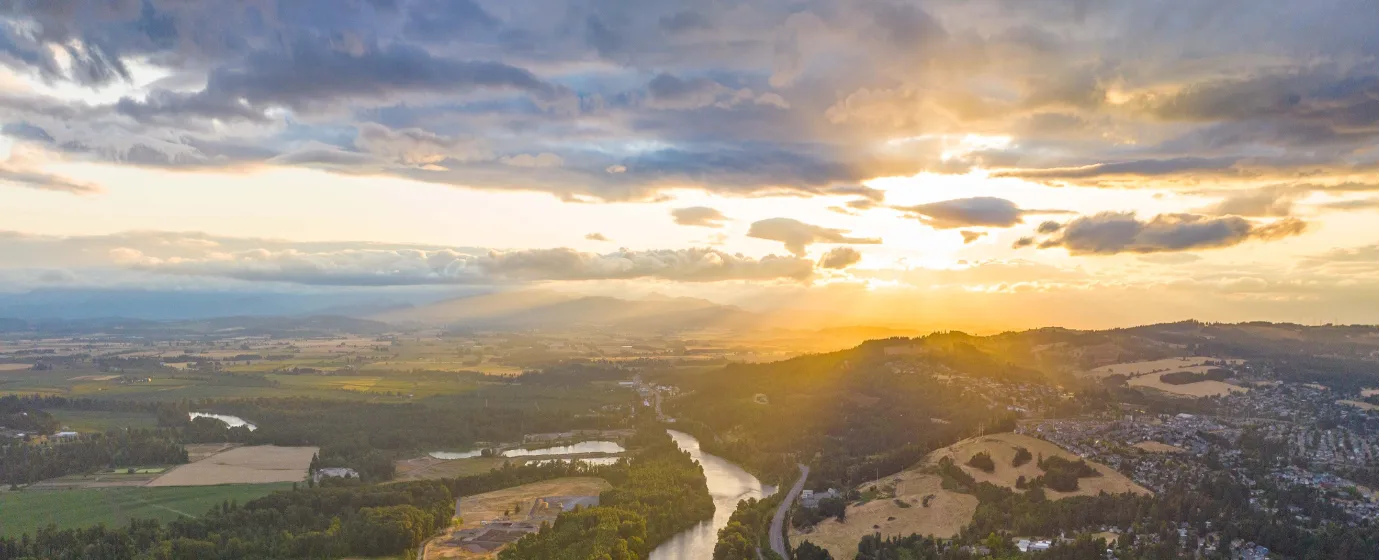
Willamette Valley · Oregon
Is Turner Safe? Crime Rates, Safest Neighborhoods & Local Reality (2026)
Turner doesn't read like a place that needs a safety guide. With roughly 2,400 residents, a single main corridor, and a community where people still wave at neighbors they recognize from church, the threat calculus here is fundamentally different from what buyers fleeing Salem or Portland are used to. But "small town" doesn't automatically mean "no crime," and buyers deserve a honest picture before they commit to a $552,000 purchase in a city where most people know their neighbors by name.
What the numbers actually show is encouraging. Turner's violent crime rate runs around 1.7 incidents per 1,000 residents — meaningfully below the Oregon state average and below the national average, despite the city sitting just 15 minutes from Salem, one of the highest-crime mid-size cities in the country. Property crime is more present, hovering around 9 per 1,000, but even that figure sits below Oregon's notoriously elevated statewide rate. In daily terms, a crime of any kind occurs on average roughly every two and a half days in the entire city — in a town of under 2,500 people, that context matters.
This guide breaks down what those figures mean block by block, compares Turner honestly to its neighbors, and gives you the practical intelligence that crime statistics alone can't provide — including where the environmental risks actually live, what residents say after years of daily life here, and what a local real estate expert wants you to know before you sign.
Turner sits in an unusual position statistically. Local police data and FBI-derived trend models suggest a total crime rate of approximately 10 incidents per 1,000 residents — lower than both the national average and the Oregon state average. For context, Oregon ranks in roughly the 14th percentile for safety nationally, meaning the state as a whole underperforms badly on crime. Turner bucks that state trend in a meaningful way. The city's overall downward trajectory over roughly the past decade reinforces the sense that this isn't a community in decline — it's one that has quietly maintained stability while the cities around it have struggled.
The structural reasons for Turner's numbers aren't hard to identify. Nearly 70% of homes in Turner are owner-occupied, a figure that consistently correlates with lower crime in small municipalities. The city's layout — primarily residential streets feeding into a compact commercial center along 3rd Street — limits the kind of transient foot traffic that drives opportunistic crime in larger towns. There's no dense retail corridor, no late-night entertainment district, and no major transit hub that would draw activity from outside the community. Turner is, in practical terms, a place people live rather than pass through.
One important caveat: the most recent verified FBI crime data reported for Turner dates to 2018, with subsequent figures drawn from statistical trend models rather than direct reporting. CrimeGrade assigns Turner a C+ for violent crime overall, which sounds worse than it is — that grade reflects the national comparison framework rather than a specific local failure. On both violent and property crime, Turner performs better than the Oregon average, and that's the relevant comparison for buyers relocating within the state.
Turner's violent crime rate is estimated at roughly 1.7 incidents per 1,000 residents in a typical year — a figure that, when mapped across the city, is concentrated primarily in the northern sections, with the central and eastern portions of town reporting as low as zero violent crimes in an average year. For a buyer, that means the vast majority of Turner's residential areas carry a day-to-day violent crime risk that is essentially negligible. People walk Mill Creek Trail at dusk. Kids ride bikes to Turner City Park. The community functions like a place where violent crime is genuinely rare rather than just statistically managed.
Property crime tells a more nuanced story. At approximately 9 incidents per 1,000 residents, it's the dominant crime category — as it is in nearly every small Oregon city — and it follows predictable patterns. Vehicle-related theft and minor package theft near the 3rd Street commercial corridor and Highway 99E account for most of what gets reported. The city's proximity to I-5 means occasional outsider traffic, and that's where most opportunistic property crime originates rather than from within the community itself. Residents who park in lit areas and maintain basic home security report very few issues.
Turner is small enough that formal neighborhood designations are more informal than official — there's no city zoning map that carves the town into named districts. What residents and local agents recognize instead are a handful of distinct pockets with meaningfully different characters, each shaped by proximity to Mill Creek, the Highway 99E corridor, or the city's newer residential development edges.
The commercial heart of the city runs along 3rd Street SE, where city hall, the post office, and a small cluster of businesses create the closest thing Turner has to a downtown. This is also where the bulk of Turner's property crime concentrates — not because the area is dangerous, but because it's the only place with regular foot traffic and parked vehicles. Residents here have few concerns about personal safety but do exercise basic vehicle precautions that are standard practice across small Oregon towns with highway proximity.
Best for: Buyers who want walkability to civic amenities and don't mind being a short block from the commercial strip.
The eastern residential sections consistently carry Turner's lowest violent crime estimates — the chance of being a victim of violent crime on these streets runs as low as 1 in 1,190, compared to less favorable odds in the southern quadrant. These streets are almost exclusively owner-occupied single-family homes, largely developed between the 1970s and 1990s, with the quiet, low-traffic character that makes evening walks and unsupervised kids on bikes feel completely normal. The Turner Police Department itself is located on Chicago St SE, which functions as a natural anchor for community visibility in this part of town.
Best for: Families with school-age children and buyers prioritizing residential quiet with minimal through-traffic.
The area along Mill Creek running through Turner City Park and Turner Lake Park offers some of the most appealing daily living in the city — trail access, open space, and a genuine sense of place that small Oregon towns often lack. Crime along the creek corridor itself is minimal, though the park areas attract occasional after-hours loitering that is more nuisance than threat. Residents near the creek tend to be the most vocal advocates for Turner's quality of life, and homes backing to the park command a premium for good reason.
Best for: Outdoor-oriented buyers and retirees who prioritize access to green space and low noise.
One of the few named residential communities in Turner, Enchanted Ridge is a gated development on the southern edge of town with single-level homes situated on one- to two-acre lots. The combination of gated access, larger lot sizes, and an owner-occupied demographic creates a self-reinforcing safety dynamic that residents consistently describe in positive terms. The southern quadrant of Turner does carry a slightly elevated violent crime risk relative to the east — odds of roughly 1 in 383 versus 1 in 1,190 in the east — though even the higher figure remains low in absolute terms.
Best for: Buyers seeking a gated community with acreage and single-level living, particularly retirees.
The northern part of Turner sees a higher concentration of reported violent incidents by simple count — roughly four per year based on trend data, which is still a low absolute number but meaningfully higher than the central and eastern sections. These streets tend to have more rental housing mixed into the residential fabric, slightly higher population density, and more proximity to the highway's traffic patterns. Nothing here rises to the level of concern that would deter a buyer, but it's worth understanding the distinction if you're choosing between specific streets.
Best for: Value-oriented buyers who want Turner's price point and community feel and aren't prioritizing the absolute lowest-crime pocket.
Turner has seen modest residential expansion on its southern and southwestern edges, with newer construction ranging from the mid-$500s into the $600s. These areas carry the lowest crime rates almost by definition — new construction attracts owner-occupants, HOA-governed subdivisions create social accountability, and the newer streetscape limits the informal gathering that can sometimes develop in older commercial-adjacent zones. The trade-off is commute logistics: some of these streets require navigating Turner's limited internal road network before reaching Highway 99E, which adds a few minutes to an already manageable Salem commute.
Best for: Buyers wanting newer construction and the cleanest possible safety profile in a growth-edge setting.

| City | Violent Crime/1K | Property Crime/1K | Overall Safety Profile |
|---|---|---|---|
| Turner | ~1.7 | ~9 | Below Oregon average; meaningfully safer than Salem |
| Salem | ~4.5 | ~28 | Among Oregon's highest-crime mid-size cities |
| Aumsville | ~2.1 | ~11 | Similar small-town profile; slightly higher property crime |
| Stayton | ~2.3 | ~13 | Comparable small-city feel; slightly elevated from Turner |
| Sublimity | ~1.2 | ~7 | Rural profile; very low crime, limited services |
| Marion | ~1.5 | ~8 | Rural township; comparable to Turner |
Looking to buy in Turner? Estimate your payment.
Enter your numbers to see an estimated monthly mortgage payment.
Estimate only. Excludes HOA fees and mortgage insurance.
The crime statistics are reassuring, but longtime Turner residents would add a few practical layers that the data doesn't capture. The stretch of Highway 99E running through the north end of town toward Salem sees occasional late-night speeding, and that corridor has a different energy after 10 PM than the residential streets do. It's not dangerous — it's a highway — but buyers whose lots back to 99E should understand that the trade-off isn't just noise. Commuters cutting through on their way to Salem create the one consistent pattern of outsider traffic in an otherwise internally-oriented community.
The Marion County Community Crime Map, accessible through LexisNexis, is something savvy Turner buyers use before making offers. You can query crimes by specific address and date range, which gives you a street-level picture that city-wide statistics obscure. In most Turner neighborhoods, running that search produces very little — which is exactly the point. The exercise matters less as a warning and more as documented confirmation of what residents already intuitively know.
One environmental consideration that doesn't appear in crime data but belongs in any honest safety conversation: roughly 59% of Turner properties carry significant flood risk over a 30-year horizon, concentrated near the Mill Creek floodplain. And every property in Turner carries some wildfire risk classification given the region's geography, though most of the city sits in moderate rather than high-risk territory. These aren't daily safety concerns in the same way crime is, but they are real factors in homeowner's insurance and long-term property value conversations.
Local Expert Takeaway: If you're choosing between a street in east Turner near Chicago St SE and a comparable home in the northern corridor, the east side consistently shows the cleanest crime profile in the city — and the Turner Police Department's location on Chicago St SE adds a practical presence that matters. For buyers worried about wildfire or flood risk, ask your agent to pull the specific FEMA flood zone designation before making an offer; properties within the Mill Creek floodplain carry meaningfully different insurance implications than those on higher ground just a few blocks away.
✅ Turner's violent crime rate of ~1.7 per 1,000 runs below both the Oregon state average and the national average — a meaningful distinction in a state that ranks in the bottom 15% nationally for safety.
⚠️ Property crime near the 3rd Street corridor and Highway 99E is the most common concern — vehicle precautions and package security are the practical habits locals adopt, not anything more serious.
📍 East Turner and the Mill Creek residential areas carry the lowest crime profiles in the city — if safety ranking within Turner matters to your search, these are the pockets worth prioritizing.
Is Turner a safe place to live?
Yes, by most meaningful measures. Turner's total crime rate of roughly 10 per 1,000 residents falls below the national average and well below the Oregon state average, which is itself elevated compared to the rest of the country. Violent crime in particular is rare in the central and eastern parts of town, and the community's high owner-occupancy rate reinforces the stability that keeps those numbers low.
How does Turner compare to Salem for safety?
The contrast is significant. Salem carries a crime rate of approximately 33 per 1,000 residents — placing it among the higher-crime cities of its size in the country — while Turner's overall rate sits around 10 per 1,000. For buyers who work in Salem but want a safer residential base, the 26-minute commute to Turner is essentially the primary value proposition the city offers.
Are there specific areas in Turner to avoid?
"Avoid" is too strong a word for any part of a 2,400-person town. The northern corridor along Highway 99E sees more through-traffic and a slightly higher concentration of reported incidents than the eastern and central residential streets. Buyers who want the cleanest possible safety profile within Turner tend to gravitate toward the east side of Chicago St SE and the neighborhoods surrounding Turner City Park — not because the north is dangerous, but because the difference is measurable.
Explore the full Turner series: The Ultimate Turner Relocation Guide · Is Turner Safe? · Cost of Living in Turner · Best Neighborhoods in Turner · Turner Schools & Family Life · Turner Youth Sports · Turner Parks & Recreation · Retiring in Turner · 1031 Tax-Deferred Exchange in Turner · Turner First-Time Homebuyers Guide · · Moving to Turner from California
Tell us what you need help with and we'll connect you with local resources.

About the Author
Todd Davidson is the founder of Living in Oregon and Living in Washington, where he publishes in-depth city guides, neighborhood resources, and local market insights covering more than 180 communities across the Pacific Northwest. While his background is in home financing and real estate, he created these digital platforms to help families research and compare regions before making a move.