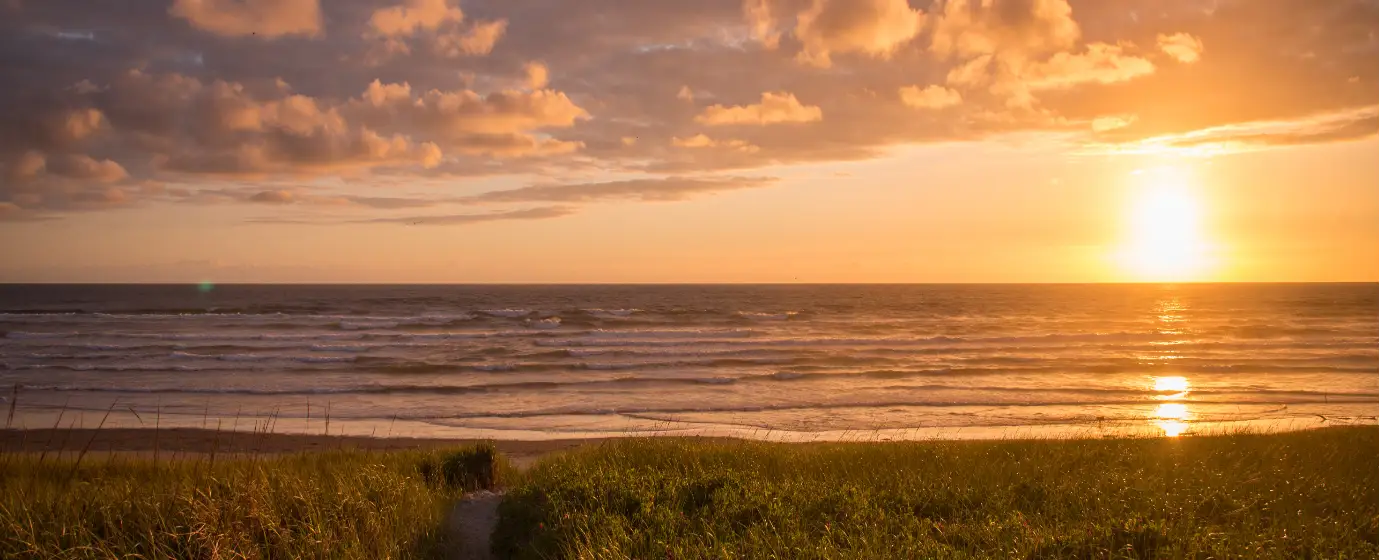
Oregon Coast · Oregon
Living in Gearhart: The Ultimate Relocation Guide (2026)
Maybe you've been searching Oregon Coast towns for months, and everyone keeps steering you toward Cannon Beach — the galleries, the iconic rock, the weekend crowds. Maybe you stumbled across Gearhart by accident on Zillow, noticed the prices looked more approachable than your Cannon Beach shortlist, and started wondering what the trade-off actually is. Maybe someone at work mentioned it as the place on the coast where people actually live, rather than just vacation.
Gearhart sits three miles north of Seaside on the northern Oregon Coast, occupying just under two square miles of sand dunes, golf fairways, and quiet residential streets. With roughly 1,870 residents, it's one of the smallest incorporated cities on the Oregon Coast — and deliberately so. There are no traffic signals. There is no big-box retail. The beach stretches for two miles in each direction, and on a Tuesday morning in February, you may be the only person on it. The practical reality is that Gearhart functions less like a traditional town and more like a well-organized retreat for people who have chosen a specific quality of life over urban convenience.
This guide is built for the buyer who is serious about making that choice. Whether you're a remote worker pricing out a permanent move, a retiree comparing Oregon Coast options, or a Portland-area family looking for a weekend property that could eventually become a primary residence — you need to understand what Gearhart is and what it isn't before you make an offer. We'll walk through who this town suits best, what daily life actually looks like, the honest tradeoffs, a neighborhood breakdown, and how Gearhart stacks up against its neighbors.
Not every Oregon Coast town fits every buyer. Gearhart has a very specific appeal — and an equally specific list of people who tend to leave within two years. Before diving into the details, here's a fast read on fit.
| Best For | Why |
|---|---|
| Retirees seeking coastal quiet | Low crime, walkable beach access, strong community identity, slower pace than Seaside |
| Remote workers craving coast life | Strong home-office culture, quiet streets, fiber internet available in most of town |
| Golfers | Gearhart Golf Links — Oregon's oldest golf course — is essentially in the backyard |
| Portland second-home buyers | Roughly 90 minutes from PDX with a distinct "arrive and decompress" feel |
| Buyers priced out of Cannon Beach | Comparable coast lifestyle at meaningfully lower price points |
| Nature-focused families | Direct beach access, razor clamming, dune walks — but limited youth programming locally |
The geographic reality shapes everything. Gearhart is bounded by the Pacific on the west, Neacoxie Creek and its wetlands on the east, Seaside to the south, and Del Rey Beach to the north. That constraint isn't a limitation — it's the point. The town is small enough that you can walk from the Pacific Way corridor to the beach in under ten minutes. Residents don't drive through Gearhart; they live inside it.
Daily errands, however, require a car and a trip to Seaside. Gearhart's own commercial footprint is minimal — Pacific Way Bakery and Cafe is the closest thing to a town anchor, and the Trail's End Art Association gallery adds a bit of cultural texture. For groceries, hardware, or anything resembling a full shopping run, you're looking at five minutes south on US-101 to Seaside, or 15 minutes north to Astoria, which has significantly more retail depth. Residents who moved here from Portland suburbs describe the adjustment less as inconvenience and more as a deliberate recalibration of what daily life is for.
The commute reality is blunt: Gearhart is not a commuter town. The drive to Portland runs approximately 102 minutes under good conditions, and Highway 26 through the Coast Range is a two-lane road that doesn't forgive bad weather or logging trucks. If you have a hard office requirement in Portland three or four days a week, Gearhart will grind you down within a season. The town's resident population skews heavily toward retirees and remote workers for this exact reason. About 28% of residents are 65 or older, and the median age sits around 47 — well above Oregon's state average.
What you get in exchange is a community vibe that feels almost impossible to replicate elsewhere on the Oregon Coast at this scale. People know their neighbors. The Trail's End Art Association has been a gathering point for decades. The golf course functions as a social hub as much as a sporting facility. On weekend mornings, the cluster of activity around Pacific Way — coffee, conversation, dogs — is about as lively as Gearhart gets, and most residents will tell you that's precisely the point.
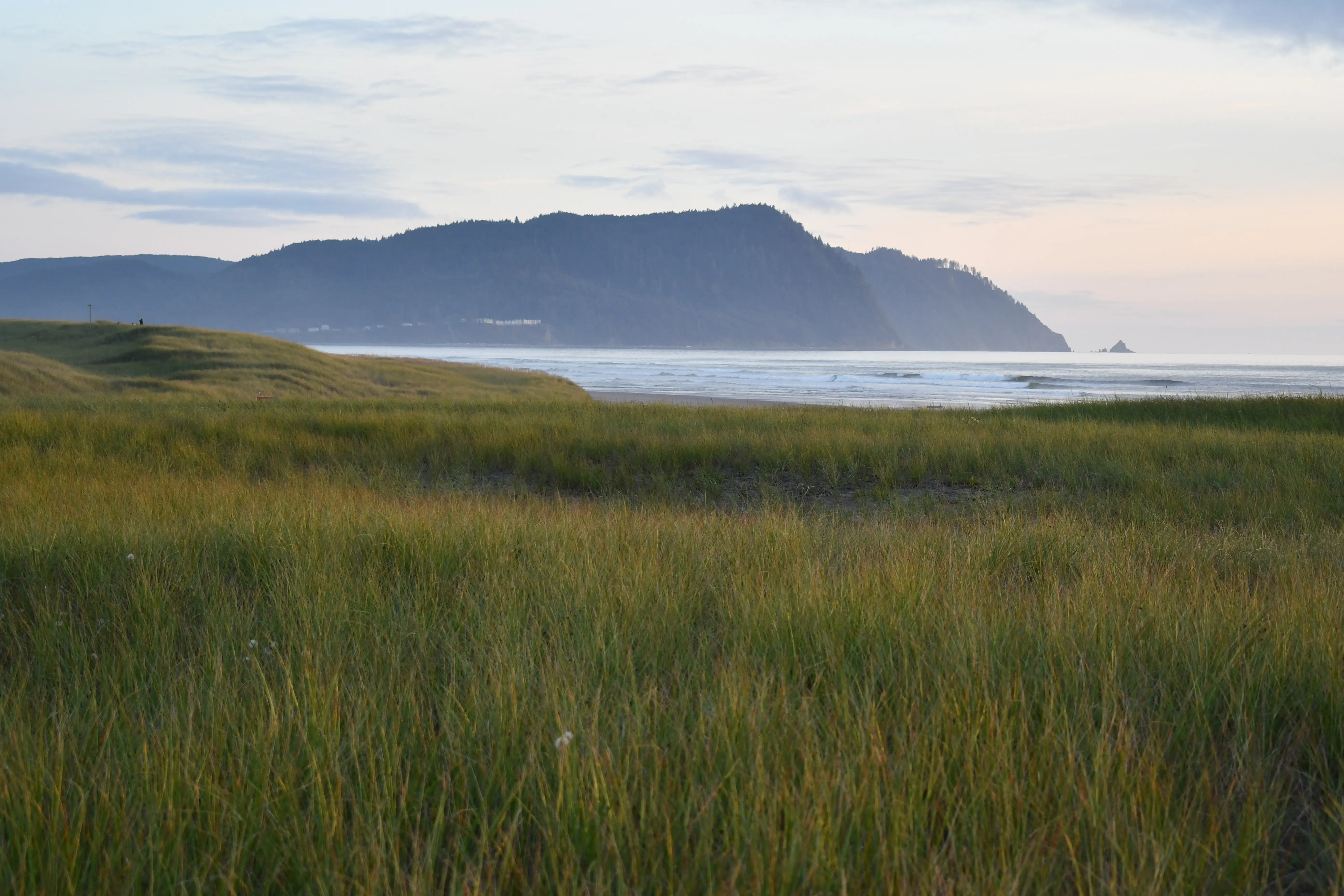
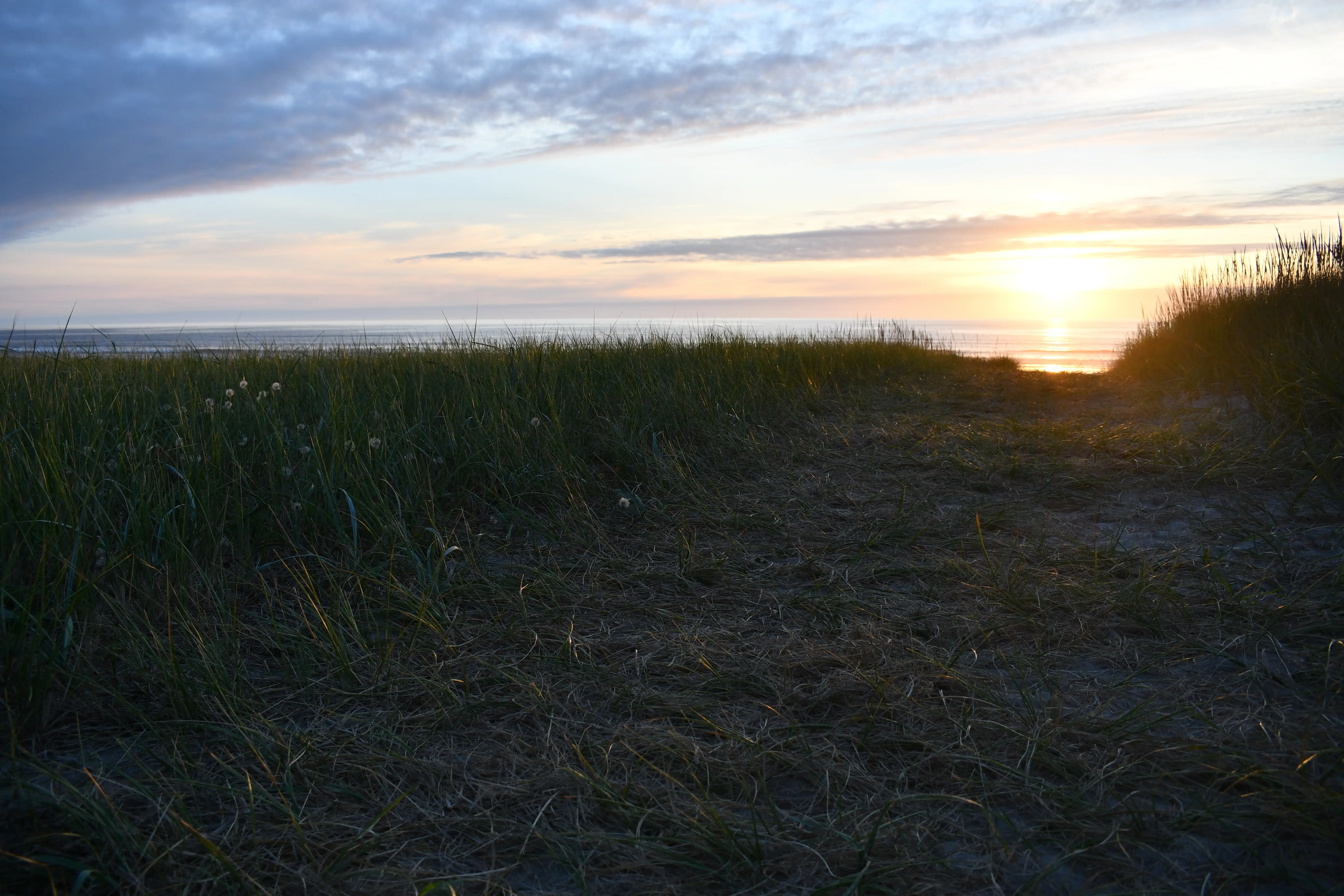
The beach is the first thing and the constant thing. Gearhart's two-mile stretch of white sand is wide, accessible, and rarely crowded in the way that Cannon Beach or even Seaside's main beach gets on summer weekends. It's one of a small number of Oregon beaches where vehicles are permitted on the sand, which matters for clamming trips and beach bonfire setups. The dunes behind the beach — golden grass, driftwood, shifting sand — give the whole coastline a more wild, less curated feel than the beaches further south.
Gearhart Golf Links is Oregon's oldest golf course, and its presence shapes the entire character of the town more than most non-golfers initially realize. The Links-style course runs through the heart of the residential area, which means many homes back up to fairways or sit within a short walk of the clubhouse. For residents who golf, this is a lifestyle feature that's difficult to put a price on. For residents who don't, the course still provides wide open green space, a social gathering point, and a reason the town has attracted a well-traveled, financially comfortable demographic for generations.
The cost of living index sits at approximately 92.4 — modestly below the U.S. average — which surprises buyers who assume an Oregon Coast address carries a premium on everything. Property taxes are particularly favorable: the 0.69% rate means a $700,000 home carries an annual tax bill well below what comparable properties cost in Portland suburbs. That figure tends to be a genuine decision-mover for retirees on fixed incomes who are comparing Oregon Coast options.
Safety registers as a meaningful upside, especially for retirees and families with young children. Gearhart recorded zero violent crimes per 1,000 residents in recent reporting periods. Property crime runs at approximately 31.4 per 1,000 — elevated compared to rural Oregon but consistent with coastal resort towns that see seasonal visitor traffic. Most longtime residents describe feeling genuinely safe in a way that doesn't require thought or precaution.

The weather is the thing people know about and still underestimate. The northern Oregon Coast averages around 185 rainy days a year, and from November through March, overcast and gray is the reliable expectation rather than the exception. This isn't Portland's intermittent drizzle — it's persistent, low-ceiling coastal weather that can go weeks without significant sun. Buyers who visit in July and fall in love sometimes discover by February that the beauty of the landscape requires a genuine tolerance for gray.
Healthcare access is functional but limited. Providence Seaside Hospital is roughly five minutes away, which handles urgent and routine care adequately. For specialized services — cardiology, oncology, major surgery — you are looking at a drive to Portland. This is a real consideration for older buyers with complex health needs, and it tends to be the factor that eventually moves some retirees back toward a larger metro even after years of loving the coast.
The isolation is real in ways that compound over time. There is no movie theater in Gearhart. There is no gym. There is no library. There is no pharmacy inside city limits. The nearest grocery store is in Seaside. What feels liberating in the first six months — no traffic, no noise, no commercial clutter — can start to feel limiting in year two if your social and professional networks are all back in Portland or wherever you moved from. The people who thrive here tend to be those who came with a clear plan for how they would fill their days, not those who expected the coast to provide that structure.
Why some people leave: The combination of limited services, healthcare distance, and long coastal winters pushes out residents who moved here without fully accounting for those realities. Remote workers sometimes find that the slower pace, while appealing in theory, makes it difficult to maintain professional momentum without deliberate effort. Families with school-age children eventually contend with the fact that Gearhart feeds into the Seaside School District — solid schools, but the daily commute for kids and the limited extracurricular options locally mean some families ultimately prefer to be closer to Seaside's activity base.
Gearhart is small enough that "neighborhoods" overlap considerably, and several of these designations are more informal than officially mapped. What matters for buyers is understanding which part of town delivers what.
West Gearhart runs closest to the beach and encompasses the blocks between Pacific Way and the ocean. Homes here are a mix of original coastal cottages, mid-century construction, and newer builds that have replaced older structures over time. Walkability to the beach is the defining feature — many homes are within a three-to-five minute walk of the sand, and the quiet, residential feel is pronounced even by Gearhart's standards. Prices in this corridor tend to command a premium over the town's broader range, with detached homes typically sitting in the upper $700,000s to well over $1 million depending on age, condition, and proximity to the waterline.
Best for: Retirees or remote workers who want beach access as a daily ritual, not a weekend event.
East of US-101, Gearhart East is the more affordable and practical side of town. It's where you'll find more modestly sized homes, some older manufactured housing, and properties that work for buyers who want an Oregon Coast address without paying the beach-proximity premium. The Neacoxie Creek wetlands frame the eastern edge, providing a quiet natural boundary. City-wide median pricing applies here most accurately, with entry points for detached homes sometimes beginning in the upper $400,000s to low $500,000s.
Best for: First-time buyers or budget-conscious buyers who prioritize town access over beachfront proximity.
"Downtown" is a relative term in a city of 1,870 — but the Pacific Way corridor is the genuine heart of the town. Pacific Way Bakery and Cafe anchors the commercial activity, and the Trail's End Art Association sits nearby. Residential properties here are interspersed with the town's modest commercial footprint, and buyers who want to walk to coffee and community gather along this stretch. It's a small zone, and available properties turn over infrequently.
Best for: Buyers who want to be in the middle of whatever activity Gearhart has — which is quieter than most towns, by design.
Sitting slightly elevated above the surrounding neighborhood grid, The Highlands at Gearhart features newer construction and planned residential development that attracts buyers looking for more updated floor plans and amenities. Homes here tend to be larger than the town average, and the neighborhood has a slightly more polished suburban feel compared to Gearhart's older cottage core. Prices reflect the newer construction premium.
Best for: Families or remote-working couples who want more space and modern finishes without committing to oceanfront pricing.
Pinehurst is where Gearhart's luxury market lives in clearest form. Properties along Pinehurst Road include some of the most expensive real estate in Clatsop County, with active listings ranging from approximately $2 million to nearly $4 million for high-end builds. Lots here are generous by Gearhart standards, and the address carries a specific cachet among buyers who know the coast well. The Ridge Path, which runs through the dune system, is accessible from this area and is a defining outdoor amenity.
Best for: Luxury buyers and second-home purchasers for whom Gearhart is a destination rather than a primary residence.
Named for the creek that forms the eastern boundary of the city, the Neacoxie area offers some of the most natural, unmanicured settings within city limits. Properties here back up to or sit near the creek and associated wetlands, providing birdwatching opportunities and genuine wildlife access that buyers who've been looking in more developed coastal towns often find striking. It's quiet, even by Gearhart's standards.
Best for: Nature-oriented buyers who prioritize wildlife habitat and natural surroundings over beach proximity or commercial access.
At the northern edge of Gearhart, Del Rey Beach sits adjacent to Del Rey Beach State Recreation Site — a stretch of beach accessible by vehicle and popular for clamming, kite flying, and low-key beach recreation. Homes in this area are quieter and more removed from whatever limited commercial activity exists in the Pacific Way corridor. It's one of the more genuinely tucked-away pockets of the city.
Best for: Buyers who want maximum quiet and direct beach recreation access with minimal neighbors and no commercial noise.
Shamrock Pines is a smaller residential pocket with a mix of older and mid-generation homes, characterized by the pine tree coverage that gives the area its name. It has a settled, established feel — the kind of neighborhood where residents have often lived for many years. Properties here are typically more modestly priced than the west side, offering a reasonable entry point into city ownership.
Best for: Buyers looking for a quiet, established residential feel at prices below the beach-side premium.
Looking to buy in Gearhart? Estimate your payment.
Enter your numbers to see an estimated monthly mortgage payment.
Estimate only. Excludes HOA fees and mortgage insurance.
| City | Best For | Median Home Price | Commute to Portland | Vibe |
|---|---|---|---|---|
| Gearhart | Quiet coast living, golf, retirees, remote workers | ~$514,000 (wide range) | ~102 min | Intimate, residential, intentionally slow |
| Seaside | Families, first-time buyers, beach activity | ~$475,000–$525,000 | ~95 min | Lively, commercial, tourist-facing |
| Cannon Beach | Luxury buyers, art lovers, established second homes | $1M+ | ~90 min | Polished, artistic, premium |
| Warrenton | Workforce buyers, value seekers, practical living | ~$330,000–$380,000 | ~100 min | Working class, practical, service town |
| Astoria | History buffs, creatives, urban amenity seekers | ~$350,000–$420,000 | ~95 min | Quirky, arts-forward, real city feel |
| Hammond | Remote waterfront, boat access buyers | ~$290,000–$350,000 | ~100 min | Rural, waterfront, very small |
| Metric | Detail |
|---|---|
| Population | Approximately 1,870 (2024–2025 estimates) |
| Median Home Price | $514,000 (wide range: ~$450K condos to $4M+ oceanfront) |
| Property Tax Rate | Approximately 0.69% (ZIP 97138) |
| Median Household Income | $85,966 |
| Median Age | Approximately 47 years |
| School District | Seaside School District 10 |
| Commute to Portland | Approximately 102 minutes |
| Cost of Living Index | 92.4 (below U.S. average of 100) |
| Violent Crime (per 1,000) | 0 |
| Property Crime (per 1,000) | 31.4 |
| Incorporated | 1918 |
| City Size | 1.88 square miles |
The Gearhart Golf Links tradition runs deeper than the sport. Oregon's oldest golf course doesn't just attract golfers — it functions as the social connective tissue of the town. Longtime residents treat the course as a community gathering space, and the relationships formed there are often how newcomers finally feel like they've broken into Gearhart's tightly knit social fabric. If you don't golf, expect a slightly longer on-ramp to feeling truly plugged in.
Razor clamming is a seasonal obsession. When the Oregon Department of Fish and Wildlife opens razor clam digs on the north coast — typically in coordination with minus tides between fall and spring — Gearhart Beach fills in a way it almost never does otherwise. Locals who have clamming gear staged by the door and a tide table on the fridge aren't exaggerating their commitment. It's a genuine community ritual that involves pre-dawn alarms, wet sand, and a specific kind of coastal patience.
The Trail's End Art Association has been a cultural anchor since 1948. In a town with essentially no commercial entertainment infrastructure, this gallery and arts organization has functioned as a community gathering point for over seven decades. Monthly shows, seasonal events, and the steady presence of working artists in the membership give Gearhart a quiet cultural identity that you don't see reflected in the commercial streetscape — because there isn't much of one.
What I would not do if moving to Gearhart: I would not buy on the eastern side of US-101 expecting walkability to the beach and the Pacific Way corridor to feel convenient. The highway is a meaningful psychological and practical divide in a town this small — crossing it on foot with groceries or a dog on a dark winter evening is more unpleasant than it looks on a map. Buyers who prioritize beach access and community connectivity should be west of the highway, even if that means adjusting the budget or the square footage expectation.
Local Expert Takeaway: Gearhart rewards buyers who know exactly what they're buying into — and punishes those who assume "Oregon Coast" is interchangeable. If quiet beach living, a functional golf-and-community social scene, and low property taxes are your priorities, Gearhart is genuinely hard to beat in this region. Get clear on your price bracket before touring: what sells here ranges from the upper $400,000s for condos and smaller cottages to well over $1 million for detached homes on the west side, and the gap between the median figure and what you'll actually see at open houses surprises almost every buyer. Focus your search west of US-101 if walkability and beach proximity matter — and plan your first winter honestly before committing to full-time residency.
✅ Gearhart delivers genuine coastal quiet — small population, zero reported violent crime, beach access without the crowds of Cannon Beach or the commercial energy of Seaside.
⚠️ The isolation compounds. No pharmacy, no grocery, no gym inside city limits. Buyers who haven't experienced a full Oregon Coast winter before committing to full-time residency often find the adjustment harder than expected.
📍 Location within the city matters enormously. West of US-101 means beach walkability and community proximity. East of the highway means value, but also a fundamentally different daily experience — know which you're buying before you make an offer.
Is Gearhart a good place to retire?
For the right retiree, Gearhart is exceptional. Zero violent crime, a strong community identity, property taxes running approximately 0.69%, and one of the most beautiful beaches on the Oregon Coast are a compelling combination. The honest caveat is healthcare: Providence Seaside Hospital handles routine and urgent needs nearby, but specialized care requires a trip toward Portland, which matters for retirees with complex medical situations.
What is the housing market like in Gearhart?
Gearhart's market is thin by design — inventory frequently sits below 20 active listings, and the number of monthly sales is often in the single digits. That low volume makes median prices volatile and means the city-wide figure of $514,000 reflects a wide range rather than a reliable single data point. Condos and smaller properties can enter in the upper $400,000s; detached single-family homes on the west side of town typically run $700,000 to $900,000 and beyond, with luxury oceanfront properties reaching several million.
How does Gearhart compare to Seaside for families?
Gearhart and Seaside both feed into the Seaside School District, so school quality is comparable. Where they differ significantly is in scale and services: Seaside has grocery stores, restaurants, a downtown commercial corridor, and more youth programming infrastructure. Gearhart offers quieter streets, arguably better beach access, and a more residential feel — but families with school-age children who need activity variety or daily convenience typically find Seaside the more practical base. Gearhart suits families who have deliberately chosen simplicity over infrastructure.
Explore the full Gearhart series: The Ultimate Gearhart Relocation Guide · Is Gearhart Safe? · Cost of Living in Gearhart · Best Neighborhoods in Gearhart · Gearhart Schools & Family Life · Gearhart Youth Sports · Gearhart Parks & Recreation · Retiring in Gearhart · 1031 Tax-Deferred Exchange in Gearhart · Gearhart First-Time Homebuyers Guide · · Moving to Gearhart from California
Tell us what you need help with and we'll connect you with local resources.

About the Author
Todd Davidson is the founder of Living in Oregon and Living in Washington, where he publishes in-depth city guides, neighborhood resources, and local market insights covering more than 180 communities across the Pacific Northwest. While his background is in home financing and real estate, he created these digital platforms to help families research and compare regions before making a move.
Check Out the Oregon Coast Rankings: Oregon Coast Cost of Living — All 16 Cities Ranked · Best Places to Retire on the Oregon Coast · Best Oregon Coast Cities for Families · Best Oregon Coast Cities for Remote Workers · Oregon Coast Real Estate Market Report 2026 · Oregon Coast vs. Washington Coast