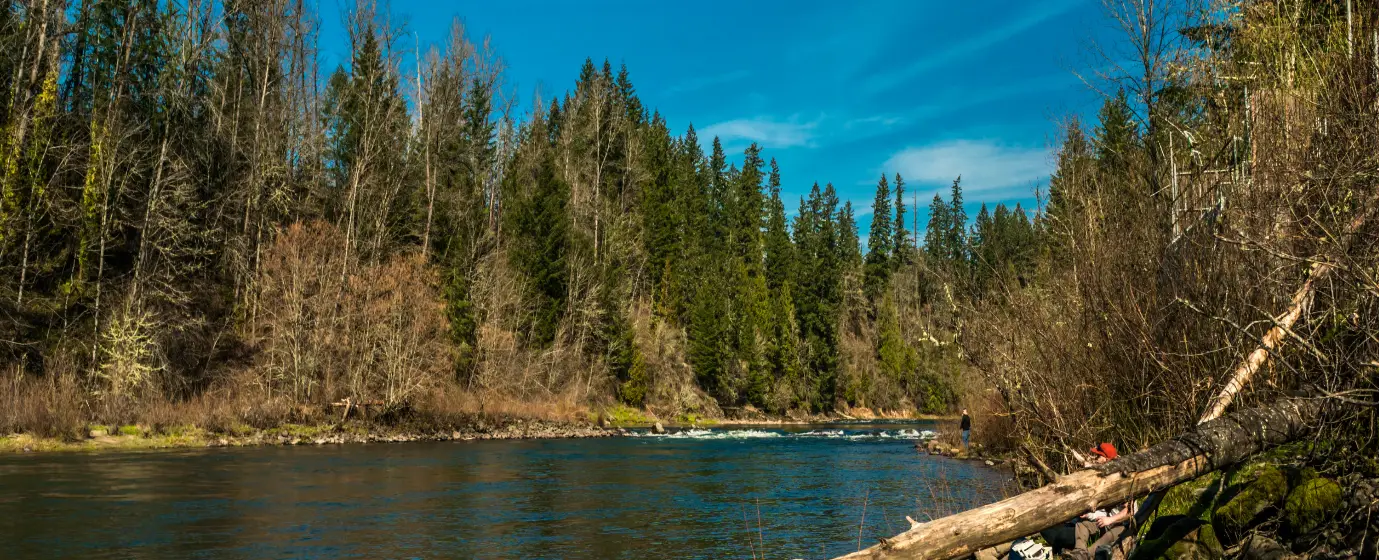
Mt Hood / Columbia Gorge · Oregon
Moving to Estacada from California: The Honest Comparison (2026)
The Bay Area software engineer who finally went fully remote didn't move to Portland — they moved 46 minutes southeast, to a small river town at the edge of the Mount Hood National Forest, where $546,000 bought them a four-bedroom house with a yard, a garage, and a view of the Clackamas River corridor. The Sacramento family who was renting a three-bedroom for $2,800 a month discovered they could own a newer home in Estacada for less than their landlord's asking price. This is the pattern playing out across Estacada right now: California equity, liberated from coastal prices, landing in one of the most underappreciated small cities in the Pacific Northwest.
The hard part is what nobody tells you until month four. Estacada gets roughly 150 rainy or overcast days a year, and that's on the optimistic side for this stretch of the Cascades foothills. The closest thing to a Target is in Oregon City, 25 miles away. The food scene is genuinely small-town. If you moved from Walnut Creek or Santa Monica expecting to trade your commute for a version of California at lower cost, you will have some adjusting to do — not because Estacada isn't worth it, but because it's a fundamentally different kind of place.
This guide walks through the actual cost comparison by California region, what your equity realistically buys here, the tax picture that surprises most transplants, the weather reality, the mistakes California buyers consistently make, and an interactive tool to compare your specific California city to Estacada directly.

| Estacada, Oregon | Bay Area | Southern CA | Sacramento Metro | Central Valley | |
|---|---|---|---|---|---|
| Median Home Price (approx 2026) | $546,345 | $1.4M–$1.8M+ | $750K–$1.2M | $500K–$650K | $320K–$450K |
| Property Tax Rate (effective) | 0.80% | 1.1%–1.3% | 1.0%–1.25% | 1.0%–1.2% | 1.0%–1.15% |
| State Income Tax (top bracket) | 9.9% | 13.3% | 13.3% | 13.3% | 13.3% |
| State Sales Tax | 0% | 7.25%–10.75% | 7.25%–10.75% | 7.25%–9.0% | 7.25%–8.75% |
| Avg Utilities (monthly est.) | $160–$200 | $230–$320 | $200–$290 | $175–$250 | $160–$230 |
| Avg 1BR Rent | $1,200–$1,500 | $2,800–$3,800 | $2,200–$3,200 | $1,500–$1,900 | $1,100–$1,500 |
A buyer leaving Walnut Creek with $1.5 million in equity isn't just downsizing their mortgage — they're likely eliminating it. Buying in Estacada at $546,345 all-cash still leaves that buyer with nearly $950,000 in liquid capital, plus a property tax bill roughly half of what they paid in California on a comparable assessed value. The savings compound: no sales tax on groceries, clothing, or household purchases adds up to $2,000–$4,000 annually for a typical household that was living in a 9% sales tax county.
The comparison from Sacramento is closer but still meaningful. A Sacramento buyer who bought in 2018 and is sitting on $400,000–$500,000 in equity can purchase a newer three- or four-bedroom home in Estacada outright, or put 50–60% down and carry a modest mortgage at a payment well below what they'd pay renting in the Sacramento metro today. The land-per-dollar ratio tilts sharply in Estacada's favor — where $500,000 in Sacramento often means a standard subdivision lot, that same price range in Estacada regularly comes with half-acre to full-acre parcels in subdivisions like Dugan Estates or Currin Creek Heights.
Oregon's tax picture is not a simple win for California transplants — it requires honest math. The assumption that Oregon means "no income tax" is a California transplant myth; Oregon has a graduated state income tax that reaches 9.9% at the top bracket, one of the higher rates in the country. What you are trading is not an income tax burden for nothing — you're trading a higher California rate for a lower Oregon rate, with different structure.
What Oregon genuinely eliminates is the sales tax. California's baseline state sales tax runs 7.25%, and county and city add-ons push it to 10.75% in some jurisdictions. In Oregon, that number is zero. On a household that spends $60,000 annually on taxable goods and services, the difference between a 9% blended California sales tax rate and Oregon's zero is roughly $5,400 per year — real money that doesn't show up on a tax return but accumulates steadily in your bank account.
Oregon's Measure 50 creates a structural advantage for long-term property owners that California's Proposition 13 buyers intuitively understand. After you purchase, your property's assessed value can only increase by 3% per year regardless of market appreciation. A buyer who purchases in Estacada in 2026 and stays for 15 years will see their tax bill grow at a controlled pace even if values double — which mirrors the Prop 13 protection many California buyers already relied on.
| Tax Item | California | Oregon | Net Impact |
|---|---|---|---|
| State Income Tax (on $150K income) | ~$11,500–$13,500 | ~$10,500–$12,000 | Modest savings in OR |
| State Sales Tax | 7.25%–10.75% | 0% | ~$3,000–$6,000/yr savings |
| Effective Property Tax Rate | 1.0%–1.3% | 0.80% | Lower in OR |
| Annual Property Tax on $546K home | $5,460–$7,098 | $4,371 | $1,000–$2,700 savings |
| Capital Gains (state) | 13.3% | 9.9% | Significant savings |
| Senior Property Tax Deferral (62+) | Limited | Yes, available | Advantage in OR |
A household earning $150,000 moving from San Jose to Estacada will pay somewhat less in state income tax and substantially less in property tax — but the single largest savings is the elimination of sales tax on every transaction for the rest of their time in Oregon. Over a decade, that compounds into a meaningful lifestyle subsidy that doesn't require filing anything or qualifying for a program.
A buyer selling a home in the East Bay, South Bay, or Peninsula with $1.4 million in net equity can purchase outright in Estacada's top tier and still hold significant capital. At $546,345 median, that buyer is looking at an all-cash transaction with roughly $850,000 remaining — enough to invest, renovate to high-end finishes, or purchase a second lot in Eagle Creek's acreage corridor as a long-term hold. For buyers who want the best the Estacada market offers, that means new construction in Cascadia Ridge or Dugan Estates in the $650,000–$750,000 range: four bedrooms, 2,300–2,500 square feet, greenbelt views, and a two-car garage, purchased debt-free.
The Bay Area buyer who came from a rental or a smaller unit might find the step-up in space disorienting in the best way. A 2,265-square-foot home on NE Currin Creek Drive listed under $700,000 represents a category of property that simply does not exist at any price in most Bay Area zip codes. For remote workers in tech or finance, the calculation frequently comes down to: a $4,500/month mortgage in Cupertino, or no mortgage and a 15-minute walk to the Clackamas River.
A buyer selling in Pasadena, Irvine, or Carlsbad with $900,000 in equity lands in Estacada's market with room to be selective. That figure comfortably covers a cash purchase of a newer home in Park Place or Campanella Estates — established neighborhoods with mature landscaping, reasonable lot sizes, and proximity to the downtown core — with $350,000–$450,000 remaining. Buyers who prefer to carry a small mortgage and preserve liquidity can put 50–60% down and finance the balance at a payment that often runs less than a Los Angeles studio apartment rents for.
Southern California buyers tend to gravitate toward Estacada's newer subdivisions because the architectural style is familiar — open floor plans, primary suites with walk-in closets, attached garages — without the HOA complexity of planned communities they may be used to in Orange County or the Inland Empire. Many of Estacada's active builds carry no HOA or a minimal one.
This buyer cohort has the most nuanced calculation. Their equity is real and meaningful but doesn't enable the all-cash freedom that Bay Area sellers enjoy. What the move still offers is a genuine step-up in both property size and long-term tax structure. A Rancho Cordova seller with $480,000 in equity can put 80–90% down on a home in River Mill or Park Place, carry a mortgage under $100,000, and own a property with more square footage and land than anything comparable in their Sacramento neighborhood.
The sales tax elimination is particularly tangible for Sacramento buyers, who've been paying 8.75% on virtually every purchase. Combined with Estacada's lower property tax rate, the monthly household financial picture often improves even when the mortgage payment doesn't drop dramatically.
The Central Valley buyer — coming from Fresno, Bakersfield, Visalia, or Stockton — faces the narrowest relative advantage but still finds genuine value in Estacada's entry-tier inventory. Downtown Estacada and River Mill offer established homes in the $380,000–$500,000 range that a Central Valley seller with $350,000 in equity can approach with a substantial down payment. The key advantage for this buyer isn't dramatic equity arbitrage — it's owning more land per dollar than California offers, in a community where the cost of daily life runs meaningfully lower once sales tax is removed from the equation.

Looking to buy in Estacada? Estimate your payment.
Enter your numbers to see an estimated monthly mortgage payment.
Estimate only. Excludes HOA fees and mortgage insurance.
Let's not pretend this part is easy. Estacada sits in the foothills of the Clackamas River watershed, which means it collects more rainfall than Portland proper and significantly more than most of California. The Portland metro averages around 144 rainy days annually; in Estacada's microclimate, nestled against the Cascade foothills, gray and wet days stretch from mid-October through May with only occasional breaks. A buyer leaving San Diego, where the sun shines more than 265 days a year, is making a genuine lifestyle trade — not a minor adjustment.
What the good friend who moved three years ago actually tells you: summers in Estacada are legitimately spectacular. June through September brings warm, low-humidity days that California transplants frequently describe as better than coastal California — no marine layer, no heat dome, just clear skies and access to the Clackamas River for kayaking, swimming, and fishing steps from your neighborhood. Milo McIver State Park becomes a weekly destination. The farmers market on Broadway fills up. The pace slows in the best way. Most California transplants who've survived a full winter report that by month 18, they've stopped missing the sunshine as acutely as they expected.
What they genuinely miss is harder to soft-pedal. Year-round beach access doesn't have a substitute here. The food scene — particularly for transplants from the Bay Area or Los Angeles — is small-town in both selection and quality. The social energy of a city of 100,000 does not exist in Estacada's 6,000-person community. Transplants from Sacramento or the Inland Empire tend to adapt faster than those from coastal metros, because the pace and commercial density of Estacada isn't far from what mid-sized California cities offered before coastal pricing pushed them out. But the honest answer for a San Francisco buyer is: you are choosing a genuinely different life, not a cheaper version of the same one.
If you want to see how Estacada compares directly to the city you're leaving, use the tool below — it covers the 120 largest California cities with current housing and tax data.
Home prices: Redfin median sale data, Q1–Q2 2026. Select your city to compare.
Ready to talk through what your specific California equity could do in Estacada? Todd can model your exact scenario in a single call.
Mistake 1: Assuming the whole market is uniform. Estacada has a meaningful character divide between its active new-construction subdivisions — Currin Creek Heights, Dugan Estates, Cascadia Ridge along the north end — and its established neighborhoods closer to Broadway Street. A buyer who tours a Cascadia Ridge new build and makes an offer without understanding that they're buying in a still-developing subdivision with active construction activity on adjacent lots for the next 2–3 years may be surprised by that reality. The established downtown and River Mill corridors offer a completely different ownership experience. Visit both before deciding.
Mistake 2: Skipping radon testing. Oregon has elevated radon zones, and the Clackamas County area — including Estacada — is not exempt. California buyers who've never encountered radon as a standard inspection item often wave it off as a formality. In Oregon, it's a genuine consideration: mitigation systems are relatively inexpensive, but the leverage to require them or negotiate on price exists only before you close. Budget for a radon test on every property, without exception.
Mistake 3: Underestimating winter commuting on Highway 224. The 46-minute Portland commute is a summer figure. Highway 224 through the Clackamas River canyon is scenic and functional in dry months, but winter brings fog, ice patches, and the occasional brief closure. Buyers who plan to commute to Portland's tech corridor or the Lloyd District three days a week should drive the route on a January morning before assuming the commute math holds year-round. The canyon stretch between Boring and Estacada deserves specific attention.
Mistake 4: Comparing Estacada to Oregon City and expecting the same amenities. Oregon City is 25 miles away and carries a much larger commercial footprint — Costco, Target, major medical, expanded dining. Estacada's downtown is genuinely small-town, which is part of its appeal but requires honest accounting. California transplants who assume that a quick run to a big-box store is always convenient often find themselves planning Oregon City trips like they're planning errands to a neighboring city — because that's exactly what they are.
Bay Area sellers with large equity are frequently the most efficient buyers in Estacada's market, and the mortgage picture for them is almost beside the point. An all-cash offer at $546,345 — or even at $700,000 for new construction — removes rate risk, appraisal contingency, and financing timeline entirely. For sellers who had a California investment property rather than a primary residence, the 1031 exchange route into an Oregon rental or multi-family deserves serious consideration before closing escrow in California. That conversation needs to happen before the California property closes — not after.
Southern California sellers with $700,000–$900,000 in equity typically don't need jumbo financing for Estacada purchases. Most of the active inventory sits well below conforming loan limits, which means conventional financing applies. These buyers often have the option of a large down payment with a modest conventional loan, preserving liquidity while still securing favorable terms. The key decision is whether to carry any debt at all or liquidate the equity position entirely.
Sacramento and Inland Empire buyers entering Estacada's market with $400,000–$550,000 in equity may still benefit from OHCS programs or Oregon's conventional assistance options if their purchase price falls below program thresholds — though at Estacada's current median, many will be just above eligibility. The more common structure for this cohort is a 50–70% down payment on a conventional loan, locking in a payment that competes favorably with Sacramento rents even accounting for the higher Oregon income tax rate.

Local Expert Takeaway: California buyers consistently underestimate the importance of timing their close around Estacada's 92-day average days on market. In a neutral market with active new construction inventory, the buyer who can demonstrate a clean close — all-cash or fully pre-approved with minimal contingencies — has leverage that simply doesn't exist in competitive Portland suburbs. If you're a Bay Area seller with significant equity, consider getting a bridge loan commitment or selling first before you shop Estacada's new-build corridors. The best lots in Currin Creek Heights and Dugan Estates do move, and a pre-approved buyer ready to close in 30 days will consistently beat a contingent offer regardless of price.
✅ California equity goes significantly further in Estacada — Bay Area sellers can often purchase all-cash with seven figures remaining; Sacramento sellers can dramatically reduce or eliminate their mortgage.
⚠️ Oregon has a state income tax — the top bracket hits 9.9%, which is lower than California's 13.3% but not zero. Factor this into your net savings calculation before assuming a full tax windfall.
📍 Estacada is a small town, not a suburb — the nearest major retail is Oregon City, 25 miles away. The lifestyle trade is real space, river access, and community pace for urban commercial density. Most transplants who stay past year two say it was worth it.
Is moving from California to Estacada worth it?
For most California sellers, the financial math is compelling — but the lifestyle shift is the real question. Buyers leaving markets like Walnut Creek or Irvine with $1 million or more in equity can purchase Estacada's top-tier new construction outright, eliminate a mortgage, and reduce their property tax bill simultaneously. What requires honest self-assessment is whether a 6,000-person river town with small-town commercial infrastructure matches how you want to live day-to-day. For remote workers who prioritize space, nature access, and lower cost of living over urban amenity density, the answer is typically yes — and most report the adjustment takes about 12–18 months before Estacada feels like home rather than a trade-off.
How does Oregon property tax compare to California?
Oregon's effective property tax rate in Estacada runs approximately 0.80%, compared to California's typical range of 1.0%–1.3% on assessed value. On a $546,345 purchase, that translates to roughly $4,371 annually in Estacada versus $5,500–$7,100 on a comparable California assessment. The Measure 50 cap — which limits annual assessed value increases to 3% regardless of market appreciation — mirrors the Prop 13 protection many California buyers already relied on and creates a meaningful long-term advantage for buyers who plan to stay a decade or more.
What does California home equity buy in Estacada?
The range is wide and depends on your origin market. A Bay Area seller with $1.4 million in equity can buy outright in Estacada's new-construction tier — four bedrooms, 2,300+ square feet, greenbelt views — and hold $850,000 in reserve. A Sacramento seller with $450,000 in equity can put 80–85% down on an established home in Park Place or River Mill and carry a mortgage under $100,000. A Central Valley seller with $325,000 in equity can purchase entry-level inventory in downtown Estacada with a significant down payment and a manageable conventional loan. Every California equity position buys meaningfully more here than it does in origin market — the degree varies by where you're coming from.
Explore the full Estacada series: The Ultimate Estacada Relocation Guide · Is Estacada Safe? · Cost of Living in Estacada · Best Neighborhoods in Estacada · Estacada Schools & Family Life · Estacada Youth Sports · Estacada Parks & Recreation · Retiring in Estacada · 1031 Tax-Deferred Exchange in Estacada · Estacada First-Time Homebuyers Guide · · Moving to Estacada from California
Tell us what you need help with and we'll connect you with local resources.

About the Author
Todd Davidson is the founder of Living in Oregon and Living in Washington, where he publishes in-depth city guides, neighborhood resources, and local market insights covering more than 180 communities across the Pacific Northwest. While his background is in home financing and real estate, he created these digital platforms to help families research and compare regions before making a move.