
Mt Hood / Columbia Gorge · Oregon
Moving to Boring, Oregon from California: The Honest Comparison (2026)
The Bay Area software engineer who finally gets a yard. The San Diego couple who opened their first summer utility bill here and nearly cried with relief. The Sacramento buyer who sold a townhome for $680,000 and bought a four-bedroom house on half an acre in Boring without maxing out their equity. These are real patterns playing out in Clackamas County right now — and Boring, tucked into the Cascade foothills about 12 miles southeast of Portland, keeps appearing on California buyers' shortlists for one straightforward reason: the math is hard to argue with. Oregon was the number one inbound migration destination in the country in 2025, and the households leading that trend are coming from California.
What this guide won't do is pretend the move is seamless. Boring is not California. The winters here are genuinely gray in a way that requires psychological recalibration, not just a new wardrobe. The food scene, the cultural density, the social energy of a major California metro — none of that follows you over the state line. What you get instead is space, quiet, a slower pace, and a property tax bill that will make you read it twice just to confirm it's real.
This guide covers the full comparison: cost of living broken down by California region, what your specific equity level actually buys in Boring, the honest tax picture (Oregon has income tax — a surprise for some), the weather reality, the mistakes California buyers make most often, and an interactive tool to compare your specific California city directly to Boring.

| Boring, Oregon | Bay Area | Southern CA | Sacramento Metro | Central Valley | |
|---|---|---|---|---|---|
| Median Home Price (approx. 2026) | ~$581,000–$800,000 | ~$1.4M–$2.0M | ~$800K–$1.1M | ~$550K–$750K | ~$350K–$500K |
| Property Tax Rate (effective) | ~0.76% | ~1.1–1.2% | ~1.1–1.25% | ~1.0–1.15% | ~0.85–1.0% |
| State Income Tax (top bracket) | 9.9% | 13.3% | 13.3% | 13.3% | 13.3% |
| State Sales Tax | None | 7.25–10.75% | 7.25–10.75% | 7.25–8.75% | 7.25–8.75% |
| Avg Utilities (monthly est.) | ~$150–$180 | ~$250–$350 | ~$280–$380 | ~$220–$300 | ~$210–$290 |
| Avg 1BR Rent | ~$1,400–$1,700 | ~$2,800–$3,800 | ~$2,200–$3,200 | ~$1,500–$1,900 | ~$1,100–$1,500 |
A buyer leaving Walnut Creek or San Jose and selling at $1.5 million is looking at a potential cash purchase in Boring with six figures remaining. That's not an exaggeration — it's the arithmetic of moving from a $1.4M market to one where active listings run $766,000 to $895,000 and sold prices have registered closer to $581,000 depending on the quarter. Even accounting for California's capital gains exposure (federal, and California taxes gains at ordinary income rates for residents until you establish Oregon residency), the delta is significant.
The savings compound monthly after you arrive. Oregon's zero-percent state sales tax means a household spending $60,000 annually on taxable goods — electronics, appliances, vehicles, clothing — is looking at roughly $4,000 to $6,500 in annual savings compared to a high-sales-tax California county. Utilities in the Portland metro foothills run meaningfully lower than Southern California and the Bay Area, particularly in summer, when Sacramento Valley residents routinely face $400+ monthly cooling bills and Boring rarely exceeds $180.
The most common misconception among California transplants is that moving to Oregon means escaping high income taxes. It does not. Oregon's graduated income tax tops out at 9.9% — the fourth-highest top marginal rate in the country — and while that's still below California's 13.3%, it's not the relief some buyers expect. What Oregon removes entirely is sales tax, and that elimination is genuinely impactful for everyday purchasing.
| Tax Item | California | Oregon | Net Impact |
|---|---|---|---|
| State Income Tax (top bracket) | 13.3% | 9.9% | Save ~3.4 points on top bracket |
| State Sales Tax | 7.25–10.75% | 0% | Eliminate entirely |
| Property Tax (effective rate) | ~1.1–1.25% | ~0.76% | Save ~$2,000–$3,500/yr on $581K home |
| Capital Gains (state) | Taxed as ordinary income | Taxed at income rates | Roughly comparable structure |
| Assessed Value Cap | Prop 13 (2% annual max) | Measure 50 (3% annual max) | Both protect long-term owners |
On a $150,000 household income, moving from California to Oregon drops your state income tax liability by roughly $5,000 to $6,000 annually. That's not nothing — but it's not the full-elimination windfall that states like Nevada or Washington offer. Where Oregon wins decisively is property taxes. A home purchased at Boring's median carries an annual tax bill of roughly $4,400 — compared to $6,400 or more on a comparably valued California home. And Measure 50 caps assessed value increases at 3% annually, meaning your property tax stays predictable as values rise.
For buyers 62 and older, Oregon also offers a property tax deferral program — the state pays your property taxes and recovers the amount when the home is sold. It's a meaningful cash-flow tool for retirees on fixed incomes and one California doesn't offer in the same form.
A buyer selling a Bay Area home in the $1.4M to $2.0M range arrives in Boring with the ability to eliminate their mortgage entirely — and in many cases, to do so with cash remaining for renovations or investment. At Boring's median, a $1.5M equity position covers the purchase outright and leaves $700,000 or more in liquidity. The question for these buyers isn't whether they can afford Boring; it's whether Boring's pace and scale matches what they're looking for.
The neighborhoods that make sense at this equity level are the larger-parcel areas — properties along Revenue Road, the Cottrell corridor, and acreage listings near North Boring tend to offer the kind of space and privacy that justifies a premium in this market. Buyers with Bay Area equity can often access the true upper end of what Boring offers: newer construction on multiple acres, shop buildings, privacy, and mountain views, at price points that would represent entry-level in San Jose or Palo Alto.
A buyer leaving Irvine or Pasadena with $900,000 in equity is in an exceptional position in Boring. That equity covers the median purchase outright or finances a significantly larger property with a modest mortgage — in a market where mortgage balances are a fraction of what they'd carry in Southern California. This buyer realistically enters Boring's top-tier inventory without stretching.
Sandy River corridor properties and Richey Road acreage parcels often land in the $650,000 to $850,000 range — well within reach for Southern California equity holders, and offering a land and lifestyle profile that simply doesn't exist at that price in Orange County or the South Bay. The trade-off is a commute to Portland that runs 35 minutes under normal conditions, and a downtown Boring that is genuinely small compared to any SoCal suburb.
Sacramento and Inland Empire buyers have a closer relative gain, but the move still pencils out meaningfully. A buyer selling a Sacramento home at $620,000 and buying in Boring at $581,000 to $700,000 is making a lateral financial move — but arriving with Oregon's zero sales tax, lower effective property taxes, and a Clackamas County income profile that runs notably higher than the Sacramento metro median.
What makes this equity level compelling in Boring specifically is land-per-dollar. Central Boring and Telford Road areas offer parcels and established homes in the $500,000 to $700,000 range, where Sacramento buyers often find more square footage and more outdoor space than they had at their original price point. The community is small and the services are limited — buyers coming from Elk Grove or Roseville need to calibrate expectations accordingly.
Central Valley buyers — Fresno, Bakersfield, Stockton — face the most modest relative advantage, but the move can still represent a step forward in quality of life rather than pure financial gain. At the $450,000 equity level, a buyer enters Boring's lower end of the active market, where older homes on smaller lots in Central Boring or the Dodge Park area are periodically available in the $500,000 to $600,000 range.
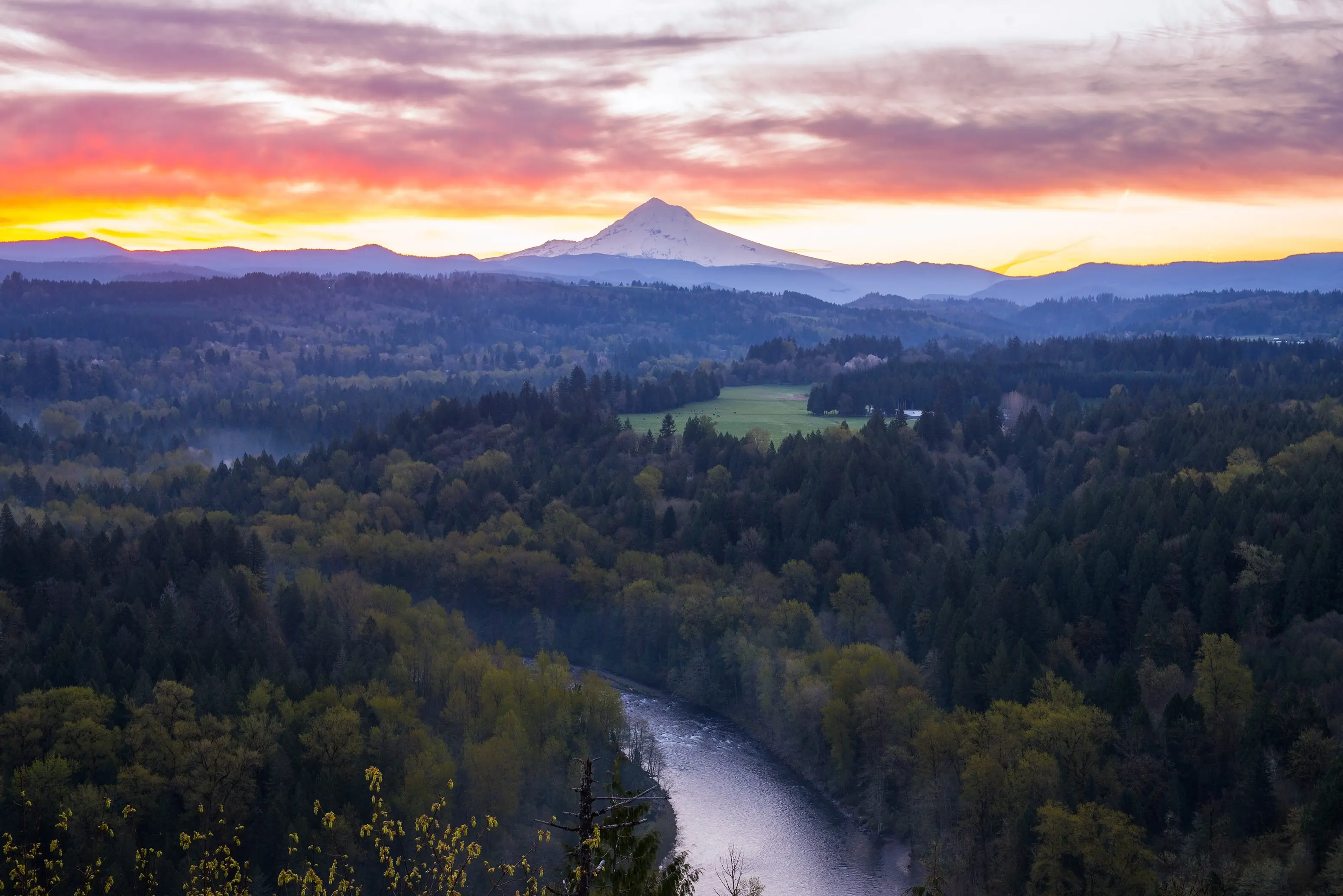
The honest reality for Central Valley buyers is that Boring is not significantly more affordable than where they're leaving in pure housing terms. The compounding advantage comes from Oregon's tax structure — particularly the absence of sales tax on everyday purchases — and from the quality of the surrounding environment: Cascade foothills, Mount Hood access, the Sandy River corridor, and a genuine small-town character that Central Valley metros rarely offer.
Looking to buy in Boring? Estimate your payment.
Enter your numbers to see an estimated monthly mortgage payment.
Estimate only. Excludes HOA fees and mortgage insurance.
Most California-to-Oregon guides either gloss over the weather or mention "rainy winters" the same way you'd mention "light traffic." Let's be precise. Boring sits in the Cascade foothills east of Portland, and it receives rain on roughly 144 to 155 days per year. December brings rain on 17 or more days. March is statistically the wettest month by day count. January and February average just over four hours of sunshine daily. If you're coming from Los Angeles, which sees approximately 284 sunny days annually, this is not an adjustment — it's a transformation of your baseline relationship with daylight.
What the numbers don't capture is what that looks like in practice. October through April, the sky in Boring is predominantly overcast. It's rarely a hard rain — more of a persistent gray mist — but it is relentless. Buyers from San Francisco, who already know marine layer fog, adapt faster than buyers from Sacramento or the Inland Empire, where 269 sunny days a year is the norm. The people who thrive in Boring's winters are those who genuinely lean into indoor projects, embrace weekend drives to Mount Hood's ski areas, and stop expecting the weather to cooperate before going outside.
Here's what California transplants consistently say they love after a year: the summers. July and August in Boring average nearly eleven hours of sunshine daily and temperatures that peak around 80°F — not the brutal heat of a Sacramento summer, but genuinely warm and beautiful. The outdoor culture from June through September — hiking from Boring Station Trailhead, kayaking the Sandy River, visiting the Farmers Market, evening walks with almost no traffic — is legitimately excellent. What they miss most honestly: year-round beach access, the food density of any major California metro, the energy of a city with real nightlife, and — for Bay Area transplants especially — the particular social culture of tech-adjacent urban California. Boring is quiet in ways that are peaceful and also, occasionally, loud in their absence.
If you want to see how Boring compares directly to the city you're leaving, use the tool below — it covers the 120 largest California cities with current housing and tax data.
Home prices: Redfin median sale data, Q1–Q2 2026. Select your city to compare.
Ready to talk through what your specific California equity could do in Boring? Todd can model your exact scenario in a single call.
Assuming Boring is a compact, walkable suburb. It isn't. Boring is an unincorporated community — not an incorporated city — and large portions of it feel more like dispersed rural Oregon than a suburb. There is no town center with coffee shops and a main street the way Damascus or Sandy might offer. Buyers who arrive expecting a California-style suburb with sidewalks, walkable errands, and a grocery store three blocks away should understand that daily life in Boring requires a car for almost everything. The nearest full-service grocery options are a 10 to 15-minute drive toward Gresham or Damascus.
Ignoring radon testing. Oregon has elevated radon zones, and Clackamas County falls within an area where radon testing should be considered standard practice on any home purchase. This is not something California buyers are accustomed to flagging — California's radon risk profile is significantly lower. Skipping the test or treating it as optional on a Boring home is a mistake that can turn into a five-figure remediation project after closing.
Underestimating winter commuting conditions. Boring's position at the base of the Cascade foothills means that Route 212 and the roads feeding it can get icy or snow-dusted several times per winter in ways that rarely affect Portland proper. A 35-minute commute to Portland in October can become a 60- to 70-minute commute in January if you haven't driven in weather before and you're not accounting for road conditions east of Gresham. Buyers from San Diego or Los Angeles should take this seriously — driving in freezing drizzle on a two-lane rural road is genuinely different from anything in Southern California.
Treating inventory like a California market. California buyers in competitive metro areas are accustomed to fast-moving markets with substantial inventory. Boring operates on a fundamentally different rhythm — there may be fewer than five or six genuinely suitable homes available at any given moment, and they turn over slowly. The mistake is waiting for the "right" moment or treating the search casually while holding onto California housing until the last possible minute. Cash buyers who arrive pre-positioned to act immediately are the ones who land the best properties; buyers who are still selling and waiting for their contingency to clear frequently lose to better-positioned competitors.
Bay Area sellers with large equity are often best positioned to enter Boring as cash buyers, and the advantages are real — no rate exposure, faster closing timelines, and stronger negotiating position in a thin-inventory market. For Bay Area sellers who held investment property in California and want to roll proceeds into a Boring purchase without triggering immediate capital gains, a 1031 exchange is worth exploring early in the process. The mechanics require strict timelines (45 days to identify, 180 days to close), so the conversation with a qualified intermediary needs to happen before California escrow closes, not after. More detail is in the 1031 Tax-Deferred Exchange in Boring guide in this series.
Southern California sellers arriving with $700,000 to $1.2 million in equity typically don't need jumbo financing in Boring's price range — most transactions here fall under conforming loan limits, which simplifies approval and rate structures. A buyer putting 40% to 60% down from California equity qualifies for favorable LTV pricing and shorter approval timelines. The focus for these buyers is timing: bridging the gap between California closing and Boring closing without carrying two mortgages, which often means either a temporary rental in the Gresham or Damascus area or a sale-leaseback arrangement on the California home.
Sacramento and Inland Empire buyers moving with $400,000 to $650,000 in equity are making a move that often results in a meaningful down payment but not an outright cash purchase in Boring. Conventional financing at 30% to 40% down is a clean path for most of these buyers. If a purchase comes in below $350,000 — possible in Boring's lower end for fixer properties — Oregon Housing and Community Services programs may offer additional assistance, though at current Boring price levels most transactions exceed those thresholds.
Local Expert Takeaway: The single thing California buyers most consistently underestimate about Boring is how quickly the handful of genuinely good listings move — and how thin the available inventory is at any given moment. In a market with fewer than ten active listings at a time, hesitation has a direct cost. California buyers who arrive pre-approved, understand the cash-offer advantage, and have already toured the Route 212 corridor from Boring Station Trailhead toward Sandy will make better offers and close faster than buyers who are still orienting to the geography. Focus your initial search on the North Boring and Cottrell areas if acreage matters to you — those are the pockets where California equity delivers the clearest advantage over local buyers working with conventional financing.
✅ California equity goes significantly further in Boring — Bay Area and Southern California sellers frequently eliminate their mortgage entirely or purchase at the top of the local market with cash remaining.
⚠️ Oregon has state income tax — at a 9.9% top bracket, it's meaningfully lower than California's 13.3%, but not zero. Budget for it.
📍 Boring's small inventory moves on its own schedule — being pre-positioned as a cash or high-equity buyer is a genuine competitive advantage in a market with limited turnover.
Is moving from California to Boring worth it?
For buyers with significant California equity — particularly from the Bay Area or Southern California — the financial case is strong. The same money that bought a townhome in Fremont or a tract home in Temecula can purchase multiple acres and a larger home in Boring outright. The lifestyle trade-off is real: Boring is genuinely rural, winters are gray, and the cultural density of California cities doesn't exist here. Buyers who prioritize space, quiet, and long-term affordability typically find the move worth it; buyers who want urban amenity and year-round sunshine often end up back in California within two years.
Does Oregon have a state income tax?
Yes — Oregon taxes income on a graduated scale that tops out at 9.9%, making it the fourth-highest top marginal rate in the country. What Oregon eliminates entirely is sales tax, which saves a typical household several thousand dollars annually on everyday purchases. The net tax position versus California is favorable — particularly for high earners who benefit from dropping from California's 13.3% top bracket — but Oregon is not a no-income-tax state, and buyers who assume otherwise tend to be surprised at filing time.
How competitive is the Boring real estate market for cash buyers from California?
Cash buyers from California hold a meaningful structural advantage in Boring's market. Because Boring is a small unincorporated community with limited inventory — often fewer than ten active listings at a time — sellers respond strongly to offers that eliminate financing contingencies and promise faster closings. Active listings in mid-2026 are running in the $766,000 to $895,000 range with median days on market around 90 days, suggesting the market is not frantic, but well-priced properties with acreage or updated interiors still attract multiple offers. An equity-rich California buyer who is pre-positioned and decisive has a genuine edge over local buyers working with conventional financing.
Explore the full Boring series: The Ultimate Boring Relocation Guide · Is Boring Safe? · Cost of Living in Boring · Best Neighborhoods in Boring · Boring Schools & Family Life · Boring Youth Sports · Boring Parks & Recreation · Retiring in Boring · 1031 Tax-Deferred Exchange in Boring · Boring First-Time Homebuyers Guide · · Moving to Boring from California
Tell us what you need help with and we'll connect you with local resources.

About the Author
Todd Davidson is the founder of Living in Oregon and Living in Washington, where he publishes in-depth city guides, neighborhood resources, and local market insights covering more than 180 communities across the Pacific Northwest. While his background is in home financing and real estate, he created these digital platforms to help families research and compare regions before making a move.