Portland Metro · Oregon
Is Tualatin Safe? Crime Rates, Safest Neighborhoods & Local Reality (2026)
Tualatin sits in an interesting position on the Portland metro safety spectrum — a city that looks quiet from the freeway but generates surprisingly polarized scores depending on which data source you consult. The violent crime picture is genuinely reassuring: FBI data suggests Tualatin's violent crime rate runs well below both the Oregon and national averages, giving most residents a day-to-day experience that feels safe and uneventful. The property crime story is more complicated, and understanding why requires knowing something about how Tualatin is physically built.
The city's commercial density — particularly in the northeast, where retail corridors, a busy Nyberg Road shopping district, and high daily visitor traffic concentrate — inflates the raw crime numbers in ways that don't reflect residential reality. A city of 28,000 that hosts thousands of daily shoppers will record theft incidents against a resident population base, making the rate look worse than what actual residents experience. That structural reality explains why aggregate crime grade sites can assign Tualatin an alarming letter grade while long-term residents describe feeling comfortable walking their neighborhoods after dark.
This guide breaks down what the numbers actually mean, which parts of town residents describe as the most settled and secure, and what practical habits locals develop over time. By the end, you'll have a clear-eyed picture of Tualatin safety — not a marketing spin, and not a scare story.
FBI data released in September 2025 — covering the 2024 calendar year — puts Tualatin's total crime rate at roughly 2,844 per 100,000 residents, which sits about 34% above the national figure and just under 5% above Oregon's own elevated statewide rate. That sounds alarming in isolation, but the composition of that number matters enormously. Tualatin's violent crime rate comes in around 220 per 100,000 — approximately 39% below the national average and about a third lower than Oregon as a whole. Property crime is where Tualatin takes its hits, pushing the overall rate up in ways that have more to do with retail geography than residential character.
Local police data and third-party aggregators largely agree on the directional story, even when their exact figures differ by methodology. BestPlaces, using a 1–100 scale where higher means more crime, scores Tualatin's violent crime at 9.8 against a national average of 22.7 — a meaningful gap. Property crime scores 41.7 against a national average of 35.4, reflecting the commercial reality. The practical implication: the chances of being involved in a violent incident in Tualatin are genuinely low by most measures, while property-related incidents — particularly motor vehicle theft and retail-area larceny — occur at rates that warrant awareness rather than alarm.
What structurally drives the property numbers is worth understanding before you draw conclusions. Tualatin's northeast quadrant contains the city's densest concentration of big-box retail, restaurants, and commuter-adjacent commercial strips. Shoppers from Tigard, Sherwood, and Lake Oswego pass through daily. Theft, fraud, and auto-related crimes recorded in those parking lots count against Tualatin's resident population base — a distortion that shows up in aggregate crime scores but disappears almost entirely when you look at quieter residential streets in the southwest. The city's five official neighborhood associations — Hazelbrook, Hedges Creek, Fox Hill, Dakota Hills, and Victoria Woods — are all primarily residential in character, and residents consistently describe the southwest portions of those areas as the places where crime feels genuinely distant from daily life.
Tualatin recorded roughly 60 violent crimes in the most recent reporting year — a figure that translates to a rate well below what most Oregon cities of comparable size report. The practical daily reality is that most residents go years without any direct exposure to violent incidents. What violent crime does occur tends to cluster around the city's busier commercial corridors rather than in established residential neighborhoods, a pattern consistent with what local police data suggests about call distribution across the city.
Property crime accounts for the bulk of Tualatin's crime volume, with approximately 714 incidents recorded in the most recent year. Motor vehicle theft stands out as a particular pressure point — Tualatin's car theft rate is elevated compared to national figures, and local police calls reflect that. The northeast shopping corridors see the highest concentration of retail theft and parking lot incidents, while the lower-density southwest residential areas log substantially fewer incidents — roughly 48 crimes annually in the west quadrant compared to around 592 in the north, according to available estimates.

When buyers ask me whether Tualatin is safe, I always start by reframing the question: safe compared to where, and for whom? What I consistently see is that buyers who do their homework on the southwest side — neighborhoods like Hedges Creek, Jurgens Park, and the Ibach area — find exactly the quiet, established residential environment they were hoping for. These are the pockets where the property crime data that looks concerning on a spreadsheet simply doesn't match what people experience at street level. The median home price in Tualatin sits at $575,000, and in the southwest quadrant specifically, buyers are getting access to that price point in neighborhoods that residents themselves describe as the most settled and low-incident in the city.
One thing buyers consistently underestimate is how much Tualatin's commercial geography shapes its crime statistics. The Nyberg Road retail corridor and the big-box district in the northeast are genuine drivers of the property crime numbers you'll see on aggregate sites — but those same corridors are also why Tualatin is so convenient to live in. It's one of the more honest trade-offs in the Portland metro: the retail access that makes daily life easy also inflates the statistics that worry buyers during their research phase. My advice is to look at where crimes are actually occurring before letting a letter grade from a national crime-grading site steer you away from what is genuinely a livable, family-friendly community. If you're considering Tualatin and want insight into which neighborhoods align with your priorities and budget, I'd welcome the opportunity to share what I've learned from helping hundreds of families make this move successfully.
Tualatin Village is the most centrally located of Tualatin's residential areas, with a mix of entry-level condos and townhomes positioned close to shopping, dining, and major commuter routes. Its proximity to commercial activity means the surrounding crime data reflects retail-adjacent patterns — auto theft and larceny incidents in nearby parking areas can color neighborhood-level scores on aggregate sites. Buyers drawn to the price point and convenience should understand that the neighborhood itself is occupied primarily by working residents, not a high-incident zone, but awareness of the commercial surroundings is warranted.
Best for: First-time buyers and commuters who prioritize affordability and access over the quiet-street feel of the southwest.
The Jurgens Park neighborhood sits in Tualatin's southwest quadrant — the area residents and local observers consistently identify as the city's safest corridor. The neighborhood takes its name from the Jurgens family, whose potato farm on this land was designated an Oregon Century Farm, and today the surrounding streets have a settled, long-established residential character. The park itself at 17255 SW Jurgens Ave received a new forest-themed playground in March 2024, and the community feel that generates — families at the ball fields, kids at the sand play areas — is reflective of the neighborhood's general character and low-incident environment.
Best for: Families with school-age children who want the southwest safety profile without moving to the city's outer edges.
DoorProfit's 2026 crime analysis specifically calls out the Ibach area as one of Tualatin's safest, a designation that matches resident experience on the ground. The neighborhood clusters around Ibach Park at 10455 SW Ibach St, giving residents walkable access to tennis courts, baseball fields, soccer fields, and hiking trails without leaving the neighborhood. Its proximity to Tualatin High School and Byrom Elementary makes it a natural landing spot for households with kids, and the mid-sized homes here tend to come in at prices slightly more accessible than the city's southwestern luxury pockets.
Best for: Buyers who want a safety-forward neighborhood with walkable park access and proximity to good schools at a reasonable price point.
Fox Hill is one of Tualatin's five official neighborhood associations, characterized by tree-lined streets, established 1980s construction, and larger lots than most of the city's newer subdivisions. The residential density here is low enough that the commercial-district crime inflation that affects the northeast simply doesn't reach it. Locals who have been in the neighborhood for a decade or more describe it as a place where you recognize your neighbors, which is the kind of social fabric that tends to correlate with lower incident rates over time.
Best for: Buyers who want an established, owner-occupied feel with mature landscaping and a quieter pace.
Hedges Creek represents Tualatin's more upscale southwestern tier, with homes regularly trading in the $850,000 to over $1 million range. The low-density layout, larger parcels, and distance from the city's commercial corridors put it firmly in the same southwest safety corridor that residents describe as Tualatin's quietest. The neighborhood association character here means streets are well-maintained and community standards are high — factors that tend to reinforce residential stability.
Best for: Move-up buyers and those relocating from higher-cost markets who want the southwest safety profile in a premium home.
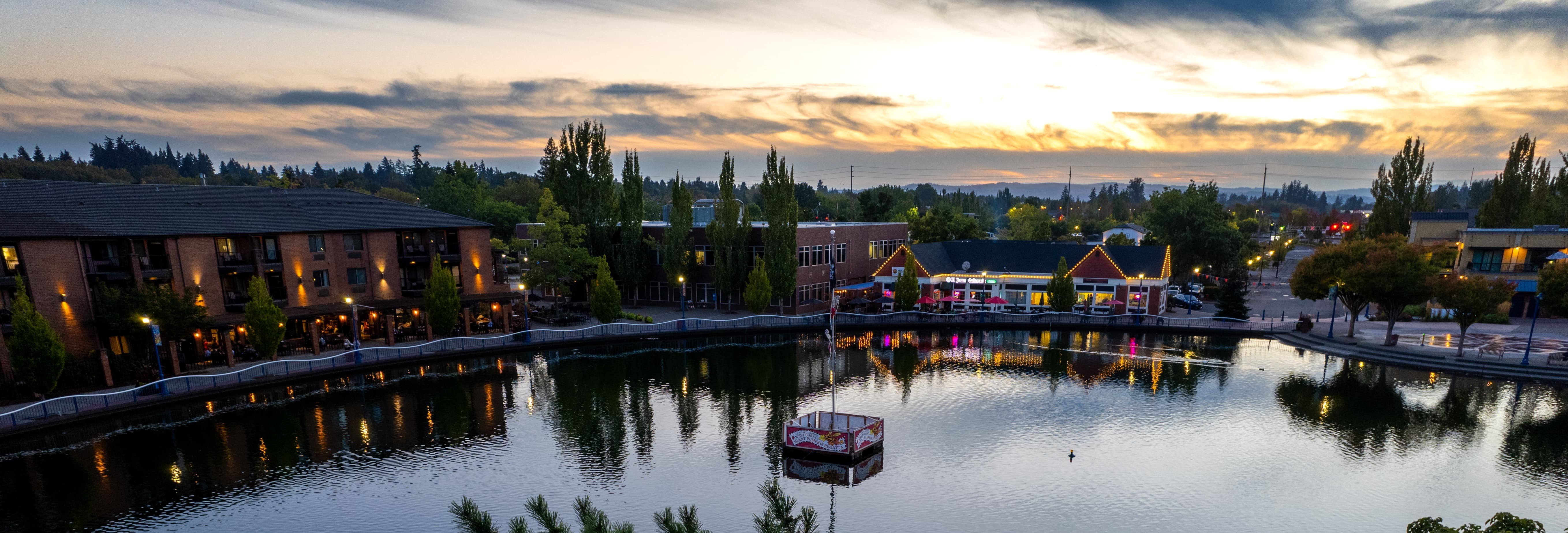
The Tualatin Commons district is the city's most walkable and urban-feeling pocket, centered on the man-made lake and surrounded by restaurants, shops, and community event space. It's where Tualatin hosts outdoor concerts and seasonal events, and the foot traffic that generates makes it the liveliest part of the city. That same commercial and pedestrian activity means crime statistics in this corridor — particularly petty theft and minor property incidents — run higher than the residential southwest, a pattern that reflects visitor density rather than anything about the people who live here.
Best for: Buyers who want an urban-adjacent lifestyle and don't mind trading some statistical quiet for walkability and neighborhood energy.
| City | Violent Crime/1K | Property Crime/1K | Overall Safety Profile |
|---|---|---|---|
| Tualatin | ~2.2 (well below OR avg) | ~28–31 (elevated; retail-driven) | Mixed — safe residentially, elevated commercially |
| Lake Oswego | Among lowest in metro | Among lowest in metro | Consistently high safety ratings |
| Sherwood | Low | Low to moderate | Quiet suburban; lower commercial density |
| Tigard | Moderate | Elevated | Similar commercial-corridor dynamics to Tualatin |
| Oregon Statewide | ~3.3 | Moderate–high | Tualatin violent crime outperforms state avg |
| National Average | ~3.6 | Moderate | Tualatin violent crime well below national avg |
The most relevant comparison for safety-conscious buyers is Sherwood, which offers similarly priced homes with a lower commercial footprint and correspondingly cleaner property crime numbers. Lake Oswego outperforms Tualatin on most safety metrics, but the price premium is substantial. Tigard shares Tualatin's retail-corridor dynamic and generates comparable crime patterns for similar structural reasons.
Looking to buy in Tualatin? Estimate your payment.
Enter your numbers to see an estimated monthly mortgage payment.
Estimate only. Excludes HOA fees and mortgage insurance.
The most consistent piece of advice from Tualatin residents is straightforward: know which part of the city you're in. The stretch of Tualatin-Sherwood Road and the Nyberg Street commercial corridor near I-5 see the parking lot incidents, retail fraud, and auto theft that drive the city's property crime statistics. Locals who live in the southwest don't think about these corridors as part of their neighborhood experience — but buyers who purchase a condo near the Nyberg retail strip and then compare it to what the safety scores promised should recalibrate their expectations.
Car theft deserves specific attention because Tualatin's rate stands out even against other suburban communities. Locals who park regularly in commercial areas around the Tualatin-Sherwood Road corridor tend to use steering wheel clubs or avoid leaving anything visible in vehicles — not because break-ins are constant, but because the rate is high enough to warrant the habit. That precaution is fairly standard advice across the metro, but it applies with a bit more urgency here than in lower-density neighboring cities like Sherwood.
What crime apps and aggregate sites consistently miss is the difference between a crime recorded at a retail address and one recorded on a residential street. A theft at the Fred Meyer on Nyberg and a break-in on a quiet cul-de-sac in the Fox Hill neighborhood register identically in FBI data but represent entirely different realities for residents. Buyers who dig into Tualatin's crime maps rather than relying on letter grades tend to come away with a much more nuanced — and more accurate — picture of what daily life here actually looks like.
Local Expert Takeaway: If safety is a primary factor in your Tualatin search, focus your attention on the southwest quadrant — the Jurgens Park neighborhood, Ibach Park Estates, Hedges Creek, and Fox Hill all sit in the corridor residents consistently describe as the city's quietest. Avoid drawing conclusions from aggregate crime grade sites without understanding that Tualatin's northeast retail corridor inflates the citywide numbers significantly. The $575,000 median home price in the southwest gives you access to genuinely settled residential streets — don't let a letter grade generated from a retail parking lot data pull you toward the wrong conclusion.
✅ Tualatin's violent crime rate runs meaningfully below both Oregon's and the national average — for most residents, the day-to-day experience is quiet and safe, particularly in southwest neighborhoods like Jurgens Park and Ibach Park Estates.
⚠️ Property crime — especially motor vehicle theft — is the real watchpoint. The Nyberg Road and Tualatin-Sherwood Road commercial corridors account for a significant share of incidents. Parking in high-traffic retail areas warrants basic precautions.
📍 Location within Tualatin matters more than the city's aggregate crime score suggests. The difference between the northeast commercial corridor and the southwest residential neighborhoods is substantial — buyer research should be neighborhood-specific, not city-wide.
Is Tualatin a safe city to raise a family?
For families settling into the southwest residential neighborhoods — Jurgens Park, Ibach Park Estates, Fox Hill, and Hedges Creek — Tualatin generally delivers the quiet, stable environment that parents are looking for. The violent crime rate is well below Oregon and national averages, and these specific neighborhoods are consistently identified by residents and local data sources as the city's safest corridors.
What type of crime is most common in Tualatin?
Property crime — particularly motor vehicle theft and retail-related larceny — accounts for the large majority of incidents in Tualatin. Most of this activity concentrates in and around the city's commercial corridors in the northeast, near the Nyberg Road retail district and I-5 access points. Residential neighborhoods, especially in the southwest, see substantially fewer incidents.
How does Tualatin compare to nearby Sherwood and Lake Oswego for safety?
Lake Oswego consistently posts some of the lowest crime rates in the Portland metro and outperforms Tualatin on most measures — though the home price gap between the two cities is significant. Sherwood is a closer comparison: similar price ranges, lower commercial density, and correspondingly cleaner property crime numbers. Tigard, on the other hand, shares many of Tualatin's retail-corridor dynamics and produces similar aggregate crime patterns for the same structural reasons.
Browse current listings updated daily — filtered for Tualatin buyers by Elizabeth Davidson, your local expert.
Powered by Elizabeth Davidson · Cascade Hasson Sotheby's International Realty · 503-939-2035
Explore the full Tualatin series: The Ultimate Tualatin Relocation Guide · Is Tualatin Safe? · Cost of Living in Tualatin · Best Neighborhoods in Tualatin · Tualatin Schools & Family Life · Tualatin Youth Sports · Tualatin Parks & Recreation · Retiring in Tualatin · 1031 Tax-Deferred Exchange in Tualatin · Tualatin First-Time Homebuyers Guide · · Moving to Tualatin from California · The Tualatin Realtor's Perspective · Top 10 Questions a Realtor Gets About Tualatin
Tell us what you need help with and we'll connect you with local resources.

About the Author
Todd Davidson is the founder of Living in Oregon and Living in Washington, where he publishes in-depth city guides, neighborhood resources, and local market insights covering more than 180 communities across the Pacific Northwest. While his background is in home financing and real estate, he created these digital platforms to help families research and compare regions before making a move.