Southern Oregon · Oregon
Moving to Roseburg from California: The Honest Comparison (2026)
The Bay Area software engineer who finally went remote didn't move to Roseburg for the scenery — though the Umpqua River Valley doesn't hurt. She moved because her Walnut Creek condo had appreciated to $1.1 million and she was watching her neighbors' kids grow up in 900 square feet. The San Diego family who relocated last spring stopped dreading the summer utility bill around month two. The Sacramento buyer who sold a modest three-bedroom in Elk Grove and bought a four-bedroom on half an acre in Garden Valley still can't quite believe what happened. Roseburg keeps showing up on California radar for a specific reason: the math is almost absurd by comparison, and the lifestyle trade-offs are real but survivable.
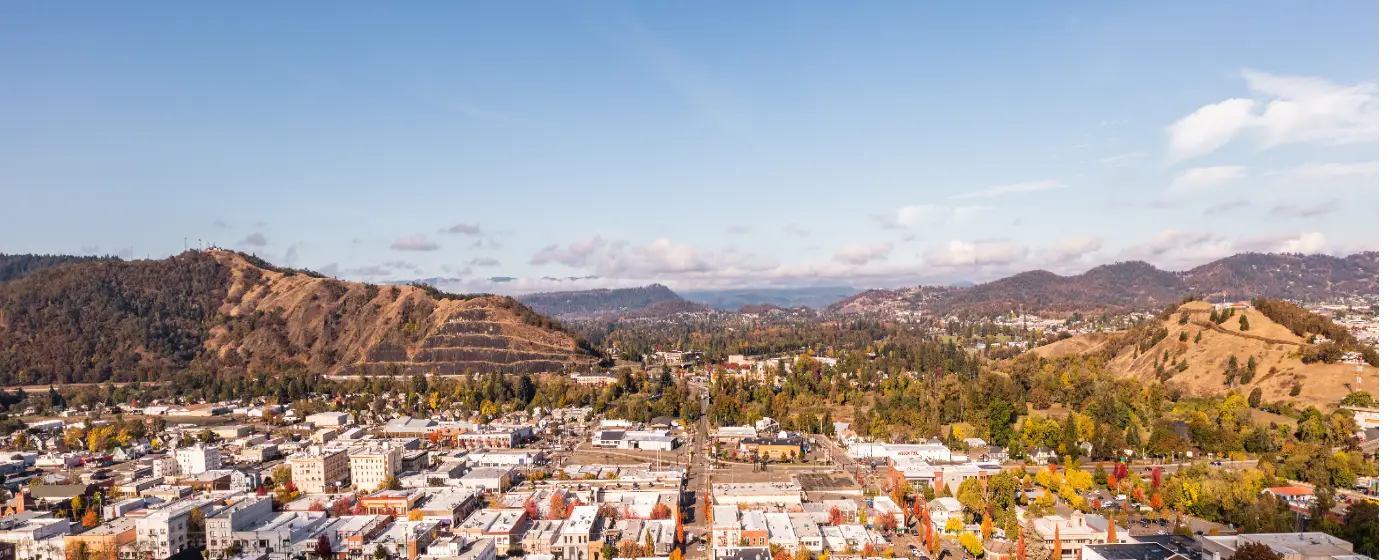
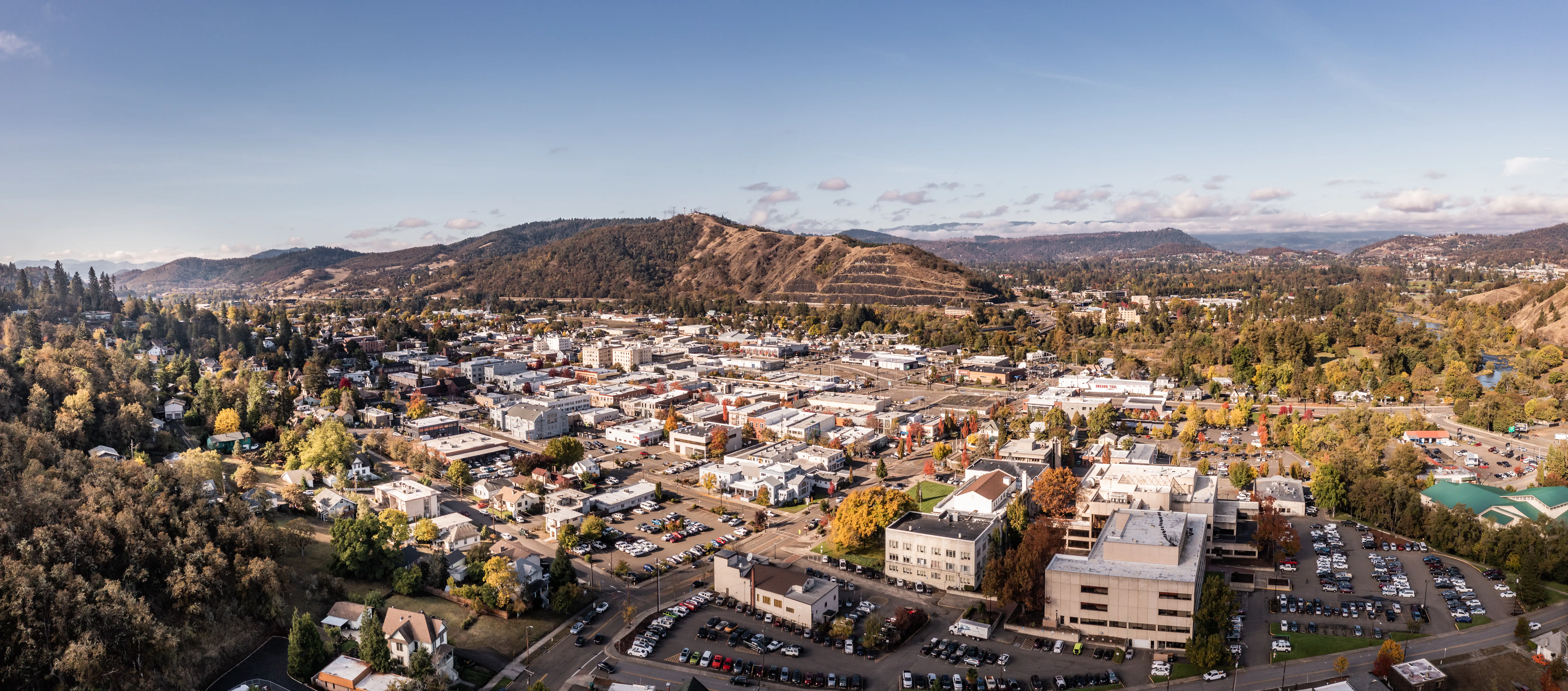
The hard part is that Roseburg is genuinely not California. It's a working timber and healthcare town of roughly 24,000 people in Douglas County, set between mountain ranges in southern Oregon. The restaurant scene is limited. The winters are gray in a way that Pacific sunlight does not prepare you for. The social energy is different — quieter, slower, more neighborly in some ways, less stimulating in others. California transplants who arrive expecting a smaller version of where they came from tend to struggle. The ones who arrive knowing what they're trading tend to stay.
This guide is built for the buyer who has done the spreadsheet and wants the human version. You'll find a detailed cost comparison by California origin market, a realistic picture of what your equity actually buys here, the full Oregon tax picture — including the state income tax that surprises more people than it should — a weather reality check, and an interactive tool to compare your specific California city directly to Roseburg.

| Roseburg, Oregon | Bay Area | Southern CA | Sacramento Metro | Central Valley | |
|---|---|---|---|---|---|
| Median Home Price (approx. 2026) | $350,018 | $1.3M–$1.6M | $750K–$950K | $550K–$680K | $350K–$480K |
| Property Tax Rate (effective) | 0.69% | 0.75–1.1% | 0.75–1.25% | 0.85–1.1% | 0.85–1.0% |
| State Income Tax (top bracket) | 9.9% | 13.3% | 13.3% | 13.3% | 13.3% |
| State Sales Tax | None | 7.25–10.75% | 7.25–10.75% | 7.25–8.75% | 7.25–9.25% |
| Avg Utilities (monthly est.) | $130–$160 | $200–$280 | $220–$300 | $180–$240 | $190–$260 |
| Avg 1BR Rent | $950–$1,200 | $2,800–$3,800 | $2,200–$3,000 | $1,500–$1,900 | $1,100–$1,500 |
A buyer leaving Walnut Creek after selling a $1.4 million home and purchasing in Roseburg at the $350,018 median is either eliminating their mortgage entirely or carrying a loan so small it barely registers against what they were paying in California. Even a buyer coming from the Sacramento metro — where the gains feel more modest — is likely moving into a home with no mortgage at all if they've owned for five or more years. The purchasing power shift is not incremental; it's categorical.
What the table doesn't show is what that freed-up cash does for daily life. A household earning $90,000 that was cash-strapped in San Jose is comfortable in Roseburg. Oregon has no sales tax, so every grocery run, every appliance purchase, every car repair comes back at face value. On a household spending $60,000 per year on taxable goods and services, eliminating a 9% California sales tax returns roughly $5,400 annually — money that quietly accumulates in ways that only become visible when you stop spending it.
Oregon has a graduated state income tax that tops out at 9.9% — the "no income tax" assumption that California buyers sometimes carry from conversations about Nevada or Washington does not apply here. What Oregon does offer is a fundamentally different tax structure with real advantages for property owners and high-spending households.
The absence of a state sales tax is Oregon's most immediate financial gift to California transplants. California's baseline sales tax sits at 7.25%, and most metro areas stack local additions on top — San Francisco runs 8.625%, Los Angeles 10.25%, and parts of the South Bay hit 10.75%. Oregon charges zero. For a family buying a car, furnishing a home, and covering ordinary household expenses in their first year after relocating, the savings can exceed $6,000.
Property taxes in Roseburg are also notably favorable. The effective rate of 0.69% falls below both the Oregon statewide average of approximately 0.86% and the national average. On a $350,018 home, that translates to roughly $2,415 per year in property taxes — a number that requires a double-take from California buyers used to seeing Prop 13-adjusted bills on much higher assessed values, or new buyers paying full market-rate assessments. Oregon's Measure 50, passed in 1997, caps annual increases in assessed value at 3% — meaning long-term Roseburg homeowners see their tax burden grow slowly even as market values rise. For anyone planning to stay a decade or more, that cap compounds into meaningful savings.
| Tax Item | California | Oregon | Net Impact |
|---|---|---|---|
| State Income Tax (top bracket) | 13.3% | 9.9% | Oregon saves ~3.4 pts at top bracket |
| State Sales Tax | 7.25–10.75% | None | Oregon saves $3,000–$6,500+/yr depending on spending |
| Property Tax Rate | 0.75–1.25% (varies) | 0.69% (Roseburg) | Oregon generally favorable |
| Assessed Value Cap | Prop 13 (1% + 2% max increase, purchase-year reset) | Measure 50 (3%/yr cap) | Similar long-term protection |
| Capital Gains (state) | Up to 13.3% | Up to 9.9% | Oregon meaningfully lower |
| Estate/Inheritance Tax | None (state) | Oregon estate tax 10–16% on estates over $1M | Oregon disadvantage for larger estates |
A California transplant earning $150,000 who moves to Roseburg is dropping from a top California marginal rate of 9.3–10.3% on that income bracket to Oregon's comparable brackets — saving roughly $3,000–$5,000 in state income taxes annually. That savings, combined with no sales tax and lower property taxes, means the full household tax picture in Oregon is materially better than California for most working-age transplants, even accounting for Oregon's estate tax provisions that matter to wealthier buyers.
The one area California buyers sometimes overlook is Oregon's estate tax, which applies to estates over $1 million at rates from 10% to 16%. California has no state estate tax. For buyers with significant assets beyond the home, that's worth a conversation with an Oregon estate planning attorney before the move.
A buyer leaving Palo Alto, San Francisco, or the East Bay hills with $1.5 million in equity is operating in a completely different universe in Roseburg. At the $350,018 median, that equity buys the home outright and leaves $1.1 million sitting in cash or investment accounts. For buyers willing to move up the Roseburg price ladder, the $500,000–$700,000 range delivers custom homes on multiple acres, newer construction with mountain and river views, and properties that would be classified as estates in any California context. The Hucrest neighborhood on Roseburg's western hillside and the Garden Valley corridor offer some of the most desirable residential settings in the city — and nothing there approaches what a buyer from Marin County paid for their last home. Bay Area buyers at this equity level should also know that Roseburg's top-of-market ceiling extends to approximately $1.26 million, meaning a buyer who wants to deploy equity into a genuine luxury property with acreage near Umpqua National Forest access has that option.
For Bay Area buyers with investment property, the 1031 exchange path deserves early attention. Exchanging a California investment property into Oregon real estate is fully viable, and Roseburg's rental market — driven by the hospital, the VA, the college, and regional employment — provides a legitimate income-property runway. More on the mechanics is covered in the Roseburg 1031 Exchange guide.
A buyer leaving Irvine, Pasadena, or the South Bay with $900,000 in equity lands in the top 10% of the Roseburg market with meaningful reserves. That figure buys the median home outright with $550,000 remaining — or stretches into a premium four-bedroom on a half-acre in Garden Valley or a newer build in the Green area south of the city with cash to spare. Southern California buyers at this level frequently find they can afford both a primary home and a rental property in Roseburg, a combination that was theoretical rather than practical in most Los Angeles-area submarkets. The lifestyle shift is larger for SoCal buyers than for most — the beach access, the year-round warmth, and the cultural density of Southern California don't have local equivalents — but the financial relief tends to be immediate and undeniable.
Sacramento and Inland Empire buyers arrive with a closer relative advantage, but it still moves the needle. A buyer selling in Elk Grove or Rancho Cucamonga with $500,000 in equity is buying Roseburg's median home outright with $150,000 remaining. That remainder funds a renovation, a year of living expenses, or a down payment on a rental. For buyers in this equity range who still want a mortgage, falling under Oregon's conventional loan limits means no jumbo financing — straightforward qualification at standard rates. The property types in this price range include updated 1970s ranch homes in Southeast Roseburg and East Downtown, mid-century homes in the Harvard neighborhood, and well-maintained suburban properties in the Laurelwood and Grandview areas.
Central Valley buyers — Fresno, Stockton, Bakersfield, Modesto — arrive with the smallest relative gain, but the gain is real. A buyer with $380,000 in equity is still buying the Roseburg median outright, or making a large down payment that produces a monthly payment dramatically lower than what they left behind. At this equity level, the no-sales-tax advantage and the lower cost of daily living carry more weight than the equity pop. Buyers in this range find the most value in the Southeast Roseburg and Dixonville areas, where homes in the $280,000–$350,000 range offer solid square footage and reasonable proximity to Highway 99 and I-5 access.

Looking to buy in Roseburg? Estimate your payment.
Enter your numbers to see an estimated monthly mortgage payment.
Estimate only. Excludes HOA fees and mortgage insurance.
The weather is where California-to-Roseburg guides tend to lose credibility by softening the truth. Roseburg gets roughly 182 sunny days per year — about 23 fewer than the national average, and dramatically fewer than San Diego's 266, Sacramento's 269, or even Fresno's 300. The city sees precipitation on approximately 146 days per year, with December delivering 21 rainy days and about 6.6 inches of rain in a single month. The winters are genuinely gray. Not Seattle gray, and not Portland gray — Roseburg sits in a valley that earns comparatively more sunshine than the Willamette Valley to the north — but the cumulative dreariness between November and March is something no California upbringing adequately prepares you for. Transplants who struggle most tend to be those who moved from Sacramento or the Central Valley, where 260+ sunny days per year becomes ambient expectation rather than conscious appreciation.
The summer, however, is legitimately excellent. July averages 12.4 hours of daylight per day, the Umpqua River and its tributaries are accessible for swimming, fishing, and kayaking, and temperatures are warm without the oppressive heat of the San Joaquin Valley. Most Roseburg transplants who were honest about the winter adjustment will tell you the summer feels like a reward. The Umpqua National Forest access from Roseburg means hiking trails, waterfalls, and old-growth forest within 30–45 minutes of downtown — outdoor access that rivals anything the Sierra Nevada foothills offered, without the drive from a major metro.
What transplants genuinely miss after a year: the food scene, specifically. Roseburg has decent dining relative to its size, but it is not a restaurant city. Bay Area and Los Angeles buyers accustomed to deep ethnic food variety — Korean BBQ, authentic dim sum, Persian grocery stores — will find those options absent or limited. The social pace is slower and more predictable, which some transplants embrace and others find deflating. Year-round beach access, specifically, cannot be replicated — Coos Bay is 75 miles west, and Pacific Northwest beach culture is a fundamentally different experience from what Southern California offers. What most transplants do not expect to miss: traffic. The I-5 corridor through Roseburg is a real freeway with real congestion around the Highway 99 interchange during commute hours, but it bears no resemblance to the 405 or Highway 80.
If you want to see how Roseburg compares directly to the city you're leaving, use the tool below — it covers the 120 largest California cities with current housing and tax data.
Home prices: Redfin median sale data, Q1–Q2 2026. Select your city to compare.
Ready to talk through what your specific California equity could do in Roseburg? Todd can model your exact scenario in a single call.
Assuming Roseburg is uniform. The city's character shifts significantly between neighborhoods, and the price range doesn't always track with desirability the way California buyers expect. The Downtown and East Downtown areas have lower price points but also higher crime density relative to the city average — a buyer who optimizes purely on price-per-square-foot without understanding that distinction can land in a block that feels very different from what they previewed online. Garden Valley and Hucrest represent the more established residential character of the city, while Southeast Roseburg and the Roberts Creek area offer newer suburban feel at mid-range prices. Spending a week in Roseburg and driving the neighborhoods before making an offer is not optional for out-of-state buyers.
Skipping radon testing. Oregon sits in a radon-elevated zone, and Douglas County homes — particularly older ones and those with basements or crawl spaces — carry meaningful radon risk. California buyers are accustomed to inspection contingencies focused on seismic retrofitting and fire hardening; radon testing doesn't typically appear on their radar. In Roseburg, it should be standard in every purchase offer. Remediation is generally inexpensive when caught early, but buyers who waive inspections to compete in a fast market are taking a risk that has no California equivalent.
Misjudging winter outdoor access. California buyers who mountain bike year-round in Marin, hike January trails in the Santa Monica Mountains, or run outdoors in shorts through December should plan for a genuine reset in winter behavior. The trails around Umpqua National Forest become muddy and sometimes inaccessible in the wet season. The river recreation that defines Roseburg's summer culture largely pauses between November and April. Buyers who are deeply identity-invested in year-round outdoor activity without adjustment tend to find the winter harder than they projected.
Not accounting for Oregon income tax on California-sourced deferred income. Buyers who hold substantial deferred compensation, stock options, or retirement accounts that they plan to draw down after moving will owe Oregon income tax on distributions — even if the income was earned in California during California residency. This matters most for tech workers with large RSU grants vesting post-move and for early retirees planning to draw from 401(k) accounts. Oregon's 9.9% top bracket on ordinary income is meaningfully lower than California's 13.3%, but it's not zero, and buyers who assumed they were escaping all California tax consequences on deferred income sometimes discover otherwise.
Bay Area sellers with large equity — $1 million or more arriving from markets like Sunnyvale, Burlingame, or Oakland Hills — often have enough to purchase outright with cash. When cash is the option, the Roseburg market responds well: cash buyers in a market where the median sits at $350,018 and days on market run 34–81 days depending on the segment can often negotiate from a position of real strength. For buyers who want to preserve liquidity and still carry a small mortgage, rates matter less than terms at low loan-to-value ratios, and lenders compete aggressively for low-risk, high-credit profiles. Bay Area sellers with investment property should evaluate a 1031 exchange before triggering capital gains — the Roseburg 1031 Exchange guide covers the Oregon-specific mechanics.
Southern California sellers arriving with $700,000–$1.2 million in equity are well-positioned for conventional financing on any Roseburg property. Roseburg's price point means even a 20% down payment on a $500,000 home requires only $100,000 out of pocket, leaving substantial reserves intact. Jumbo loan thresholds don't apply at most Roseburg price points, which simplifies qualification significantly compared to California lending environments where jumbo is the default.
Sacramento and Inland Empire buyers with equity in the $400,000–$650,000 range who are eyeing Roseburg homes under the $350,000 threshold may qualify for Oregon Housing and Community Services (OHCS) down payment assistance programs if certain income guidelines are met — particularly relevant for buyers whose California equity is partially tied up in a simultaneous purchase and doesn't fully close before the Oregon transaction. The Roseburg First-Time Homebuyers Guide and the cover these programs in detail.
Local Expert Takeaway: The single thing California buyers most consistently underestimate about Roseburg is the neighborhood variation within the city. A $300,000 home on one street and a $300,000 home six blocks away can represent genuinely different living experiences — the Downtown core, parts of East Downtown, and pockets along Stephens Street have higher property crime concentrations than the hillside neighborhoods or Garden Valley. Drive the specific street, not just the neighborhood name, before committing. California buyers who rely on Zillow neighborhood boundaries rather than local knowledge are the ones who call back with regrets.
✅ The financial case is strong regardless of your California origin market. Even Central Valley buyers with modest equity find Roseburg's no-sales-tax environment, 0.69% property tax rate, and lower cost of daily living produce real, immediate budget relief.
⚠️ Oregon has a state income tax — plan accordingly. At 9.9% top bracket, it's materially lower than California's 13.3%, but buyers drawing down deferred compensation, RSUs, or retirement accounts need to model the Oregon tax picture before assuming they've escaped California's tax reach on that income.
📍 Neighborhood selection matters more in Roseburg than buyers expect. The city's character varies significantly by area — research the specific street, not just the city or neighborhood name, and spend time in the market before making an offer from California.
Is moving from California to Roseburg worth it?
For most California buyers who've built meaningful equity, the financial math makes a compelling case. The gap between California home prices and Roseburg's $350,018 median is large enough that even Sacramento or Inland Empire sellers often arrive able to buy outright. The lifestyle trade-off is real — the restaurant scene is limited, the winters are genuinely gray, and the social energy is quieter — but buyers who prioritize space, financial relief, and outdoor access over urban density tend to find the move worth it within the first year.
How does Oregon property tax compare to California?
Roseburg's effective property tax rate of 0.69% is lower than both the Oregon statewide average and the national average. On a $350,018 home, that works out to roughly $2,415 per year. California's Prop 13 can produce artificially low bills for long-term owners, but buyers purchasing at current California market values often face much higher effective rates on their new assessed value. For California buyers purchasing in Roseburg, the combination of a lower price and a lower rate produces a property tax bill that tends to be a fraction of what they were paying — or would have paid — in California.
What does California home equity buy in Roseburg?
A buyer with Bay Area equity of $1.5 million buys the Roseburg median outright and has over $1.1 million in remaining capital. A Southern California buyer with $900,000 in equity accesses the top tier of Roseburg's market — custom homes, acreage, premium neighborhoods — with reserves intact. Even a Central Valley buyer with $380,000 in equity can purchase Roseburg's median home outright. The relative gain scales with your California origin market, but at every level, the purchasing power shift is meaningful enough to change how buyers think about their next chapter.
Explore the full Roseburg series: The Ultimate Roseburg Relocation Guide · Is Roseburg Safe? · Cost of Living in Roseburg · Best Neighborhoods in Roseburg · Roseburg Schools & Family Life · Roseburg Youth Sports · Roseburg Parks & Recreation · Retiring in Roseburg · 1031 Tax-Deferred Exchange in Roseburg · Roseburg First-Time Homebuyers Guide · · Moving to Roseburg from California
Tell us what you need help with and we'll connect you with local resources.

About the Author
Todd Davidson is the founder of Living in Oregon and Living in Washington, where he publishes in-depth city guides, neighborhood resources, and local market insights covering more than 180 communities across the Pacific Northwest. While his background is in home financing and real estate, he created these digital platforms to help families research and compare regions before making a move.