
Southern Oregon · Oregon
Moving to Jacksonville from California: The Honest Comparison (2026)
The Bay Area software engineer who finally went fully remote started looking at a map differently. When your employer stops requiring the Caltrain commute and your Walnut Creek townhome sells for $1.3 million, a small Oregon town with a National Historic Landmark designation, summer temperatures that push 90 degrees, and a median home price well below what you just sold suddenly becomes very real. Jacksonville, Oregon has been drawing exactly this kind of buyer — equity-rich, done with California's cost structure, ready for something that feels genuinely different. At roughly 3,020 residents tucked into 1.89 square miles of Southern Oregon foothills, it is not trying to be California. That is precisely the point.
The hard part is worth naming before we get into the numbers. Jacksonville winters are not San Diego winters. December brings 18 rainy days, peak sunshine drops to about 3.4 hours per day, and the town quiets in ways that Southern California transplants find disorienting in year one. The outdoor culture that makes Jacksonville feel so alive from May through October looks fundamentally different by February — and some buyers who didn't fully reckon with that find themselves on a plane back to the Bay Area by year three. This guide exists to prevent that surprise.
What follows covers the full California-to-Jacksonville financial picture by region — Bay Area equity, SoCal equity, Sacramento-area equity, and Central Valley equity — alongside the tax comparison, the lifestyle honesty, common mistakes California buyers make, and an interactive tool to compare your specific California city directly to Jacksonville. If you're deciding whether to make this move, the information here will save you from going in with the wrong assumptions.

| Jacksonville, Oregon | Bay Area | Southern CA | Sacramento Metro | Central Valley | |
|---|---|---|---|---|---|
| Median Home Price (approx. 2026) | $595K–$700K | $1.3M–$1.6M+ | $750K–$1.1M | $500K–$650K | $320K–$440K |
| Property Tax Rate (effective) | ~0.92% | ~1.1%–1.25% | ~1.1%–1.25% | ~1.0%–1.15% | ~0.95%–1.1% |
| State Income Tax (top bracket) | 9.9% | 13.3% | 13.3% | 13.3% | 13.3% |
| State Sales Tax | 0% | 7.25%–10.75% | 7.25%–10.75% | 7.75%–8.75% | 7.25%–8.75% |
| Avg Utilities (monthly est.) | $150–$210 | $220–$310 | $180–$270 | $180–$240 | $170–$230 |
| Avg 1BR Rent | $1,200–$1,600 | $2,800–$4,200 | $2,200–$3,400 | $1,500–$2,000 | $1,100–$1,600 |
A buyer leaving San Jose with $1.4 million in home equity and purchasing in Jacksonville at $700,000 is not just cutting their housing cost in half — they are potentially eliminating their mortgage entirely and banking the remainder. Even a buyer who rolls equity into a premium Jacksonville property on Britt Hill or along the California Street corridor is typically looking at a dramatically lower monthly obligation than they carried in their California ZIP code.
The savings on sales tax alone register quickly for households with normal spending patterns. A family spending $60,000 per year on taxable goods and services in a Bay Area county running 9.25% sales tax was paying roughly $5,500 annually before buying a single thing they actually wanted. In Oregon, that number drops to zero — permanently, regardless of purchase size.
The "no income tax" assumption is a common and costly mistake. Oregon absolutely has a state income tax, and it is not gentle at higher income levels. The graduated rate runs from around 4.75% at lower incomes up to a top bracket of 9.9% — a rate that catches most California transplants earning $150,000 or more. At that income level, a California resident was paying 13.3% in state income tax on every dollar above the top bracket threshold. Oregon's 9.9% top rate is meaningfully lower, but it is not zero, and buyers relocating while continuing to earn Bay Area-level remote income should model that number carefully before assuming they've escaped state taxation entirely.
What Oregon does offer that California does not: zero state sales tax, a property tax system stabilized by Measure 50 (which caps annual assessed value increases at 3% per year after purchase), and a senior property tax deferral available to homeowners 62 and older. On a $700,000 property at Jacksonville's 0.92% rate, annual property taxes run approximately $6,440 — a figure that holds relatively steady as long as you own the home, unlike California's Proposition 13 corollary which works similarly but starts from a potentially far higher assessed base.
| Tax Item | California | Oregon | Net Impact |
|---|---|---|---|
| State Income Tax (top rate) | 13.3% | 9.9% | Save ~3.4 points on high income |
| State Sales Tax | 7.25%–10.75% | 0% | Eliminates thousands annually |
| Effective Property Tax Rate | ~1.1%–1.25% | ~0.92% | Lower in Jacksonville |
| Assessed Value Caps | Prop 13 (similar structure) | Measure 50 (3%/yr cap) | Comparable long-term protection |
| Senior Property Tax Deferral | Available | Available (62+) | Comparable benefit |
| Capital Gains on Home Sale | State taxes apply | State taxes apply | No advantage either direction |
The income tax difference matters most for remote workers earning California-level salaries. A remote software engineer earning $180,000 in Oregon pays state income tax at Oregon rates — top bracket 9.9% — versus 13.3% in California. On $80,000 of income taxed at the top bracket, that difference is roughly $3,200 per year. It adds up, but it's not the headline saving. The headline saving is the sales tax elimination and the housing equity differential, which for most Bay Area sellers runs well into six figures.
A buyer leaving Walnut Creek or Palo Alto with $1.5 million in equity arrives in Jacksonville with the full market at their disposal. The current listing price benchmark sits at $700,000, while the typical sold price converges closer to $595,000 — meaning a buyer at this equity level can purchase the finest homes in the Historic District or on Britt Hill in cash and still retain six figures in reserve. Premium Historic District properties — fully restored Victorians within walking distance of the Britt Music & Arts Festival grounds at Peter Britt Gardens — are available in the $700,000 to $900,000 range. Buyers at this equity level who aren't interested in an all-cash deal frequently choose to put 50% down, invest the remainder, and use the low-LTV loan as a wealth management tool rather than a necessity.
The Britt Hill and California Street corridors represent Jacksonville's most coveted addresses for this buyer profile. Mature landscaping, walkability to downtown, and proximity to the Beekman House and Jacksonville's core cultural institutions make these properties outperform the broader market in sustained demand. At this equity level, Jacksonville is one of the few Western U.S. markets where the move genuinely feels like a step up in quality of life across every measurable dimension simultaneously.
A buyer leaving Pasadena or Carlsbad with $950,000 in equity has a compelling set of choices in Jacksonville. That equity covers the full purchase price of a well-positioned property with cash to spare, or finances a premium home with a very low loan-to-value ratio that keeps monthly costs well below what they were carrying in Southern California. The West Main corridor and Historic District offer properties in the $550,000–$750,000 range that typically include Victorian-era construction on oversized lots, mature fruit trees, and architectural character that Southern California's newer suburbs simply don't replicate.
What buyers at this equity level consistently find is that the financial relief is real and immediate — but the lifestyle adjustment is where the work is. SoCal transplants used to year-round beach access and 262 sunny days annually are moving to a market with 199 sunny days and December rainfall that runs over 18 days in the month. The summer upside is genuine — July highs average 90°F with nearly two full weeks of rain-free blue sky — but the winter expectation reset is non-negotiable.
The relative financial gain for Sacramento and Inland Empire buyers is more modest than the Bay Area scenario, but it remains meaningful in specific ways. A buyer leaving Elk Grove with $500,000 in equity is not eliminating their mortgage in Jacksonville — but they are likely putting 60–70% down on a Historic District property and carrying a small loan at favorable terms. The elimination of California's sales tax structure and the lower income tax rate tend to show up within 12–18 months for buyers who track their spending.
Entry-level Jacksonville properties — smaller Historic District homes, National Register-eligible properties in the $400,000–$500,000 range on 0.25-acre lots — represent the best value in this equity tier. Straw Bale Village properties in the mid-$500,000s offer a genuinely distinctive architectural character that Sacramento's newer suburbs cannot match at any price. For a buyer who values land, privacy, and distinctiveness over urban access, Sacramento equity still buys a meaningful upgrade in Jacksonville.
Central Valley buyers — leaving Fresno, Visalia, or Bakersfield — have the narrowest relative advantage of the four groups, but the calculation still runs in their favor on several fronts. At $350,000–$400,000 in equity, a Central Valley buyer can cover the down payment on a well-priced Jacksonville property and reduce their mortgage to a level that the Oregon income tax savings partially offset over time. The zero sales tax environment is tangible for households with higher taxable spending, and Measure 50's 3% annual cap on assessed value increases offers long-term stability that California's system doesn't guarantee for buyers who enter at higher base valuations.
The practical reality for this equity tier is that the move to Jacksonville is less about financial transformation and more about quality-of-life trade — more space, more quiet, more community, and an architectural environment that is genuinely irreplaceable. A $400,000 entry-level Jacksonville property on a quarter-acre in the Woodlands area offers something no Central Valley suburb at that price point can: proximity to a federally designated National Historic Landmark district and a community built around outdoor culture, live music, and small-town rootedness.
Looking to buy in Jacksonville? Estimate your payment.
Enter your numbers to see an estimated monthly mortgage payment.
Estimate only. Excludes HOA fees and mortgage insurance.
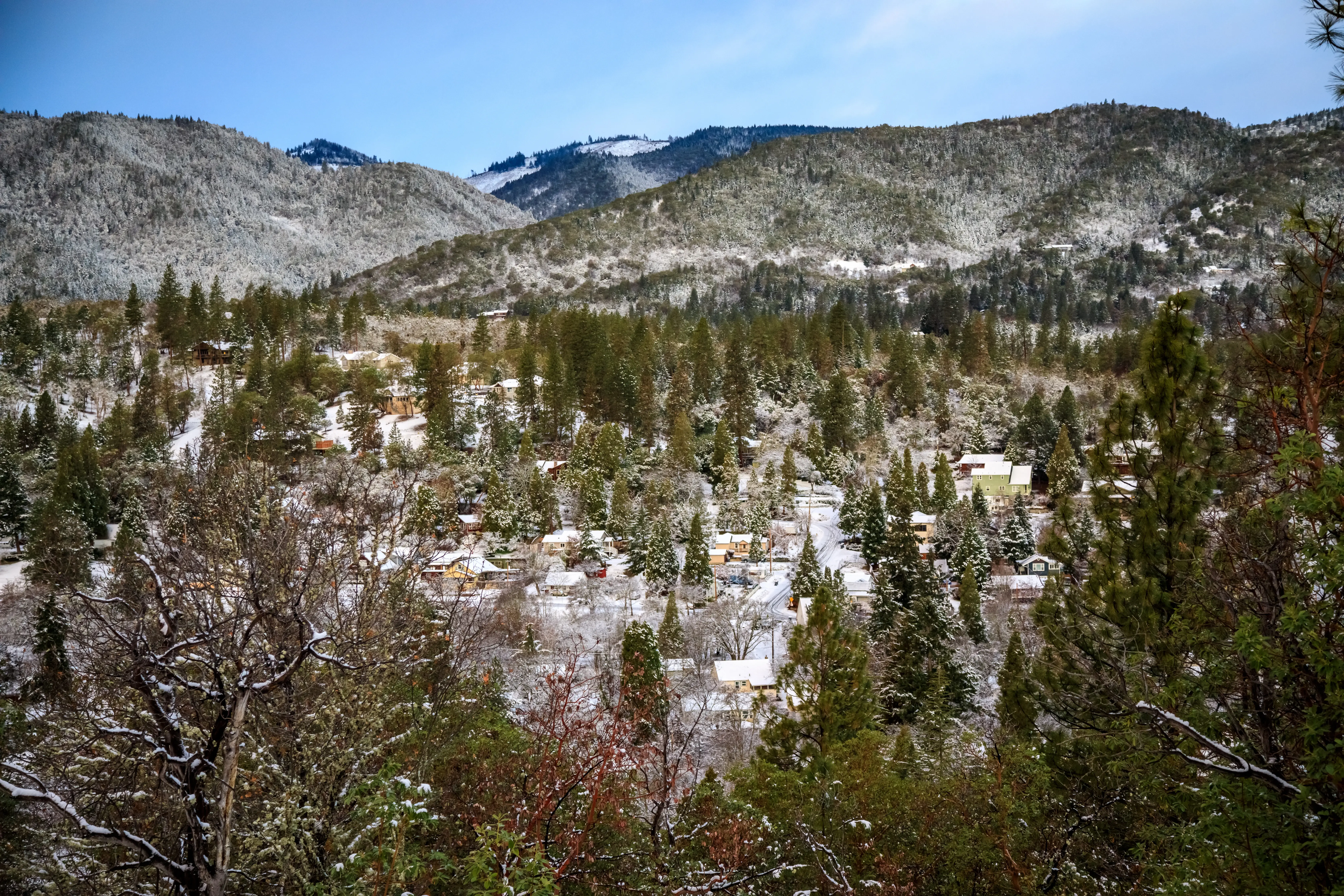
Jacksonville gets approximately 199 sunny days per year — essentially equal to the national average of 205, and meaningfully below Los Angeles's 262. Annual sunshine hours run around 2,909, which sounds like a lot until you understand how unevenly they're distributed. July delivers 13.2 hours of sunlight per day with only two rainy days in the month. December delivers 3.4 hours of peak sunlight per day across 18 rainy days. That swing is what catches California transplants off guard — not because the data is hidden, but because Southern California has trained buyers to assume "Oregon" means "Portland rainy gray" year-round, when the reality is a sharp seasonal split that feels almost Mediterranean in summer and genuinely Pacific Northwest in winter.
What buyers genuinely love after a year in Jacksonville, consistently and specifically: the summers. Hot, dry, and culturally alive — the Britt Music & Arts Festival draws national acts to an outdoor amphitheater set into the hillside at Peter Britt Gardens from late June through August, and the event fills the Historic District with the kind of energy that makes Jacksonville feel much larger than 3,020 people. The traffic situation after leaving the Bay Area or greater Los Angeles is the other consistent surprise — not just "less traffic" in the abstract, but a 10-minute commute to Medford's employment core that California buyers do not initially believe is real. The pace of life in Jacksonville is not slow so much as it is chosen; no one is fighting the commute because there isn't one to fight.
What buyers genuinely miss: year-round beach access tops the list, followed by the social energy and cultural diversity of larger California metros. A buyer leaving San Francisco's Mission District or Los Angeles's Silver Lake is trading a specific kind of cosmopolitan density for something quieter and more homogeneous. The food scene in Jacksonville and greater Medford has improved substantially, but it is not the Bay Area, and transplants who built their social identity around restaurant culture and nightlife find the adjustment real. The community is warm but small — 3,020 residents is a number where you genuinely begin to recognize faces at the Jacksonville Woodlands Trail System, which some buyers love and others find constricting.
If you want to see how Jacksonville compares directly to the city you're leaving, use the tool below — it covers the 120 largest California cities with current housing and tax data.
Home prices: Redfin median sale data, Q1–Q2 2026. Select your city to compare.
Ready to talk through what your specific California equity could do in Jacksonville? Todd can model your exact scenario in a single call.
Mistake 1: Treating the listing price as the sale price. Jacksonville's median listing price sits at $700,000, but typical sold prices converge near $595,000, with homes spending an average of 68–79 days on market and frequently closing about 3% below list. California buyers conditioned by bidding wars and waived contingencies arrive expecting to offer over asking and sometimes overpay in a market where patient negotiation is both possible and rewarded. The Jacksonville market is currently buyer-balanced — more inventory than recent prior years, allowing time for inspections that California's competitive markets trained buyers to skip. Do not skip inspections here.
Mistake 2: Underestimating radon testing. Oregon has elevated radon zones, and Jackson County properties — particularly older Historic District homes with basement or crawl space construction — are worth testing specifically. California buyers who have never needed to think about radon often skip this step, and it is not a step worth skipping in Southern Oregon's geology.
Mistake 3: Assuming the entire Jacksonville market is uniform. California Street and Britt Hill represent the most coveted addresses in town — walkable, historically significant, and priced accordingly. The Woodlands area near the Jacksonville Woodlands Trail System and West Main corridor offer meaningfully different character and price points. A buyer who falls in love with one section of Jacksonville without understanding that the market segments significantly by street and elevation can end up in the wrong part of town for their actual lifestyle.
Mistake 4: Expecting California-pace outdoor access in winter. The Jacksonville Woodlands Trail System's 30-plus miles of trails are genuinely excellent from late spring through early fall. But December through February brings 32°F overnight lows, occasional snow averaging around 4 inches per season, and the trail experience that a buyer from San Diego has never actually prepared for. Buyers who come from year-round outdoor cycling and hiking lifestyles in Southern California need to honestly plan what winter recreation looks like — because Jacksonville in January is not Encinitas in January, and the adjustment is real.
Bay Area sellers with substantial equity arrive in Jacksonville with a level of purchasing power that makes mortgage terms almost secondary to speed and certainty. An all-cash offer in Jacksonville's moderately competitive market carries meaningful negotiating weight — buyers closing in 14 days without financing contingencies have consistently secured properties below list price over the past 24 months. For sellers who converted a California investment property and want to defer capital gains, a 1031 exchange into a Jacksonville rental or multi-unit property is worth modeling carefully before closing escrow in California; the timeline is strict and the planning must begin before the California sale closes. The full mechanics are covered in Jacksonville's 1031 exchange guide.
Southern California sellers bringing $700,000–$1.2 million in equity typically find Jacksonville's price range well inside conventional loan territory — no jumbo product required in most scenarios, which simplifies qualification. A 40–50% down payment is realistic at this equity level, putting monthly obligations well below California levels even after the Oregon income tax adjustment.
Sacramento and Inland Empire buyers in the $400,000–$650,000 equity tier may find select Jacksonville properties — particularly entry-level Historic District homes in the $400,000–$500,000 range — accessible with Oregon Housing and Community Services (OHCS) programs if their purchase price falls within program guidelines. It is worth verifying eligibility early in the search process, as purchase price caps apply and Jacksonville's premium market pricing can push buyers above threshold quickly.

Local Expert Takeaway: The single most underestimated factor in Jacksonville's market for California buyers is how thin the sales volume is — typically only a handful of homes change hands per month in this ZIP code. In a market this small, one motivated seller or one competing cash offer can shift the dynamics of any individual negotiation dramatically. California buyers should come prepared with pre-approval or proof of funds, move quickly on properties they're serious about, and resist the instinct to low-ball in the way they might in a high-volume suburban market. The Historic District and Britt Hill properties specifically hold value because there are genuinely few of them — and that scarcity does not resolve over time.
✅ The financial case is real. Bay Area and SoCal equity buyers can eliminate or dramatically reduce their mortgage, eliminate state sales tax, and own homes with irreplaceable historic character at prices their California peers cannot access.
⚠️ The winter adjustment is not cosmetic. December brings 18 rainy days, 3.4 peak sunshine hours, and overnight lows near freezing. Buyers who don't plan for this specific seasonal reality are the ones who return to California.
📍 The market is thin and requires preparation. With only a handful of homes selling per month, Jacksonville rewards prepared buyers — cash-ready or pre-approved, flexible on timing, and realistic about the 68–79-day average days-on-market rhythm compared to California's bidding-war pace.
Is moving from California to Jacksonville worth it?
For equity-rich buyers who value small-town community, architectural authenticity, and genuine outdoor culture over urban density, the answer is consistently yes. The financial relief is real — zero sales tax, lower income tax burden, and a market where Bay Area equity buys outright ownership of historically significant homes. The honest caveat is that Jacksonville is small, the winters are genuine, and the social pace is fundamentally different from any major California metro. Buyers who've done the honest accounting on both sides of that ledger tend to stay.
How does Oregon property tax compare to California's?
Jacksonville's effective property tax rate runs approximately 0.92%, and Measure 50 caps annual assessed value increases at 3% per year after purchase — providing the same long-term stability that California's Proposition 13 was designed to create. For a $700,000 property, that translates to roughly $6,440 annually, a figure that holds relatively steady as long as you own the home. California buyers entering at similar price points often paid comparable or higher effective rates without Oregon's predictable cap structure.
What neighborhoods in Jacksonville are most popular with California transplants?
The California Street corridor and Britt Hill draw the most attention from equity-rich California buyers — walkable to downtown, architecturally significant, and close to the Britt Festival grounds at Peter Britt Gardens. The Historic District more broadly appeals to buyers who want the full National Historic Landmark experience within walking distance of Jacksonville's commercial core. West Main offers slightly more breathing room on price. Straw Bale Village attracts buyers from California's design-forward communities who want architectural distinctiveness over historical pedigree.
Explore the full Jacksonville series: The Ultimate Jacksonville Relocation Guide · Is Jacksonville Safe? · Cost of Living in Jacksonville · Best Neighborhoods in Jacksonville · Jacksonville Schools & Family Life · Jacksonville Youth Sports · Jacksonville Parks & Recreation · Retiring in Jacksonville · 1031 Tax-Deferred Exchange in Jacksonville · Jacksonville First-Time Homebuyers Guide · · Moving to Jacksonville from California
Tell us what you need help with and we'll connect you with local resources.

About the Author
Todd Davidson is the founder of Living in Oregon and Living in Washington, where he publishes in-depth city guides, neighborhood resources, and local market insights covering more than 180 communities across the Pacific Northwest. While his background is in home financing and real estate, he created these digital platforms to help families research and compare regions before making a move.