Portland Metro · Oregon
Living in Canby: The Ultimate Relocation Guide (2026)
Maybe your company is relocating you to the south Portland metro and someone mentioned Canby as the alternative to Oregon City — more affordable, more spacious, less traffic. Maybe you've been scrolling listings and keep noticing that $650,000 buys something genuinely different here: a newer home on a real lot, with a yard your kids can actually use, in a town that still feels like a town. Or maybe you drove through on Highway 99E and couldn't quite reconcile what you saw — a small agricultural community with a surprisingly active downtown — with the Portland suburb you expected to find. That tension is real. Canby is simultaneously rural and suburban, sleepy and growing, close enough to Portland for a daily commute and far enough to feel like a different world by Friday evening.
Geographically, Canby sits in northern Clackamas County about 25 miles south of Portland, tucked between the Molalla River to the east and the Willamette River to the west. The city covers just under four square miles of land, which means nearly everything is close. What shapes daily life isn't the city's size, though — it's its position. Interstate 205 is roughly 10 minutes north, I-5 is about 10 minutes west, and Highway 99E runs straight through town. That road access is what makes the 36-minute commute to Portland possible, and it's also what keeps Canby from feeling isolated despite sitting well outside the urban growth boundary. The landscape around the city — dahlia farms, nurseries, egg farms, filbert orchards — reinforces the sense that you've genuinely left the city behind, even if you're back in it by morning.
This guide is designed to help you figure out whether Canby is the right fit for your specific life. Not whether it's a "great place to live" in the abstract, but whether it matches what you actually need: the right school situation, the right commute tolerance, the right neighborhood character, the right balance between small-town atmosphere and suburban convenience. We'll cover who thrives here, who doesn't, what the neighborhoods actually feel like, and what the honest tradeoffs are before you make an offer.
| Best For | Why |
|---|---|
| Commuters to Portland or Wilsonville | A roughly 36-minute drive to Portland and proximity to major employment corridors along I-5 and I-205 make daily commuting realistic — if you time it right |
| Families with school-age children | Canby School District earns a B rating, high school graduation rates run above the state average, and newer subdivisions like Tofte Farms sit close to schools and parks |
| First-time buyers priced out of Oregon City | At a $650,000 median, Canby often delivers more square footage and newer construction than comparable money buys closer to the metro core |
| Retirees seeking small-town pace | Downtown's walkable blocks, community events, and the Canby Depot Museum give retirees a meaningful local scene without city-scale noise and density |
| Remote workers who want space | Larger lots, newer builds, and genuine quiet make Canby appealing for buyers who no longer need to commute every day |
| Agriculture and outdoor lifestyle seekers | The Canby Ferry, Molalla River State Park, Swan Island Dahlia Fields, and surrounding farmland offer a lifestyle that simply doesn't exist closer to Portland |

Canby is one of those markets where buyers who move quickly tend to come out ahead. Over the past year or two, well-priced homes in newer subdivisions like Tofte Farms and the Knights Bridge area have moved faster than many buyers expect — partly because inventory in this price range is still limited relative to demand from the south metro and outer Clackamas County. The $650,000 median here buys something meaningfully different than what that same figure gets you in Oregon City or Milwaukie: newer construction, real yards, and a neighborhood that still has room to grow.
What buyers consistently underestimate is how much the school district matters to resale. Canby School District's above-average graduation rates and the district's expanding CTE pathways at Canby High School have started to show up in buyer conversations more than they used to. Homes near Cecile Trost Elementary and within walking distance of the high school corridor have held their value well. If you're buying with a five-to-ten-year horizon, prioritizing that school proximity — even at a slight premium — has historically been a sound strategy in this market. If you're considering Canby and want insight into which neighborhoods align with your priorities and budget, I'd welcome the opportunity to share what I've learned from helping hundreds of families make this move successfully.
Downtown Canby is the kind of place that surprises people on their first visit. Along First Avenue and adjacent blocks, you'll find locally owned coffee shops, a bookstore, a brewery, and bakeries that locals treat as regular stops rather than destinations. The Canby Night Market and the weekly Farmers Market bring genuine foot traffic on summer evenings, and the scale of downtown — compact enough to walk end-to-end in ten minutes — creates a community-gathering function that many larger suburbs have lost entirely. This isn't a preserved historic district or a planned "town center" development; it's a working small-town main street that happened to survive the suburban sprawl era.
The daily rhythm here is shaped heavily by Highway 99E, which functions as Canby's main artery and its most significant chokepoint. The stretch through downtown and north toward Oregon City gets congested during morning and evening commute windows — roughly 7:00 to 8:30 AM and 4:30 to 6:00 PM — and the single-lane sections through town don't give drivers much relief. Buyers planning to commute north toward Portland regularly discover that the actual drive time varies more than the 36-minute average suggests: on a clear Tuesday morning it's accurate; on a rainy Friday it isn't. Using NE Territorial Road or cutting over to I-205 via Molalla Avenue tends to shave meaningful minutes off the northbound run.
Living in Canby for six months tends to produce a specific kind of surprise: people discover how much of their daily life they can handle without leaving town at all. The Fred Meyer on NE Territorial Road covers most grocery needs, there's a Providence Health clinic nearby, and the school district's footprint means most families with kids are moving within a pretty compact area. What catches people off guard isn't the inconvenience — it's the convenience. The slower pace is a feature, not a compromise, and many buyers who moved here expecting to miss Portland find they're going back less and less.
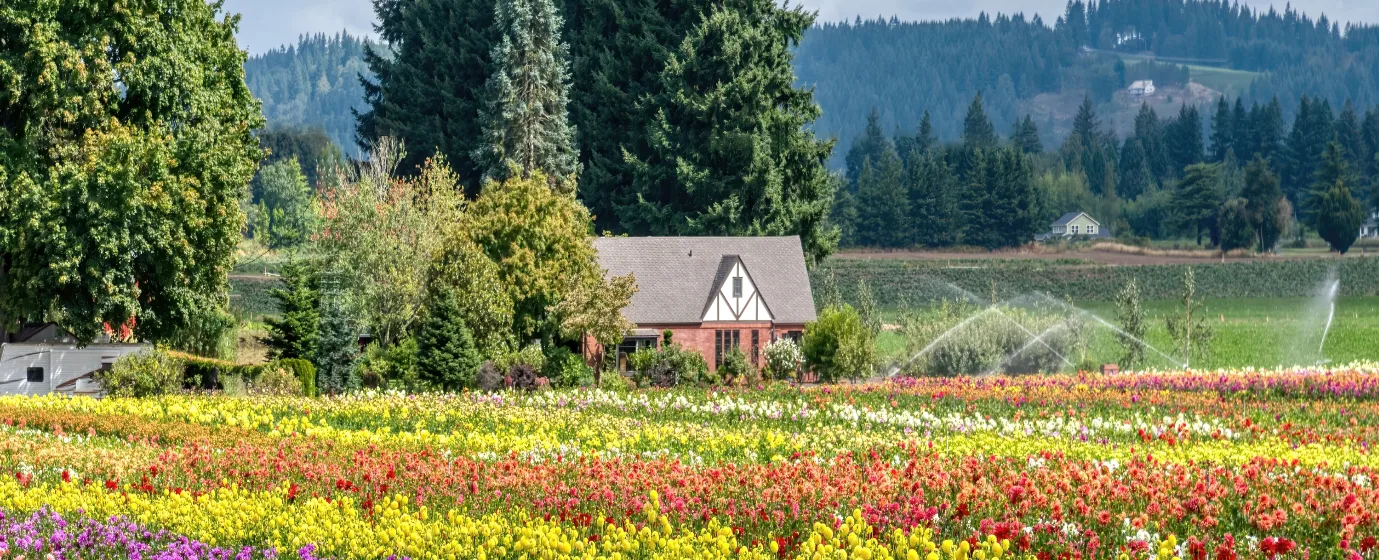
The community culture in Canby leans toward the genuinely local. The Clackamas County Fair, held annually at the fairgrounds just east of town, draws residents from across the region and has a working-agricultural energy that feels authentic rather than performative. The Swan Island Dahlia Fields — a nationally recognized dahlia farm that draws visitors from across the country during late summer — sit just outside the city limits and operate as an informal source of civic pride. These aren't just things to do on a weekend; they're part of what Canby residents mean when they say the town has a distinct identity.
Space that actually feels like space. At 3.75 square miles of land area and a population of about 18,000, Canby doesn't have the density that makes outer Portland suburbs feel compressed. Yards are real, lots are larger than the metro norm, and the surrounding agricultural land — nurseries, dahlia farms, egg farms, filbert orchards — means there's genuine green space in your peripheral view on most drives. For buyers coming from denser parts of the metro, this registers immediately.
A local economy that doesn't depend on one employer. Canby's employment base is more diversified than it appears. Columbia Distributing, Clarios battery manufacturing, Pioneer Pump, Shimadzu USA, Kendall Floral, and Willamette Egg Farms all maintain significant local presence. The Canby School District itself is a meaningful employer. This isn't a one-factory town — it's a working industrial and agricultural community with multiple anchors, which matters for neighborhood stability and long-term resale.
Oregon's sales-tax advantage, felt acutely. Oregon collects no state sales tax and Canby adds no local sales tax either, which means every major purchase — appliances, vehicles, building materials — carries the full purchase price and nothing more. For buyers relocating from California, Washington, or the Sun Belt, this is a concrete and recurring financial benefit that doesn't show up in home price comparisons but absolutely shows up in annual household budgets.
A small-town calendar that locals actually use. The Canby Farmers Market, the Night Market, the County Fair, the dahlia harvest season — these aren't niche events that draw a hundred people. They draw the town. The Vietnam War Memorial at Wait Park gives the community a genuine civic anchor. The Canby Ferry, one of the last working cable ferries in Oregon, crosses the Willamette River and functions both as a practical rural shortcut and as something residents show visitors with a degree of quiet pride. These are the kinds of details that make a place feel like a place.
Newer housing stock in a market that still has room. New subdivisions are actively under construction, and established newer developments like Tofte Farms offer move-in-ready homes built by builders like Pahlisch Homes. For buyers who want updated finishes, efficient floor plans, and warranty coverage without the full custom-build timeline, Canby's active new construction pipeline is a genuine advantage over older inner-ring suburbs where the housing stock is largely fixed.
Looking to buy in Canby? Estimate your payment.
Enter your numbers to see an estimated monthly mortgage payment.
Estimate only. Excludes HOA fees and mortgage insurance.
Canby's greatest asset — its distance from Portland — is also its most significant friction point. The 36-minute commute figure is a reasonable average under normal conditions, but normal conditions on Highway 99E during peak hours are rarer than that number implies. The road narrows, signals cluster, and the route through Barlow and Canby's own downtown creates stop-and-go patterns that add unpredictability. Buyers who commute daily to Portland or Lake Oswego and are factoring this into their budget should spend a week actually driving the route before committing.
What buyers give up moving to Canby from the inner metro is restaurant and entertainment density. Downtown Canby's locally owned businesses are genuinely good — the brewery, the coffee spots, the Farmers Market — but the selection is small-town-scale. A Friday night with meaningful dining options usually means driving to Oregon City, Wilsonville, or Tualatin. For households where dining out frequently is a significant quality-of-life factor, this is worth naming honestly.
Oregon's state income tax, which reaches up to 9.9% at higher income brackets, applies fully in Canby as it does everywhere in the state. For relocating households accustomed to no-income-tax states like Washington, Nevada, or Florida, this is the counterbalance to the sales-tax savings — and at higher income levels, it tips decidedly negative. The math is household-specific, but it's worth running before assuming Oregon is cheaper.
Why some people leave Canby tends to come down to one of two things: the commute becomes unsustainable as family schedules compound (two working adults, after-school activities, the occasional school pickup), or the limited services and entertainment options produce a kind of small-town restlessness that wasn't anticipated. This isn't a criticism of the city — it's a category mismatch. Canby is a better fit for households who actively want a quieter, more locally rooted life. Buyers who are settling for Canby because it's all they can afford in the metro area, but who genuinely want to be closer to the city's amenities, are more likely to regret the decision.
Northeast Canby carries the highest listing volume in the city and a distinctly suburban residential character. Streets are well-maintained, homes range across multiple eras of construction, and the area's proximity to Lark Meadows and the school district's main corridor makes it popular with families. Prices here tend to track closely with the citywide median, offering solid value without the premium of newer planned communities.
Best for: Families who want good school proximity and established neighborhood feel without the new-construction price bump.
Southeast Canby is broadly considered by longtime residents to be among the calmer, more stable parts of the city — a perception that shows up consistently in neighborhood conversations. The residential character here leans quiet: single-family homes on predictable lots, low through-traffic, and a sense of settled permanence. It's not the part of town with the most activity, but for buyers prioritizing consistency over energy, that's the point.
Best for: Households with children or retirees who want a peaceful, low-traffic residential setting.
Northwest Canby is one of the more sought-after residential areas, with homes that tend toward the upper end of the local price range and a character that reads as polished suburban rather than rural adjacent. Access to downtown amenities is straightforward, and the neighborhood's physical position keeps it largely clear of the Highway 99E congestion that affects more central corridors.
Best for: Buyers who want established neighborhood quality and convenient access to both downtown and the western freeway connections.
Southwest Canby is an active listing area with a primarily residential character, offering a mix of home vintages and lot sizes that gives buyers some flexibility in what they prioritize. It sits far enough from the downtown core to feel quieter but close enough to make errands practical. Prices here are generally competitive within the $650,000 range, occasionally coming in below median for older stock.
Best for: First-time buyers or buyers seeking flexibility in price point without sacrificing citywide access.
Central Canby sits closest to the everyday infrastructure most households use — the Fred Meyer, Providence clinic, schools, and the Highway 99E commercial strip. The tradeoff is exactly what you'd expect: more traffic, more noise, and older housing stock that's priced accordingly. For buyers who want to minimize driving for daily errands, the convenience is real, but so is the ambient activity.
Best for: Buyers who prioritize walkable access to services and don't mind trading quiet for convenience.
Knights Bridge is an established neighborhood with active market participation — enough current inventory to give buyers real options — and a character that blends newer homes with a community-scale feel. The name recognition among local agents reflects genuine buyer demand rather than marketing, and the area's price points generally sit at or slightly above the city median.
Best for: Buyers who want an established neighborhood with enough inventory to be selective without the premium of brand-new construction.
Tofte Farms is arguably Canby's most recognizable newer development, built primarily by Pahlisch Homes with an emphasis on larger floor plans, modern finishes, and proximity to parks and schools. The sidewalks are well-kept, the homes are move-in ready, and the neighborhood draws a significant share of young households relocating from the metro core who want new construction without a fully custom timeline. Prices here trend at or above the city median.
Best for: Families with children who want newer construction, proximity to schools, and a neighborhood where the HOA aesthetic is maintained consistently.
Lark Meadows sits in Northeast Canby with enough active inventory to give buyers genuine choice and a residential character that reads as established rather than newly built. The neighborhood's position in the northeast quadrant means school access is practical and the commute north is as direct as Canby offers. It's not the flashiest neighborhood in the city, but it's a dependable one.
Best for: Buyers who want a stable residential neighborhood in a convenient northeast location without paying a premium for brand recognition.
| City | Best For | Home Price (Approx.) | Commute to Portland | Vibe |
|---|---|---|---|---|
| Canby | Space, newer construction, small-town identity | $650,000 | ~36 min | Agricultural suburb with working downtown |
| Oregon City | Historic character, closer metro access | $575,000–$650,000 | ~25–30 min | River-bluff city with dense established neighborhoods |
| Wilsonville | Employer proximity, polished suburban amenities | $650,000–$700,000 | ~28 min | Planned suburb, highly walkable in core |
| Molalla | Maximum rural feel, lower price points | $450,000–$525,000 | ~50 min | Small-town rural; fewer services |
| Aurora | Antiques district, very small community | $500,000–$575,000 | ~35 min | Tiny historic town; minimal services |
| Hubbard | Lowest price point in the immediate area | $400,000–$475,000 | ~38 min | Small agricultural community; rural feel |
| Category | Details |
|---|---|
| Population | Approximately 18,027 |
| County | Clackamas |
| Median Home Price | $650,000 |
| Median Household Income | $100,268 |
| Property Tax Rate | Approximately 0.93% |
| Commute to Portland | ~36 minutes (Highway 99E) |
| School District | Canby School District (Grade: B) |
| Violent Crime Rate | 2.7 per 1,000 residents |
| Property Crime Rate | 9 per 1,000 residents |
| Median Gross Rent | Approximately $1,580/month |
| Sales Tax | None (Oregon statewide) |
| Known For | Canby Ferry, Swan Island Dahlias, Clackamas County Fairgrounds |
Canby carries a nickname — "Oregon's Garden Spot" — that sounds like chamber-of-commerce boosterism until you actually drive the surrounding roads in late summer. The Swan Island Dahlia Fields bring visitors from across the country during the August and September harvest season, and the scale of what's growing out there reframes what you thought a flower farm could look like. Residents treat the annual dahlia festival as something between a civic event and a community ritual, and it draws a crowd that surprises first-year residents every time.
The Canby Ferry is the other thing people didn't expect to find. One of the last remaining cable-guided ferries in Oregon, it crosses the Willamette River on a seasonal schedule and connects Canby to the rural west bank — technically a shortcut to Wilsonville and the I-5 corridor, practically a piece of working history that locals use casually and newcomers photograph enthusiastically. The ferry doesn't appear in most suburban amenity comparisons, but it's the kind of detail that reveals what kind of town Canby actually is.
The Clackamas County Fair — held annually at the fairgrounds east of town — is Canby's biggest recurring community event and one of the larger county fairs in Oregon. It runs for five days each August and draws attendees from throughout the region with livestock competitions, carnival rides, live music, and the full agricultural-fair experience. For households with kids, it becomes an annual fixture almost immediately. For buyers considering Canby, it's worth understanding that this is a working-agricultural community event, not a curated lifestyle festival.
What I would not do if moving to Canby: I would not buy on the Highway 99E commercial corridor without spending several mornings and evenings in the immediate area first. The traffic patterns between the Fred Meyer intersection and the southern edge of downtown create a persistent noise and stop-and-go environment that doesn't register during a Sunday afternoon showing but becomes very present on weekday mornings. The homes are often priced attractively for a reason. A block or two of separation from the main arterial makes a significant difference in livability.
Local Expert Takeaway: If you're choosing between Canby and Oregon City, the decision usually comes down to whether you want more home or more access. Canby's $650,000 median buys newer construction with larger lots in neighborhoods like Tofte Farms and Knights Bridge — but Oregon City gets you closer to the metro and the Clackamas Town Center corridor without sacrificing much on price. If you're leaning toward Canby, prioritize neighborhoods in the northeast and northwest quadrants, where the school access is strongest and the highway noise is minimal. And if you plan to commute north daily, drive the 99E route yourself during rush hour before you fall in love with a listing.
✅ Canby delivers genuine small-town character at a median price of $650,000 — with newer construction options in neighborhoods like Tofte Farms that are genuinely competitive with what you'd find in more expensive suburbs north of the city.
⚠️ The commute is real but manageable with the right approach — Highway 99E congestion is the most common complaint among residents, but buyers who use the route strategically (timing, alternate roads) typically find the 36-minute average holds up on most days.
📍 The surrounding agricultural landscape is a feature, not a liability — from the Swan Island Dahlia Fields to Molalla River State Park to the Canby Ferry, the outdoor and rural amenities here are specific to this town in a way that doesn't exist in more developed suburbs.
Is Canby a good place for families?
Yes — Canby offers a B-rated school district with above-average graduation rates at Canby High School, newer family-oriented neighborhoods within walking distance of schools, and a community calendar anchored by events like the Clackamas County Fair that draws families year after year. The combination of larger lots, newer builds, and a genuinely town-scaled community makes it a strong fit for households with school-age children who don't need to be close to the city core every day.
What is the crime rate in Canby?
Canby reports approximately 2.7 violent crimes per 1,000 residents and roughly 9 property crimes per 1,000 — numbers that compare favorably to many similarly-sized Oregon cities and most Portland suburbs. Southeast Canby is broadly regarded by longtime residents as the most consistently calm part of the city, and the overall crime profile reflects a community where safety is rarely a primary concern for buyers evaluating the area.
How does Canby compare to nearby cities like Oregon City and Wilsonville?
Canby sits between Oregon City and Wilsonville in most relevant categories: home prices are broadly similar to Oregon City's current range, commute times are slightly longer than Wilsonville's, and the overall vibe is distinctly more small-town than either. What Canby offers that neither competitor does is a genuine agricultural identity — the dahlias, the ferry, the fairgrounds — and a newer construction pipeline that gives buyers options that simply don't exist in Oregon City's more established residential grid.
Explore the full Canby series: The Ultimate Canby Relocation Guide · Is Canby Safe? · Cost of Living in Canby · Best Neighborhoods in Canby · Canby Schools & Family Life · Canby Youth Sports · Canby Parks & Recreation · Retiring in Canby · 1031 Tax-Deferred Exchange in Canby · Canby First-Time Homebuyers Guide · · Moving to Canby from California · Canby Realtor's Perspective
Tell us what you need help with and we'll connect you with local resources.

About the Author
Todd Davidson is the founder of Living in Oregon and Living in Washington, where he publishes in-depth city guides, neighborhood resources, and local market insights covering more than 180 communities across the Pacific Northwest. While his background is in home financing and real estate, he created these digital platforms to help families research and compare regions before making a move.