
Oregon Coast · Oregon
Moving to Lincoln City from California: The Honest Comparison (2026)
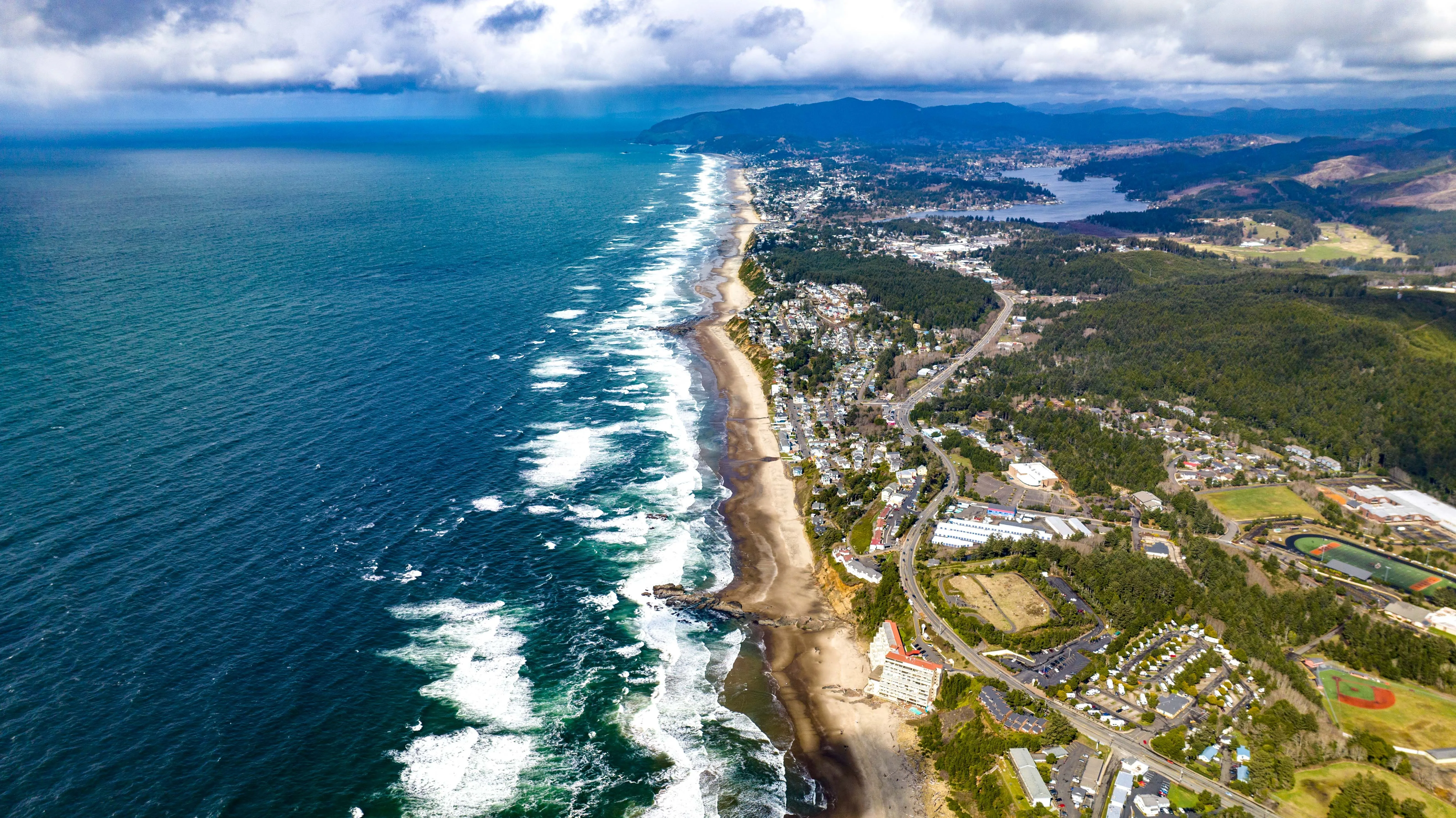
The Bay Area software engineer who finally got the yard. The San Diego family that stopped dreading the summer utility bill. The Sacramento buyer who sold a townhome and bought a three-bedroom house with an ocean view and a garage — and still had cash left over. California-to-Oregon migration isn't a trend anymore; it's a well-worn path, and roughly 25,000 to 31,000 Californians walked it in 2024 alone. Lincoln City draws a specific type of California transplant: someone who wants the Pacific Coast without paying Pacific Coast California prices, and who has either gone fully remote or is willing to reconfigure their career around a town of 10,000 people and seven miles of beach.
The hard part deserves equal airtime. Lincoln City is not Santa Cruz. It is not even Monterey. The summers here are genuinely spectacular — mild, clear, and uncrowded by California standards — but the other eight months exist, and they involve a level of gray that Californians raised on 267 sunny days a year are almost never fully prepared for. The food scene is limited. The nightlife is limited. The Amazon delivery windows are occasionally limited. If you move here expecting a California coastal lifestyle at Oregon prices, you will be disappointed by February. If you move here expecting something genuinely different — slower, quieter, rougher around the edges in ways that eventually feel like character — you may never leave.
This guide runs the full comparison: housing costs by California region, what your equity actually buys, the real tax picture, the weather reality, and the specific mistakes California buyers make that a local would tell you about over coffee. An interactive tool at the end lets you plug in your specific California city for a direct comparison.
| Lincoln City, Oregon | Bay Area | Southern CA | Sacramento Metro | Central Valley | |
|---|---|---|---|---|---|
| Median Home Price (approx. 2026) | $439,000 | $1.35M–$1.8M+ | $750,000–$1.1M | $520,000–$620,000 | $350,000–$450,000 |
| Property Tax Rate (effective) | ~0.89% | ~1.1–1.25% | ~1.1–1.25% | ~1.1–1.2% | ~1.0–1.15% |
| State Income Tax (top bracket) | 9.9% | 13.3% | 13.3% | 13.3% | 13.3% |
| State Sales Tax | None | 7.25–10.75% | 7.75–10.25% | 7.25–8.75% | 7.25–9.0% |
| Avg Utilities (monthly est.) | $150–$190 | $220–$320 | $230–$340 | $200–$280 | $180–$260 |
| Avg 1BR Rent | $1,100–$1,500 | $2,800–$3,800 | $2,100–$2,900 | $1,600–$2,100 | $1,100–$1,500 |
A buyer leaving Walnut Creek with a $1.4 million home and a $400,000 remaining mortgage walks into Lincoln City with enough equity to eliminate their mortgage entirely, buy at the median price in cash, and still have roughly $500,000 remaining. That is not a hypothetical — it is a scenario playing out repeatedly in Lincoln City's market, where roughly 17 homes sold in March 2026 and cash offers are not uncommon. The absence of Oregon sales tax adds meaningful friction-free spending on top: a California household spending $60,000 annually on taxable goods and services eliminates somewhere between $4,350 and $6,450 in annual sales tax by crossing the border, depending on which California county they left.
The utilities comparison matters more than most buyers account for in their spreadsheets. Lincoln City's coastal climate — temperatures that rarely crack 71°F even in August — means air conditioning is essentially nonexistent here. Southern California households running central AC through June, July, August, and September often spend $300 to $400 per month on summer electricity alone. That cost disappears in Lincoln City, replaced by a modest heating bill during the wet season and utility totals that most California transplants describe as almost comically low by comparison.
| Tax Item | California | Oregon | Net Impact |
|---|---|---|---|
| State Income Tax (top marginal) | 13.3% | 9.9% | Oregon saves ~3.4 points at top bracket |
| State Sales Tax | 7.25–10.75% | None | Full elimination |
| Property Tax Rate (effective) | ~1.1–1.25% | ~0.89% | Oregon lower at same price point |
| Property Tax Assessment Cap | Prop 13 (2% cap) | Measure 50 (3% cap) | Similar long-term protection |
| Senior Property Tax Deferral | Available | Available (62+) | Comparable benefit |
| Capital Gains Tax (state) | Up to 13.3% | Up to 9.9% | Oregon saves ~3.4 points |
Oregon's income tax catches California transplants off guard — the assumption that the Pacific Northwest means no state income tax is a Washington State fact, not an Oregon one. Oregon taxes income at graduated rates up to 9.9%, which is real money. A California household earning $150,000 annually pays roughly $13,800 at an average effective California state income tax rate of approximately 9.2%, while the same income in Oregon yields an effective state rate closer to 7 to 8%, saving somewhere between $1,800 and $3,300 per year depending on filing status and deductions. That is meaningful but not transformative on its own.
The real tax advantage compounds across categories. Eliminate California sales tax, lower your property tax rate, and reduce your income tax burden simultaneously, and a $150,000 household plausibly saves $8,000 to $12,000 annually in combined state and local tax costs. Oregon's Measure 50 — which caps annual increases in assessed value at 3% — provides the same kind of long-term property tax stability that California's Prop 13 gave a generation of California homeowners. Buyers who purchase in Lincoln City today and stay long-term lock in that assessed value trajectory from their purchase price, not from whatever the market does over the next decade.
A buyer leaving San Jose or Palo Alto with $1.4 million in equity is looking at a market where the median sold price sits at $439,000. That gap is not a typo. At that equity level, buying in Lincoln City outright — in cash, with no mortgage — is genuinely on the table, and many Bay Area buyers do exactly that. What remains after a $439,000 purchase represents meaningful investable or reserve capital, which changes the retirement math for buyers in their 50s and 60s substantially.
For buyers who want to step up within Lincoln City's market, that equity level reaches the Salishan area's coastal properties, oceanfront parcels along Roads End, and the upper tier of the Devil's Lake waterfront — properties that list in the $650,000 to $900,000 range and represent the luxury tier of the local market. A Bay Area buyer purchasing at that level still arrives debt-free or with a mortgage so small it barely registers against their remaining liquidity. The psychological shift from a $6,500 monthly Bay Area mortgage to zero is something multiple Lincoln City transplants describe as the single biggest quality-of-life change of their adult lives.
A buyer selling in Irvine or Pasadena with $850,000 in equity has access to the entire Lincoln City market, including its waterfront and coastal-view properties, without stretching. At the median price of $439,000, they are purchasing with roughly half their equity and holding the remainder. Southern California buyers at this equity level frequently land in the Salishan resort corridor or the oceanfront sections of Oceanlake and Roads End, neighborhoods that carry local prestige and strong rental income potential during summer months if they choose to offset carrying costs.
The Taft neighborhood — historically Lincoln City's commercial and civic center — offers well-maintained mid-century homes in the $350,000 to $500,000 range that SoCal buyers often find surprisingly spacious. For buyers arriving from San Diego or the Inland Empire with equity in the $700,000 range, Lincoln City represents a full step up in property size and land ownership relative to what the same money produced in their departure market.
This is a closer trade than the Bay Area math suggests, but it still tilts meaningfully toward Oregon. A Sacramento buyer selling a home purchased in 2018 or 2019 for $380,000 and now worth $580,000 walks out with roughly $450,000 to $500,000 after transaction costs. At Lincoln City's $439,000 median, they are buying at or near their full equity — which means they either arrive with a very small mortgage or stretch slightly into the Nelscott or Oceanlake neighborhoods for a comparable property. The no-sales-tax environment and lower property tax rate do real work on a monthly budget that was previously stretched by California cost pressures.
What makes this move financially compelling at this equity level is the monthly payment reduction, not the cash surplus. A Sacramento buyer who was paying $2,800 per month on a $480,000 remaining California mortgage can arrive in Lincoln City with a $100,000 to $150,000 mortgage and a payment under $1,000. That margin funds a life change, not just a home purchase.
Fresno, Visalia, and Bakersfield buyers have the most modest relative advantage — but the comparison still works. A Central Valley buyer with $380,000 in equity is arriving at a market priced similarly to what they left, but with no sales tax, lower property taxes, and coastal access that simply does not exist in the Central Valley at any price. The Cutler City and Delake neighborhoods in Lincoln City offer entry-level properties in the $300,000 to $400,000 range that represent genuine value — older construction, some deferred maintenance, but real ownership in a coastal town with a livable climate and a significantly lower cost-of-living ceiling than California imposes.

Looking to buy in Lincoln City? Estimate your payment.
Enter your numbers to see an estimated monthly mortgage payment.
Estimate only. Excludes HOA fees and mortgage insurance.
Lincoln City averages 157 sunny days per year. Los Angeles averages 267. That gap — 110 fewer sunny days annually — is the central weather reality, and softening it would be dishonest. The Oregon Coast's wet season runs November through April with humidity peaking at 83% in February and December, and December alone delivers around 24 rainy days in a single month. Californians from San Diego or the Santa Barbara corridor — where 40 rainy days annually is considered a wet year — tend to find this the hardest single adjustment of the entire move.
What the weather data does not show is how livable the summers actually are. July and August in Lincoln City average highs around 67°F — comfortable, genuinely pleasant, and free from the brutal heat waves that have made Sacramento summers increasingly unpleasant and San Diego summers deceptively expensive to stay cool through. The beach is not crowded the way California beaches are crowded. The D River access, Siletz Bay, and the Roads End stretch of beach feel genuinely different in July — the kind of access that California coastal residents spend decades paying a premium to live near and still sharing with three million strangers on a holiday weekend.
What California transplants genuinely love after a year, consistently: the traffic, or rather the absence of it. The community pace. The ability to get to a beach or a hiking trail in under ten minutes from anywhere in town. The year-round farmers markets. The sense that they actually know the people at their coffee shop. What they genuinely miss: the food scene (Lincoln City's dining options are limited and the sushi situation is not comparable to the Bay Area by any measure), the social density of a California city, and — particularly in year two — the sunshine. February is when the reality arrives. March sometimes relents. The buyers who make it to their second spring generally stay.
If you want to see how Lincoln City compares directly to the city you're leaving, use the tool below — it covers the 120 largest California cities with current housing and tax data.
Home prices: Redfin median sale data, Q1–Q2 2026. Select your city to compare.
Ready to talk through what your specific California equity could do in Lincoln City? Todd can model your exact scenario in a single call.
Treating Lincoln City as a uniform market. Lincoln City formed in 1964 from the merger of five separate towns — Taft, Nelscott, Cutler City, Delake, and Oceanlake — and those distinctions still shape what you're buying. Roads End in the north has a fundamentally different character and price profile than Taft in the south. Buyers who shop by Zillow radius without understanding these neighborhood identities sometimes end up in areas that don't match what they actually wanted, and that mistake is hard to fix without another transaction.
Underestimating winter outdoor access. California outdoor culture is year-round in practice — trails, bikes, kayaks, surfboards every month. Lincoln City outdoor culture is year-round in spirit but seasonally constrained in execution. The hiking around Drift Creek Falls is genuinely world-class, and Devil's Lake offers freshwater recreation through much of the year — but the January version of Oregon Coast outdoor life requires gear, tolerance for rain, and a mental adjustment that California hikers in particular often underestimate until they've lived through a coastal November.
Assuming Oregon homes don't need radon testing. California buyers are typically well-versed in earthquake retrofitting, fire zone disclosure, and coastal erosion risk — but radon rarely comes up in California real estate transactions. Oregon has elevated radon zones, particularly in older construction, and Lincoln City's housing stock includes substantial mid-century inventory. Buyers who skip the radon test as a seemingly unnecessary Oregon formality occasionally regret it. Include it in every inspection.
Expecting California-speed retail and services. Lincoln City's Tanger Outlet Mall is genuinely useful, but the overall retail footprint of a 10,000-person coastal town is what it is. The nearest Costco is roughly an hour's drive. Specialty groceries, medical specialists beyond what Samaritan North Lincoln Hospital provides, and same-day delivery options that California buyers treat as baseline infrastructure require either a trip to Lincoln County's larger neighbors or patience. Buyers who map their California consumption patterns onto Lincoln City without adjusting them spend the first year frustrated by logistics that locals solved long ago.
Bay Area sellers with substantial equity are frequently in a position where the rate environment matters less than terms and speed. Arriving with $800,000 or more in liquid equity, many choose an all-cash offer — which in Lincoln City's relatively low-inventory market carries real competitive weight even in a softened cycle. For Bay Area buyers who owned a rental property in California and are selling it rather than a primary residence, the 1031 exchange pathway is worth a direct conversation before closing; Lincoln City's vacation rental market has real income potential and can qualify as replacement property. You can read more about that in the Lincoln City 1031 Exchange guide.
Southern California sellers typically arrive with enough equity for a conventional loan at favorable loan-to-value ratios. Lincoln City's median price of $439,000 sits well below the conforming loan limit, meaning most SoCal buyers won't touch jumbo territory even with modest down payments. Strong FICO scores and documented income make this the most straightforward buyer profile in the market.
Sacramento and Inland Empire buyers whose target falls under the $350,000 threshold are often well-positioned to buy outright, sidestepping financing and qualification questions for that slice of Lincoln City's market — a meaningful option for buyers who are equity-rich on paper but limited in liquid cash after transaction costs. The Lincoln City First-Time Homebuyers Guide covers financing basics for buyers who'd rather go the traditional mortgage route.

Local Expert Takeaway: The mistake California buyers most consistently make in Lincoln City is shopping the active listing median ($534,000 range) instead of the recent sold median ($439,000). These are different numbers for a reason — active listings in a small coastal market skew toward aspirational pricing, while sold prices reflect what buyers actually paid. Come in anchored to what transactions are clearing, not what sellers are hoping for. And if you're arriving with Bay Area equity, understand that cash offers in Lincoln City's thin inventory environment carry leverage that a financed offer from a local buyer simply can't match — use it strategically rather than defaulting to a contingent offer out of habit.
✅ California home equity works hard in Lincoln City. Bay Area and SoCal sellers can frequently purchase at or near the median price in cash, eliminating their mortgage entirely — a quality-of-life shift that most transplants describe as more significant than the weather adjustment.
⚠️ Oregon has a state income tax. The 9.9% top marginal rate surprises transplants who assumed they were leaving California's 13.3% for nothing. The savings are real but not as dramatic as Washington State would deliver — factor this into your retirement income projections, especially if drawing from IRAs or investment accounts.
📍 The neighborhood you choose within Lincoln City matters more than most buyers realize. The character difference between Roads End, the Salishan corridor, Taft, and Cutler City is not cosmetic — it reflects pricing, walkability, vacation rental viability, flood zone exposure, and daily commute patterns within the city itself. Visit each area before making an offer.
Is moving from California to Lincoln City worth it?
For the right buyer, it is one of the more financially and experientially transformative moves available on the West Coast. The housing cost differential is real and substantial, the tax picture is meaningfully better across most categories, and the lifestyle trade-off — less sun, less urban density, more space and coastal access — is one many California transplants find they prefer after they've lived with it for a full year. The buyers for whom it does not work are those who underestimate the isolation and the weather, or who expect the retail, dining, and social infrastructure of a California metro to appear in a town of 10,000.
How much cheaper is housing in Lincoln City vs. California?
The recent sold median in Lincoln City as of early 2026 sits at $439,000, against a California statewide median trending toward $780,000 and a Bay Area median well above $1.3 million. At the Bay Area end of the spectrum, that is a 65 to 70 percent reduction in purchase price — the difference between a $1.4 million Bay Area home and a $439,000 Lincoln City property is not just dollars saved; it is the structural difference between a mortgage and no mortgage at all.
What do I need to know about moving from California to Oregon?
Oregon has no state sales tax — that savings is immediate and real on every transaction. Oregon does have a state income tax topping out at 9.9%, which surprises most California transplants who assumed the move meant escaping income tax entirely. Property taxes run lower effective rates than most California counties, and Measure 50's 3% annual assessment cap provides long-term stability similar to Prop 13. The two things most California buyers wish someone had told them before moving: radon testing is genuinely relevant on Oregon homes and should not be skipped, and the retail infrastructure of a small Oregon coastal town requires behavioral adjustments that take several months to feel natural.
Explore the full Lincoln City series: The Ultimate Lincoln City Relocation Guide · Is Lincoln City Safe? · Cost of Living in Lincoln City · Best Neighborhoods in Lincoln City · Lincoln City Schools & Family Life · Lincoln City Youth Sports · Lincoln City Parks & Recreation · Retiring in Lincoln City · 1031 Tax-Deferred Exchange in Lincoln City · Lincoln City First-Time Homebuyers Guide · · Moving to Lincoln City from California
Tell us what you need help with and we'll connect you with local resources.

About the Author
Todd Davidson is the founder of Living in Oregon and Living in Washington, where he publishes in-depth city guides, neighborhood resources, and local market insights covering more than 180 communities across the Pacific Northwest. While his background is in home financing and real estate, he created these digital platforms to help families research and compare regions before making a move.
Check Out the Oregon Coast Rankings: Oregon Coast Cost of Living — All 16 Cities Ranked · Best Places to Retire on the Oregon Coast · Best Oregon Coast Cities for Families · Best Oregon Coast Cities for Remote Workers · Oregon Coast Real Estate Market Report 2026 · Oregon Coast vs. Washington Coast