
Southern Oregon · Oregon
Moving to Klamath Falls from California: The Honest Comparison (2026)
The move happens in stages. First comes the spreadsheet — median home prices, tax rates, commute times. Then comes the offer accepted on a place in California, the equity number that surprises everyone including the sellers, and the sudden realization that $900,000 in proceeds from a Walnut Creek townhome buys something entirely different in southern Oregon. Klamath Falls shows up in these calculations because it's genuinely affordable in a way that most Oregon cities aren't anymore. At a median sold price of $318,000, it sits well below Medford, well below Bend, and in a different universe from the Bay Area markets most transplants are leaving.
The honest part of this guide lives in section five. Klamath Falls is not a California city with lower property taxes. It sits at 4,100 feet elevation on the east side of the Cascades, it gets 38 inches of snow in an average winter, and it has a median household income of $46,693 — which shapes everything from the restaurant scene to the local economy. California transplants who research only the housing costs and skip the lifestyle audit sometimes arrive with expectations the city can't meet.
This guide covers what California equity actually buys here by region, the full tax picture (including what Oregon income tax does to a $150,000 remote salary), the weather reality compared to California origin markets, and the four mistakes California buyers consistently make. There's also an interactive comparison tool to map your specific California city against Klamath Falls numbers.
| Klamath Falls, OR | Bay Area | Southern CA | Sacramento Metro | Central Valley | |
|---|---|---|---|---|---|
| Median Home Price (approx. 2026) | $318,000 | $1,300,000+ | $750,000–$950,000 | $480,000–$510,000 | $310,000–$380,000 |
| Property Tax Rate (effective) | 0.66% | 1.1–1.2% | 1.1–1.25% | 1.1–1.2% | 1.1–1.2% |
| State Income Tax (top bracket) | 9.9% | 13.3% | 13.3% | 13.3% | 13.3% |
| State Sales Tax | 0% | 7.25–10.75% | 7.25–10.75% | 8.75% | 8.25–9.0% |
| Avg Utilities (monthly est.) | $180–$220 | $250–$350 | $200–$300 | $200–$280 | $180–$260 |
| Avg 1BR Rent | ~$962 | $2,800–$3,500 | $1,900–$2,600 | $1,500–$1,900 | $1,000–$1,400 |
A Bay Area buyer selling a $1.4 million house and purchasing in Klamath Falls at $318,000 is not just downsizing their mortgage — they're likely eliminating it entirely, with $1 million or more sitting in equity. Even a Sacramento buyer selling at $490,000 and buying here all-cash walks away debt-free with $170,000 left over, lower property taxes on day one, and zero sales tax on everything they buy from that point forward.
The sales tax elimination is the figure most California transplants underestimate over time. A household spending $60,000 annually on taxable goods and services in a California city with a 9.5% blended rate is surrendering roughly $5,700 per year that disappears entirely when they cross the Oregon border. Over a decade, that's a new car.
Oregon collects a state income tax — the assumption that Oregon equals no income tax is a California myth worth correcting immediately. The Oregon rate is graduated, running from roughly 4.75% on lower income to 9.9% on income above approximately $250,000 for joint filers. That's lower than California's 13.3% top bracket, but it's not zero, and a remote worker earning $150,000 who expected tax relief needs to do the actual math before celebrating.
| Tax Item | California | Oregon | Net Impact |
|---|---|---|---|
| State Income Tax (top bracket) | 13.3% | 9.9% | Oregon wins — significant savings at higher incomes |
| State Sales Tax | 7.25–10.75% | 0% | Oregon wins — saves thousands annually |
| Effective Property Tax Rate | ~1.1–1.25% | 0.66% (Klamath Falls) | Oregon wins — roughly half the effective rate |
| Capital Gains Tax (state) | Up to 13.3% | Up to 9.9% | Oregon wins — meaningful for equity-rich sellers |
| Measure 50 Assessment Cap | No equivalent | 3%/year max increase | Major long-term Oregon advantage |
| Senior Property Tax Deferral | Limited program | Available at age 62+ | Oregon advantage for retirees |
A California remote worker earning $150,000 in a state like Los Angeles County is paying approximately $14,600 in California state income tax at that bracket. Moving to Oregon, that same income produces approximately $11,000 in state income tax — a savings of roughly $3,600 annually, every year. Add the sales tax elimination on a typical household spending pattern and the effective total tax burden in Klamath Falls is meaningfully lower than almost any California metro, even accounting for Oregon income tax.
Oregon's Measure 50 is the property tax feature most California transplants discover only after closing. Unlike California's Proposition 13, which locks assessed value at purchase, Oregon's Measure 50 caps annual increases in assessed value at 3% per year after purchase. A home bought in Klamath Falls today at $318,000 will see its assessed value rise no more than 3% per year — which means that even if market values jump 20% over five years, your property tax bill increases only modestly. For long-term owners, this is a substantial compounding advantage.
A buyer leaving Palo Alto or San Jose with $1.5 million in home equity is walking into Klamath Falls with the ability to purchase any property in the city outright, in cash, with a significant remainder. The top of the Klamath Falls market — the custom builds in North Hills with Mount Shasta views, the lakefront and Running Y Resort properties — runs $550,000 to $700,000 for premium construction. At Bay Area equity levels, buyers can purchase at the top of the local market all-cash and still retain $800,000 or more in liquid capital. The question for these buyers is not affordability; it's whether the lifestyle justifies the move. For remote workers especially, the financial case is almost absurdly strong.
The Running Y Ranch Resort community and the upper end of North Hills represent the best-value prestige properties in the city at this equity level. A 4-bedroom home with 4,300 square feet and mountain views in North Hills has sold in the $620,000 range. That same square footage in a comparable California community would approach $2 million. Bay Area buyers who've decided to relocate should be looking at these neighborhoods first.
A buyer leaving Irvine, Pasadena, or Temecula with $900,000 in equity has multiple paths. The most straightforward is purchasing at the top of Klamath Falls's market all-cash and banking the remainder — securing a premium property outright while maintaining meaningful financial reserves. A buyer from Rancho Cucamonga with $750,000 in equity can still eliminate their mortgage entirely while purchasing a 3-bedroom home with room to spare, something that would require a $500,000+ mortgage in their California city.
Southern California buyers at this equity level should look seriously at the Running Y area for its amenity package — resort-adjacent, newer construction, and positioned at the upper end of the Klamath Falls market. At $500,000–$650,000, these properties represent a fraction of what comparable golf-community living costs in San Diego County or the Coachella Valley.
This cohort gets a slightly smaller relative advantage, but the move still makes financial sense in specific scenarios. A buyer leaving Elk Grove or Roseville with $550,000 in equity can purchase a well-finished 3-bedroom home in Klamath Falls with $200,000+ remaining — or put $150,000 down, take a very manageable mortgage, and invest the difference. The no-sales-tax benefit and the roughly half-rate property tax compared to their Sacramento origin address are meaningful ongoing savings on top of the equity position.
For families with children who've been renting in Sacramento due to California prices, Klamath Falls at $318,000 median makes homeownership genuinely accessible. A Sacramento buyer who's been renting a two-bedroom apartment for $1,800 per month can purchase a three-bedroom house in Klamath Falls and pay less in principal, interest, and property taxes combined.
A buyer leaving Fresno or Stockton with $350,000 in equity has the narrowest relative advantage — Klamath Falls and parts of the Central Valley actually overlap in median price. What makes the move financially compelling is not the home price arbitrage but the tax environment: no sales tax, a 0.66% property tax rate versus California's effective 1.1–1.2%, and lower state income taxes. A Fresno family buying at Klamath Falls's median price with their equity saves roughly $2,000–$3,000 annually on property taxes alone versus staying in Fresno at a comparable purchase price.
At this equity level, buyers in Klamath Falls are looking at solid 3-bedroom homes in established neighborhoods like Hot Springs, Lake Shore Gardens, and Altamont Acres — areas with good access to Highway 97, reasonable condition, and more land per dollar than Central Valley comparables.
Looking to buy in Klamath Falls? Estimate your payment.
Enter your numbers to see an estimated monthly mortgage payment.
Estimate only. Excludes HOA fees and mortgage insurance.
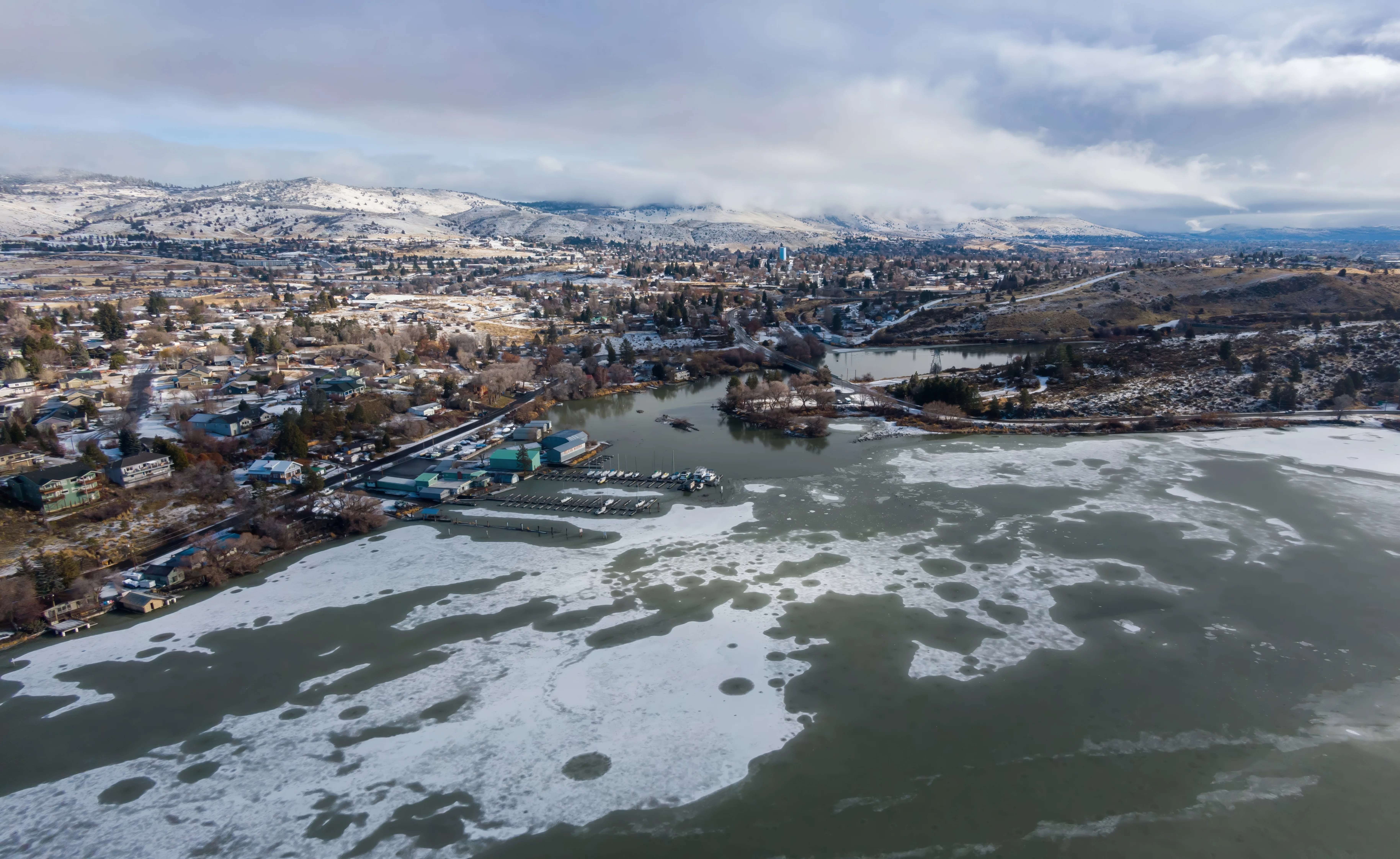
Here's what the relocation guides usually bury in footnotes: Klamath Falls gets real winter. Sitting at 4,100 feet on the dry east side of the Cascades, it averages around 38 inches of snow per year and temperatures that regularly drop below freezing between November and March. The commute from a Lakewoods Village address to downtown Klamath Falls on an icy morning is a different experience than anything a San Diego or Fresno transplant has navigated before. Snow tires are not a nice-to-have — they're standard practice.
The counterintuitive part of the Klamath Falls weather story is the sunshine. The city sits east of the Cascade moisture shadow, which means it avoids the gray, wet winters that define Portland and Eugene. The Klamath County Chamber of Commerce documents approximately 290 days of sunshine annually — comparable to Los Angeles (around 284), higher than San Francisco (roughly 259), and dramatically more than Portland (144). Precipitation falls mostly as snow rather than gray drizzle, and summers are warm, dry, and clear. A buyer leaving Sacramento for Klamath Falls will find the summer weather genuinely comparable and the winter sharper but sunnier than they expected from Oregon.
What California transplants report loving after a year: the traffic relief is real and immediate — a 14-minute average commute means something different when you've spent years in Bay Area or LA gridlock. The outdoor access to Crater Lake National Park, Upper Klamath Lake, the OC&E Woods Line State Trail, and the Cascades in summer is genuine and uncrowded compared to California equivalents. The pace is different in a way that reads as slower to some and as relief to others. What they miss is harder to replace: year-round beach access, the food and cultural density of a major California metro, and — especially for Bay Area and LA transplants — the social and professional networks built over years in a major city. Klamath Falls has a population of 22,308. It is not going to replicate San Francisco's restaurant scene, and buyers who arrived expecting otherwise tend to plan more frequent trips back.
If you want to see how Klamath Falls compares directly to the city you're leaving, use the tool below — it covers the 120 largest California cities with current housing and tax data.
Home prices: Redfin median sale data, Q1–Q2 2026. Select your city to compare.
Ready to talk through what your specific California equity could do in Klamath Falls? Todd can model your exact scenario in a single call.
Assuming the whole city is uniform. Klamath Falls has genuine neighborhood character differences that don't show up in aggregate data. Running Y Ranch is a resort-adjacent community with HOA amenities, newer construction, and a very different feel from the older stock in Hot Springs or the central city core. Buyers who drive Highway 97 through downtown and decide the whole city looks like that are missing the North Hills properties with mountain views, the lake-access addresses near Upper Klamath Lake, and the newer development corridors that look nothing like the city center. Spend a full day driving the neighborhoods before forming an opinion.
Skipping the radon test. Oregon has elevated radon zones, and Klamath County properties — particularly older ranch-style homes with crawl spaces or basements — can show elevated readings. California buyers coming from coastal markets often have no experience with radon testing and don't know to request it. It belongs in every inspection contingency on an Oregon purchase, and it's cheap to test and not expensive to mitigate.
Underestimating winter driving. A buyer leaving San Jose who has never driven on snow will encounter Highway 97 in January with a different level of respect than they anticipated. The road itself is manageable with the right tires and preparation — Klamath Falls residents navigate winter routinely — but it requires an adjustment period and the right vehicle setup. Buyers who commute between Klamath Falls and Medford occasionally should understand that the Siskiyou Summit stretch, particularly approaching Ashland, can close or require chains on short notice in heavy winters.
Not accounting for the elevation and humidity adjustment. At 4,100 feet, Klamath Falls sits significantly higher than any California coastal market and most inland California cities. New arrivals from California's Central Valley or coast often take several weeks to adjust to the altitude, the dry air, and the temperature swings that come with high-desert mountain living. Homes here need adequate insulation for winters in a way that Southern California construction doesn't prioritize, and buyers purchasing older stock should factor heating costs and weatherization into their renovation budgets.
Bay Area sellers with large equity are often the clearest scenario: when your equity exceeds the purchase price of your Klamath Falls home, the mortgage becomes optional. All-cash offers move faster, skip appraisal contingencies, and often win over financed buyers in multiple-offer situations. For Bay Area sellers who owned a rental property rather than a primary residence, a 1031 exchange may defer capital gains on the California sale entirely — that option is detailed in the Klamath Falls 1031 exchange guide. Buyers in this bracket who do choose to mortgage should use the liquidity advantage to negotiate terms and speed rather than rate-optimizing a small loan.
Southern California sellers landing at $700,000–$1.2 million in equity are almost universally positioned for conventional financing at very low LTV if they choose to carry a mortgage — and in most Klamath Falls price ranges, they won't need jumbo. Conforming loan limits cover most of the Klamath Falls market comfortably, which keeps rates competitive and documentation requirements standard.
Sacramento and Inland Empire buyers with $400,000–$650,000 in equity and purchase targets under $350,000 are often well-positioned to buy outright, sidestepping financing and qualification questions entirely. At the $318,000 median price point, this applies to a significant portion of available inventory. The Klamath Falls first-time homebuyer guide covers financing basics for buyers who'd rather go the traditional mortgage route.
Local Expert Takeaway: The single most important thing California buyers underestimate about Klamath Falls is how different the upper tier of the market looks compared to the citywide median. The $318,000 median reflects a city with significant older, lower-cost inventory — but buyers arriving with $600,000–$900,000 in California equity should be looking at Running Y Ranch, North Hills, and upper Lake Shore Gardens, where $450,000–$650,000 buys finished construction, mountain or lake views, and amenities that simply don't exist at this price point in California. Buyers who anchor to the median and don't explore the top of the Klamath Falls market are leaving significant quality-of-life value on the table.
✅ California equity goes further here than almost anywhere else in Oregon. At $318,000 median, Klamath Falls is well below Medford, Bend, and Portland — and Bay Area or Southern California sellers can often purchase outright with equity to spare.
⚠️ Oregon income tax is real. Remote workers earning $120,000–$200,000 who assumed "no income tax" should recalculate. The Oregon rate is lower than California's, but the savings come from sales tax elimination and lower property taxes — not income tax disappearance.
📍 Winter requires preparation, not fear. With nearly 290 sunny days and 38 inches of snow, Klamath Falls winter is dry and bright — not gray and wet like Portland — but it's genuinely cold, and snow tires, home weatherization, and adjusted outdoor expectations are real considerations for California transplants.
Is moving from California to Klamath Falls worth it?
For remote workers, retirees, and equity-rich sellers who don't require the amenity density of a major California metro, the financial case is strong. No sales tax, a 0.66% property tax rate, meaningfully lower income taxes, and a median home price of $318,000 add up to a substantially lower cost of living than almost any California city. The move is less straightforward for buyers who depend on a deep local job market, value year-round beach access, or have strong social networks in their California city that would be difficult to replace.
How much cheaper is housing in Klamath Falls vs California?
Against the Bay Area, Klamath Falls is roughly 75–80% cheaper at median sold prices. Against Sacramento's $480,000–$510,000 range, Klamath Falls comes in approximately 35–40% lower. Against parts of the Central Valley, the gap is smaller — Fresno and Stockton median prices overlap with Klamath Falls's range — but the tax environment in Oregon still provides ongoing savings beyond the purchase price itself.
What do I need to know about moving from California to Oregon?
Oregon has no sales tax, a property tax cap under Measure 50 that limits assessed value growth to 3% per year, and a state income tax that runs lower than California's top bracket but is not zero. Driver's license and vehicle registration must be transferred to Oregon within 30 days of establishing residency. Oregon has elevated radon zones — request a radon test on any property you're purchasing. And if you're leaving a California investment property, consult a 1031 exchange specialist before closing on the California side, as the exchange timeline is strict.
Explore the full Klamath Falls series: The Ultimate Klamath Falls Relocation Guide · Is Klamath Falls Safe? · Cost of Living in Klamath Falls · Best Neighborhoods in Klamath Falls · Klamath Falls Schools & Family Life · Klamath Falls Youth Sports · Klamath Falls Parks & Recreation · Retiring in Klamath Falls · 1031 Tax-Deferred Exchange in Klamath Falls · Klamath Falls First-Time Homebuyers Guide · · Moving to Klamath Falls from California
Tell us what you need help with and we'll connect you with local resources.

About the Author
Todd Davidson is the founder of Living in Oregon and Living in Washington, where he publishes in-depth city guides, neighborhood resources, and local market insights covering more than 180 communities across the Pacific Northwest. While his background is in home financing and real estate, he created these digital platforms to help families research and compare regions before making a move.