Willamette Valley · Oregon
Moving to Keizer from California: The Honest Comparison (2026)
The Bay Area software engineer who finally got a yard. The San Diego family who opened their first June utility bill in Oregon and actually laughed. The Sacramento buyer who paid $462,000 for a three-bedroom with a two-car garage and a fenced backyard — and spent three weeks waiting for the catch. California-to-Oregon migration has been building for years, and Keizer keeps showing up in the search results for a specific kind of buyer: one who wants a real house, a real commute under 15 minutes, and a city that doesn't require a $1.4 million budget just to own something with a lawn.
Keizer is not California, and the guides that skip over that part are doing transplants a genuine disservice. The winters are long and gray in ways that Southern California and Sacramento residents are not prepared for. The food scene is modest. The social energy is quieter. Some of what you assume will exist here — the year-round outdoor culture, the ethnic food variety, the specific pace of a California suburb — does not exist in the same form. Knowing that before you make an offer is worth more than any savings spreadsheet.
This guide covers what the move actually costs and saves across four California origin markets — Bay Area, Southern California, Sacramento, and the Central Valley — what your equity realistically buys in Keizer's current market, the full tax picture including the Oregon income tax surprise most transplants don't see coming, and the honest lifestyle comparison a good friend who made this move three years ago would actually give you.

| Keizer, Oregon | Bay Area | Southern CA | Sacramento Metro | Central Valley | |
|---|---|---|---|---|---|
| Median Home Price (approx. 2026) | $462,000 | $1,300,000+ | $900,000–$1,200,000 | $490,000 | $350,000–$420,000 |
| Property Tax Rate (effective) | 0.88% | ~1.1–1.2% | ~1.1–1.25% | ~1.1–1.2% | ~1.1–1.2% |
| State Income Tax (top bracket) | 9.9% | 13.3% | 13.3% | 13.3% | 13.3% |
| State Sales Tax | 0% | 8.5–10.75% | 7.75–10.75% | 7.75–8.75% | 7.25–8.75% |
| Avg Utilities (monthly est.) | $150–$170 | $200–$280 | $180–$260 | $175–$240 | $160–$230 |
| Avg 1BR Rent | $1,200–$1,500 | $2,800–$3,500 | $2,200–$2,900 | $1,600–$2,000 | $1,100–$1,500 |
A buyer leaving Walnut Creek and selling a $1.4 million home to purchase in Keizer at $462,000 is not just reducing their housing cost — they are likely eliminating their mortgage entirely, with several hundred thousand dollars in cash remaining after the transaction. That figure is not hypothetical. It describes a scenario that plays out regularly in Keizer's market, where California equity-rich buyers have become a meaningful segment of the all-cash and low-LTV purchase pool.
What makes the math even sharper is the property tax gap. California's Proposition 13 has held many long-term owners at artificially low assessed values — but the minute they sell and buy elsewhere, they reset into the new market rate. In Keizer, that reset lands at 0.88% of purchase price. On a $462,000 home, that's roughly $4,066 per year in property taxes, protected by Oregon's Measure 50 from growing more than 3% annually after purchase. On a comparable Southern California property at $950,000 with a 1.2% effective rate, the same buyer was paying over $11,000 per year.
Oregon's income tax structure is the number that catches California transplants off guard. The assumption that "Oregon has no sales tax so my overall tax burden drops significantly" is partially correct — but incomplete. Oregon does have a graduated state income tax that tops out at 9.9%, and for a household earning $150,000, the effective Oregon rate runs in the 8–9% range depending on deductions.
Running a rough comparison: a California household earning $150,000 pays a marginal state income tax rate of 9.3% in California, plus the state sales tax on every purchase. In Oregon, the marginal rate at that income level is similar — but every dollar spent on groceries, clothing, furniture, electronics, and home goods is untaxed. A family spending $48,000 per year on taxable goods and services in a California metro paying 9% sales tax was sending roughly $4,300 annually to Sacramento that they'll never see again. In Keizer, that number goes to zero.
| Tax Item | California | Oregon | Net Impact |
|---|---|---|---|
| State Income Tax (top marginal) | 13.3% | 9.9% | Oregon saves ~3.4% on top earnings |
| State Sales Tax | 7.25–10.75% | 0% | Saves $3,000–$5,000+/year depending on spending |
| Property Tax (effective rate) | ~1.1–1.25% | 0.88% | Oregon saves $2,000–$5,000+/year |
| Property Tax Growth Cap | Prop 13 (resets on sale) | Measure 50 (3%/yr cap) | Long-term owners win in Oregon |
| Senior Property Tax Deferral | Limited programs | Age 62+, income-qualified | Oregon offers meaningful deferral option |
| Capital Gains (state) | Up to 13.3% | Up to 9.9% | Oregon saves 3.4% on investment gains |
For a household in the $120,000–$180,000 income range, the combined savings from no sales tax and lower property taxes typically offset a significant portion of the income tax difference. The net tax picture in Oregon is genuinely better for most California transplants — but it requires calculating the full picture, not just celebrating the zero on the sales tax line.
Homeowners who plan to stay long-term benefit most from Measure 50. Unlike Prop 13's reset-on-sale structure, Oregon's 3% annual cap kicks in from the moment you purchase and compounds in your favor every year you own. A buyer who purchases a Keizer home at $462,000 in 2026 and holds for 15 years will pay property taxes on an assessed value that grows slowly — not on whatever the market does.
A buyer selling a three-bedroom in Sunnyvale or a townhome in Oakland's Rockridge neighborhood and walking away with $1.4 million in equity arrives in Keizer in a position most locals never experience: the ability to purchase any home in the city outright with cash remaining. The entire Keizer market — including the highest-end custom homes near Willamette River frontage on half-acre-plus lots — tops out well below $900,000. McNary Estates, which represents Keizer's most prestigious address-by-neighborhood standard, runs from the low $400,000s to the upper $700,000s. A Bay Area buyer at the $1.5 million equity level can purchase the best available property in Keizer for cash and still retain $700,000–$800,000 in liquid assets.
What that equity doesn't buy is the same urban environment. If the reason you lived in the Bay Area was the restaurants, the walkable neighborhood life, the cultural density — Keizer does not replicate those things at any price point. What it does offer at this budget level is a custom-build opportunity on a riverfront lot, a golf course home you never expected to own, and a property tax bill that will feel almost fictional by comparison to what you were paying.
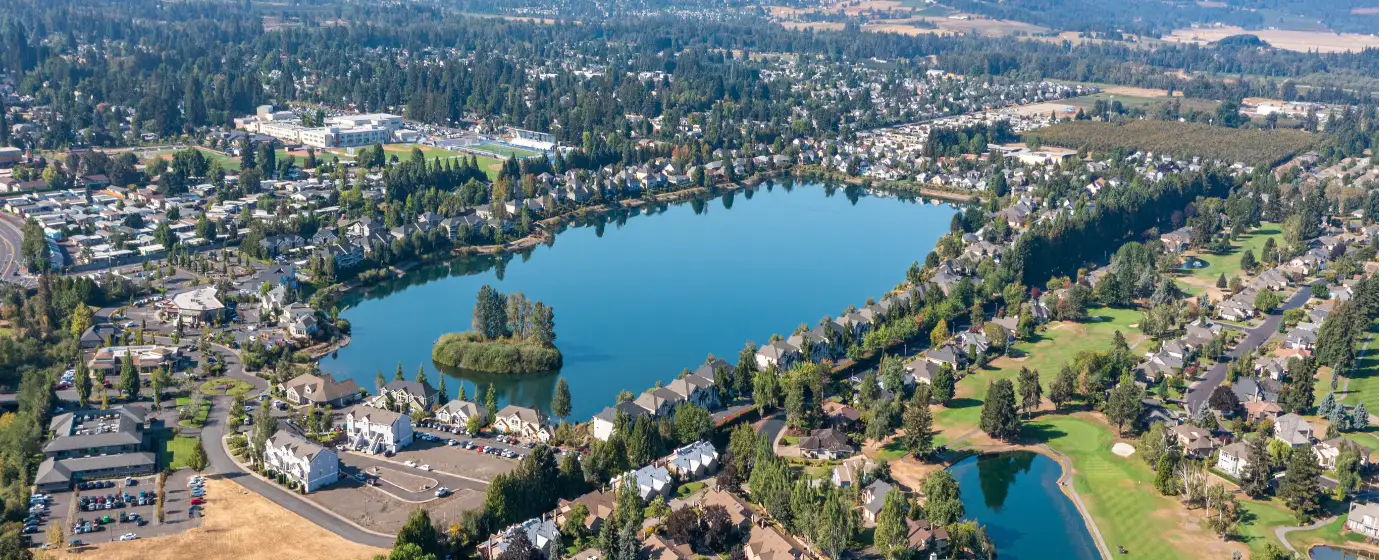
A buyer leaving Culver City, Irvine, or San Diego's North County with $900,000 in equity can purchase the top tier of Keizer's market — Inland Shores lakefront, Hidden Creek Estates, Cedar's newer construction — entirely in cash and still hold meaningful reserves. The Inland Shores neighborhood wraps around Staats Lake, a private body of water exclusive to the neighborhood where residents fish, paddleboard, row, and swim. Lakefront homes there represent Keizer's most distinctive inventory and carry prices in the $500,000–$700,000 range. For a buyer coming from a Carlsbad or Yorba Linda sale, paying $600,000 cash for a lakefront property is a transaction that requires re-reading the contract to make sure nothing is missing.
Even buyers on the lower end of this equity range — say, $700,000 from a Long Beach or Anaheim townhome sale — can enter Keizer's market with a 60–70% down payment, nearly eliminating the mortgage and dramatically reducing monthly housing costs.
This cohort faces the closest relative comparison — Sacramento's median home price sits around $490,000, putting it in similar territory to Keizer. What makes the move financially compelling here is not the equity windfall but the structural cost differences: no sales tax on every purchase, a lower effective property tax rate, and more land per dollar. In Sacramento proper, $490,000 buys an entry-level home in many neighborhoods. In Folsom or El Dorado Hills, that same budget is the floor for a modest property.
In Keizer, $462,000 — the current median — lands you a genuine three-bedroom, two-bath home with a two-car garage and yard in neighborhoods like Gubser, Southeast Keizer, or West Keizer. A Sacramento buyer with $500,000 in equity from a Roseville or Elk Grove sale can purchase in that range without a mortgage and still retain living reserves. The Inland Empire comparison is similar: a buyer from Rancho Cucamonga or Temecula carrying $500,000–$600,000 in equity can step directly into Keizer's mid-range market with cash.
The relative financial advantage here is the most modest, but it remains real. A Fresno or Stockton seller carrying $350,000 in equity is likely entering Keizer's market with a meaningful down payment — enough to keep a monthly payment well below what a comparable California purchase would require, particularly when the zero sales tax impact is factored across an annual household spending pattern.
At this equity level, the neighborhoods to focus on are North Keizer, Cummings, and Southeast Keizer, where the $400,000–$450,000 price range still delivers full single-family homes on proper lots. What the Central Valley buyer gains most is the long-term property tax advantage via Measure 50 — a mechanism that doesn't exist back home in the same form.
Looking to buy in Keizer? Estimate your payment.
Enter your numbers to see an estimated monthly mortgage payment.
Estimate only. Excludes HOA fees and mortgage insurance.
The number that matters most for California transplants is this: Keizer receives approximately 153 sunny days per year, compared to Sacramento's 280-plus, Los Angeles's 267, and San Francisco's 265. The annual sunshine hours gap is roughly 750–900 hours — nearly equivalent to losing two and a half months of California sun. Winters in Keizer run from November through March with persistent cloud cover, regular rain, and occasional stretches where you won't see meaningful sunlight for two to three weeks at a time. Someone from San Diego — where it rains fewer than 40 days annually — experiences this as a genuine psychological adjustment that no amount of preparation fully anticipates.
What California transplants genuinely love after 12 months in Keizer, based on the pattern among those who stay: the summers are legitimately spectacular. July's rainfall averages less than a third of an inch, temperatures peak around 82°F, and evenings cool predictably. The access to outdoor space is different in kind — not just Keizer Rapids Park along the Willamette River, but the broader Willamette Valley and the Oregon Coast less than 90 minutes west. The traffic is different in a way that only registers after living with it: the 10-minute Salem commute, the fact that grocery runs don't require planning, the absence of the low-grade highway anxiety that becomes background noise in California metro life.
What transplants genuinely miss, stated plainly: year-round beach access for Southern California buyers is not replaced by anything in Keizer. The ethnic food scene — Vietnamese, Korean, Thai, Oaxacan, Persian — is thin compared to a Bay Area or LA baseline. The social energy of a California city, the density of things happening on any given Friday night, does not exist here at the same volume. Keizer is a family suburb in the Pacific Northwest. It is excellent at being that thing, and it is not particularly interested in being anything else.
If you want to see how Keizer compares directly to the city you're leaving, use the tool below — it covers the 120 largest California cities with current housing and tax data.
Home prices: Redfin median sale data, Q1–Q2 2026. Select your city to compare.
Ready to talk through what your specific California equity could do in Keizer? Todd can model your exact scenario in a single call.
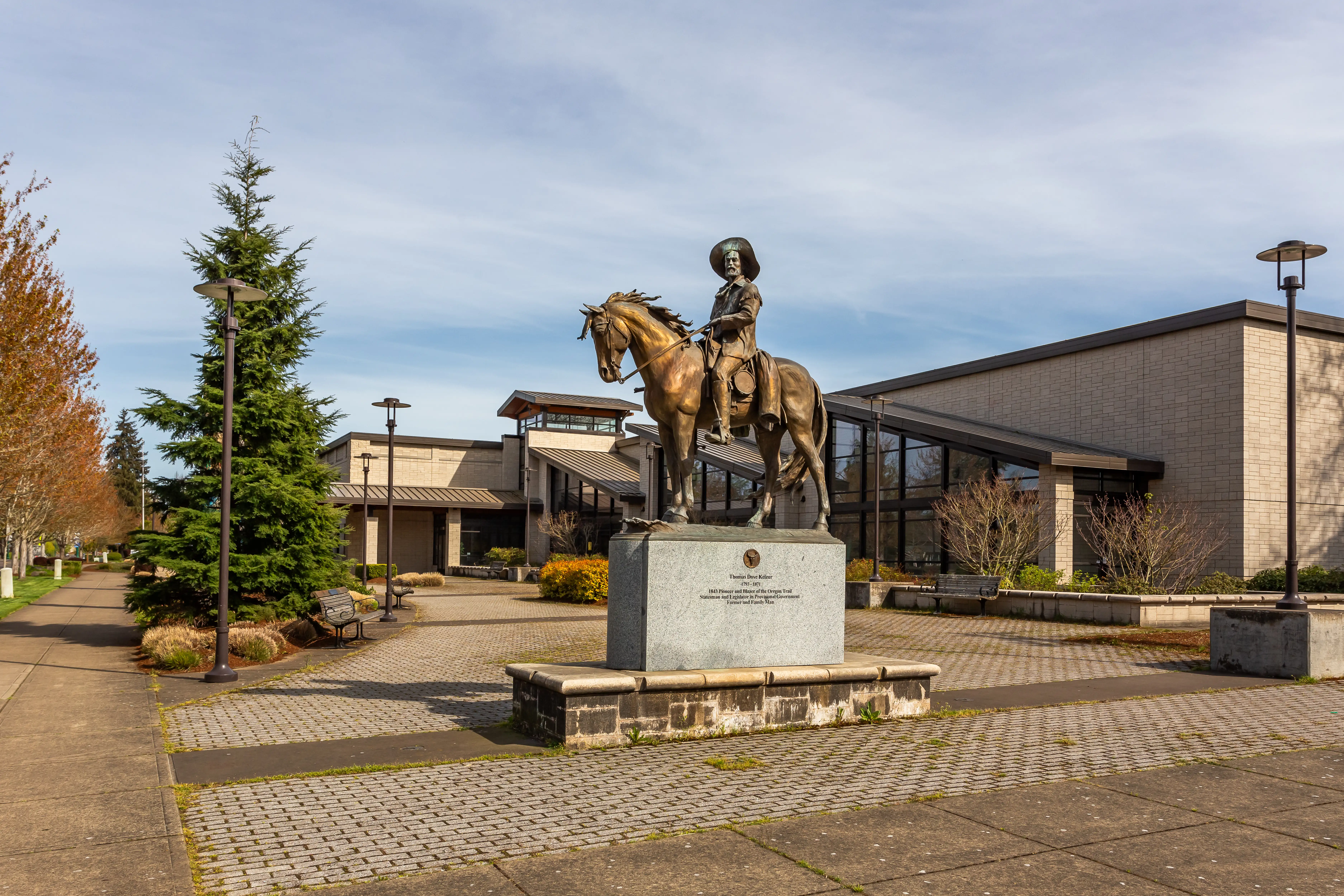
Assuming the whole city reads the same. Keizer has real neighborhood variation that doesn't show up on a ZIP code search. The character of West Keizer — established lots, mature trees, proximity to Claggett Creek Park — is meaningfully different from the newer construction in Hidden Creek Estates or the lakefront environment of Inland Shores. Buyers who tour one neighborhood and extrapolate to the whole city miss opportunities and sometimes land in areas that don't match what they actually wanted. Spending two full days driving McNary Road versus River Road North versus Chemawa Road reveals a city with more range than the satellite view suggests.
Not budgeting for radon testing. Oregon's Willamette Valley sits in an elevated radon zone, and Keizer homes — particularly older slab-on-grade construction common in established neighborhoods — can test above EPA action levels. This is not a dealbreaker; mitigation systems run $800–$1,500 and are highly effective. But California buyers who've never had to think about radon sometimes skip the test entirely, which is a genuine mistake in this market.
Underestimating winter driving and outdoor access. Keizer gets roughly 4 inches of snow per year on average, but ice events on the bridges and the Willamette River crossings can disrupt commutes in ways that feel disproportionate to the actual precipitation. More practically: the outdoor lifestyle that dominates summer in Keizer — Claggett Creek trails, Keizer Rapids Park along the river, the McNary Golf Club season — pulls back sharply from November through March. A buyer who moved from Phoenix or San Diego and planned to hike every weekend will find Oregon's outdoor culture more seasonal than California's, particularly below the Cascades.
Missing the full Oregon income tax picture at offer time. California buyers focused on the sales tax savings sometimes don't run the full income tax comparison before structuring their offer. For a household earning $150,000 working remotely for a California employer that has not yet updated payroll to Oregon withholding, there can be a first-year tax situation that requires active management. An Oregon CPA consultation before closing — not after — is the move most experienced transplants wish they'd made earlier.
Bay Area seller with large equity: The most common scenario here is an all-cash or very low LTV purchase — a buyer with $1.2 million or more in proceeds who simply purchases without a mortgage, or takes a minimal loan to preserve liquidity. When rate matters less than terms and speed, working with a local lender who can close in 21 days beats a national bank every time. If the California property was an investment or rental, a 1031 exchange into an Oregon investment property may defer capital gains tax — Keizer has multifamily inventory worth evaluating for that purpose. See the 1031 Tax-Deferred Exchange in Keizer post for the mechanics.
Southern California seller: Buyers arriving with $700,000–$1.1 million in equity are generally looking at conventional loans with down payments in the 40–70% range. Jumbo loan thresholds rarely come into play at Keizer's price points — the median sits at $462,000, well within conforming limits. This cohort typically qualifies easily on credit and income metrics but benefits from a local lender who understands the Willamette Valley appraisal environment.
Sacramento and Inland Empire buyer: For buyers at the lower end of this equity range — purchasing in the $380,000–$420,000 range — an outright cash purchase is often within reach, especially against Keizer's $462,000 median. Buyers who'd rather stay leveraged often find that a 30–40% down payment puts them in a very competitive position given Keizer's average days-on-market of 48 days — not a panic market, but one where serious preparation closes deals.
Local Expert Takeaway: The single most important thing California buyers underestimate about Keizer is how quickly Inland Shores and McNary Estates inventory moves when it's priced accurately — and how rarely it comes available. If you're a Bay Area or SoCal buyer with the equity to play in the $500,000–$750,000 range, set up active MLS alerts the week you start seriously considering the market. Don't wait until you're under contract on your California sale. The homes that represent the best value in Keizer get picked up by buyers who were already watching, and the gap between "thinking about it" and "ready to offer" has cost more than one transplant their first choice.
✅ California equity goes significantly further in Keizer — Bay Area and SoCal sellers can often purchase outright in cash while retaining six-figure reserves.
⚠️ Oregon does have state income tax — the zero-sales-tax benefit is real, but the full tax picture requires running your income, spending, and property scenarios together, not separately.
📍 Neighborhood research is not optional — Inland Shores, McNary Estates, and West Keizer represent meaningfully different lifestyles and price points within a city that looks uniform on the map.
Is moving from California to Keizer worth it?
For buyers who can work remotely or commute to Salem-area employers, the financial case is strong across nearly every California origin market. The median Keizer home at $462,000 eliminates or dramatically reduces the mortgage that Bay Area and SoCal buyers carry — and the ongoing cost savings from zero sales tax and lower property taxes compound meaningfully over time. The honest caveat is lifestyle: Keizer is a family-oriented Pacific Northwest suburb, not a California city at lower cost. Buyers who are genuinely ready for that shift find it worth it. Buyers who assume the cultural environment will feel similar are often surprised.
How does Oregon property tax compare to California?
Keizer's effective property tax rate of 0.88% is lower than California's typical 1.1–1.25% effective rate on current-market purchases. More importantly, Oregon's Measure 50 caps annual assessed value growth at 3% per year after purchase — meaning your property tax bill grows slowly regardless of what the market does. California's Proposition 13 offered similar protection to long-term owners, but it resets entirely when you sell. In Oregon, the cap begins the day you close and compounds in your favor from that point forward.
What neighborhoods in Keizer are popular with California transplants?
McNary Estates attracts buyers from the Bay Area and Southern California who want a golf course address, strong lot sizes, and a range running from the low $400,000s to the upper $700,000s — a price spread that accommodates both the Sacramento seller and the San Jose seller. Inland Shores draws buyers who want a water feature and outdoor amenity that simply doesn't exist at comparable price points in California. West Keizer and Gubser are the neighborhoods where Sacramento and Inland Empire buyers most often land — established, well-maintained, and priced at or below the city median with genuine room and yard.
Explore the full Keizer series: The Ultimate Keizer Relocation Guide · Is Keizer Safe? · Cost of Living in Keizer · Best Neighborhoods in Keizer · Keizer Schools & Family Life · Keizer Youth Sports · Keizer Parks & Recreation · Retiring in Keizer · 1031 Tax-Deferred Exchange in Keizer · Keizer First-Time Homebuyers Guide · · Moving to Keizer from California
Tell us what you need help with and we'll connect you with local resources.

About the Author
Todd Davidson is the founder of Living in Oregon and Living in Washington, where he publishes in-depth city guides, neighborhood resources, and local market insights covering more than 180 communities across the Pacific Northwest. While his background is in home financing and real estate, he created these digital platforms to help families research and compare regions before making a move.