
Portland Metro · Oregon
Retiring in Forest Grove: Is It the Right Fit for Your Next Chapter? (2026)
Forest Grove doesn't promise a retirement fantasy — and that honesty is part of what makes it worth considering. This is a real working city of 27,000 people anchored by a university, a historic downtown, and an agricultural landscape that still feels genuinely western Oregon rather than suburban. Home prices sit around $485,000 at the median, property taxes run approximately 0.95%, and the pace of life lands somewhere between Hillsboro's go-go energy and the deep-rural quiet of Banks. For the right retiree, it's an exceptional fit. For the wrong one, it can feel isolated and underserved within six months.
The retiree who thrives in Forest Grove typically wants more than a warm place to park a golf cart. They're drawn to Pacific University's cultural programming, the McMenamins Grand Lodge for a Friday evening out, or the slow morning rhythms of downtown coffee shops surrounded by genuinely historic architecture. They don't need a dense urban grid to feel alive — but they do want walkable access to at least some of what daily life requires.
This guide covers the Oregon tax picture for retirees, the honest healthcare situation (which is more nuanced than it appears on a map), the range of senior living communities, and a straight comparison against the nearby cities most retirees are weighing against Forest Grove.
Oregon's tax treatment of retirement income is a mixed picture — generous in some ways, genuinely expensive in others. The table below breaks down how the state handles the income types most common in retirement.
| Income Type | Oregon Tax Treatment |
|---|---|
| Social Security | Fully exempt from Oregon state income tax |
| Public pension (federal/state) | Partially exempt up to $6,250 per person; excess taxed as ordinary income |
| Private pension / 401(k) withdrawals | Fully taxable as ordinary income |
| IRA distributions | Fully taxable as ordinary income |
| Capital gains | Taxed as ordinary income (no preferential rate) |
| Property tax | Approximately 0.95% effective rate in Forest Grove |
| Sales tax | None — Oregon has no sales tax |
| Estate/inheritance tax | Oregon imposes an estate tax starting at $1 million (one of the lowest thresholds nationally) |
The Oregon Senior Property Tax Deferral program is one of the more underappreciated tools available to Forest Grove retirees. Homeowners who are 62 or older, have household income under $51,000, and have at least 40% equity in their home can defer property taxes until the home is sold. On a $485,000 home at 0.95%, that's roughly $4,600 annually that stays in a retiree's pocket during their lifetime rather than going to Washington County each fall. Oregon's income tax burden is real, but for Social Security-dependent retirees and those who qualify for deferral, the net picture is more livable than the top-line rates suggest.

Forest Grove is one of the most underrated retirement markets in the entire Portland Metro, and I've watched that quietly change over the past two years. Buyers who were priced out of Beaverton or Sherwood are discovering that the same budget that gets you a dated ranch in Aloha gets you something genuinely lovely here — a craftsman near Pacific University, a single-level home near the park system in Southeast Forest Grove, or a newer construction in Council Meadows with a manageable HOA. The $485,000 median is real, and entry-level options starting in the mid-$400s for move-in-ready single-level homes are very much still available in this market.
What buyers consistently underestimate is how much the Pacific University campus contributes to the retirement experience. The university brings lectures, art exhibitions, athletic events, and a year-round cultural energy that most cities this size simply don't have. I've had clients move here specifically for the McMenamins Grand Lodge on Pacific Avenue and then discover that the broader community — the farmers market, the historic downtown, the proximity to wine country — far exceeded what they expected. The buyers who thrive here are curious people who want life to have some texture. If you're considering Forest Grove and want insight into which neighborhoods align with your priorities and budget, I'd welcome the opportunity to share what I've learned from helping hundreds of families make this move successfully.
The healthcare picture in Forest Grove requires a little context before it becomes useful. The Tuality Forest Grove Hospital campus at 1809 Maple Street is a licensed hospital facility, but its emergency department transitioned to an urgent care clinic in 2018. Inpatient services are no longer available on-site. What the Maple Street campus does offer is meaningful: a Hillsboro Medical Center primary care clinic, urgent care services, lab work, and rehabilitation — all integrated into the OHSU Health system's electronic health record. For routine care and most outpatient needs, the Forest Grove campus handles a great deal without requiring a drive.
Hillsboro Medical Center's full-service inpatient hospital sits approximately 15 miles east at 335 SE 8th Avenue in Hillsboro. This is a 215-bed community hospital with Joint Commission accreditation that handles cancer treatment, cardiac services, a critical care center, surgical services, and maternity care. With a medical staff of 300 physicians and over 1,200 total employees, it's a credible regional hospital rather than a small critical-access facility. For most non-emergency health needs, the combination of Forest Grove's outpatient clinics and Hillsboro Medical Center's full inpatient capabilities covers the typical retiree's healthcare demands.
For higher-complexity care — cardiac surgery, advanced neurology, transplant services — OHSU's main campus in Portland is the tertiary referral point, roughly 30–35 miles east. The Hillsboro Medical Center affiliation with OHSU, formalized in 2016, means patient records and care coordination flow between the two systems without starting from scratch. That integration matters more than most retirees realize until they actually need it. Rehabilitation services are also available locally through Tuality Rehabilitation Services at 2333 Pacific Avenue, which provides physical therapy, neurologic rehabilitation, and vestibular rehabilitation on weekdays.
Forest Grove has a genuine depth of senior living inventory that surprises most people who haven't looked closely. Thirteen senior communities serve the city, with monthly costs ranging from around $1,635 on the low end to upward of $7,000 for higher-acuity or luxury assisted living. The city-wide median for assisted living runs approximately $4,132 per month — below the Washington County average of $4,442, which provides modest but real financial relief compared to facilities in Hillsboro or Beaverton.
| Community | Type | Location | Est. Monthly Cost |
|---|---|---|---|
| Elms Retirement Living Center | Independent Living | 2030 Elm St | From ~$1,635/mo |
| Grove Pointe Senior Living | Independent Living | West Forest Grove | Mid-range |
| The Beehive | Assisted Living | 2122 Hawthorne St | Market rate |
| Hawthorne House Memory Care | Memory Care | Adjacent to Beehive | Market rate |
| Marquis Forest Grove | Assisted Living | 3336 19th Ave | Mid-to-upper range |
| The Gardens Enhanced Care | Assisted Living / Apartments | 3334 22nd Ave | Mid-range |
| Jennings-McCall | IL / AL / Memory Care | 3336 19th Ave | Mid-to-upper range |
| Brookdale Forest Grove | Assisted Living | Forest Grove | Market rate |
For those who need or anticipate needing memory care, The Beehive and adjacent Hawthorne House together offer 70 units covering the full spectrum from assisted living through dedicated memory care — a rare combination within a single campus in a city this size.
Looking to buy in Forest Grove? Estimate your payment.
Enter your numbers to see an estimated monthly mortgage payment.
Estimate only. Excludes HOA fees and mortgage insurance.
Walkability in Forest Grove is honest but uneven. The core of downtown — the stretch of Pacific Avenue through the Historic District — is genuinely pleasant on foot, with independent restaurants, the historic bank buildings, and coffee shops within a few blocks. The Pacific University neighborhood creates a second walkable cluster around the campus. Outside those two zones, Forest Grove is car-dependent in the way most Oregon cities of its size are. Getting to Safeway, Fred Meyer, or the medical clinics without a vehicle is possible but not always convenient.
The Forest Grove Senior Center at 2037 Douglas Street serves as the daily social hub for older residents. Drop-in programs, fitness classes, arts and crafts, and community meals anchor the week for hundreds of local retirees. The Saturday Farmers Market runs through the growing season downtown and reliably draws a crowd that skews older, community-minded, and locally rooted. McMenamins Grand Lodge on Pacific Avenue functions as a kind of living room for many retirees — evening concerts, film screenings in the Little Theater, and a courtyard that turns into an outdoor gathering space from May through September.
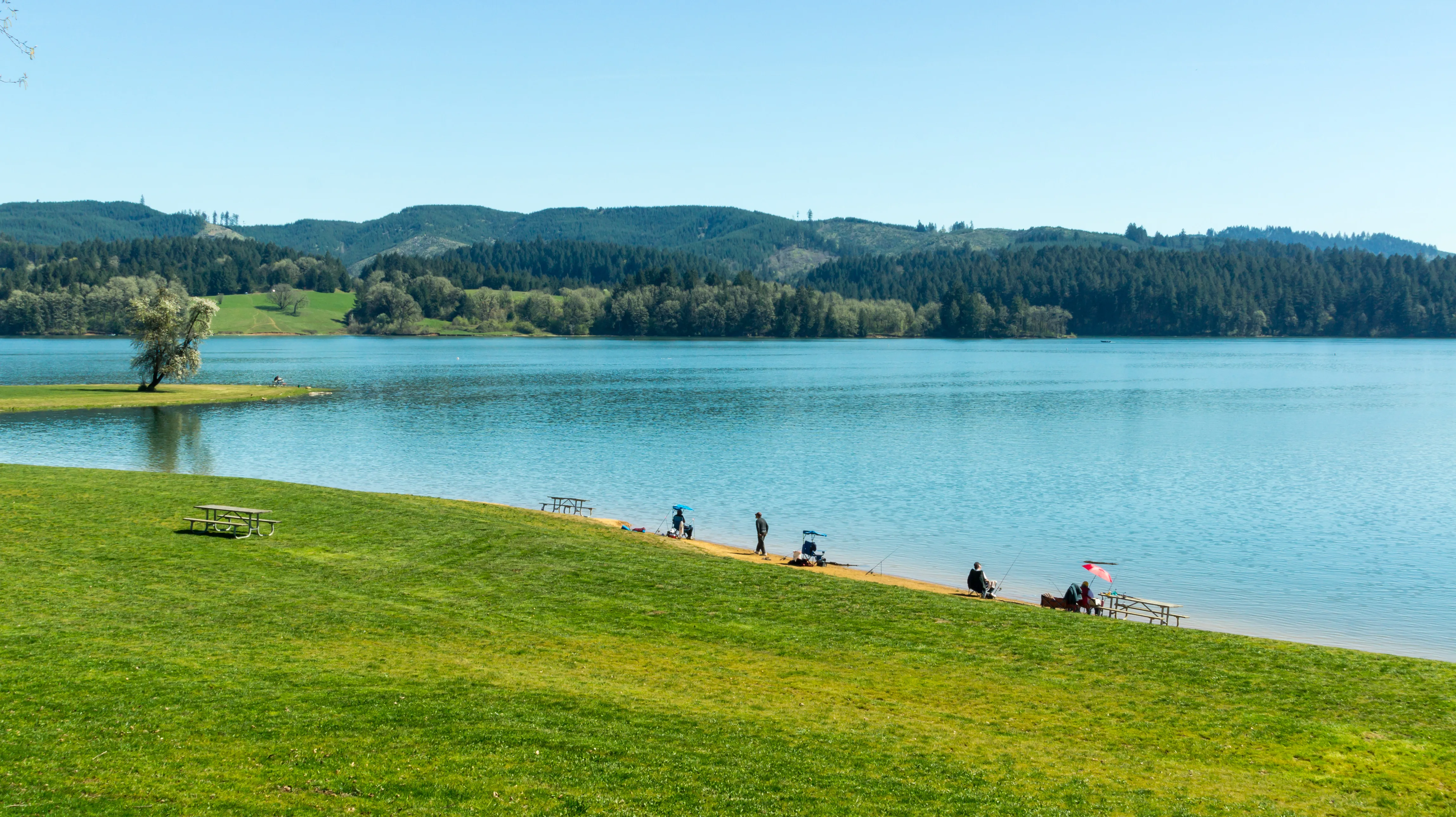
Pacific University's presence shapes the cultural calendar in ways that go beyond the expected. The university hosts public lectures, music performances through its Arts & Lecture Series, and Division III athletics that local residents follow with real enthusiasm. The Fernhill Wetlands, about a mile from downtown, is one of Washington County's best birdwatching destinations and a daily draw for walkers — a 700-acre constructed wetland system that connects to the Tualatin River National Wildlife Refuge. Retirees who are serious walkers or naturalists consistently describe it as one of Forest Grove's best-kept lifestyle assets.
Getting around without a car requires some planning. TriMet bus service connects Forest Grove to Hillsboro and the broader metro, with the MAX light rail accessible from Hillsboro's station about 12 miles east. For retirees who no longer drive, that connection requires time and patience rather than being genuinely convenient. Ride-share services operate in the area but with longer wait times than urban neighborhoods. Forest Grove is a better fit for retirees who can still drive or have a partner who does than for those relying entirely on public transit.
One thing that surprises most new arrivals after six months: how much of their social life ends up centered on Pacific Avenue within a three-block radius. The Historic District is small enough to feel like a genuine town rather than a suburb, and the regulars at the Saturday market, the local coffee shop, and the Grand Lodge dining room start to feel familiar quickly. It's a community where you actually see the same people twice — and that matters more to retirees than to any other demographic.
| City | Median Home Price | Nearest Hospital | Walkability | Senior Community Depth | Overall Fit |
|---|---|---|---|---|---|
| Forest Grove | ~$485,000 | HMC Forest Grove (urgent/outpatient); HMC Hillsboro 15 mi | Moderate (downtown) | Strong — 13+ communities | Strong for active, culturally minded |
| Hillsboro | ~$530,000–$560,000 | Hillsboro Medical Center (full inpatient) | Moderate | Very strong | Excellent all-around |
| Beaverton | ~$540,000–$570,000 | Providence St. Vincent 10 mi | Good | Very strong | Strong; more urban feel |
| Banks | ~$400,000 | No hospital; nearest 25+ mi | Very low | Minimal | Rural only — high drive dependency |
| Cornelius | ~$430,000–$450,000 | HMC Forest Grove 3 mi | Low | Limited | Budget-driven only |
| McMinnville | ~$380,000–$420,000 | Willamette Valley Medical Center | Low | Moderate | Wine country lifestyle; more isolated |
Local Expert Takeaway: Active retirees who want a small-town feel with genuine cultural texture — Pacific University events, McMenamins Grand Lodge, the Fernhill Wetlands trail system — tend to thrive in Forest Grove. Look specifically at the Elms and the Pacific University neighborhood for walkable independent living, or Southeast Forest Grove for single-level homes with quiet residential streets and easy access to the senior center. Retirees who need frequent specialist care or who can no longer drive will likely find Hillsboro a more practical fit — but for those who can drive and value character over convenience, Forest Grove consistently over-delivers.
Is Forest Grove a good place to retire?
For the right retiree, absolutely. The combination of affordable home prices relative to the broader Portland Metro, a walkable historic downtown, Pacific University's cultural programming, and genuine depth in senior living communities makes Forest Grove a legitimate retirement destination rather than a fallback option. Retirees who are still mobile and active tend to find it far more rewarding than its size suggests.
What healthcare is available to Forest Grove retirees?
Forest Grove has an OHSU-affiliated outpatient campus on Maple Street offering primary care, urgent care, lab services, and rehabilitation. Full inpatient care — including surgery, cardiac services, and emergency department services — is available 15 miles east at Hillsboro Medical Center. For complex tertiary care, OHSU's main Portland campus is approximately 30–35 miles east.
How does Forest Grove compare to Hillsboro for retirement?
Forest Grove offers lower home prices, a stronger small-town character, and a cultural life anchored by Pacific University that Hillsboro doesn't replicate. Hillsboro counters with a full inpatient hospital on-site, better public transit access to the MAX light rail, and a larger range of shopping and services. Retirees who prioritize healthcare proximity and daily convenience often choose Hillsboro; those who want town character and affordability tend to land in Forest Grove.
Explore the full Forest Grove series: The Ultimate Forest Grove Relocation Guide · Is Forest Grove Safe? · Cost of Living in Forest Grove · Best Neighborhoods in Forest Grove · Forest Grove Schools & Family Life · Forest Grove Youth Sports · Forest Grove Parks & Recreation · Retiring in Forest Grove · 1031 Tax-Deferred Exchange in Forest Grove · Forest Grove First-Time Homebuyers Guide · · Moving to Forest Grove from California · Forest Grove Realtor's Perspective
Tell us what you need help with and we'll connect you with local resources.

About the Author
Todd Davidson is the founder of Living in Oregon and Living in Washington, where he publishes in-depth city guides, neighborhood resources, and local market insights covering more than 180 communities across the Pacific Northwest. While his background is in home financing and real estate, he created these digital platforms to help families research and compare regions before making a move.