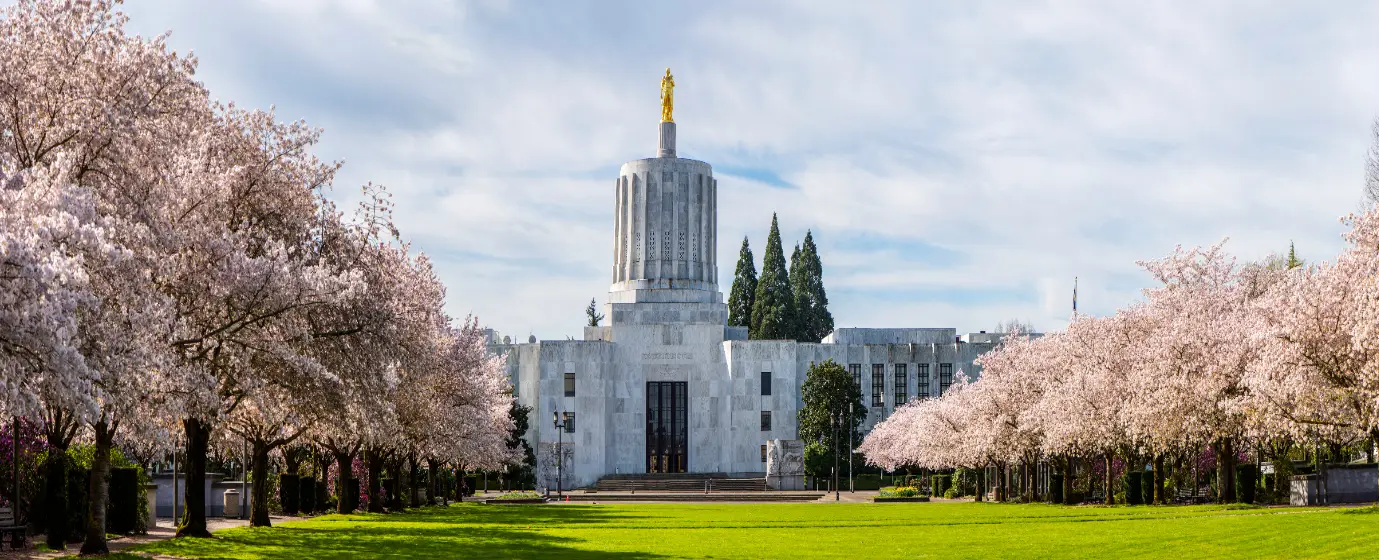
Willamette Valley · Oregon
Is Salem Safe? Crime Rates, Safest Neighborhoods & Local Reality (2026)
Salem gets painted with a broad brush in online crime databases, and the picture isn't flattering. A quick search drops you into percentile rankings and per-capita comparisons that make the Oregon capital sound like a city to avoid. The reality on the ground is more layered than that — Salem is a city of genuine contrasts, where the neighborhood you choose matters enormously, and where the direction of travel over the past 12 months is meaningfully more optimistic than the headline numbers suggest.
The daily experience of living in Salem depends heavily on geography. The northwest quadrant near West Salem and areas like Sunnyslope in the south feel like quiet suburbs with well-maintained streets and low incident rates. The northeast corridor and downtown, by contrast, carry crime loads that pull the citywide average up substantially. Those two realities coexist inside the same city limits, which is exactly why raw per-capita statistics can mislead buyers who don't know where those numbers are actually coming from.
This guide breaks down what the 2024 and 2025 crime data actually shows, which neighborhoods land on the safer end of the spectrum, and how Salem compares to its neighbors — so you can make a decision based on the local reality, not a percentile ranking that treats the entire city as one monolithic place.
Salem's citywide crime picture has two distinct stories running simultaneously, and the most important one gets buried under the alarming headline stats. FBI estimates for 2024 put Salem's total crime rate at roughly 3,335 per 100,000 residents — higher than both the Oregon average and the national average by a meaningful margin. Those numbers are real. What they don't capture is the trend: Salem's 2025 Salem PD annual data showed the largest single-year crime reduction the department has recorded in 15 years, with approximately a 17% overall decline.
Violent crime, which drives fear more than any other category, dropped around 20% in 2025 according to city-reported data — translating to roughly 194 fewer incidents than the year prior. That's not a rounding error. The 2024 spike in aggravated assaults and sexual offenses pushed Salem's violent numbers to a 15-year high, but local police data suggests 2025 reversed that trend sharply. Salem still holds the second-highest violent crime rate among Oregon cities, as the department itself has acknowledged — there's no spinning that — but the direction matters for anyone planning to relocate in 2026.
Structurally, what drives Salem's elevated numbers is a combination of factors common to mid-sized Oregon cities: a large homeless services footprint concentrated near the downtown core, a commercial density along Lancaster Drive and Mission Street that generates opportunistic property crime, and income stratification that creates stark differences between adjacent neighborhoods. Salem is also a state capital with significant transient population — government workers, court visitors, social services clients — which adds activity patterns that smaller suburban cities don't contend with.
Violent crime in Salem runs at roughly 5 incidents per 1,000 residents, based on available data — higher than the Oregon average and above national figures, but not uniformly distributed across the city. In practical terms, the vast majority of Salem residents go about daily life without being a victim of violent crime. The incidents that inflate the rate tend to cluster in the northeast quadrant and near the downtown core, and they often involve individuals already known to each other. For households moving into West Salem, South Salem, or the Sunnyslope area, the violent crime exposure is dramatically lower than citywide figures imply.
Property crime runs closer to 28 per 1,000 residents, with motor vehicle theft as the standout concern. Salem has one of the higher car theft rates in the region — roughly a 1-in-255 chance annually across the city — which locals take seriously in a practical way. Larceny and vehicle break-ins tend to cluster along the commercial corridors on the east side, particularly around the Lancaster and Mission Street retail areas where high parking lot traffic creates opportunity. The good news is that property crime has been on a downward trend since its 2017 peak, with 2025 logging the fewest property offenses in over a decade.
Sitting across the Willamette River from the downtown core, West Salem functions almost as its own community — connected by the Marion Street and Center Street bridges but buffered from the activity that drives the city's crime figures. Local data consistently places West Salem among the safer quadrants of the metro area, with a crime grade in the A range and a median household income around $87,000. The commercial strip along Wallace Road NW provides daily errands without the exposure of the Lancaster corridor, and residents here tend to describe a suburban neighborhood feel that's genuinely distinct from east-side Salem. For buyers who want access to Salem's amenities but a quieter daily footprint, the bridges are both the practical commute and the psychological divide worth understanding.
Best for: Buyers prioritizing low crime exposure and suburban calm while still commuting into the capital for work.
South Salem is where a significant share of relocating families land when they've done their homework on the city. The area around South Commercial Street and the neighborhoods feeding into Faye Wright Elementary and Sprague High School carry a quieter residential character, with property crime well below the citywide average. Neighborhood watch programs here are active and long-established — a sign that residents are invested in maintaining what makes the area work. The Minto-Brown Island Park adjacency in the southwest of this zone also functions as a natural buffer, keeping large retail density away from the residential blocks.
Best for: Families with school-age children who want the city's better school options alongside genuinely lower crime exposure.
Sunnyslope sits near the south edge of Salem and earns the highest crime safety grade in the city — an A+ on available 2026 local data — backed by a median household income above $86,000. What you're getting here is a newer residential neighborhood with less transient foot traffic, good street lighting, and neighbors who own rather than rent at higher-than-average rates. It's not a neighborhood with strong walkability or entertainment infrastructure, but for households prioritizing safety above all else, it benchmarks among the city's best by a meaningful margin.
Best for: Safety-first buyers and retirees who want the best crime profile Salem offers.
Downtown Salem is where the data diverges sharpest from the experience of specific users. The Oregon State Capitol grounds, Riverfront Park, the Carousel, and Willamette University create a daytime downtown that feels active and reasonably safe. After dark, the picture shifts — shelter services, transitional housing, and social service infrastructure concentrated along Commercial Street and Liberty Street SE create a higher-activity environment that most families navigate consciously rather than casually. Violent crime exposure in central neighborhoods runs closer to 1 in 133 by some local estimates, compared to 1 in 396 on the southwest side. Buyers considering downtown condos should walk the blocks at multiple times of day and evening — the experience at 11am and 10pm are genuinely different.
Best for: Single professionals or government workers who want walkable access and understand the trade-off that comes with urban density.
Northeast Salem generates the highest crime totals of any quadrant in the city by raw incident count — roughly 2,530 crimes annually according to available local data, and a larceny/theft rate running well above both the city and national averages. Median household income in the named Northeast Salem neighborhood runs around $38,000, and home values sit below the city median at roughly $349,000. The Hollywood District area and the Highland Neighborhood are frequently cited in community discussions as elevated-concern areas. That said, the northeast isn't uniformly dangerous — parts of the area are stable and have long-term owner-occupants — but buyers should go in clear-eyed about what the surrounding blocks look like.
Best for: Budget buyers comfortable with a higher-activity environment and willing to research specific blocks carefully before committing.
Faye Wright is one of the neighborhoods local agents mention when buyers ask where south Salem families actually settle. Located in the southeast quadrant of south Salem, the neighborhood sits near the park of the same name and draws strongly from the South Salem High School and Faye Wright Elementary attendance zones. Crime data places the broader south central and southwest area in a much better position than the citywide average — a combination of higher homeownership rates, lower transient traffic, and proximity to the Minto-Brown Island corridor that keeps commercial density away from residential streets. It's a genuinely family-oriented pocket where safety rarely comes up as a daily concern.
Best for: Families who want the south Salem school zone in a neighborhood that actually reflects the reputation.

| City | Violent Crime / 1K | Property Crime / 1K | Overall Safety Profile |
|---|---|---|---|
| Salem | ~5.0 | ~28 | Below Oregon average; wide neighborhood variation |
| Keizer | ~2.5 | ~18 | Noticeably safer; independent city, lower transient traffic |
| Silverton | ~1.8 | ~12 | Small-town profile; significantly lower rates |
| Independence | ~2.0 | ~15 | Quiet small city; limited service infrastructure driving crime |
| Monmouth | ~1.5 | ~11 | WOU campus town; low violent crime, minimal property concern |
| West Salem | ~1.8 | ~16 | Effectively suburban; river separation buffers from Salem core |
Looking to buy in Salem? Estimate your payment.
Enter your numbers to see an estimated monthly mortgage payment.
Estimate only. Excludes HOA fees and mortgage insurance.
Anyone who's lived in Salem more than six months develops an intuitive understanding of which corridors to treat differently at night. Commercial Street SE between downtown and South Salem carries more foot traffic and higher incident density than the surrounding residential blocks suggest. The Lancaster Drive corridor, particularly the stretch between Mission Street and Silverton Road, is a high-activity retail zone that drives a meaningful share of the city's property crime — car break-ins, shopping center theft, and the occasional vehicle theft that local data identifies as Salem's most distinctive crime concern. Locals know to park facing the right way, to not leave valuables visible, and to be more aware of their surroundings on that strip than they would be two miles south.
The crime apps and neighborhood ratings sites don't capture the spatial granularity that matters. A house on a quiet residential street in northeast Salem can sit three blocks from a block with much higher incident activity — that distinction doesn't show up in zip-code-level crime grades. The practical local habit is to drive the specific streets at multiple times of day, talk to neighbors directly, and check the city's online crime mapping tool rather than relying on aggregated scores. Salem also has a visible tent encampment presence near the downtown core that's been a point of city-level policy discussion; the Pringle Creek corridor and areas near the Salem Station have seen concentrated activity at various points. It's not a static situation, but it's one worth checking current status on before buying near those zones.
The more honest version of the Salem safety conversation is this: the city has real challenges concentrated in specific areas, and the 2025 crime drop is a genuine positive signal that the trajectory is improving. Chief Womack, before his announced retirement in mid-2026, explicitly stated that Salem still holds the second-highest violent crime rate among Oregon cities — the department doesn't paper over that reality. At the same time, residents in West Salem, Sunnyslope, Faye Wright, and South Salem neighborhoods routinely describe daily life that doesn't feel like living in a high-crime city. The citywide numbers and the neighborhood-level experience are both true simultaneously.

Local Expert Takeaway: If you're buying in Salem and safety is a primary concern, anchor your search south of Mission Street or across the river in West Salem — those areas benchmark dramatically better than the citywide averages that tend to dominate search results. Specifically, the Faye Wright and Sunnyslope corridors in south Salem and the McNary Estates area in West Salem consistently show the city's best crime profiles. Avoid drawing conclusions from zip-code-level crime scores; instead, pull Salem's crime mapping portal for the specific street you're considering, and walk the immediate two-block radius on a weekday evening before making an offer.
✅ Salem's 2025 crime data showed the largest single-year drop in 15 years — both violent and property offenses hit new lows, a meaningful signal for buyers tracking trends rather than peak-year snapshots.
⚠️ Neighborhood choice is everything in Salem. The gap between the city's safest areas (Sunnyslope, West Salem, Faye Wright) and its highest-crime corridors (northeast Salem, downtown after dark) is wider than in most comparable Oregon cities.
📍 Motor vehicle theft is Salem's most distinctive crime concern — locals in every neighborhood treat visible valuables in cars as an invitation, and residents near the Lancaster and Mission Street corridors are especially deliberate about this.
Is Salem, Oregon a safe place to live?
Salem's safety depends almost entirely on where within the city you live. Neighborhoods like West Salem, Sunnyslope, and Faye Wright in south Salem have crime profiles comparable to much smaller Oregon towns. The citywide per-capita numbers are elevated due to concentrated activity in the northeast corridor and near the downtown core — areas that pull the average up significantly for residents who will never live or regularly travel through them.
What are the safest neighborhoods in Salem?
Based on 2026 local crime data, Sunnyslope and South Gateway in south Salem carry the city's best safety grades, with median household incomes above $86,000 and low incident rates for both violent and property crime. West Salem across the river and the Faye Wright corridor in south Salem are also consistently cited among the safer areas for families. The southwest quadrant broadly sees violent crime victimization odds roughly three times better than central Salem neighborhoods.
How does Salem compare to Portland for crime?
Salem's violent crime rate runs above Portland's on a per-capita basis in some metrics, though Salem's 2024 homicide rate of roughly 4.5 per 100,000 was less than half of Portland's rate that year. Property crime in Salem has been trending down since its 2017 peak and hit a 15-year low in 2024. For buyers choosing between the two, Salem's lower home prices — a $425,000 median compared to Portland's substantially higher figure — come with a crime profile that requires neighborhood-level diligence rather than city-level avoidance.
Explore the full Salem series: The Ultimate Salem Relocation Guide · Is Salem Safe? · Cost of Living in Salem · Best Neighborhoods in Salem · Salem Schools & Family Life · Salem Youth Sports · Salem Parks & Recreation · Retiring in Salem · 1031 Tax-Deferred Exchange in Salem · Salem First-Time Homebuyers Guide · · Moving to Salem from California
Tell us what you need help with and we'll connect you with local resources.

About the Author
Todd Davidson is the founder of Living in Oregon and Living in Washington, where he publishes in-depth city guides, neighborhood resources, and local market insights covering more than 180 communities across the Pacific Northwest. While his background is in home financing and real estate, he created these digital platforms to help families research and compare regions before making a move.